A most unusual movie. Katy loved it and wants to see more like it, if such a thing exists. Opens in Oz, which is like a Miiverse Second Life, then quickly becomes the story of Kenji, a student and not-terribly-important freelance Oz coder, who gets talked into joining cute girl Natsuki at a family reunion to pretend to be her boyfriend.

Family reunion conflict:

Oz gets super-hacked, which has real-world consequences because, unlike Second Life or Miiverse, people and companies use it for actual business, and traffic signals and emergency services can be accessed through it. After the family’s beloved grandma dies, they pool their real and online skills to stop the Oz hacker, with some great digital swarm animation along the way.

One of the few movies I’ve watched recently without reading any critic reviews/comments first – just looked interesting when Alamo programmed it last month – and now all I can find is Adam Cook hating on it at Letterboxd. Good thing I didn’t read that sooner, since we’re now looking forward to more of Hosoda’s movies.

That Flicker Alley blu-ray set I threatened to buy at the beginning of the year, well I bought it. And besides being full of interesting avant-garde films beautifully preserved in high-def, it’s really well sequenced and presented. Gonna have to break this into a few screenings and posts since I’m taking so many screenshots.


Manhatta (1921 Sheeler & Strand)

City photography, mostly seaside and rooftop, floats by, with intertitles from a Whitman poem. Impossible to know how this looked in 1921 since by now I’ve seen hours and days of NYC photography. Buildings and ships still look like buildings and ships, so I was mostly interested in the few shots of people and traffic. Strand later photographed Redes and codirected Native Land.

Lewis Jacobs, writing in Film Quarterly in late 1947:

In technique the film was simple and direct, avoiding all the so-called “tricks” of photography and setting. In a sense it was the forerunner of the documentary school which rose in the United States in the middle 1930’s … The picture’s emphasis upon visual pattern within the real world was an innovation for the times.


Anemic Cinema (1926 Marcel Duchamp)

Alternates geometric spirals with word spirals (jokey French puns, I think). Peaceful. His buddy Man Ray helped out, and some prankster named Gustavo contributed a drone soundtrack.

In Visionary Film, Sitney calls it one of the “two fundamental works of the graphic cinema from the 1920s made without animation,” along with Ballet Mechanique.

Kristin Thompson:

Duchamp’s purpose was presumably to create an artwork with minimal means, including quasi-found objects, the disks he had made for another purpose. His idea is clearly reflected in the title, Anémic cinéma, which suggests a weakness or thinness of means. “Anémic” is also an anagram for “cinéma.”


Life and Death of 9413 (1927 Florey & Vorkapich)

Still one of my favorite shorts ever. I love that Florey & Vorkapich were already this cynical about Hollywood in the silent era – especially great is the “babababa” mouth-flapping in place of speech. Would be a good short to run before The Last Command.


Skyscraper Symphony (1929 Robert Florey)

New York buildings, photographed straight ahead and jutting out in all directions, making this an appropriate follow-up to the city documentary Manhatta and the expressionist angles of 9413. Donald Sosin contributes a very nice piano score. Florey directed a Marx Brothers movie the same year.


Mechanical Principles (1930 Ralph Steiner)

Pistons, meshing gears and other mechanics, beginning slow and simple and getting into crazier and faster gizmos. Really cool.


A Bronx Morning (1931 Jay Leyda)

More New York scenes, this one more social than the structural interests of the others. Leyda had documentary cinematography and editing pretty well figured out by age 20, worked with Steiner, later with Eisenstein and went on to write film histories.

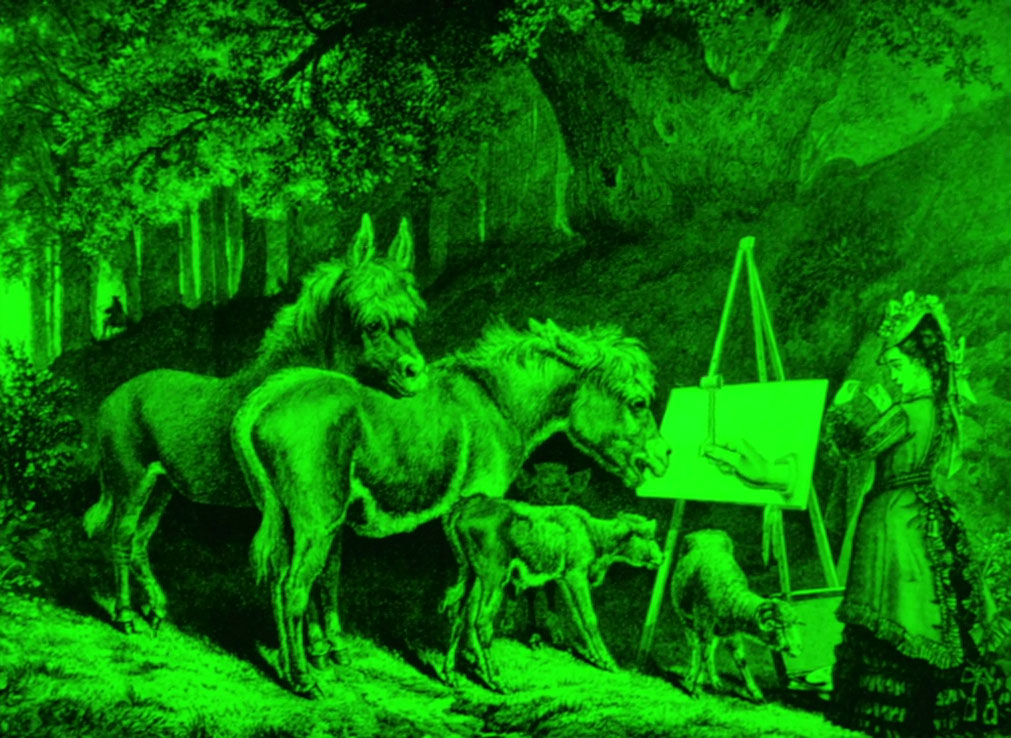
How much does expert ladies hair bobbing cost to-day?


Lot in Sodom (1933 Watson & Webber)

Leagues beyond the previous films in visual poetry. Bodies collide in slow motion, mirrored and refracted. Eventually a plot takes shape when an angel appears to woolen-bearded Lot and tells him to get out of town before it’s destroyed by a rain of fire (there’s some other stuff I didn’t catch, not being familiar with the bible story). Like I wrote for the same directors’ Fall of the House of Usher, “I still don’t know exactly what happened, but boy was it awesome.”

Jacobs called it “the most distinguished experimental sound film of the period.”

Lot in Sodom used a technique similar to that of The Fall of the House of Usher, but far more skillfully and resourcefully. It drew upon all the means of camera, lenses, multiple exposure, distortions, dissolves, and editing to achieve a beauty of mobile images, of
dazzling light and shade, of melting rhythms, with an intensity of feeling that approached poetry. Its brilliant array of diaphanous shots and scenes … were so smoothly synthesized on the screen that the elements of each composition seemed to melt and flow into one another with extraordinary iridescence.


Poem 8 (1933 Emlen Etting)

Visual poetry with no narrative – the first time that had been done, according to Etting, who is wrong (Man Ray, Hans Richter, Ballet Mechanique). Rough on the technical side, but it works for me. Dig the first-person camera sipping a cocktail and making out with an undressing woman. I didn’t feel the new piano score by Rodney Sauer was appropriately poetic.


An Optical Poem (1938 Oskar Fischinger)

Floating shapes appear and move in sync with a Liszt song. Since it’s made with paper cutouts in stop-motion (which must have been aggravating) you can their shadows upon each other.


Thimble Theater (1938 Joseph Cornell)

Cornell and his posthumous editor Lawrence Jordan throw together a bunch of things and run circus music under them all. Too many kids in a paper flower… what looks like a Melies movie… a cartoon printed inverse and upside down… mountain goats… a man vs. kangaroo fight in slow-motion. Before Spike & Mike or Everything Is Terrible or Star Spangled to Death, Cornell was the original curator of clip shows of wonderous things.

I’ve previously written up McCay’s Little Nemo (aka Winsor McCay, the Famous Cartoonist of the N.Y. Herald and His Moving Comics) and How a Mosquito Operates and The Sinking of the Lusitania, and Bill Plympton’s restoration of The Flying House. Well, I got my hands on the Master Edition DVD, so now I’m watching (in most cases rewatching) the rest.


Gertie The Dinosaur (1914)

Similar to Lusitania, the full movie is more than the animation – it opens with a documentary account of the cartoon’s inspiration, with intertitles explaining to audiences unfamiliar with animation how work-intensive the process was. Per the commentary, the shorter version of this film lacks the intro and titles and was played in a live show with McCay on stage interacting with his dinosaur, giving commands and having conversation. I like how the commentary says Emile Cohl and J. Stuart Blackton were McCay’s primary influences, but that McCay also publicly claimed to have invented the animated film.

Gertie attacks the camera/presenter:

Guess what’s about to happen to that stack of original Gertie drawings:


The Centaurs (fragment)

Because you can show topless women if they’re half horse. A weird, slow-moving little piece that Canemaker imagines may have been part of McCay’s vaudeville act a la Gertie.


Gertie On Tour (fragment)
Gertie torments a trolley then dances for a crowd of dinosaurs. Animation scholars today don’t know why.


Flip’s Circus (fragment)

Little Nemo character Flip performs a stage show with a mini-Gertie, which finally eats Flip then vomits him out. Serves him right, really, since Flip spends half the movie beating the thing with a club.


Bug Vaudeville (1921)

Sketches of insects doing circus-like stunt routines on a stage, each one lasting about twice as long as it could. All this is being dreamt by a hobo under a tree (his head appearing MST3K-style watching the insect action) who frustratingly ate some cheesecake, not rarebit.


The Pet (1921)

Cute little creature walks into a house where a woman feeds it. It grows visibly larger while eating. As as it grows, it eats increasingly large things, from food to dishes to household decorations, finally to buildings and airplanes, until the army blows it to bits. Favorite scene: the pet drinks from a hose, then slurps up and eats the hose like spaghetti. Of course this is all just a rarebit dream by the man of the house, who eats dinner at “the club” and resents his wife for wanting a pet. Plympton’s redo of The Flying House is great and all, but I think this was my favorite of the rarebit fiend shorts.

The included documentary, Remembering Winsor McCay (1976) by John Canemaker, is cool for providing first-hand accounts of McCay’s life and work by his younger assistant John Fitzsimmons. But since the films are silent, I’d already played them with Canemaker’s commentary, which reuses all of Fitz’s stories and comments.

A Gentle Spirit (1985)

Morphy, smeary animation beneath a crosshatched texture overlay. Time is ticking away and people appear still and sad, a slow-motion human drama with insect cameos, until music ramps up to a climactic chase scene. I couldn’t figure out the story, but I think Dumala assumed no viewer would be so uncultured as to be unfamiliar with the source Dostoevsky novel. Will have to watch this again after seeing the Bresson version (Une Femme Douce, “a young woman kills herself, leaving no explanation to her grief-stricken pawnbroker husband”), which sounds like a barrel of laughs. Some very cool effects in this, including a table transforming into a bed.


Walls (1988)

A man is trapped within some walls. Sometimes things (drawers, insects) appear on their featureless surfaces. I guess he goes mad from sensory deprivation, since his senses start freaking out, his eyes and ears transforming. I liked it better than the previous movie.

This would seem to be an inspiration for both Tool’s Prison Sex video and the movie Symbol. Dumala would further explore his interest in insects with Franz Kafka before returning to Dostoevsky for his half-hour opus.


Crime and Punishment (2000)

I don’t think it’s all drawing, looks like there are layers of filmed objects in there, though in standard-def it’s hard to tell. Of course there are insects – buzzing flies in every scene – and I recognize the basic Crime (with an axe, killing the pawnbroker and a witness), but the crime is finished with only seven minutes to go in the film, so there’s little Punishment. The killer sits at home feeling bad for a minute before Dumala goes outside to play with animals in the rain. Perhaps a mute witness to the crime kills himself at the end? There are some cool effects – I liked the liquid glimmer of nervous eyes in extreme close-up – but it’s so static it loses my attention repeatedly over the thirty minutes.

Raptor in the rain, a drop falling from its beak:

Still watching the nice HD collection of Looney Tunes


Duck! Rabbit, Duck! (1953, Chuck Jones)

The duck season/rabbit season short in which Daffy gets blown to bits a hundred times and Bugs causes chaos and confusion. Murderous fun. “I hope I didn’t hurt you too much when I killed you.” IMDB calls it the end of a Hunting Trilogy with Rabbit Fire and Rabbit Seasoning.


I Love To Singa (1936, Tex Avery)

“Enough is too much! Out of my house!” Forgot that Owl Jolson’s parents have heavy German accents… also forgot an excellent scene combining telegram lingo with sexual harassment.


A Tale of Two Kitties (1942, Robert Clampett)

Abbot & Costello cats try to steal a pink, featherless, smartass bird from its nest. Very quippy and gaggy, only loosely a story. Explicit Hays Office reference! “Lemme at him Babbit, I’ll moydalize him.” Pre-Tweety premiere of “I tawt I taw a putty tat”?


The Old Grey Hare (1944, Robert Clampett)

God listens to Elmer for some reason, and sends him to the year 2000, which has futuristic weapons and newspapers full of 1940’s references. Then we get a flashback within the flash-forward, so both elderly and baby versions of Elmer & Bugs.


Hare Tonic (1945, Chuck Jones)

In which Bugs convinces Elmer that he’s caught Rabbititis. I thought this was an old-model Elmer, but it’s made a year after the modern-Elmer Old Grey Hare, so what’s going on? The Elmer-torture is prompted not by hunting this time but by Elmer trying to buy fresh rabbit at the meat market, which at least proves that he intends to eat rabbits and isn’t just hunting them for the sport of it.


Fast and Furry-ous (1949, Chuck Jones)

Coyote and Road Runner origin story, setting up the template for many to come – and arguably never surpassed. I like that Road Runner doesn’t just zoom past the traps, but actively fucks with the coyote. I also like that there are complicated cloverleaf interchanges in the middle of the desert. My birds responded to the “meep meep”

My favorite invention, very Silver Surfer:


The Scarlet Pumpernickel (1950, Chuck Jones

Daffy begs his movie producer J.L. to give him a dramatic role for once, which is enacted by an all-star cast: Porky, Sylvester, Elmer, Chicken Hawk. Rated R for snuff usage and suicide.


Chow Hound (1951, Chuck Jones)

Red kitty has a whole string of “owners”, who all feed him, but the food is stolen by a bully dog, who finally overeats his way into the hospital.


Bewitched Bunny (1954, Chuck Jones)

Bugs is reading Hansel and Gretel when he runs into the kids themselves, with ridiculous German accents, and ends up being chased by the witch through her hilariously designed house, and nearly saved by Prince Charming, who got the wrong fairy tale. “Thanks large, mac.” Ends with maybe the rudest punchline ever.

I watched Raamat’s Lend a couple months ago, just getting to the rest of the disc.

Kutt / Hunter (1976)

More cross-fading animation. Whale-hunters dodge icebergs while tracking their prey. The whale wins. Nice water and Northern Lights effects.


Pold / Field (1978)

A black/white world, slow heavy labor, each frame crossfaded into next. Work horse dreams of a better life, escapes. I think he returns to the farm after getting hungry.


Varvilind / Colorful Bird (1974)

Bored future society starts to come alive with the addition of primary colors, as their world gradually becomes a groovy hippy paradise. A black cat threatens to make everything square and gray again, but the cool kids intervene, ending in a psychotic color trip. Maybe Estonia didn’t have the color green – the movie shows yellow and blue combining to make… blue. I like the silent-film opening titles, and how each of the Raamat shorts is so different-looking than the last.


Kilplased / Simpletons (1974)

White-suited loggers discover that logs roll downhill. A farmer tries to befriend some birds while his horse is eaten by wolves (he doesn’t see the wolves, so a cat is blamed). The men burn down their structure (silo?) and destroy their own fields while chasing a pig. At least they get to eat the pig. The cartooniest Raamat I’ve seen.

I like the way he draws bird feet:


Tyll the Giant (1980)

Tyll helps the puny humans rebuild after their towns are destroyed by demons, rescues them when rough seas overturn their boat and participates in brutal battles against their enemies. This doesn’t go over well with the devil lord who shoots boulders from his eyeballs, so he destroys Tyll’s home and murders his wife. In a final horrific battle (this is the most bloodshed I’ve seen in a cartoon since Metalocalypse), Tyll is beheaded, then a voiceover I didn’t understand (because I lack subtitles) gives an epilogue. A tremendous end to the Raamat party.

The Village (1993, Mark Baker)

Fun story with a fairly minimal drawing style. Small town is hateful and suspicious of each other until they have something to unite around: imprisoning and hanging their falsely-accused neighbor. After a rooftop fight, he manages to escape into the woods with his lover. I dig the decorative swarm of ants who end up complicating the plot. This won a pile of awards, also oscar-nominated against winner The Wrong Trousers.


His Comedy (1994, Paul Bush)

More an art piece than a short story – the poetic voiceover does nothing for me, and I couldn’t make out any sort of narrative. Maybe something religious or mythological? Ah, it’s all Dante quotes, as I should’ve known from the title. Cool looking, though – everything composed of wavy lines, with some parts (motion of bird flocks, fire, bombings) that appear rotoscoped. I liked Bush’s later, twitchy Episodes from the Life of Jekyll and Hyde.


Dreamland Express (1982, David Anderson)

Sleepwalker finds a train in the woods and takes it for a ride. All manner of wonderous imagery ensues. One of those animations that reminds you how limited and straightforward most animations are. Glad I didn’t skip this after realizing it’s by the same guy who made Deadsy. Won a Bafta (interesting thing that year: Burden of Dreams won an award; Fitzcarraldo was nominated but lost).

Happy to come across this again – haven’t seen it since the VHS days. Awesome, hour-long stop-motion with live actors interacting with the miniature creations, which must’ve been difficult. Dark sci-fi fairy-tale following tiny Tom, born to normal-sized parents, then abducted away to a torture-lab, adopted by a tiny-people society, and brought on a guerrilla mission with a well-armed little guy. Death and horror is around every corner, and pretty much everyone is doomed. The grimy, insect-filled design is marvelous, would be cool to see this in HD someday.

Stills cannot convey the majesty:

Oh no, writer/director Dave Borthwick died a few years ago, after codirecting a kids’ animated feature. Dave’s “Bolex Brothers” partner Dave Alex Riddett is a stop-motion cinematographer (Wallace and Gromit, Shaun the Sheep, way back to the Sledgehammer video), and the Bolexes also produced the great short The Saint Inspector.

Cannes Month isn’t over until I say it is. Michaël Dudok de Wit’s The Red Turtle premiered two weeks ago to absolute raves (an A+ from indiewire) so I’m checking out his shorts.

The Monk and the Fish (1994)

A monk goes out of his damn mind trying to catch a fish. Great motion and poses, and this movie does one of my favorite things, having the main character always move to music. I believe it ends with the monk reaching a spiritual oneness with the fish. Won the César, nominated for the oscar.


Tom Sweep (1992)

Found in low quality on streaming sites – a proto-Monk/Fish short, with beleaguered bin-man Tom’s garbage-collecting movements set to music.


Father and Daughter (2000)

A terribly beautiful story about a girl whose father sets off in a rowboat and doesn’t return. Won the Oscar and the Bafta and the BAA and the Annecy and the Zagreb and deserved them all, although I certainly didn’t think so on oscar night when I was rooting for Don Hertzfeldt’s Rejected.


The Aroma of Tea (2006)

A dot moves rhythmically through painted patterns, again set to music. Aha, it was painted with tea.