Preceded by nothing (well, “le beau serge”), it was The 400 Blows, Hiroshima Mon Amour and Pickpocket in 1959 France, and it’d never quite be that good again.

I wrote to Trevor
———
Aha… so in 400 Blows, he’s going to the movies with his parents.

“What’s playing?”
“Paris Belong To Us.”

In the DVD liner notes for “Paris Belongs To Us” it says:
“Rivette began production… in 1958. It was only after the commercial
success of Truffaut’s The 400 Blows and Godard’s Breathless that the
resulting film, the elusive and intellectual Paris Belongs To Us, saw its
release in 1960.”

So Antoine Doinel’s parents couldn’t have seen it AND if they had seen it
(“elusive and intellectual”) they wouldn’t have liked it, heh.
———

and he replied…
———
I was more concerned with the fact that his friend (Rene) came to visit him when he was in the correctional institute. He came on a bicycle. When Antoine escaped, he ran to the sea. The closest sea to Paris is about 200km away according to google maps, so if Antoine was within running distance of the sea how did Rene get there on a bicycle?
———

image

image

image

“I have never been so deeply moved by a picture.” – Jean Cocteau

So Rohmer’s standard scenario for the Moral Tales was: male protagonist with one girl, tempted by another. Sounds easy. Let’s go.

The Bakery Girl of Monceau (1963)
Student is in love with girl Sylvie he passes on the street, finally builds up the nerve to talk to her. Then she disappears for a month. He spends his dinner hour that month looking for Sylvie, eating pastries from a bakery, and littering. Starts flirting with the pastry girl Jacqueline, finally asks her on a date, but he’s not serious about her. Suddenly Sylvie reappears, he makes a date with her the same night and stands up Jacqueline, because why waste time with her when the dream-girl is back in his life?

Short, black and white location-shot with a documentary look, no fancy camera tricks, told very straightforward with a narrator doing most of the talking. Interesting and probably a good intro to the Moral Tales, but not a great film on its own. Moral Tales producer Barbet Schroeder (who I now know better as an actor than a director) stars. Bertrand Tavernier, not yet a director himself, narrates. Michèle Girardon, who played Sylvie and starred in Eric Rohmer’s first feature in ’59, killed herself 12 years after the short was made.

Suzanne’s Career (1963)
Bertrand is kind of a shy, low-key guy. He likes popular girl Sophie, and is friends with obnoxious Guillaume. One day they meet Suzanne and Guillaume successfully schemes to get her into bed. She stays in their life constantly, so G. and B. conspire to start getting her to pay for all their outings. But she still hangs around, now she’s just broke. A few months later, G. is busy with school, B. is still trying to date Sophie, and Suzanne shows up happily married to Sophie’s ex. Her “career” was to land a husband, and given that G. and B. have made themselves look like jerks, it would seem that Suzanne wins at the end.

A good movie. Still black and white, higher proportion of dialogue to narration than in “Monceau” and mostly set in cafes and apartments, so less of a documentary feel but still very story/character based with no showoffy new-wave tricks. It seems that Rohmer is more Truffaut than Godard.

Presentation, or Charlotte and Her Steak (1951/61)
A weird one. Filmed in ’51 with Jean-Luc Godard and two actresses, then edited and overdubbed ten years later by Godard and two different actresses, and wedged into a collection of shorts that Godard made about the Charlotte character. Apparently she’s leaving “Switzerland” soon… on her way someplace hurriedly, she stops at her house pursued by Godard to have a bite to eat. He’s not allowed in, has to stand in the doorway, but she does give him some steak, then they go their separate ways. Can’t tell if the original short even had anything to do with the overdubbed story. A curiosity.

Nadja In Paris (1964)
More of a location documentary than a character study, following visiting student Nadja (her real name) through some of her favorite parts of the city.

“Tomorrow I kill myself.”

The score by Erik Satie probably sounds familiar because it was used in a Wilson brothers scene in “Royal Tenenbaums”. Luke W. later tries to kill himself right after quoting Alain Leroy into the mirror. I’d always wondered why he says “tomorrow” when he’s killing himself right then.

It’s a sharp-looking black-and-white movie about Alain Leroy’s last two days alive, because he sure enough kills himself at the end. Kind of the opposite of “Zazie dans le metro”, which I watched right before. Because of the harsh sudden downturn in emotion from “Zazie” and the late hour it aired, I was in an annoyed daze through this one. I know that Alain visited a lot of friends but I couldn’t tell you which was Jeanne Moreau from “elevator to the gallows” or even Yvonne Clech from “zazie”. So here’s the NY Times’ character round-up:

“Lydia, his wife’s friend, wants desperately to marry him. Life, his understanding doctor says, is worth living. Dubourg, his one-time carousing sidekick, has found peace and certainty in his studies of Egyptology and with a good woman and her children. Jeanne, the disenchanted painter, is, likewise, a kindred soul but unable to possess his imagination and love. Bernard Noel, as the kindly Dubourg; Lena Skerla, as his wife’s loving friend; Jeanne Moreau, as the jaded but understanding artist, and Jacques Sereys and Alexandra Stewart, as his rich friends, are some of the fine portraits in this gallery of generally off-beat Parisians.”

image

Guess I didn’t like it much. The movie’s not ultra-depressing because Alain’s friends are alive and hopeful enough to continue – without diving deep into his own inner thoughts, it makes him out as dysfunctional, unable and unwilling to take control of his life. So it’s not a harsh unforgiving world (in fact, the world is very tastefully shot by the guy who later shot “young girls of rochefort”), it’s just Alain’s problem. Made in tribute to a suicidal friend of Malle’s as well as a tribute to Malle’s own reckless youth. Admirable, just not enjoyable.

TCM: “Long after making it, Malle remarked that with The Fire Within he finally managed to find a cinematic style—objective, unobtrusive, no frills—that ideally matched the content of the story he was telling.”

image

NY Times: “highly introspective, often tenderly touching and sometimes tediously redundant”… “A viewer can appreciate the delicate exploration of Alain Leroy’s mind and heart but he is so special a case that it is extremely difficult to relate to his highly special tragic condition. One is often more attracted to the loving or well-meaning people who are seriously anxious to aid and comfort him.”

Roger Ebert: “The film is a triumph of style. It is quiet and indicative. It doesn’t explain a lot, but we understand a lot about it all the same. And in the concerned, indifferent, kind, cruel behavior of his friends, we see ourselves acting toward people like him, or acted toward by people like them. Rarely does a film so carefully portray this complexity of personal relationships.”

Shooting Down Pictures: “One of the recurring visual fascinations of this film is its preoccupation with people’s gazes, particularly at Alain. … I think this paradox, that humans’ attentions in each other, their gazes, their advances, can be full of energy and vitality and simultaneously empty and dehumanizing, is a substantial line of investigation offered by the film (moreso than its insights into the suicidal mind).”

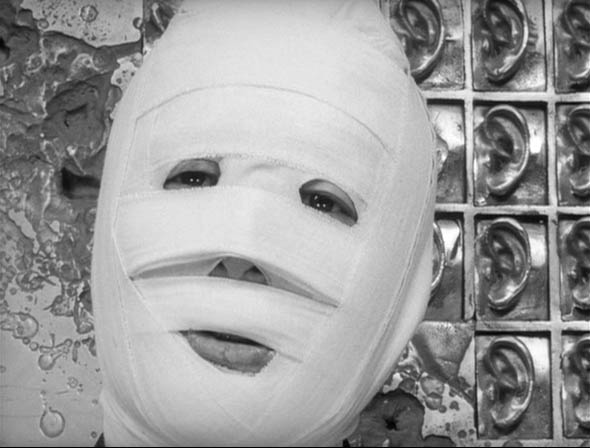
Man has accident. Needs new face.

image

Fortunately he’s friends with a brilliant tissue-replacement surgeon who wants to test his theories that facially-scarred people can reintegrate into society if their faces could appear normal again.

image

They find someone with a good face to copy (note: it’s the miner from Pitfall)

image

The doctor works hard in his all-glass laboratory.

image

The procedure is a success!

image

But the doctor’s psychological theories were wrong – the burnt man uses his new face to create a sociopath alternate personality, kind of like Hollow Man but not at all like Darkman.

image

Meanwhile, a young woman with a similarly deformed face has an unhealthy relationship with her brother.

image

Completely beautiful movie, obviously.

image

If Pitfall was a weird movie, this one just dives off a steep cliff of weirdness.

image

And it doesn’t end well. For anyone.

image

The photography & video quality on this are so excellent, the story could’ve been about nothing and I still would’ve enjoyed it. But the story is neat too.

image

A worker has deserted from the army, and runs off with his son in search of work. He’s lured to a mining town and then killed by a mysterious white-suited man. End of movie.

image

But no! First of all, he sticks around as a ghost… second, the same actor plays a lookalike union leader at one of the two mining communities. Nobody figures out who the white-suited man is, or what he’s up to, but he later kills a women shopkeeper also, the last person to see the first man alive. The union bosses flail around and finally kill each other, the dead wander among the ghost community of the town, and the murdered man’s son hides, observes, and lives off stolen candy from the shop as the movie gets quickly darker and stranger. Apparently it’s all a satire about corruption.

image

An excellent first feature. Teshigahara had his visual style down, wasn’t injecting as much surreal weirdness into the image as he later would. Reviews mention Antonioni and Resnais as visual influences, and Kafka, Beckett and Carroll as story influences. This came out right after Jigoku, Viridiana, Last Year at Marienbad, The Testament of Orpheus, Eyes Without a Face and L’Avventura, and fits right in with that early 60’s European art film scene.

Eureka says “Teshigahara coined the term ‘documentary fantasy’ for this study of the powerless, impoverished worker in postwar Japan.”

image

Unfortunately I returned this before I could get screen captures.

Lots of new-age philosophy collides with commentary on communist Yugoslavia in a way that doesn’t make much sense but involves much nudity.

Seems like this would be a fun movie, but I’m alarmed to say that I enjoyed watching critically-derided El Topo a second time more than I enjoyed seeing this acclaimed masterpiece once. This felt like a dated study or presentation, an essay of some sort. Ugly, non-sexy nude scenes in ugly, non-sexy locations, stock or documentary footage, handheld graininess and a bunch of stuff I didn’t understand. I must have missed a lot… didn’t check out Raymond Durgnat’s mash-up commentary or J. Rosenbaum’s booklet essay, so I don’t know what to do with this one, other than to compare it unfavorably to Jodorowsky and Underground and maybe rent Sweet Movie sometime to give the filmmaker another chance. Senses of Cinema: “Makavejev’s stated aim in Sweet Movie was to combine Eisensteinian montage with Buñuelian imagery.”

The film starts out talking about Wilhelm Reich, a therapist whose methods didn’t make much sense to me… his life, his followers and family, and how he was mistreated and ultimately died in prison. Blends into a tale of two women (roommates) and their chosen lovers and sexual politics. One of them is dating a stand-in for Lenin, an ice skater who finally beheads her and then sings a nice song to close out the film.

SoC: “The discontent of the New Wave auteurs was often toward the construction of fixed meanings through the approved systems of film language: Socialist Realism, Left-approved ‘orthodox’ Neo-Realism after 1948, wartime propaganda. Film should remain open to reality, be an aspect of that reality, and so incorporate the paradoxical, the contradictory, the ambiguous. In the East Bloc, this was a return of the repressed: the bourgeois “mystification” and dissembling that A. A. Zhdanov had railed against in 1935 at the First Soviet Writers’ Congress and the establishment of Socialist Realism. New Wave films should be, in Umberto Eco’s term, ‘Open Works’.”

A good movie, watched with Katy and the solo piano score. Very “modern” story of Louise “Lulu” Brooks with her bobbed black hair and grinning sexuality and the trouble she causes all the men in her life.

image

Lulu’s gonna marry Dr. Scho(e)n, but his son Alwa is secretly in love with her… as are Lulu’s former pimp (?) Schigolch, the first lesbian character in film history Countess Anna, and even at the end Jack The Ripper. Hilarity doesn’t exactly ensue… Lulu stays semi-oblivious as the situation gets worse. She gets Schon in trouble at the opening of her own big stage show, causing the cancellation of his wedding and the fight that leads to his death at Lulu’s hands. Alwa grieves his father for all of a minute before grabbing Lulu and running off to hide, taking Schigolch (a drunken load) along for the ride. They end up destitute with Lulu cheerfully offering herself to a serial killer by the end.

image

Louise Brooks is electrifying, and the film looks terrific and kept our attention easily. Great piano score, more interesting and complex than the little sound sample on the menu would imply. The rare Criterion-issued film that is more interesting from a star perspective than a director/filmmaking one… everyone then and now has been more concerned with Louise Brooks as/is Lulu than anything else.

image

image

“Masturbating much?”
“Constantly! I have a talking boil on my neck.”

I think I was supposed to watch Withnail & I first, since it’s the one that got all the bonus features on the Criterion disc, but I felt like starting with this one. Somebody I know has warned me about these two movies once… can’t remember who, but anyway I liked this just fine, and will check out Withnail sometime.

image

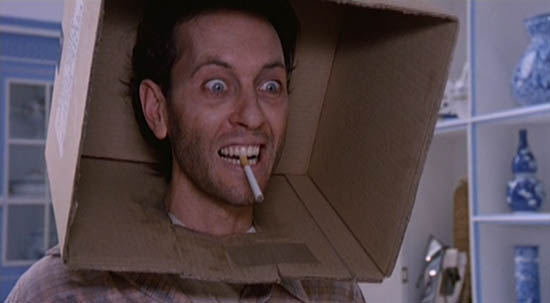
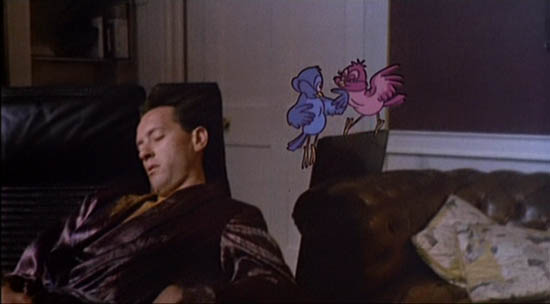
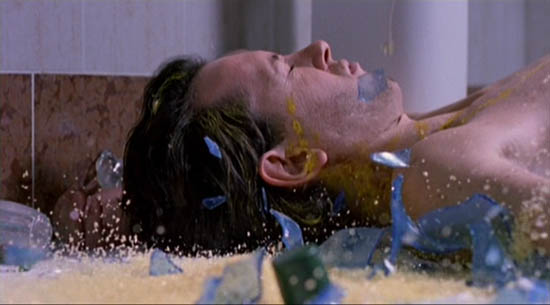
A usually-funny comedy about the advertising business. Dude is high-power ad exec until one troubling assignment to come up with a slogan for a zit cream. He has such trouble that he starts to question the entire practice of advertising… and that’s when a talking boil shows up on his neck, representing his bad ad-man self. It eventually takes over the body (with added mustache) with a good-guy-within boil on HIS neck. A little more gross than the usual angel/devil on your shoulder, but same idea. More anarchist (or communist) speeches (by the good anti-ad-man persona) than in most films. Remember the bizarre animated lovebirds, too.

image

Writer/director Bruce Robinson (also wrote The Killing Fields) put together a good comedy, with an excellent lead performance by Richard Grant (Karaoke, some latter Altmans, and Franz Kafka’s It’s a Wonderful Life).

image

Movie feels not like an advertisement but like a political attack, like a speech, but without the actual speeches interrupting the comic flow of things. Energetic and fun(ny), worth watching for sure.

image

“this has never happened before… what am i gonna wear?”

image

Starring Steve(n) McQueen as a 28-year-old teenager, with his 25-yr-old teenage girlfriend.

image

Awful dialogue and delivery, low budget sets, long talky parts, nothing-special cinematography, inept sound editing, really it’s near-mst3k fare minus McQueen’s capable lead and a cool premise and neat creature. I suppose the criterion commentary’s gonna go on about how symbolic the thing is (note: no, just talking about the making-of, giving a little context). Weird movie for them to release… is it “important” or is it just a cool sci-fi movie with a big star to which they could secure the rights? Website says it was an indie movie (unusual for the 50’s) but can’t help throwing in that the blob was “comparable to if not incarnating the growing consumerism of 1950’s America). Probably not a must-see… the 1980’s remake will do fine.

image

image