MAR 20, 2008
————–
Saw on 35mm for the first time. I do not know this movie as well as I think I do… lots of forgotten parts (the town in Iceland buried in ash) and mis-remembered bits. I was grateful to see it projected, but don’t feel that it loses too much on television – gonna keep happily watching the DVD for years to come. If I have a favorite movie right now, this is it.

A new favorite line: “At nightfall the megalopolis breaks down into villages, with its country cemeteries in the shadow of banks, with its stations and temples. Each district of Tokyo once again becomes a tidy ingenuous little town, nestling amongst the skyscrapers.” This is the impression I got from some Japanese movies.

Checked out the DVD again and watched some of the extras. The Chris Darke short didn’t teach me much, just strengthened my belief that nearly all video-art installations consist of too-small TV screens in too-large white rooms full of uncomfortable folding chairs.

DEC 30, 2006
————–
A reminder of the attempted Chris Marker Marathon begun in late August. Showed it off to Jimmy & Dawn.

A movie about memory, images, directing and editing, making pictures, turning life into art and vice versa.

“I will have spent my life trying to understand the function of remembering, which is not the opposite of forgetting, but rather its lining. We do not remember, we rewrite memory much as history is rewritten.”

Explanation for the electronically processed images: “He showed me the clashes of the sixties treated by his synthesizer: pictures that are less deceptive he says—with the conviction of a fanatic—than those you see on television. At least they proclaim themselves to be what they are: images, not the portable and compact form of an already inaccessible reality.”

Owls and cats! Digitally processed images. Tarkovsky’s Stalker. Three children on a road in Iceland. Apocalypse Now. Sacred symbols at Macy’s. Teens dancing in the streets. The same scene in Vertigo that Marker references in La Jetee. Kamikaze. An image. A memory. A glance.

Even better than I remembered, and I remembered it as a masterpiece. Such a good documentary that it may not be a documentary at all. The best travelogue ever.

If this site didn’t already exist, I may have felt compelled to create it myself.

Dawn loved it. Jimmy too, I hope?

The Chris Marker Marathon will continue someday. Got some Rivette to watch first, I think.

Jean-Louis is a Catholic engineer with an interest in mathematics and a dislike for Blaise Pascal (the mid-1600’s scientist and philosopher). JL meets up with old long-time-no-see friend Vidal, who takes him out dancing and then to visit Vidal’s friend Maud, a single mother, at her house on Christmas night. The section at Maud’s house must be at least a third of the film’s running time. Vidal is attracted to her, but she’ll have none of that. He gets drunk and finally walks home, Leaving JL to fend for himself. They talk about life, love, religion and Pascal, JL sleeps next to Maud but they only kiss once. The next day JL meets Franciose, a girl he has noticed at church, and makes a date with her, then joins Maud and Vidal out hiking in the snow, talking like comfortable old friends. Another friendly kiss. JL gives Francoise a ride home, stays over at her place (but in a separate room), flash-forward they are married with a kid, he meets Maud, and we find out that Francoise had an affair with Maud’s ex husband, but all is forgiven and the family goes to romp in the surf.

Like a more fleshed-out story of The Bakery Girl of Monceau, but this time the women have histories and personalities, and the bakery girl (or Maud) is much harder to write off. JL has a deeper character than anyone in the first two Moral Tales – Criterion calls him “one of the great conflicted figures of sixties cinema.”

JL and Maud:
image

On the film’s style, Kent Jones says “No one’s films are more ‘written,’ more narrative based, or more logistically tied to particular places and times of year.” True that, an extremely talky picture, and reliant on its snowy seasonal setting. Finely but simply shot in black and white. No real visual or plot excitement, no stylistic heightening of mood or emotion, but a deeply thought-out script and characters evolving before our eyes. This particular week from Christmas to New Year’s is one of the most important in JL’s life, and we see (or hear) his changing and challenged beliefs, principles and decisions, creating the kind of real human complexity very rarely seen in movies.

Came out a decade after its closest (so far) kin in New Wave cinema, The 400 Blows, probably the quietest and most reserved film of 1969, the year of The Gladiators, Mr. Freedom, Topaz, Satyricon and Easy Rider (but to be fair, also the year of Andrei Rublev, Passion of Anna and Army of Shadows). Third of the Six Moral Tales, the last four of which were shot by Néstor Almendros, who also worked with Truffaut and Barbet Schroeder and later shot Days of Heaven.

More Kent Jones:

What are the chances that Jean-Louis and Maud will have a life together? Based on her luck with men and his avowed preference for Catholic blondes, not so great. Based on their immediate affinity for each other, not so small. “You are a happy soul, despite appearances,” observes Maud of Jean-Louis—and the essential rightness of this observation is what makes Rohmer a greater artist than Bertolucci and also points to what gives My Night at Maud’s its special spark and effervescence. … Current fashion would favor Maud as the voice of reason when she tartly dismisses Jean-Louis’ prevarications: “I prefer people who know what they want.” Yet there’s something equally admirable about Jean-Louis’ insistence on adhering to his story and fulfilling his own platonic conception with Françoise, a decidedly unhappy soul. The necessity of choice, the pain of choice: no film is better at illuminating these two ­equally real aspects of living. There are no moments of grace in My Night at Maud’s. … Yet there are intimations of grace in the slow, serpentine movement toward intimacy between Maud and Jean-Louis.

Maud and Vidal:
image

Movie picked up a few screenplay awards, but mostly beaten out by the big political films of the era – Lindsay Anderson’s If… for feature at Cannes, Costa-Gavras Z for foreign film oscar and, ahem, Patton for screenplay oscar.

Vidal – Antoine Vitez (a smallish part in Truffaut’s The Green Room).

Franciose – Marie-Christine Barrault (Queen Gueneviere in Perceval le Gallois, also in Woody Allen’s Stardust Memories)

Maud – Francoise Fabian (the lawyer Lucie in Out 1 and the mother in Secret Defense)

Jean-Louis – Jean-Louis Trintignant, who worked with (in order) Roger Vadim, Jacques Demy, Alain Robbe-Grillet, René Clément, Claude Chabrol, Costa-Gavras, Bertolucci (star of The Conformist), André Téchiné, Kieslowski (Red), and Patrice Chéreau (Those Who Love Me Can Take The Train).

JL and Francoise:
image

This came right in between the two other Ozu films I’ve seen, around the same time as The Hidden Fortress, Underworld Beauty and Giants & Toys.

Ozu’s first color film (in a very nice looking print at Emory) and the handout told us to watch for the red teapot but didn’t say why. The teapot was often anchored in the corner of the shot, a helpful indicator of which way the camera is oriented in the room. Not too familiar with Japanese traditional housing so it confused me that there was a giant opening on both sides of the living room until I noticed the teapot. That probably wasn’t the intention.

Music is nice for the most part, but turns into an icky music-box score sometimes in the home scenes. Reading what I wrote about Tokyo Story, it says Ozu’s signature line is “it’s a beautiful day”… I remember it in this movie, though I don’t know if it was during the family outing at the lake or another time, because I wasn’t listening for it.

Stars Shin Saburi (from a few other Ozu films) as Hirayama, a man to whom everyone turns for family advice. He claims that happiness for the children is the most important thing, but when it comes to his own oldest daughter (Ineko Arima from Tokyo Twilight, The Human Condition and Late Chrysanthemums) he backs down and refuses to let her marry who she wants. Hirayama’s wife (Kinuyo Tanaka, star of Life of Oharu, Flowing, The Crucified Woman, Sansho the Bailiff) patiently waits it out as he wrestles with his daughter’s decision to marry without his consent, agrees to attend her wedding at the last minute, and finally goes to visit her new home in Hiroshima to make up for having never smiled at the wedding (final shot is his train leaving).

Hirayama’s younger daughter was Miyuki Kuwano, only 16 when this came out, starred in Oshima’s Naked Youth two years later. The family’s giant-mouthed friend from Osaka with health problems, Cheiko Naniwa, appeared in Mizoguchi’s The Crucified Woman. Hirayama’s good friend (whose daughter leaves home and marries against his will, working at a bar which Hirayama visits) is the great Yoshiko Kuga, main guy from Tokyo Story and everything else, appearing in 180 films, 32 of them by Ozu.

Everything works out in the end. Hirayama is on the train, his friend is seeing his own daughter again, and the big-mouthed woman’s daughter is thinking of marrying. All the men have lots of daughters in this film – there’s a theory presented for that, but I think it was just meant for laughs. The scenes at the bar with Hirayama and his employee are pretty funny, too – I’d forgotten that Ozu was sometimes a humorist. Ozu had a co-writer, and it’s based on a novel – not trying to credit the director with every line of dialogue, but he embraced it at least.

Senses of Cinema explains the style: “There are no long takes or are there any very brief shots in his films. Each character’s contribution to a dialogue is delivered in a single shot. This technique is not however, to be confused with television dialogue where one actor looks left to the other actor looking right. Ozu’s performers are centrally placed, looking at the listener, and, at the audience. Between each dialogue scene, there is an establishing shot. These are held longer than establishing shots are in other filmmaker’s works, and they contain very little movement, or if movement is present, it occurs in the distance, often at the junction in a long corridor framed either side by the walls.”

And: “Ultimately Ozu’s films are observational. The Osaka woman may be the most annoying and irritating individual in Equinox Flower, yet she is not judged by the film. Hirayama, in his stubbornness towards his daughter and in excusing himself to escape another conversation with the Osaka woman demonstrates his human fallibility. Ozu easily identifies his characters faults, but he readily understands and forgives their foibles. Along with Renoir, he is one of the great humanists of the cinema.”

Holy awesome, an incredible movie. The actors are OUT there, Rock Hudson all repressed, Dorothy Malone all seething sexuality, Robert Stack extreme in everything he does, and poor Lauren Bacall ping-ponging all over the place. The sweeping style announces itself right at the start with the best windstorm since David Copperfield, a speeding car and gunshots (movie starts at the end, just like all movies do today). Tons of over-the-top comic moments that had our appreciative audience chuckling (or howling, as in the ending when Malone suggestively strokes a phallic oil-well model while thinking about Rock).

Apparently based on the death of RJ Reynolds’ son. Robert Stack, fresh off Sam Fuller’s House of Bamboo (and doesn’t this movie display some Fuller-esque drama) plays the son and ROCK is his hard-working best-bud wingman. Rock (in the middle of a streak of Sirk films) is tied to Stack’s family but would like to get out and do something for himself. Dorothy (Artists and Models, Colorado Territory) is Stack’s spoiled, slutty sister who has always been in love with Rock. And Lauren (The Big Sleep, etc) is a hot thing first noticed by Rock but violently wooed away and married by Stack. The less-than-proud father of the big oil family is Robert Keith (Lt. Brannigan in Guys and Dolls).

When Lauren can’t conceive, Stack’s penis is blamed and in shame he turns to wild drinking and loutish behavior. Rock’s and Dorothy’s pent-up love issues can’t be contained and the thing explodes into a violent, windy passion when Stack beats his wife causing her to lose their baby (which he believes is Rock’s), and Dorothy accidentally shoots her brother in a fight. Closing court scene gives a somewhat believable happy ending (Dorothy has a chance to lock up Rock, but she proves herself an alright gal by setting him free).

Movie is gorgeous and wonderful. Sirk called it “a film about failure”. Laura Mulvey says the film “responds to these failures and frustrations by crowding the screen with answering images from the overtly Freudian to flamboyantly cinematic lighting, color and decor.” At oscar time, Dorothy Malone won best supporting actress, Robert Stack was beaten by Anthony Quinn, and Rock was nominated for Giant instead.

Mulvey again, on the greatest part of the movie:

In one of the film’s key moments, she performs a wild solo dance of rebellion in her bedroom. As her loud, jazzy music fills the house, her father slowly climbs the sweeping staircase, only to collapse and fall to his death. With Sirk’s instinct for melodrama (in the literal sense of music plus drama), the intercutting between the spaces occupied by father and daughter quickens to create an innovative, cinematic rhythm for a montage sequence that was rare in studio-system Hollywood.

Feb 2017: Watched it again with Katy, who was impressed and disturbed by all the psychology on display and isn’t sure what to think about this Sirk fella anymore.

“It’s your negative insinuendo!”

Whoops, I accidentally watched two bizarro hyperactive cult movies in a row from the criterion collection (Mr. Freedom and now this). In their words: “Based on Peter Barnes’ irreverent play, this darkly comic indictment of Britain’s class system peers behind the closed doors of English aristocracy. Insanity, sadistic sarcasm, and black comedy—with just a touch of the Hollywood musical—are all featured in this beloved cult classic.”

If there’s one thing you remember about The Ruling Class, it should be to not watch it again. It feels too much like other cult classics: loud, overlong, and funny but in a pained sort of way. O’Toole has a powerful character though and a wildly good performance. He’s Jesus for more than half the movie, then becomes much more dangerous when he starts appearing to be normal.

“How do you know you’re God?”
“It’s simple; when I pray to him I find I’m talking to myself.”

Definitely doesn’t count as a musical, though it has three or four scenes of Dennis Potter-style singalong. Might actually count as a horror. Gets more terrible and less funny as it progresses, closing with a shrill and mighty scream. Kind of good as political satire in that respect… the ol’ Catch-22 approach of drawing ’em in with humor and then unleashing the message, that these are very bad people in important positions of power and they should be stopped.

Lindsay Anderson fave Arthur Lowe is the only actor here who also worked on “Kind Hearts and Coronets”. He’s hilarious as the butler who inherits a fortune from the old Earl, then keeps his job but openly mocks everyone he works for.

I won’t make fun of “Species II” director Medak for this one, since he seems like a good sport, although now I realize he also made that dismal Masters of Horror episode “The Washingtonians”, another way over-the-top, shrill political piece.

Ian Christie:
“In revolting against naturalism, we should not forget that Medak (a refugee from Hungary) and Barnes were in good company. Roeg and Cammel’s Performance (1970) had plunged fearlessly into bravura fantasy… while such otherwise very different filmmakers as Kubrick and Anderson had also forsaken realism in their two great “state of the nation” films of the same period: A Clockwork Orange (1971) and O Lucky Man! (1973). And Medak’s fellow countryman, Peter Sasdy, was leading Britain’s horror specialist Hammer into post-Freudian terrain with Hands of the Ripper (1971), another tribute to the enduring fascination with the Whitechapel murderer.

“There are also some remarkable purely filmic inventions. The image of Dr. Herder embracing the police cut-out silhouette of Lady Claire has an eerie pathos, and the chilling final scream that rings out over the brooding exterior of the Gurney mansion after Jack has stabbed his wife, flushed with his acclaim in the House of Lords, seems to unite the bloody poetry that Hammer aspired to with a real protest against Britain’s decaying aristocratic tradition.

And an interesting connection to “The Trap”, which I’m in the middle of watching, also via Christie:

“R. D. Laing’s account of schizophrenia as essentially family-induced—a logical response to irrational pressures—was proving influential as a counter argument against advocates of ECT and drug treatment; and this is the backdrop to The Ruling Class’ elaborate staging of Jack’s madness and its “cure,” through a surreal confrontation with his opposite, the “electric messiah.”

“I’m very happy to announce that we’ve destroyed at least half of the country. I hope now they’ll understand that aggression does not pay.”

That sums up the whole movie. It’s so obvious and loud and obnoxious and garish and that’s probably just what it intends to be. But it makes for an unpleasant viewing experience. I can’t imagine this movie screening in theaters without walkouts by exasperated viewers saying “I GET it already” (but probably saying that in french).

All-American titular superhero is introduced blithely massacring a black family in the middle of their dinner. Then Dr. Freedom (Donald Pleasence) calls to tell him that his French equivalent Captain Formidable has been killed and commies are invading France from neutral Switzerland. It’s up to Mr. Freedom to save the ungrateful French, not for any love of the country but to stop the dreaded domino effect and protect the world from communism.

Doesn’t play like a proper movie at all. Sometimes it feels like an advertisement (America’s priorities are more Capitalist than Democratic), and sometimes like a bunch of people goofing around and pretending to make a movie. The dubbing ain’t great, either.

Some funny touches: the american embassy in France is a wal-mart full of dancing girls. And sometimes the cheapness of the project turns into a lo-fi charm. Superfrenchman is played by a balloon with easily confused henchmen, and the also-inflatable Red China Man breathes frozen fog that settles on the ground.

Freedom of course ends up destroying most of France, his french guide Marie-Madeleine turns out to be a commie traitor, Russian Moujik Man is somewhat of an ally but can’t really be trusted. Freedom, not too fazed by the death of all his compatriots and followers, prevails through violence. Sadly it’s not a dated period piece and what Klein’s saying about American foreign policy applies perfectly well today.

Criterion: “Delightfully crass, Mr. Freedom is a trenchant, rib-tickling takedown of gaudy modern Americana.” It’s funny to think how many Criterion completists will soon own this movie.

Movie plays better in stills. When considering the screen shots I took, it seems almost like a good movie, clever and funny and ramshackle without the loud, boisterous, stagey dialogue to distract. In other words, it’s a much better movie when you’re not actually watching it. And since Klein was renowned in the 50’s as a still photographer and appears in Marker’s still-composed La Jetee, I’ve kept more screenshots than the film might deserve.

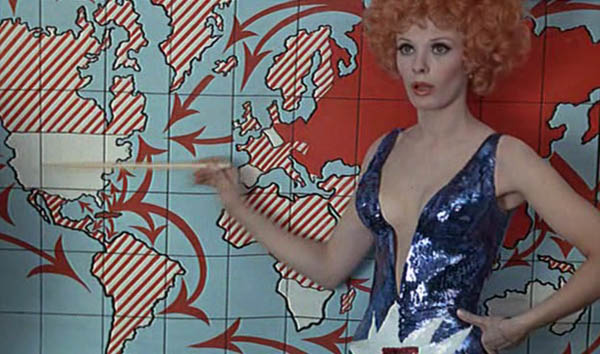
The introduction of Marienbad star Delphine Seyrig as Marie-Madeleine, yowza.
image

Dr. Freedom:
image

Captain Formidable is played by classy French icon Yves Montand:
image

“Anti-freedomism is at a new high.” Can’t get enough of that dress. Note Marie-Madeleine’s placement in front of the red portion of the map, foreshadowing the revelation that she is a communist spy. Just kidding.
image

Over a temporarily fallen Freedom, L-R: Moujik Man, Red China Man, Jesus & Mary
image

Freedom celebrates the defeat of Superfrenchman… I don’t remember exactly what went on here:
image

Forcing the maid to taste the poisoned food she brought. Nice shot setup:
image

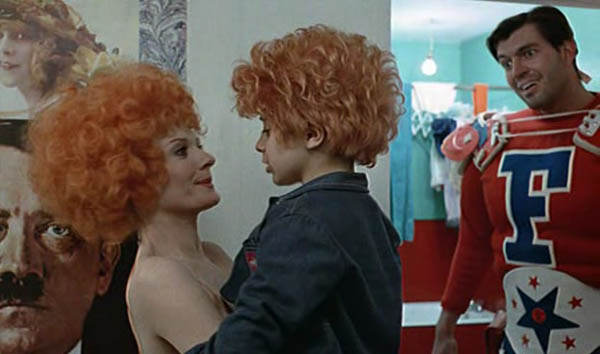
I love this shot so much. The matching hair, the goofy look on Freedom’s face, the unexplained picture of Hitler hanging on Marie-Madeleine’s wall:
image

Serge Gainsbourg very nearly survives to the end:
image

Freedom! Now available in a convenient spray!
image

Billy Wilder: “My delight… is ’cause everyone has been looking down on movies as something kind of third-rate until, thank god, the invention of television. Now we have something to look down on.”

Not quite a film noir, I don’t think, but close. Continues the string of 50’s movies I’ve watched lately, but this one’s from back in the year of Day the Earth Stood Still / Thing From Another World and Fixed Bayonets / The Steel Helmet.

It’s a damn well-made movie, as the commentary track helpfully illustrates, but Katy didn’t like it because of unlikeable characters (which is why when she asks if she’ll like “there will be blood” I tell her no) and Jimmy fell asleep since we started it at midnight. It’s about a desperate newspaper man whom Sam Fuller would have despised, making the news himself and conspiring to suppress other reporters while building up a sensationalistic story to glorify his own reporting and get himself back on top. At least when it fails, he recognizes what he has done and owns up to his own role in the trapped miner’s death, though by Code rules, the reporter dies too, stabbed by an equally hot-tempered and strong-willed woman.

A deeply-dimpled Kirk Douglas stars (shortly before doing Big Sky and Bad and the Beautiful) alongside Jan Sterling (who did High and the Mighty with John Wayne before retreating to television) as the miner’s wife who wants out but plays her part as a concerned wife out of greed for tourist cash. Professional villain and Preston Sturges actor Porter Hall is Douglas’s very straight-laced, belt-and-suspenders small-town newsman boss. Corrupt sheriff Ray Teal ended up famous for playing sheriffs, and his unhelpful deputy is Gene Evans, the newspaper man in Park Row. Porter Hall was dead in two years, and the guy who played the miner’s dad (John Berkes) died one week after the film’s release.

Our heroes:
image

Evans and Berkes:
image

Porter Hall:
image

I’d pay to see some great S&M amusement:
image

Kirk Douglas addresses his “fans” from the mount:
image

A sad father surveys the aftermath:
image

First rented this in December 2005, took over two years to finish it. Only movie to top that is The Decalogue (begun in 2001, still unfinished).

Katy didn’t want to watch it, and I’ve got trouble with it myself, not having any experience with opera. Some of the songs (“all in vain”) are lovely, though. The acting is extremely stagy, with huge facial expressions and body movements. Hoffmann himself moves stiffly through the film, maybe the only non-dancer in the cast but with a great voice (if he’s not dubbed). Sumptuous set design and costumes, one large room at a time with not much that is apparently cinematic about it. Even some of the effects (scattered, living doll parts created by actors wearing mostly black) are stagy. But then it can explode into incredible matte-painting sets with killer editing tricks and one very memorable camera-trick perspective shot involving a staircase shot from overhead. Camera is mostly still during dialogue/singing scenes, with some well-parceled sweeping movements… all fits together amazingly. Some of the richest color I’ve seen on my little television and laptop screens. They make great use of height in the frame, all columns and high-ceiling rooms. Since the dance numbers are mostly one or two people at a time, you never wish for widescreen. Only thing that really needs to be said is that it has more amazing bowl-me-over visual moments than almost anything else I’ve ever seen. Need to watch again as many times as possible.

Hoffmann is at the ballet falling for the dancer, whom his rival is also lusting over. He and his friends abandon the show for a bar where Hoff narrates three stories, starring himself, his rival, and Hoff’s nearly silent male companion (played by a female redhead), about three thwarted romances. At the end, the girls all dance together and collapse back into the original girl. And as Hoff falls exhausted to the bar table at the end of his story, the dancer shows up only to be escorted away by the rival.

image

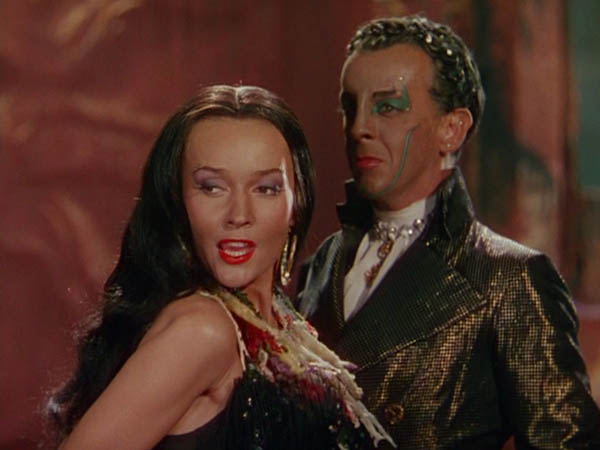
The main dancer and the doll in the first story were Moira Shearer from The Red Shoes. The second girl with a jewelry obsession was Ludmilla Tcherina. Third girl, sickly with a dead mother, was Anne Ayars. All are stage dancers best known for this and other Powell films.

Hoffmann was a big opera star, also appeared in Carousel. Rival Robert Helpmann (probably the most facially expressive here) has played sinister characters in a few films. The most prolific was Pamela Brown, Hoff’s silent companion, who had fourth-billed roles in Cleopatra, Lust For Life, Olivier’s Richard III and Powell/Pressburger’s I Know Where I’m Going, which is the next one I’ve gotta see.

image

Also watched a 1956 widescreen Powell solo short of The Sorcerer’s Apprentice with some of the same art crew as Hoffmann. It was an early showoff reel for CinemaScope, only now available in a shortened far-from-pristine print. The voiceover stands out awkwardly, but the costumes and dancing are great – the living broom and dancers representing the water that fills the room. Cool little film. IMDB says the apprentice, Bulgarian born, was the second woman to ever be knighted in Norway.

The Landmark theater of course played these Academy-ratio films in widescreen, ho-hum.

WHITE MANE, b/w, boy who lives on the marshes in southern France with his father and little brother (played by director’s son / star of Red Balloon) loves a wild horse, wants to capture it. Nearby ranchers also want to capture it. After a chase, boy rides the horse into the river and floats away, swept out to sea.

RED BALLOON, bright color, boy finds balloon which magically follows him around the city. Adults conspire to keep him away from his balloon, and other kids want to steal and destroy it. When the kids are successful, balloons from all over the city fly over and lift the kid up over Paris.

Jimmy says both movies are about the perils of acquisition. Both have somewhat the same ending… the kid getting (more or less) what he’d desired, a sense of freedom and imminent danger.

The two won a bunch of awards at Cannes, and Red Balloon got an original screenplay Oscar beating out The Ladykillers and La Strada. Remarkable for a movie with almost no dialogue. The two share excellent camerawork and primitive post-synched sound. I haven’t heard of anything else by photographer Edmond Séchan. Lamorisse made some other lesser-known children’s movies, including the earlier “Bim” and a widescreen Red Balloon sequel “Stowaway in the Sky”. The documentary he was filming over Iran when he died in an accident got an Oscar nomination after its completion. Best of all, he invented the board game RISK in ’57.