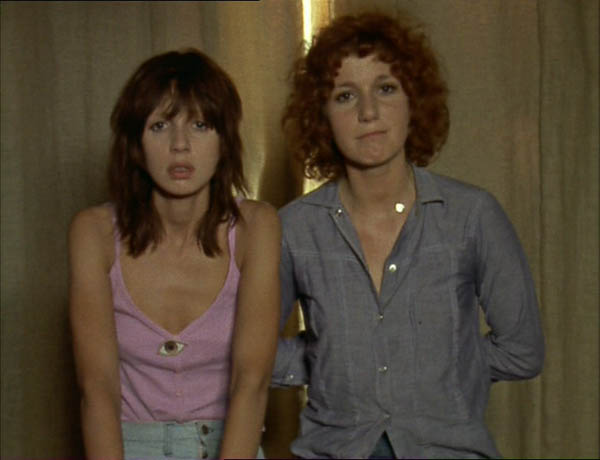
I was looking forward to this, due to my recent Rivette obsession, but didn’t expect to love it, since it’s a period piece about upper-class people unable to declare their love for each other because of societal restrictions, and I tend to hate that kind of story. It’s nice to watch fave Rivettian actors Bulle Ogier and Michel Piccoli and Barbet Schroeder (all sharing a scene) but they’re hardly in the movie and they play gentle, wise elder friends and relatives, with a bit of dialogue but no passionate acting showcases. I got my Rivette themes and trademarks served up: conspiracies, secret rooms, performance (explicitly at the convent, but throughout as the two toy with each other), real locations with creaking wood floors, oceanside drama, but all enslaved to this book-to-film adaptation of Balzac – something that I thought Rivette just said he’d never do in the DVD interview on Belle Noiseuse, that he dances around Balzac in his film writing (that one and Out 1) because a direct adaptation would be impossible. In the story, Montriveau is one of the notorious 13, but the name of the group is never stated here. Anyway, we also get very good performances from the leads – Guillaume Depardieu, lookalike son of Gerard who once played his dad in flashback in Les Misérables, with his false leg used to great effect here on the wooden floors… and Jeanne Balibar, who I don’t remember from Code 46 or Clean, and haven’t seen yet starring in Va savoir.

Not much outward passion to the movie, emotions seem detached (I know, that was the point, sorta) but it has a quietly affecting ending aboard Montriveau’s ship after he breaks into the convent and finds the Duchess dead. The plot being easy to follow, I started paying attention to nerdy cinema stuff like the quality of light (all supposedly from sunlight and candles) and the sound (music used very sparingly, as usual). Sound was rough because of the loud hissing and gurgling noises coming from the ceiling at the Landmark, and picture was even rougher since the film was projected out-of-focus (except for the left third of the screen, which looked lovely). So it was easier to measure the quality of light than, say, the details of costumes and decor. I’m not much for decor anyhow.

Definitely closer to Hurlevent (Wuthering Heights) than to anything else I’ve seen Rivette do. At least I learned how Duchess of Langeais is pronounced (vaguely: “lawn-jay”). This Balzac story was previously filmed a few times, from a 1910 lost silent to a 1995 TV version adapted by the co-writer of Goya’s Ghosts.

————
Excellent analyses found on other sites:

E. Howard:

Games are the film’s central conceit, in fact, whether they be word games, mind games, literary games, games played between appearance and feeling. The game being played at the narrative level takes place between a General and a Duchess … But this is only one game that Rivette is toying with, and he plays an entirely different one with the audience, a game of subtle winks and sly nods that continually disrupts the placid surface of the narrative … This narrative disruption is mirrored in the way the General’s story to the Duchess, about his time lost in the desert after escaping from the enemy’s imprisonment, is continually interrupted, usually by the listener’s short attention span and her tendency to divert the flow of the conversation just as the story is reaching a critical juncture. This results in the General’s story being doled out across three successive evenings that they spend together early in their relationship. On the third night, as they settle in to continue the story, Rivette frames the Duchess in a tight closeup as she asks her would-be lover to finish the tale. At this moment, she turns a sly sidelong glance directly into the camera, maintaining eye contact with the audience, as though to include them in the game.

This game of narrative interruptus is also carried through in the way Rivette uses the text of the film’s original source, a novella by Honoré de Balzac. This is a rigidly faithful adaptation… with texts from the novel periodically included as intertitles to highlight certain moments or get at the characters’ internal states. The titles are also used to convey the passage of time, which is parceled out in scrupulously precise measures: “one hour later,” “twenty-two minutes passed,” “she waited twenty-four hours.” These titles often seem to abruptly cut off the action, sometimes flashing up on screen when, after a long scene of near-stasis, a character is right in the middle of completing the scene’s first real movement or action (most often: leaving the room). The passage of time, like everything else in the film, is subject to Rivette’s subtle humor. After the Duchess kicks her friend out of her house, a title informs us that it one hour passes (a very common interlude), and surprisingly in the very next scene there’s the General again, still standing in her parlor, walking around it aimlessly, looking like only five minutes has passed since she ordered him to leave. Rivette’s use of these titles is obviously very sardonic and mannered, as when he uses a long series of images of the Duchess at a party as though it constituted a clause in between two dashes in a sentence: “the Duchess searched for him —” followed by the visuals and then, when the dangling phrase had almost been forgotten, “— in vain.”

J. Romney:

Characterised as a sort of Napoleonic wild beast ill at ease in the tameness of Restoration Paris, Armand – a general newly returned from Africa who initially fascinates married duchess Antoinette with stories of his exploits – is associated from the start with the great outdoors, prowling Mallorca’s windlashed ramparts, while Antoinette is first seen doubly imprisoned, in nun’s cowl and behind a grille.

The film is largely set in a series of enclosed salon and boudoir interiors, an overtly theatrical domain in which Antoinette is a surpassing mistress of mise en scène. Preparing for Armand’s first visit, she arranges herself for maximum effect on a canapé, in discreet déshabille, ordering her servant to lower the lighting (the thematics of light and heat later extended in the fireplace that Armand pokes with barely contained sexual frustration, and in the brand with which he threatens Antoinette).

As actress, Antoinette is skilled at the well-timed entrance and exit, whereas Armand habitually arrives too early, or storms inopportunely into the star’s dressing room. It is part of Armand’s revenge that he at last masters both mise en scène and performance, in a startlingly excessive scene that replaces Antoinette’s poised comedy of manners with a lurid melodrama: in it, he plays a menacing Byronic ravisher, supported by masked men hovering around a brazier. This sudden eruption of violence in the middle of an analytical drama may seem wildly incongruous, yet the tonal discontinuity comes directly from Balzac’s story, and Rivette achieves the seemingly impossible in making such a disjunction work convincingly on screen. The violence at the heart of the story, together with its cautionary-tale aspect, is foregrounded by Rivette’s reversion to Balzac’s original title for his novel. The reference is to a veiled warning that Armand gives Antoinette, the axe being the English one that beheaded Charles I – the implication is that the reckless cause their own downfall. In reality, however, Armand himself figuratively wields the axe that will destroy his own chance of happiness.

D. Kasman:

How strange that a filmmaker who through the years has so loved process, often in terms of acting and theatre, of seeing the expression of things worked out awkwardly before us, and conspiracy, in terms of the hints that everything out there, out of sight and out of the film frame, may be connected, has decided to adapt a reserved, 19th century historical chamber romance. Oh, but with such a surprise we then get to engage in the pleasures of the hunt! For then we find things like this: how is the navigation of social rules and norms—a very real thing with a very allusive existence—like the theatre and how is it like a conspiracy? Well, it is not without reason that Rivette opens the film at the melodramatic peak of the couple’s aching separation—the Duchess a nun on a remote Spanish isle and separated from the General by the convent’s metal bars—and then transitions and flashes back five years to the couple’s meeting and affair through two sweeps of a theatre curtain. The stage then is not the actual island (filmed on location), but is the interiors of the Restoration period, in all their glory, wood boards creaking like an empty stage. …

It is like a game played again and again with different moves but the same results, the repeating drama inside the haunted house of Celine and Julie transposed to thinking, feeling participants. The drama exists in a hanging kind of closed-off world, all frustrated performances that are almost content, as the playfulness and acting gets close to true expression, true connection. But something holds everyone back, holds the drama back, holds the love back, and gradually both General and Duchess become obsessed with this vague, menacing limitation, a mysterious stopgap to happiness that can neither be seen nor surmounted.

Whew, I love all these themes that get read into Rivette’s work. I always wonder whether he’s aware of them and consciously shaping his films in this way, or if the themes are unintended and they are more or less created by the critics, or if they’ve just become a part of his creative process, so much that he doesn’t think about them as consciously as he used to, and they become more subtle and have to be drawn out by a viewer well familiar with his previous films.

D. Ehrenstein:

The film is “dryly funny. Especially so when “the 13” make their appearance in the last act, looking more like a left bank version of the Keystone Kops than a fearsome secret society.

Only thing I’d seen before by Lelouch was his fairly conventional and lightly enjoyable entry in Chacun son cinema, which it turns out was good preparation for this fairly conventional and lightly enjoyable film.

A meta-thriller without too many thrills of its own. I would’ve been shocked if the eminently likeable Dominique Pinon turned out to be a psycho killer and slaughtered down-on-her-luck chainsmoking hairdresser Huguette, as the movie kept implying he would. I also would’ve been shocked if the top-billed Pinon whose character is a ghostwriter and a former magician had NOT been faking his own death at the end, and had actually been killed by famous author Judith Ralitzer (Fanny Ardant of some unseen Resnais and Truffaut films from the 80’s). Judith’s suicide at the end was surprising though, and seemed tonally out-of-place. There’s no evidence that Judith was a potentially-murderous monster (it’s only implied), but we’re not supposed to be upset when she is driven to suicide… I was, a little.

Pinon is on his way to a yachting trip with Judith but stops along the way to stalk Huguette who is dramatically dumped in front of him at a gas station. He waits all night to give her a ride – not because he is the escaped magician serial killer whom the radio keeps mentioning, but because he’s researching roles for “Judith’s” next novel. Takes H. to her rural home and pretends to be her boyfriend for the benefit of her family, then continues to the yacht two days late, proclaims that he’s done ghostwriting for Judith and that this will be his own “first” novel, writes the book onboard, “falls” overboard, hides out for a year, then returns Fury-style during police questioning, gets Judith to kill herself, then gives Huguette a big kiss. Why did he disappear? The book would sell tons more copies as a Judith novel than as a Dominique Pinon novel, and I guess by returning he gets all the royalties, though the movie conveniently ends before explaining that part. Also, in a cute side-plot, Dominique’s sister’s husband (never seen) leaves her and she falls in love with the police detective to whom she reports the crime.

The fun of the movie is its fooling around with thriller conventions, with Dominique alternately set up as the killer, the ghostwriter, and the sister’s missing husband. Pretty good looking film, but nothing amazing. Seems like the kind of slick, enjoyable, not-too-foreign movie that could run at the Landmark for a couple weeks.

Apr 2008:
——————-
Watched again with a very small, mildly unhappy audience. Oh how will I meet some fellow Rivette fanatics in my town if not at a public Celine & Julie screening? Love love love the last twenty minutes or so when they attack the fiction house, but the parts in the middle where they interfere in each other’s lives (Celine driving away Julie’s lover, Julie wrecking Celine’s job) are great fun also. Still don’t know what to make of Julie meeting her grandmother at the house next door to the fiction house.

Catching up with the cast: “Julie” had not-huge parts in Renoir and Fellini films, was recently in Ruiz’s Time Regained with La Belle noiseuse star Emmanuelle Béart. Marie-France Pisier played the dark-haired flower-fearing woman in the fiction house, also appeared in Time Regained, as well as Phantom of Liberty, Trans-Europ Express and got her start starring in Truffaut’s short Antoine & Collette.

Remembering the cat in the final shot, I paid attention to all the cats in the movie this time. Not much to say about that, though.

Feb 2007:
——————-
Incredible movie. Been thinking about it a lot. Lived up to expectations after I’d been wanting to see it for 6-7 years. Delightful to watch for all three of its hours, playful in every sense.

Dark-haired Celine meets red-head Julie, and they goof around for a long time, then…

James Crawford in Reverse Shot:

From the outset, Céline’s been on the run from a mysterious mansion with a gruesome secret. And so, just as the title predicts—in French, ‘aller en bateau,’ literally translated as ‘to go boating’ has a colloquial meaning of approximately ‘to get taken for a ride’ or ‘get caught up in a story’—Céline and Julie get wrapped up in discovering said secret.

The two take turns entering this house and comparing their experiences, trying to change the outcome and learn the secrets within. They mess with each other’s personal lives (jobs and friends), experiment with spells and legends and memory, and seem to never stop enjoying themselves. A big ol’ metaphor for movie watching, filmmaking, audience participation, getting caught up in the action. Out 1 is at the theater and Celine & Julie is at the movies.

Released the same year as another movie to blow my mind on video lately, Edvard Munch.

Will have to see this again and again.

Celine & Julie:
image

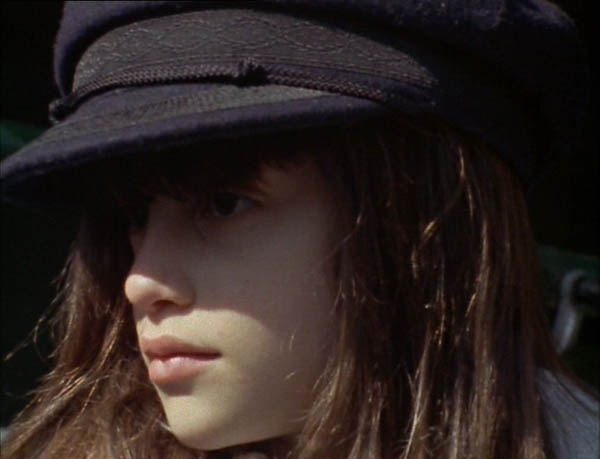
Feuillade-ing through town:
image

Bulle Ogier (Out 1’s Pauline/Emilie)
image

Director Barbet Schroeder as the guy in the fiction house:
image

The girl from the house, rescued:
image

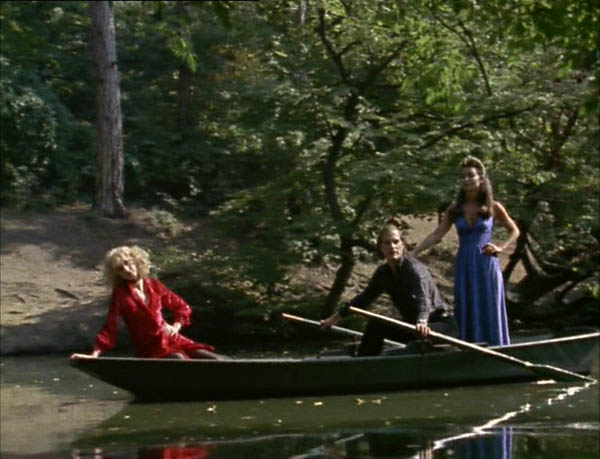
Going boating:
image

Made and released before My Night at Maud’s, but it’s part four of the Moral Tales. I made a moral decision to watch the films according to their numbering in the DVD box set, and not in the order they were made.

It’d be almost Antonioni-esque without the voiceover. Hardly anything actually happens, but Adrien always keeps us filled in on what he’s thinking. I considered disliking the movie for a while, a movie about idle rich young artists having self-conscious affairs, but it turns out Adrien and Haydée aren’t rich (only idle and leeching off their rich friend) and never manage to have an affair. I ended up liking it.
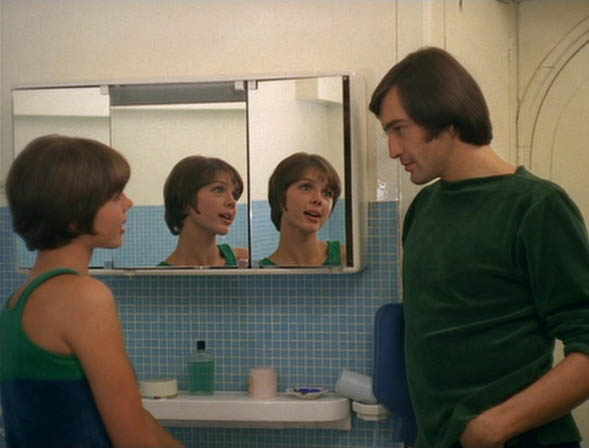
image

Buff 30ish Adrien comes to the beach to take his “first vacation in ten years” prior to an art opening, hopes to sit around with buddy Daniel and do absolutely nothing, not even think (they read so they don’t have to think). 21-yr-old Haydée is also at the house sleeping with a different guy every night. We don’t get much insight into Daniel – he’s the third wheel here – but Adrien and Haydée are both trying to find themselves, define their own moral codes, playing off each other and never quite getting together. At the end, Adrien pulls a standard Moral Tales move. Chances are good that he’s got Haydée for the night, but he leaves her in the middle of the road, deciding that sleeping with her would be against his character, and books a flight for London to see the girl he’s with (briefly) at the start of the film.

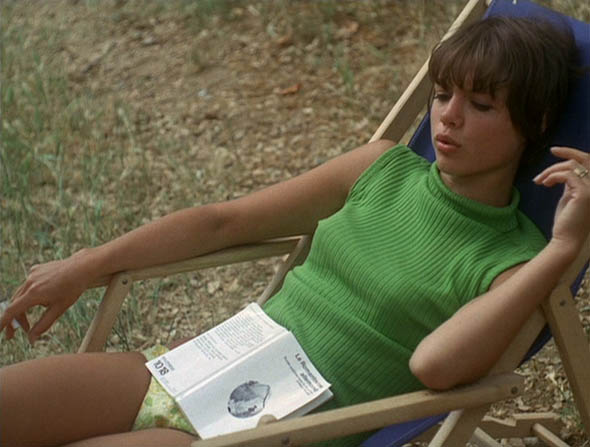
Leisurely-paced movie, but never slow or dull. Differently structured than the other films, with a few-minute prologue for each character before the main section of the movie begins. Rohmer and his cameraman would be happy to just stare at Haydée all day – her entire prologue is shots of her barely-clad body. Apparently that’s what defines her character.
image

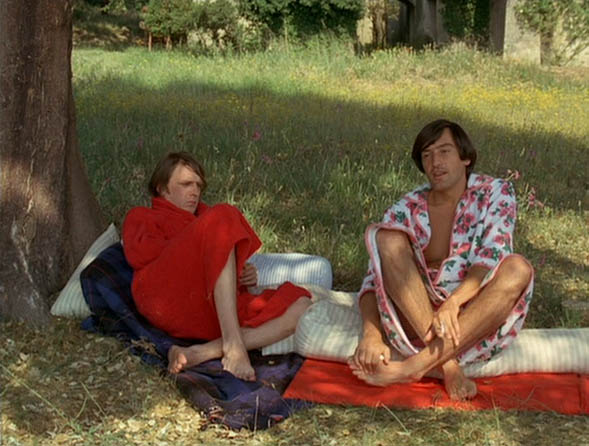
Have I mentioned that it is in color? Guess that’s another good reason to watch it fourth instead of third. Nice, rich color, too. Much of the look is in the bleached grays and browns and blues of the beach and the plain interior of their villa, so what colors we get in clothing and city life and an antique vase all stand out. Adrien and Daniel wear some hilarious clothes throughout (see above). Must be a 60’s artist thing.

Adrien was Patrick Bauchau, had a smallish part in Suzanne’s Career, later in American stuff like The Rapture and Panic Room. Haydée was Haydée Politoff, immediately turned to Spanish and Italian horror movies, had a small part in Love in the Afternoon, and mostly quit acting after that. Daniel was Daniel Pommereulle, appeared in Godard’s Weekend the same year, then two by Philippe Garrel.
image

from V. Canby’s NYT review:

Much of the comedy in La Collectionneuse, as in Rohmer’s later films, is provided by the otherwise aware hero’s elegant self-deceptions about his own motives, followed by his dimly seen perceptions of what could be another truth. In this context, it is a momentous event (and, comparatively speaking, momentously funny) when Adrien begins to have doubts about the affair of Haydée and Daniel. “I couldn’t be sure,” he tells himself with complete seriousness, “that their complicity was entirely for my benefit.”

There is a certain chilliness and lack of spontaneity to all of the performances, especially Bauchau’s, which, I suspect, has as much to do with the tiny scope of the film as to the actor’s talents. My Night at Maud’s and Claire’s Knee suggest living worlds outside the films’ rarefied milieus, whereas La Collectionneuse exists in splendid, arrogant isolation. Adrien is tiresome. Daniel is enigmatic, and Haydée is sweet, and great to look at, but, after a while, sadly commonplace.

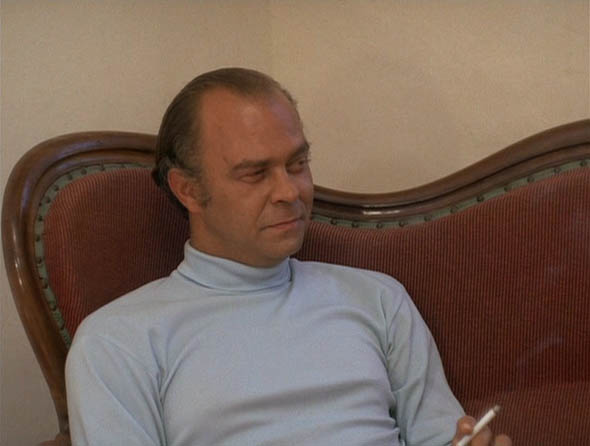
A note of interest to local film buffs: the Seymour Hertzberg who is listed in the credits (he plays Sam, the American art collector whom Adrien solicits), is the nom d’écran of Eugene Archer, a former New York Times film reviewer who, I’m told, has absolutely no intention of acting again. He is an excellent reviewer.

“Seymour Hertzberg”:
image

From P. Lopate’s Criterion essay:

Haydée is not the most articulate young woman, though she says just enough to cast doubt on the men’s interpretations. There will be other Rohmer films that take us deep into the psyches of women; this one does not, but it gives us a very daring, precise portrait of the misogynistic, entitled, self-loathing psyches of men. And unlike, say, most Woody Allen movies, it does not let the rationalizing male character off the hook. Rohmer explicitly warned us, in an interview: “You should never think of me as an apologist for my male character, even (or especially) when he is being his own apologist. On the contrary, the men in my films are not meant to be particularly sympathetic characters.”

From an appreciation in The Guardian:

Drama, for Rohmer, is made up of a number of frequently small incidents which culminate in an inevitable denouement. There are many kinds of film-making but Rohmer’s would be very difficult to beat within the confines of his chosen metier.

A Modern Coed, 1966

image

“People used to say girls went to college only to land a husband. Though today’s coed might find a husband, she isn’t necessarily looking.”

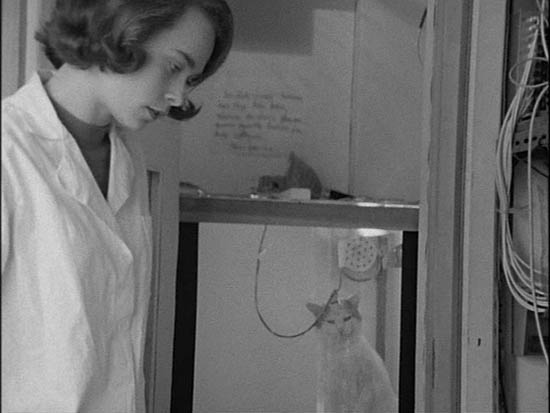
Just a short doc to tell the world that there are female college students, and some of them even study science. Its main reason to exist today is to document mid-60’s Paris hairstyles. Narrated by Vidal from Maud’s.

Foreground: our coed. Background: a cat with a hat in a box.
image

Rohmer on La Collectionneuse in 1977:
“It’s the only film I made that followed the era’s fashion. Audiences loved the new fashions, the long hair, the blue jeans. Then there was Haydée, whom audiences adored. Marcel Carné signed her for his next film right after that.”

He speaks proudly of a conversation scene in the 1976’s The Marquise of O, calling it “tiresome and static” but saying nobody else would have dared film it as written.

“This is a problem that concerns me. In the past, I was drawn by the way people spoke. I’m deeply interested in language. Currently, I find a kind of sloppiness has crept into the French language and I don’t like it very much. I like colloquial language, but today, especially as it’s used in intellectual circles, I find little of interest in it. … That said, I also believe characters in film should speak naturally. I’m getting around this currently by shooting films set in the past. When I return to contemporary films, I don’t know what my position will be. Perhaps by then language will have evolved further. Today’s spoken language is so extremely impoverished that it doesn’t inspire me. You find the same dialogue in every film now.”
image

This will be one to watch again when I know more French, or just when I’ve lived longer.


Chapter 1(a), “Toutes les histoires” (“All the (Hi)stories”)

Dedicated to Mary Meerson (Langlois’s companion who helped run the Cinematheque) and Monica Tegelaar (producer of Raoul Ruiz’s On Top of the Whale).

image

IMDB says parts one and two came out in the late 80’s, and the rest followed in the late 90’s. This one seemed more like a 50-minute trailer than an episode. Montage of archive footage, still and moving, edited and faded and superimposed and blended together. The footage includes scenes from films of course (rules of the game, great dictator, day of wrath, germany year zero) but lots of stills (producers, directors, Thalberg, Hughes) and paintings. Lots of focus on World War II, and ending with that Germany Year Zero segment, the whole thing came off as vaguely depressing. Maybe that’s why it took ten years to get the rest of the episodes made?

Three images overlapped: (1) Rita Hayworth dancing, (2) a drawing of Howard Hughes in his final days, (3) the witch-burning scene in Day of Wrath.


Chapter 1(b), “Une Histoire seule” (“A Single (Hi)story”)

Dedicated to John Cassavetes and Glauber Rocha (Brazilian director of Black God, White Devil).

image

Surprising number of references to Godard’s own films. Tons and tons of stuff I am not getting because I don’t know much French (I pick up half the film titles and some of the short sayings printed onscreen) or art history, and haven’t seen most of the films. Should’ve known better than to think part two would be more straightforward or make more sense. Even if I don’t know what it’s saying, I still get interesting juxtapositions of images and nice shots from great films seen and unseen, which is enough to keep me watching. Sounded like I heard some Leonard Cohen and Neil Diamond.


Chapter 2(a), “Seule le cinema” (“Only Cinema”)

Dedicated to Armand J. Cauliez (a writer, published a book on Jacques Tati) and Santiago Alvarez (Cuban filmmaker).

image

Fast-forward a decade. Same ol’ thing here, but two big changes:

(1) Not just montage of pre-existing footage edited with Godard in his study anymore. An actual actor, Julie Delpy, reading poetry. Also an interview with Godard by another guy (couldn’t be Serge Daney – he died in ’92), 90% untranslated.

(2) Me getting a little tired and pondering making my own historie(s) of cinema instead


Chapter 2(b), “Fatale beauté” (“Deadly Beauty”)

Dedicated to Michele Firk (film writer turned militant radical, killed herself in Guatemala to escape arrest) and Nicole Ladmiral (actress in Bresson’s Diary of a Country Priest).

image

Sabine Azema (above) recits some poetry, much of it untranslated. Godard types at his typewriter some more. I listened in the headphones and a background noise (JLG’s pet bird?) frightened me. Something about photography being invented in black and white as the colors of mourning to note the death of reality. And something about women, and murder, and Band of Outsiders and Rancho Notorious and Gone With The Wind. Good to see that Godard appreciates Tom Waits.


Chapter 3(a), “La Monnaie de l’absolu” (“The Coin of the Absolute”)

Dedicated to Gianni Amico (Italian filmmaker, assistant director on Bertolucci’s Before the Revolution and Godard’s Le Vent d’est & James Agee (film writer, champion of Chaplin’s Monseiur Verdoux, writer of Night of the Hunter and The African Queen)

image

or part 3A, the war and futility episode. WWII talk leads into an appreciation of Italian Neorealism and the most clearly presented introduction to a certain aspect of cinema and history thus far in the series. Says that Italian cinema in the 40’s and 50’s changed film like Manet (the godfather of modern art) changed painting. Closes with a nice montage of Italian film (minus too much onscreen block text and crazed fade transitions) set to a Richard Cocciante song. This episode has a clear point and meaning and narrative arc and supporting arguments… I don’t understand. Maybe the others have too, and I’ve been missing it. Juliette Binoche appears with Alain Cuny (of Les Amants and La Dolce Vita), who died in 1994, four years before this episode aired. Julie Delpy looked mighty young in her segment too – maybe all this footage was shot in the 80’s and not finished editing until ten years later.


Chapter 3(b), “Une Vague Nouvelle” (“A New Wave”)

Dedicated to Frederic C. Froeschel (head of a cine-club in Paris, 1950) and Naum Kleiman (Russian film critic, director of the Moscow Film Museum).

image

“Becker, Rossellini, Melville, Franju, Jacques Demy, Truffaut. You knew them.”
“Yes, they were my friends.”

A personal episode, sometimes celebratory but more usually melancholy. Godard himself is the guest speaker this time, but he’s actually into it, not just distractedly reciting behind his typewriter. These things never quite seem to begin, the opening titles still playing when the episode is half over. Some 400 Blows, some Henri Langlois, more goings-on about the death of cinema. What, is video the new art form?


Chapter 4(a), “Le Côntrole de l’univers” (“The Control of the Universe”)

Dedicated to Michel Delahaye (actor in Out 1, Alphaville, plenty more) and Jean Domarchi (1950’s, 60’s Cahiers critic, had a bit part in Breathless).

image

Another really good one. Probably not coincidentally, all the voiceover on this one is translated, so I was able to understand it. Lots of voiceover – it’s getting to be more of an essay lately and less of a purely visual slideshow. Still plenty of that dull video text, white-on-black block lettering. The thing always drags a little when JLG decides to move those words around the screen for thirty seconds before returning to the film clips. When there were clips, it seems half of them were by Hitchcock, “our century’s greatest creator of forms.”


Chapter 4(b), “Les Signes parmi nous” (“The Signs Among Us”)

Dedicated to Anne-Marie Miéville (one of Godard’s collaborators since 1976) and to Godard himself.

image

I hope nobody stumbles across this entry hoping to learn about the film, because I really doubt I understood most of it. More more more war images in this section (have I mentioned that the film is obsessed with WWII?) and more ponderings on love, death, art, history, man, the state, and Charlie Chaplin. And it seems to me that Godard is terribly depressed. Anyway, here’s a good bit of the voiceover from the last eight minutes:

I need a day to tell the history of a second…
I need an eternity to tell the history of a day.

We can do everything except the history of what we are doing. It is my privilege to film and live in France as an artist. Nothing like a country that every day walks further down the path of its own inexorable decline.

I am the fugitive enemy of our times. The totalitarianism of the present as applied mechanically every day more oppressive on a planetary scale. This faceless tyranny that effaces all faces for the systematic organization of the unified time of the moment. This global, abstract tyranny which I try to oppose from my fleeting point of view. Because I try, because I try in my compositions to show an ear that listens to time. And try to make it heard and to surge into the future.

The only thing that survives from one epoch is the art from it created. No activity can become an art until its proper epoch has ended. Then, this art will disappear. Thus, the art of the 19th century – cinema – made the 20th century exist, which barely existed.

Cinema feared nothing of others or of itself. It wasn’t sheltered from time. It was the shelter of time. Yes, image is happiness. But beside it dwells nothingness. The power of the image is expressed only by invoking nothingness. It is perhaps worth adding: The image, able to negate nothingness, is also the gaze of nothingness on us. The image is light. Nothingness, immensely heavy. The image gleams. Nothingness is that thickness where all is veiled. The most fleeting moments possess an illustrious past. If a man passed through paradise in his dreams and received a flower as proof of passage, and on waking, found this flower in his hand… What is there to say? I was that man.

Thought I’d watch the Cannes 1988 press conference, but after the first three minutes (“video artist” Godard passionately attacking television) it all turns French.

From a belatedly-discovered interview between JLG and J. Rosenbaum:

JR: Yes, but it also isn’t legally acknowledged that films and videos can be criticism.
JLG: It’s the only thing video can be — and should be.

With that strong distinction between film and video, it occurs to me that JLG considers Histoire(s) as being about cinema but not being a work of cinema itself. I watch Breathless on my TV and say I’ve seen one Godard movie, then I watch Histoire(s) on my TV and say I’ve seen two Godard movies. JLG should like to smack me for such a thought.

I don’t know why I didn’t get L’Atalante upon first viewing. Maybe ’twas the low-grade VHS tape I rented, or maybe I was drowsy or impatient, but now I see it’s almost as beautiful and twisted a love story as Sunrise.

Provincial girl marries a barge captain passing through town then finds that spending life on the boat with his two assistants is less excitingly romantic than she’d imagined. Tension mounts between the captain and the gruff-looking but tender Jules leading the girl to flee the ship to see Paris on her own. But she doesn’t fare well and the captain goes into a depression, so Jules goes and finds her for a tearful reunion finale.

Not the fault of the video, I guess, because many shots were out of focus on the 35mm print. Must’ve been rough to do so much location shooting in 1934. So many other gorgeous shots and ideas scattered throughout that it’s easy to overlook technical shortcomings. Movie holds a poetic, dreamy state throughout, and the ending seems deserved despite the captain being kinda unlikeable most of the time.

Jean Dasté got small roles in Jean Renoir films, and many years later, larger roles in Francois Truffaut films. He was also the sympathetic teacher in Zero For Conduct.
image

Dita Parlo appeared in Grand Illusion and didn’t do much acting after the 30’s.
image

Michel Simon was more well-known, starring in The Two of Us, Rene Clair’s Faust, Port of Shadows and at least three by Renoir. Jacques Rivette did a 100-minute Cinéastes de notre temps with him in ’66.
image

Cats are thrown at people from offscreen, an obvious influence on Dario Argento.
image

Happy ending:
image

Zero For Conduct, by contrast, was less anarchic hilarity and slightly more tedious than I remembered it. Still a fun boarding school romp with good characters (the dwarf headmaster, the head-standing supervisor played by Dasté who is on the kids’ side from the start) and great portrayal of repressive school life, friendships and rivalries and minor (and in the end, major) rebellions.

image

image

I watched the above two at Emory on 35mm last November but delayed posting this until now because I wanted to go through the rest of the Artificial Eye DVD.

I dug the Cinéastes de notre temps episode by Jacques Rozier (new-wave filmmaker with Adieu Philippine, also shot some of the stuff on the Contempt DVD and the Cinéastes episode on Bunuel excerpted on the Viridiana DVD). 90 minutes of Vigo stories and interviews with the three L’Atalante leads thirty years later. Michel Simon looks the same, and Dita Parlo is very recognizable when she smiles. Now that I know what Jean Daste looked like in the mid-60’s, I’ll look out for him in The War Is Over. Didn’t realize that Jean Vigo knew Jean Painleve… and Painleve has an indirect connection to Oskar Fischinger.

Not much to say about the two shorts. The Jean Taris doc has some cool photography, but I wouldn’t say it’s worth watching over and over. The Nice doc is more creative, has lots of cool photography, and is definitely worth watching over and over.

Jean Taris, swimming champion:
image

À propos de Nice
image

MAR 20, 2008
————–
Saw on 35mm for the first time. I do not know this movie as well as I think I do… lots of forgotten parts (the town in Iceland buried in ash) and mis-remembered bits. I was grateful to see it projected, but don’t feel that it loses too much on television – gonna keep happily watching the DVD for years to come. If I have a favorite movie right now, this is it.

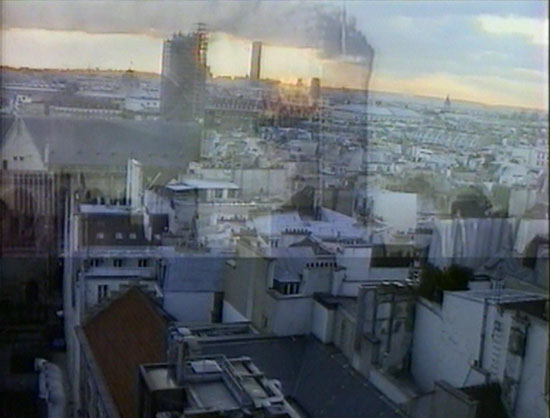
A new favorite line: “At nightfall the megalopolis breaks down into villages, with its country cemeteries in the shadow of banks, with its stations and temples. Each district of Tokyo once again becomes a tidy ingenuous little town, nestling amongst the skyscrapers.” This is the impression I got from some Japanese movies.

Checked out the DVD again and watched some of the extras. The Chris Darke short didn’t teach me much, just strengthened my belief that nearly all video-art installations consist of too-small TV screens in too-large white rooms full of uncomfortable folding chairs.

DEC 30, 2006
————–
A reminder of the attempted Chris Marker Marathon begun in late August. Showed it off to Jimmy & Dawn.

A movie about memory, images, directing and editing, making pictures, turning life into art and vice versa.

“I will have spent my life trying to understand the function of remembering, which is not the opposite of forgetting, but rather its lining. We do not remember, we rewrite memory much as history is rewritten.”

Explanation for the electronically processed images: “He showed me the clashes of the sixties treated by his synthesizer: pictures that are less deceptive he says—with the conviction of a fanatic—than those you see on television. At least they proclaim themselves to be what they are: images, not the portable and compact form of an already inaccessible reality.”

Owls and cats! Digitally processed images. Tarkovsky’s Stalker. Three children on a road in Iceland. Apocalypse Now. Sacred symbols at Macy’s. Teens dancing in the streets. The same scene in Vertigo that Marker references in La Jetee. Kamikaze. An image. A memory. A glance.

Even better than I remembered, and I remembered it as a masterpiece. Such a good documentary that it may not be a documentary at all. The best travelogue ever.

If this site didn’t already exist, I may have felt compelled to create it myself.

Dawn loved it. Jimmy too, I hope?

The Chris Marker Marathon will continue someday. Got some Rivette to watch first, I think.

Jean-Louis is a Catholic engineer with an interest in mathematics and a dislike for Blaise Pascal (the mid-1600’s scientist and philosopher). JL meets up with old long-time-no-see friend Vidal, who takes him out dancing and then to visit Vidal’s friend Maud, a single mother, at her house on Christmas night. The section at Maud’s house must be at least a third of the film’s running time. Vidal is attracted to her, but she’ll have none of that. He gets drunk and finally walks home, Leaving JL to fend for himself. They talk about life, love, religion and Pascal, JL sleeps next to Maud but they only kiss once. The next day JL meets Franciose, a girl he has noticed at church, and makes a date with her, then joins Maud and Vidal out hiking in the snow, talking like comfortable old friends. Another friendly kiss. JL gives Francoise a ride home, stays over at her place (but in a separate room), flash-forward they are married with a kid, he meets Maud, and we find out that Francoise had an affair with Maud’s ex husband, but all is forgiven and the family goes to romp in the surf.

Like a more fleshed-out story of The Bakery Girl of Monceau, but this time the women have histories and personalities, and the bakery girl (or Maud) is much harder to write off. JL has a deeper character than anyone in the first two Moral Tales – Criterion calls him “one of the great conflicted figures of sixties cinema.”

JL and Maud:
image

On the film’s style, Kent Jones says “No one’s films are more ‘written,’ more narrative based, or more logistically tied to particular places and times of year.” True that, an extremely talky picture, and reliant on its snowy seasonal setting. Finely but simply shot in black and white. No real visual or plot excitement, no stylistic heightening of mood or emotion, but a deeply thought-out script and characters evolving before our eyes. This particular week from Christmas to New Year’s is one of the most important in JL’s life, and we see (or hear) his changing and challenged beliefs, principles and decisions, creating the kind of real human complexity very rarely seen in movies.

Came out a decade after its closest (so far) kin in New Wave cinema, The 400 Blows, probably the quietest and most reserved film of 1969, the year of The Gladiators, Mr. Freedom, Topaz, Satyricon and Easy Rider (but to be fair, also the year of Andrei Rublev, Passion of Anna and Army of Shadows). Third of the Six Moral Tales, the last four of which were shot by Néstor Almendros, who also worked with Truffaut and Barbet Schroeder and later shot Days of Heaven.

More Kent Jones:

What are the chances that Jean-Louis and Maud will have a life together? Based on her luck with men and his avowed preference for Catholic blondes, not so great. Based on their immediate affinity for each other, not so small. “You are a happy soul, despite appearances,” observes Maud of Jean-Louis—and the essential rightness of this observation is what makes Rohmer a greater artist than Bertolucci and also points to what gives My Night at Maud’s its special spark and effervescence. … Current fashion would favor Maud as the voice of reason when she tartly dismisses Jean-Louis’ prevarications: “I prefer people who know what they want.” Yet there’s something equally admirable about Jean-Louis’ insistence on adhering to his story and fulfilling his own platonic conception with Françoise, a decidedly unhappy soul. The necessity of choice, the pain of choice: no film is better at illuminating these two ­equally real aspects of living. There are no moments of grace in My Night at Maud’s. … Yet there are intimations of grace in the slow, serpentine movement toward intimacy between Maud and Jean-Louis.

Maud and Vidal:
image

Movie picked up a few screenplay awards, but mostly beaten out by the big political films of the era – Lindsay Anderson’s If… for feature at Cannes, Costa-Gavras Z for foreign film oscar and, ahem, Patton for screenplay oscar.

Vidal – Antoine Vitez (a smallish part in Truffaut’s The Green Room).

Franciose – Marie-Christine Barrault (Queen Gueneviere in Perceval le Gallois, also in Woody Allen’s Stardust Memories)

Maud – Francoise Fabian (the lawyer Lucie in Out 1 and the mother in Secret Defense)

Jean-Louis – Jean-Louis Trintignant, who worked with (in order) Roger Vadim, Jacques Demy, Alain Robbe-Grillet, René Clément, Claude Chabrol, Costa-Gavras, Bertolucci (star of The Conformist), André Téchiné, Kieslowski (Red), and Patrice Chéreau (Those Who Love Me Can Take The Train).

JL and Francoise:
image

An awesome little movie that my memory is already threatening to lose since I watched it right in between two Japanese mind-fucks, Glory to the Filmmaker and Sukiyaki Western Django. This is an English-language documentary by a French filmmaker about two British couples who raised each other’s children after a mix-up at the hospital. One mother knew it, or at least strongly suspected, and constantly fussed over what should be done, tried desperately to stay in contact with the other family, wrote letters to George Bernard Shaw, and so on. Other mother was unconvinced that there was a problem and just carried on. Unexpected end result is that one of the girls grew up twice loved as the other.

Excellent, interesting movie… well-considered storytelling with tons of cool framing tricks and window/mirror effects. All of the people involved gamely play themselves, relaying events and participating in recreations. Listening to them talk, you wouldn’t think these to be the kind of people to go along with a comic sort of retelling of their painful pasts for a foreign camera crew, but thankfully they did. A quirky sort of movie, but in a good way. Each member of the camera crew was shown during the closing credits – I think that’s a first for me.