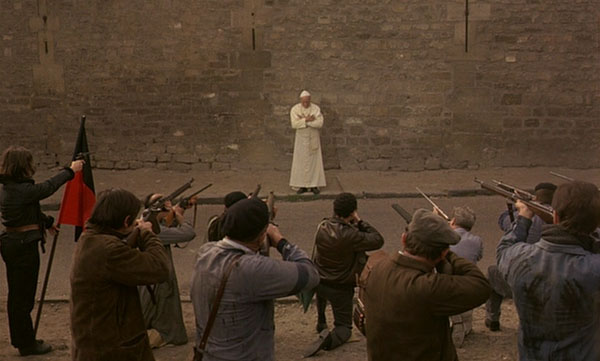
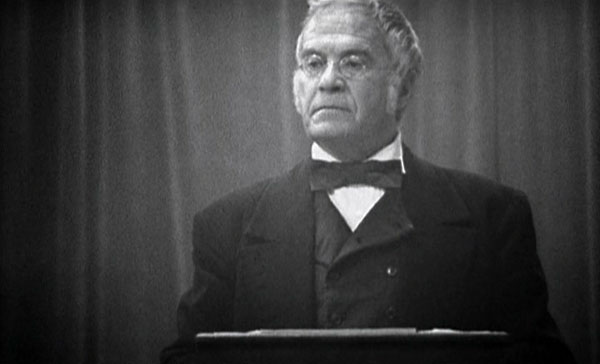
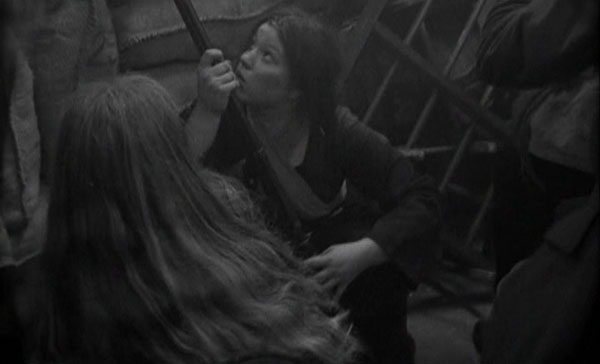
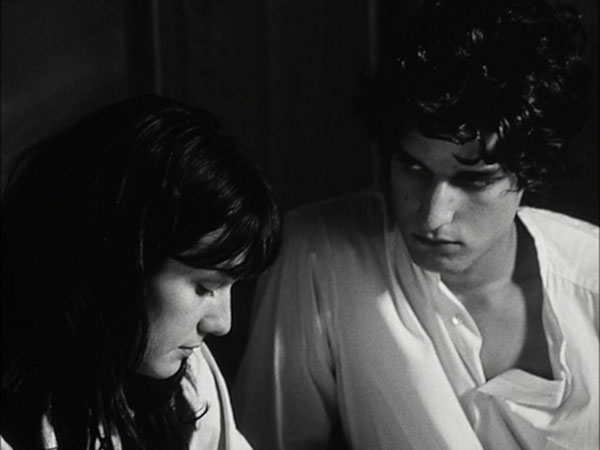
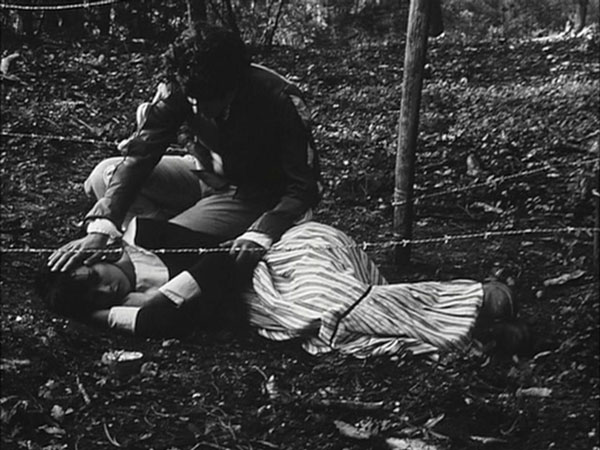
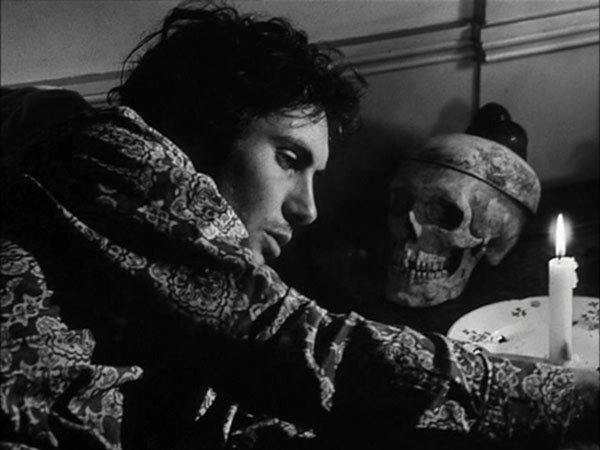
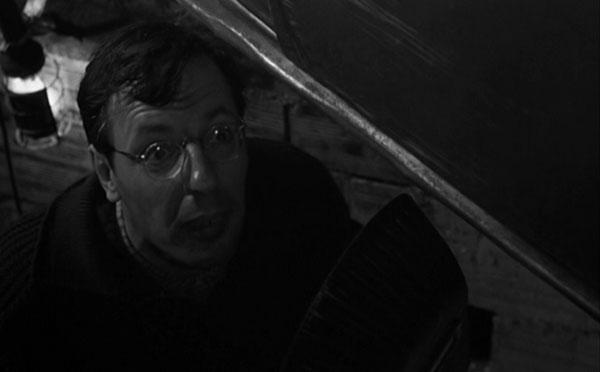
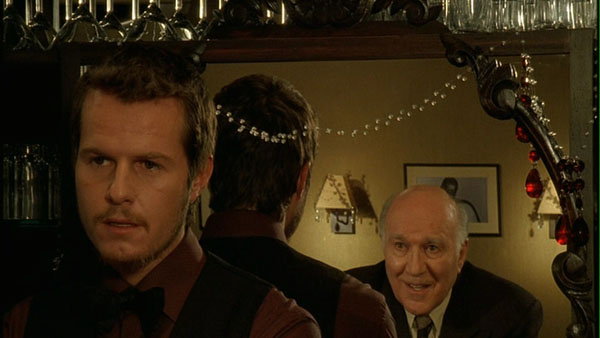
Watched this the same month as Trouble In Paradise, not having guessed how connected the two would be – the book/script of Stavisky even mentions that they stole shot ideas from Paradise. This one seems like a correction to the other, set during the same year with some of the same reference points (such as Trotsky) but here the upper-class gentleman thief is revealed to be a sham, and rather than escaping at the end to start over with his true love, the thief ends up dead, his widow in prison. The final shot is the chauffeur (of the period Rolls they drive everywhere) placing a bouquet of white flowers for her outside the prison.

Bright and lively music by Stephen Sondheim (who had already won three Tony awards in the 70’s) kept the doomed inevitability away until it was too late. Sondheim had already won three Tony awards in the 1970’s by the time Stavisky came out. It’s one of the very few times he’s written music (more than one song, anyway) for films – the other cases were Warren Beatty’s Reds (another movie featuring Trotsky!) and Dick Tracy.

image

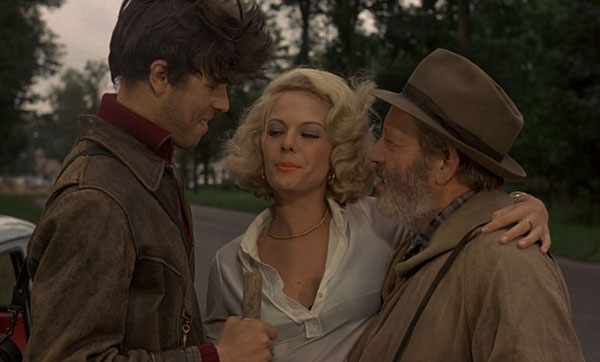
Another story by Jorge Semprún, who wrote the exile-themed The War Is Over. One of Stavisky’s associates (Juan Montalvo, a slimy guy who hits on Arlette but can provide Serge with lots of money) was funding the attempted coup in Spain which led to the Spanish Civil War. In researching the film Semprun found that the same police inspector (named Gardet in the movie) assigned to watch over Leon Trotsky in France was also assigned to report on Stavisky, so Trotsky’s exile was written into the movie, as witnessed by a kid named Michel Grandville. The movie is bookended with Trotsky – first arriving in France, beginning his exile from Russia, and at the end after the Stavisky scandal, being moved further into exile, far from Paris, his political influence feared by the conservatives. Stavisky himself is a Russian Jew in exile – so there are a few connections to the previous film.

The paperback book says it “represents the final scenario” for the shooting of the film, and the intro by Richard Seaver addresses something I had wondered about after reading The War Is Over and believing that Semprun’s script was shot word-for-word with very little added by Resnais: “Once the subject is established, the writer does an initial draft, or treatment, after which writer and director discuss it scene by scene, often line by line, in excruciating detail, until the distinction between writer and director blurs or disappears.” So in fact the books by Semprun represent the collaborative vision of he and Resnais – my beloved auteur is no longer in peril.

The real Serge Alexandre Stavisky was involved in ever-larger finance fraud and was connected with people high up in French government, and when this was made public in January 1934 it led to riots, deaths (incl. the semi-suicide of Stavisky himself), trials for his friends and widow (all acquitted the following year) and political upheaval. Not knowing much about French politics, the Wikipedia articles are hard to follow, but it seems the ultra-conservatives tried to overthrow the leftists in power – eventually one leftist resigned, a conservative replaced him, and somehow socialists ended up in power.

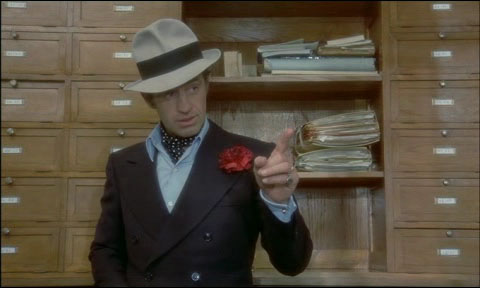
Belmondo, a decade after Pierrot le fou and still looking the same:
image

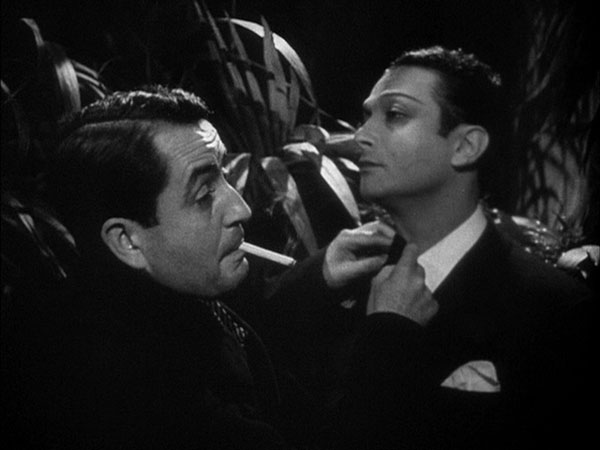
Jean-Paul Belmondo as Stavisky/Alexandre is dazzling, a con-man with absolute confidence in himself. Arlette is his glamorous wife, and he’s surrounded by associates, some complicit in his underhanded dealings like assistant Borelli and Serge’s in-pocket doctor (Michael “Thomas” Lonsdale) who keeps declaring Stavisky unfit to stand trial for a six-year-old fraud offense… and some are just content to spend time with Stavisky, enjoying his company and not asking questions, like friend Baron Raoul (an outstanding Charles Boyer).

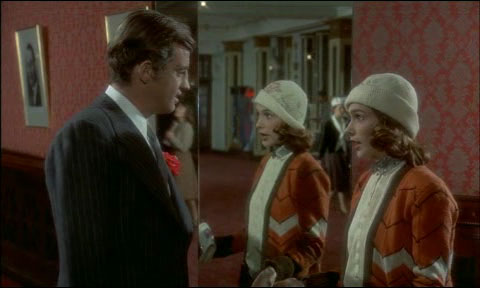
Arlette: Anny Duperey’s debut was seven years earlier in Godard’s Two or Three Things I Know About Her.
image

The book says “Barol Raoul’s looks, gestures, diction and bearing are those one would expect a baron to possess in those films where barons play a part.” That’s hilarious… I hope those are the character notes they gave to Charles Boyer.

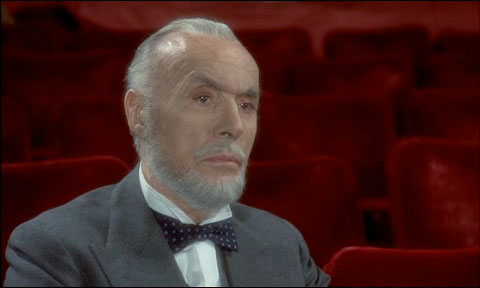
This was French superstar Boyer’s second-to-last film. I saw him as the star of Fritz Lang’s not-so-good Liliom. He is the second actor I’ve seen lately (after Maurice Chevalier) claimed to be the inspiration for Pepe le Pew.
image

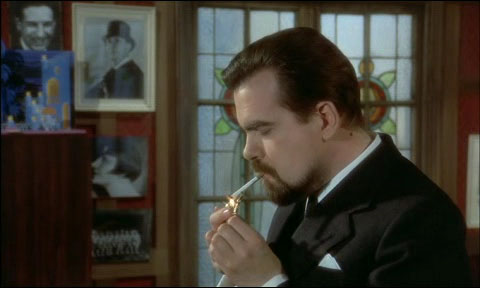
As Stavisky’s right-hand man, beloved character actor Francois Périer of Nights of Cabiria, Orpheus, Le Samourai, also narrated some Chris Marker films. From the book: “Albert Borelli’s face is impassive, but he has a sharp eye. He is a man of few words but not of few thoughts.”
image

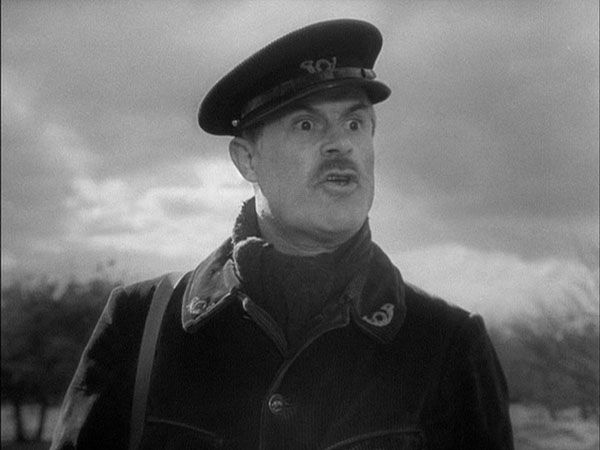
No wonder I had trouble with inspectors Bonny and Boussard – it’s complicated. Boussard arrested Stavisky years ago, and a couple years afterwards Serge became Boussard’s “informant” – actually Serge pays Boussard to keep an eye on things inside the police department, and the informant thing is just a front so they can meet. Bonny has it out for Serge, hires the blackmailer who comes to the theater during auditions to extort money from Stavisky by threatening to expose his past, and later engineers the police raid during which Stavisky shoots himself. Plus I always have to look hard to tell which Inspector is which, since they look and dress the same.

Inspectors Boussard (left, Marcel Cuvelier, also played an inspector in The War Is Over) and Bonny (right, Claude Rich, star of Je t’aime, je t’aime):
image

Bad Boy Bonny:
image

Michel Grandville (Jacques Spiesser of The Man Who Sleeps and Black and White in Color) and Erna Wolfgang (Silvia Badescu), who auditions for a part at Stavisky’s theater (he reads with her, playing a ghost – see quote below):
image

Lonsdale, after “Serge Alexandre” tells him to get rid of Stavisky and his problems: “The person he once was has become someone else: a ghost he despises. But a ghost who worries him.” And later: “To understand Stavisky sometimes you have to forget files. You have to dream of him and to imagine his dreams.”

Dream doctor Michel Lonsdale:
image

Gérard Depardieu got his break as a star just two months earlier. Here he has one scene as an excited young inventor trying to get Stavisky to invest in his product:
image

And back to Erna Wolfgang. I just liked this shot.
image

One more look at Thomas:
image

I wasn’t in love with the movie after I watched it, seemed like a really well-done portrayal of a controversial man with great acting and an over-complicated plot, but reading the book afterwards cleared up all the characters and the structure of the whole thing, and thinking back on the story, acting and photography, I’m now liking this better than The War Is Over. Nobody here is a good guy – not even Bonny, who goes against police corruption but for personal & political reasons – but the movie doesn’t judge them, or go into the details of the scandal. It just gets inside their characters and shows where the scandal came from, how one guy’s belief that he could fake his way into the upper echelon ended up shaking the country.

image

Resnais’s fourth feature, coming out the same year as Rivette’s The Nun. Watched this once before and have practically no memory of it, so this time I read the screenplay then watched again. By doing so, and by watching it alongside the other Resnais films I’ve seen this year, I’m sure I’ll remember and appreciate it more than I did before, but it also makes me wonder about the nature of Resnais’s art, because he has filmed Spanish writer Jorge Semprún’s screenplay word for word and shot for shot. Semprún describes flashback cuts and actors’ facial expressions, and there it is on the screen. The film isn’t as poetic and dreamy as Resnais’ other films of this period, but it definitely fits in with them, has a similar feel, plays like the work of the same artist. The book felt more tense, and the movie felt more melancholy, like a somewhat lighter Army of Shadows.

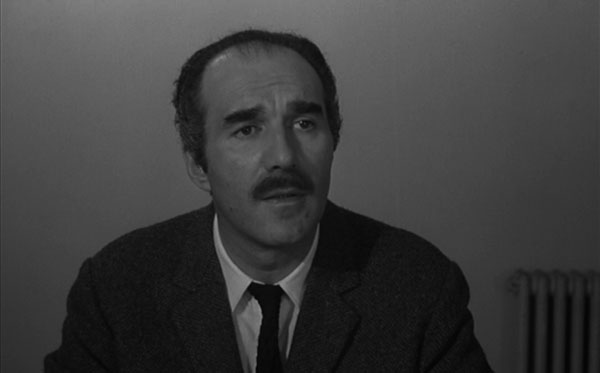
Story takes place across just a couple of days (not counting flashes-backs-and-forward) in Paris suburbs, two weeks before a planned protest and strike in Spain. Diego aka Carlos aka Domingo aka The Passenger (Yves Montand, halfway between his starring roles in Let’s Make Love and Tout va bien) returns from Spain to warn his underground anti-Franco activist organization (led by chief Jean Dasté) about the recent police crackdown in Madrid which led to the arrest of some operatives including one good friend. Diego wants to warn his other friend Juan away from returning to Spain, but Juan is already on his way to Barcelona. Diego was himself detained at the border, his false passport inspected by Customs official Michel Piccoli, which leads to complications later. Diego lives (on the rare occasions when he is back in France) with lover Ingrid Thulin (a Bergman regular who is wonderful in this movie) but he also half-heartedly messes around with a young Geneviève Bujold, daughter of the man whose passport he borrowed and herself a revolutionary, but with a younger group that practices impatient and violent means of returning Spain to her mythical (never existent) past Marxist glory. Diego and his group (incl. pro smuggler Jean Bouise, who later played Warok in Out 1) resent that Spain has become a symbol of the radical left but without any definite progress, that they’ve lost more and more comrades promoting these strikes and protests which are never as widespread or effective as intended. They continue their struggle, workmanlike but without much hope… a tone more fitting (in France) for the mid 70’s than the mid 60’s. Interesting that this came out right when Resnais’s contemporaries were about to turn to politics, then he followed it up with the much less political Je t’aime, je t’aime.

Writer Semprún later adapted screenplays for Costa-Gavras and wrote Stavisky for Resnais. He must be the only non-English speaker to receive TWO oscar nominations for writing. Shot by his regular guy Sacha Vierny with music by Giovanni Fusco, an Antonioni regular who died of a heart attack in May ’68.

The movie is called “stylistically orthodox” and “one of his most accessible films.” It’s not reportage-style realism, just straight drama, which never feels heightened by technique even though there are some signature smooth tracking shots and the love scene with Bujold is downright expressionist. I found the look and the camerawork to be more Muriel than Je t’aime, but of course the editing is completely unlike either of those.

Time Out: “Perhaps it is the film’s directness and obviously dated aspects (middle-age male angst faced with effervescent feminine adoration having become such a staple ‘art movie’ subject) that have made it seem a minor item in an often challenging director’s career.”

Harvard: “A series of premonitions told in flash-forward near the film’s conclusion make powerful statements about memory and aspiration, commitment and faith.”

A. Agarwal: “The film ends in inevitability. Thulin, the mistress whose devotion sometimes makes Montand uncomfortable yet at peace with himself, learns Montand is going to be sucked into a trap, and she starts out to let him know and save him from crossing into Spain. The film ends here, yet there’s a shadow of death over it. Either Thulin will not be able to save Montand, or she will be able to save him and Montand will quit this life and spend the remaining part of it trying to make peace with himself and his country.”

Michel Piccoli
image

Jean Daste
image

Warok
image

Genevieve Bujold
image

Thulin & Montand
image

image

“It’s in my style as homage to Bunuel’s style which is very different.”

Very spare, a couple talky dialogue scenes but mostly quiet, with pillow shots of Paris at night between scenes. Opening titles at the symphony, Husson spies Severine, out to the street, to a bar. Her hotel, a near miss. Back to the bar, Husson confesses what’s on his mind to the bartender – this scene must contain over half the dialogue of the film. Another chance meeting on the street, an invitation to dinner. At dinner Severine wants to know one thing, but Husson plays around, doesn’t tell her. She storms out. A chicken! He pays the servers from her forgotten purse, they clean up after he has left.

Piccoli (right) with the director’s grandson Ricardo Trêpa
image

Bulle Ogier also acted in Bunuel’s Discreet Charm
image

Piccoli, reprising his Belle De Jour role, was in a pile of other Bunuel films
image

N.D. Carlson of Cineaste has a compelling explanation for every part of the film: why it works and what it means… a wonderful analysis.

Sam, as usual, sees something I don’t see, even when I’m seeing what he saw, since it was his favorite narrative film of the year.

M. Dargis calls it “an act of critical violence.”

J. Rosenbaum calls it a “sequel-or tribute, or speculative footnote … more about class and less about sexual desire”

M. Piccoli: “Very often, cinema is indecent. What characterizes Manoel de Oliveira and Bunuel is their reserve. But don’t get me wrong: this reserve allows them to explore the most secret gardens of our existence. They are very modest but very immodest when it comes to shaking the imagination of the audience.”

image

“Why sometimes do images begin to tremble?”

From the film:

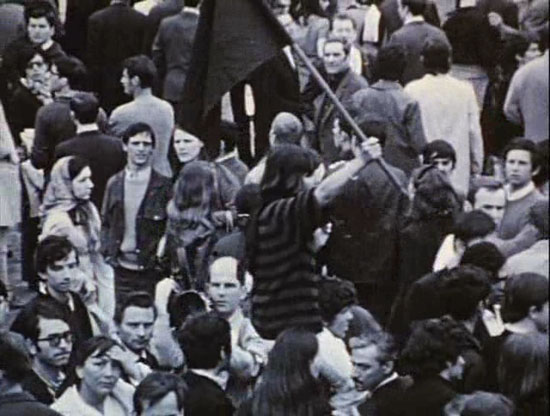
1967 saw the arrival of a rather peculiar breed of adolescents. They all looked alike. They would immediately recognize each other. They seemed to posses a silent but absolute knowledge of certain issues but to be totally ignorant about others. Their hands were unbelievable skillful at pasting up posters, handing paving stones, spraying on walls short and cryptic messages which stuck in the memory, all the while calling for more hands to pass on the message they’d received but had not completely deciphered. Those fragile hands have left us the mark of their fragility. Once they even wrote it on a banner. “The workers will take the flag of struggle from the fragile hands of the students.” But that was the following year.
image

Watched the 3-hour 2008 edit with English narration. There are so many versions of this out there… maybe next time I can watch the 2008 or 1977 French with subtitles.

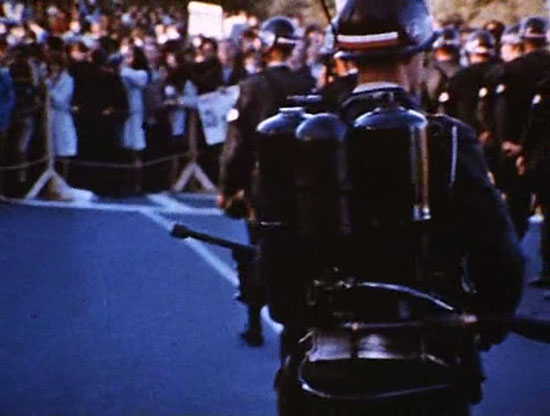
I thought I’d have more to say about it… three hours’ worth of Chris Marker’s most celebrated film, but I don’t really. Marker is mainly credited as an editor here, arranging others’ footage to show a bigger picture. There’s no wall-to-wall narration, just pops up occasionally. And I’m starting to notice a real sadness beneath many of Marker’s films… the same feeling in Chats Perches is present here. Glad I prepped a little by watching Sixth Side of the Pentagon and Battle of Chile, but I still had to check on wikipedia to see what exactly happened in Bolivia (Che Guevara killed Oct. 1967) and Prague (Jan-Aug 1968, attempted reform of Czech socialism led to 30 years of Soviet military occupation). The movie isn’t here to teach basic history of revolution – assumes you know something already, and since I quit reading The People’s History of the United States before it reached the 1900’s, I do not. Still, was able to follow the movie, thought lots of the footage was excellent, enjoyed watching and learned a little. Some segments have little gems of Marker wit in their editing or narration, but much of it is making connections between different scenes of revolution, both real and wishful, and thinking about what has been achieved, what might have been achieved. Really have to watch again sometime.
image

Either this was an early use of the electronic soundtracks that Marker would use in Sans Soleil and beyond, or the sound on my copy of the movie was pretty badly distorted. Or, more likely, both. The sound got worse during part two – there were some sections when I couldn’t make out any of the (English) dialogue.

image

Video and audio footage by: Pierre Lhomme (Mother and the Whore, Le Joli Mai, Army of Shadows), Etienne Becker (The Spiral, Le Joli Mai, Malle’s Calcutta), Michele Ray (Latcho Drom), Francois Reichenbach and his crew, Harald & Harrick Maury (The Owl’s Legacy, Day For Night, In the Year of the Pig), Théo Robichet (Band of Outsiders), Pierre Dupouey (Silence… on tourne), Raymond Adam (Jodorowsky’s Tusk), Paul Bourron of the Dziga Vertov Group, Willy Kurant (Far From Vietnam, Masculin-Feminin, Pootie Tang), Peter Kassovitz (Jakob the Liar), Paul Seban (Welles’s The Trial), Michel Fano (Rivette’s The Nun), Fernand Moskovitz (Last Tango in Paris), Yann Le Masson (Je t’aime moi non plus), Mario Marret & Carlos de los Llanos (À bientôt, j’espère), Jimmy Glasberg (Sans Soleil, Shoah), Robert Dianoux (Africa, I Will Fleece You), Jean Boffety (Thieves Like Us, Je t’aime je t’aime, Adieu Philippine), Robert Destanque (Joris Ivens’s The Threatening Sky), Hiroko Govaers (Terayama’s Fruits of Passion), Michel Cenet (Celine and Julie Go Boating), and an excerpt from Volker Schlöndorff’s The Lost Honor of Katharina Blum. That is quite a list of collaborators, though you never hear anyone talking about them.

image

English voices: Jim Broadbent (Brazil), Cyril Cusack (Fahrenheit 451), Robert Kramer (dir. Ice, Against Oblivion), Alfred Lynch (The Hill), and numerous British 1970’s TV actors.

“You can never tell what you might be filming.”

Quotes and other reactions:

Icarus Films calls it an “epic film-essay on the worldwide political wars of the 60’s and 70’s: Vietnam, Bolivia, May ’68, Prague, Chile, and the fate of the New Left.”
image

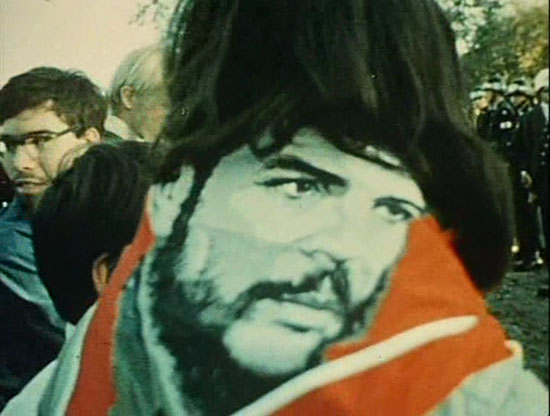
J. Hoberman: “Marker begins by evoking Battleship Potemkin, and although hardly agitprop, A Grin Without a Cat is in that tradition—a montage film with a mass hero. Unlike Eisenstein, however, Marker isn’t out to invent historical truth so much as to look for it. (The untranslatable French title, Le Fond de l’air est rouge, is a play on words suggesting that revolution was in the air but not on the ground.)”

Paul Arthur: “In its rhythms and editing structures, Grin tries to embody the very shape and textures of historical transformation, rendering the abstraction of change as an amalgam of rapid, plurivocal, uneven, and, at times, contradictory forces aligned in provisional symmetries encompassing past, present and future perspectives.”

image

Y. Meranda: “The editing de-emphasizes the narrative structure and instead stresses the poetical interrelationships of the sequences by putting almost all of them out-of-context. … Paralleling the visual editing, the sound editing is more based on poetical considerations than on intellectual ones. … Because there is very little attention paid to the intellectual arguments and because the style goes beyond making statements about a political ideology, A Grin Without a Cat becomes much more than a left wing documentary about the left: It achieves to be a poem about revolting against the system (and not just the political system), the conformity and the order. It suggests that it is an eternal struggle that is supposed to fail (as was in the case of the New Left) most of the times. This universality, achieved by Marker’s distinctive style, is what makes the film great.”

image

Excerpts from the Lupton book:

“Marker explicitly pitched the film against what he saw as the historical amnesia surrounding the period promoted by its treatment on television, where ‘one event is swept away by another, living ideals are replaced by cold facts, and it all finally descends into collective oblivion.'”

Movie is partially composed of outtakes from other projects. “Introducing the published script, Marker wrote that he had become curious about all the material that had been left out of militant films in order to obtain an idealogically ‘correct’ image, and now wondered if these abandoned fragments might not yield up the essential matter of history better than the completed films.”

“As a groundbreaking work of visual historiography, Le Fond attempts nothing less than to give cinematic form to the chaotic and contradictory movement of world history during the tumultuous decade that it covers.”

“The reappearance of cats, even in this thoroughly politicized context, is a signal that Chris Marker was beginning to re-emerge from the anonymity of unsigned militant productions and to reintroduce into his work the familiar tokens of his own distinct presence.”

image

Chris Marker:

Scenes of the third World War 1967-1977

Some think the third World War will be set off by a nuclear missile. For me, that’s the way it will end. In the meantime, the figures of an intricate game are developing, a game whose de-coding will give historians of the future – if they are still around – a very hard time.

A weird game. Its rules change as the match evolves. To start with, the super powers’ rivalry transforms itself not only into a Holy Alliance of the Rich against the Poor, but also into a selective co-elimination of Revolutionary Vanguards, wherever bombs would endanger sources of raw materials. As well as into the manipulation of these vanguards to pursue goals that are not their own.

During the last ten years, some groups of forces (often more instinctive than organized) have been trying to play the game themselves – even if they knocked over the pieces. Wherever they tried, they failed. Nevertheless, it’s been their being that has the most profoundly transformed politics in our time. This film intends to show some of the steps of this transformation.

More images:

image

image

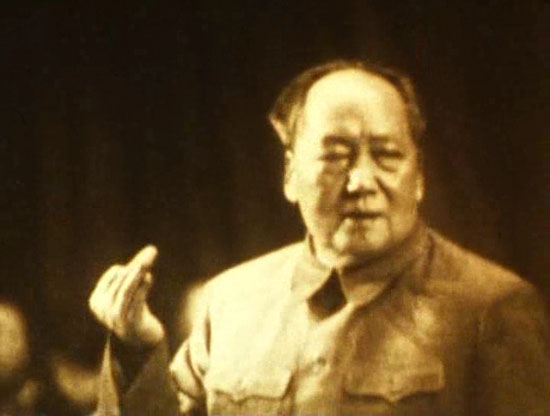
The Chairman:
image

Funeral in Prague:
image

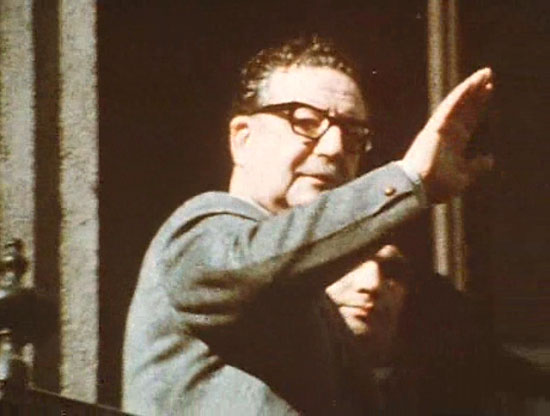
Last footage ever shot of Salvador Allende:
image

Allende’s daughter, who would commit suicide in 1977:
image

Fidel in Russia:
image

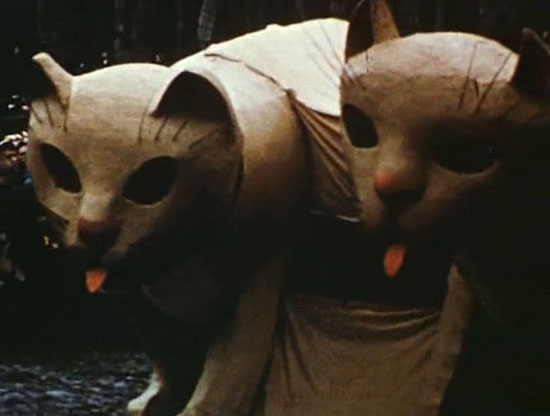
Enormous cats (no owls):
image

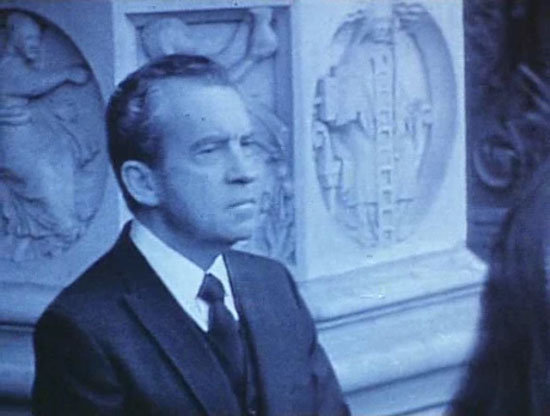
Nixon looks on:
image

My third feature by the celebrated Hou. I only half enjoyed/understood the other two, Goodbye South, Goodbye and Flowers of Shanghai, both seen on video, but I appreciated his short The Electric Princess Picture House. So I didn’t know what to think going into this, and neither did anyone, probably, seeing how it’s in French and a semi-remake of a 30-minute children’s classic. Hou’s pacing seems more suited to the big screen than home viewing, so I’m glad it played the Landmark, and Jimmy and I (who saw The Red Balloon together in the same theater earlier this year) both enjoyed it.

Juliette Binoche is a harried puppeteer mother, Simon Iteanu is her son, Hippolyte Girardot (Lady Chatterley, La Moustache) is the downstairs neighbor, and Fang Song is the kid’s new nanny. Song is an aspiring filmmaker with a handicam who loves the film The Red Balloon. Bleach-haired Binoche once worked as an au pair, feels abandoned by her husband, wants to kick out her downstairs neighbor so her older daughter can visit this summer (but can’t find the lease contract), and does marvelous voices for the Chinese puppet show she is directing. Simon seems like a happy kid, takes piano lessons, plays pinball, has a loving relationship with his absent older sister (seen in flashback, she cancels her annual summer trip to Paris late in the movie).

Then there’s the balloon. Simon sees it at the beginning and it follows him on the subway, then to his home and on a class field trip. Song sees it at one point, also… but neither of them ever touches it. It may just be a symbol of imagination, and not a real balloon at all. The camera moves slowly, fluidly, always seeming to hover balloon-like instead of resting, and blobs of red (clothing hanging to dry, a lamp) are often hanging in the frame when the balloon itself is absent.

Just as I was noticing the long length of the shots, a bus with a large Children of Men advertisement drove by – nice. Shot by the cinematographer of most Hou films, Pin Bing Lee, who also did In The Mood For Love with Chris Doyle. Score is light piano music (all staticky on our print), and it closes with the Bobby McFerrin-sounding song from the trailer.

None of these descriptions do justice to the film, which I’m starting to think is one of the few great films I’ve seen this year. Peaceful and calming to watch despite being set mostly in a cluttered, loud, claustrophobic apartment, there’s just enough story/character/action to play upon every emotion in the book without leaning too hard on any of them, leaving me feeling like I’ve experienced & felt so much within such a minimal framework. The characters aren’t desperate, but they don’t have an easy time either. One review described Binoche as a mother under siege, and with all that’s going on around him, Simon’s childhood is under siege too. But even while portraying conflict, the movie manages to ooze joy – so much joy that it’s put a major dent in my plans to watch all the commerce-driven Hollywood product out this summer. How could The Incredible Hulk compare?

A different kind of movie than the other Marker works I’ve seen. Really this is what I’d been waiting for: the politically-engaged street filmmaking of the 60’s and 70’s combined with the travelogue gaze and personal essay style (with distancing commentary) of Sans Soleil. Didn’t fill me with joy like most of Marker’s movies do, however… more contemplative and sadder, takes more time to think about each section and let them all sink in. Uses public artwork of cats to weave from Sept. 11th reactions to political situations in France to the death and imprisonment of friends and entertainers in such a way that, like Sans Soleil, I don’t realize what the film is about until I watch it again. Two versions of the film… first time I played it with English narration, then a couple weeks later I ran the French version with live sound and no narration, just scattered intertitles. Shockingly (since I usually love Marker’s narrations) I liked the second way better. But then, I got more out of it having just seen the English version. So I’d recommend both as a double-feature!
image

Quotes below are from the English commentary.

Opens with a flash mob in Paris. People mill around opening and closing umbrellas, to music from Alfred Hitchcock Presents.
image

November 2001 Paris. September 2001 New York.
image

Cats on a roof, on buildings high and low, hidden in a tree.
image

The metro, a bridge, signs of Paris from long ago. Presidential election at the end of year… the left is split, so the far-right candidate Le Pen comes close to challenging the incumbent Chirac, who is defensively re-elected after protests in the streets against Le Pen.
image

“Let’s face it: these girls with their war paint are lovely, but the fascist legions are not besieging our gates. And if Le Pen is a dictator, it’s mainly against his own people. Yet what we see here coming onstage is an entire generation that was spoken of as being apolitical.”
image

More about the cat, appearing in the evening news and all over the internet.
image

March 19th, Bush (backed by Blair) declares war on Iraq, but UN inspectors find no weapons. More street protests in Paris, but as with the American protests of the time, they’ve splintered into hundreds of mini-demonstrations. “Why should the streets of Paris be less chaotic than the rest of the world.”
image

The plundering of Iraqi museums in April, a “die-in” for the victims of AIDS in June. “In these times, we the people gathered to watch eleven billionaires kicking a ball. What about the French team? Stalinesque-sized posters, as we had never seen the like of in Paris – and not one goal recorded.” More about street demonstrations with “a certain fuzziness in the symbols.” “It’s a great asset in life, not to know what you’re talking about. Marker follows political and popular developments with great interest but without total enthusiasm, removed from it all. Seems like he’s either saying “it’s nice that they’re trying, but their struggles are shadows of the struggles I lived through” or “this is what I was once like, with the same futility and wasted energy.”
image

Sees a personal friend (below) in a street crowd, then records news footage relaying that friend’s death at age 79 soon afterwards. Flashback to 1999, at a concert benefitting a cause that same activist friend had supported, Marker had filmed a young singer, who five years later had become famous for accidentally killing his actress girlfriend. “And you wonder why the Cats abandon us?”
image

What if they left us for good?”
‘We were the Freedom Cats. If you didn’t catch the message, just move on!’
And then – comes a sign.
The same unknown hand has painted circles of Cats on the sidewalk, to watch over our sleep.
Thank you, Cats.
We will badly need you…
…wherever we go.

image

This film is dedicated to M. Chat and those who, like him, are creating a new culture.
image

Embassy, 1973
When I first watched Embassy in February, I didn’t like it very much, and never dreamed I’d be watching it again in three months on a commercial U.S. DVD… but here we are! Nice of First Run/Icarus to release it, but it would’ve been even nicer to provide a translation for the opening titles that claim the film was found in an embassy. Maybe it’s mentioned in the packaging. Anyway, clearer image for this not-clear-at-all film, and after watching The Battle of Chile this one is making more sense, since I know what Marker was reacting to. It’s still never gonna be a favorite film, but it’s a cool idea to make something that immediate as a reaction to current events.

image

image

image

The Sixth Side of the Pentagon, 1967
Filmed during “World War III: Vietnam, Bolivia, Israel” on October 15-16, 1967, a recording of the anti-war march on the Pentagon in which Abbie Hoffman and the Yippies participated. Marker gets to combine his budding obsession with anti-authoritarian political protest with his love for filming faces of people on the street. One of his most famous images was in here – an angry man shouting, his head covered in blood – I always thought that was from Grin Without a Cat. Co-director François Reichenbach would later act as cinematographer and producer on F For Fake.

image

image

image

image

image

image

Vive la baleine [Long Live The Whale], 1972
A short film about and against industrialized whale-hunting using mostly illustrations with some archive footage, saving the gruesome modern footage for the last few minutes.

Petit bestiare
Cats and owls! In and out of zoos, off and on pianos. Bullfight and the reminder that these animals are behind bars bring a touch of darkness to otherwise straightforward set of nice animal shorts.

I am pleased to say that the movie never quite dives into gritty, depressing realism. It seems like it will… I mean, the second scene is set in a horrible homeless shelter with our hero lying half dead on the floor, his leg smashed after a car ran over it, being dragged unconscious into the showers by the shelter’s other miserable-looking occupants. But forty minutes later he is motoring down the Seine towing Juliette Binoche on waterskiis, surrounded by fireworks in what must’ve been one of the most exuberant film sequences of the decade. When he’s sick of it, he throws away his crutch and in the next scene his cast is gone too. The movie reminds us of real-world problems but its heroes are above them… homeless, sick, injured, lonely, hungry, fighting with each other, but never so bad that the next scene can’t fix everything.

Guy with the busted leg is Alex, resourceful homeless guy who lives on the under-construction bridge with his scary mentor Hans (who dispenses whatever drug Alex needs to sleep at night). Binoche is heartbroken Michelle who was a painter before she started going blind and ran away from her treatment. After they fall in love, Alex rebels when he hears that a search is on to find and cure Michelle, preferring her to be dependent on his care. But she finds out and gets the cure, while he inadvertently lights a guy on fire and goes to jail for a couple years. Very romantic-comedy-like, they make a date to meet on Christmas on the repaired bridge and end up together. Sounds dreadfully obvious, and it does get a bit indie-film-cutesy, but the love story and the ballsy storytelling pulled me right in… loved the movie.

Binoche was nominated for a best actress Cesar, but running against Emmanuelle Beart for La Belle noiseuse and Irene Jacob for Double Life of Veronique, the “brave young actress in awesome art film” vote was split, and the award went to elder Jeanne Moreau for a comedy I’ve never heard of. But up against a completely different group of actresses, Binoche took the European Film Award that year. Denis Lavant, also star of Carax’s Bad Blood and Denis’s Beau travail, unsurprisingly (because he’s funny-lookin’) later appeared in A Very Long Engagement. Hans was Klaus-Michael Grüber, previously a director for television, who has appeared in nothing else.

image

Learned some stuff on other sites. Everyone wants to talk about the movie’s huge spiraling budget as Carax, unable to use the bridge itself, built a new bridge (and the surrounding buildings!) over a lake for a movie set. And everyone wants to talk about the movie being a flop upon release in theaters. And Americans want to gripe about the nine-year-delayed release to theaters here. And everyone makes a point of mentioning that Leos Carax is a made-up name, but I only saw one mention that the character Alex is a stand-in for the director (real name Alex), who was dating Juliette Binoche while this was in production. Also found plenty of comparisons to other films:

Titanic – for the ending (“king of the world” bit on the barge), fact that it’s a super-expensive movie but plot is a simple two-person love story.

One From The Heart – for the romantic tone, but mostly for the huge, awesomely expensive artificial set created for the movie, and the subsequent damage to the director’s career after the movie was not well-received.

City Lights – blind girl, in love with a homeless man, regains her sight at the end. Clearly an influence on the story.

L’Atalante – ahh, there’s the one Carax probably had in mind. Protagonists are poor but resourceful, in love but in a rocky relationship, joined by a moody father-figure old man, end up together on a barge. Perfect.

So I’ve shown Katy two post-9/11 movies with downer endings in a row, and now I realize that I was about to show her a third. Unintentional, but can’t be a coincidence. Current theory is that 9/11 hit in the middle of my exploding cinephilia and I was angry that nobody wanted to talk about it in film, so the few films that dared to discuss it stuck in my mind… and it’s been about five years since I’ve seen ’em, the perfect amount of time to watch them again? Does that make sense?

Malkovich is still deliciously distracting as the captain. I’d forgotten how BUNUELIAN the whole thing seems. From one ancient landmark to another, having slightly unreal meetings and conversations with people along the way, then a huge narrative jump and we’re at dinner with the captain and his famous friends, then another dinner conversation, this time with the mother and child, Malkovich standing the whole time, a song in Greek, then terrorist attack!

A very unusual movie. I kinda love it, but never quite knew what to make of it. I remember this M. Dargis piece:

As the two stop at ports from France to Turkey, the film takes the shape of a genial history lesson, one that grows progressively darker when you realize the message Mr. Oliveira has been delivering alongside all the seemingly benign tourist shots. The film begins, rather prophetically, with the image of people waving goodbye. … As they stand in the shadow of the Acropolis, Maria Joana wonders, “What did people do here?” Her mother replies, “They worshipped their gods.” In a sense, who those gods were and what they meant is at the center of “A Talking Picture,” which takes the measure of Western civilization for good and for ill. Although the mother-and-daughter exchanges purposely recall the discourses that once echoed throughout the Acropolis, their sightseeing also has the flavor of everyday life. … The metaphor of privileged tourists blithely afloat on a luxury ship – and embarked on a circle tour of that crime scene known as Europe and its colonial-era environs, no less – is at once blunt and brilliant. In both its intellectual reach and the elegant simplicity of its form, “A Talking Picture” bears resemblance to Andrei Sokurov’s “Russian Ark.” … this is the only film I can think of that, in the aftermath of Sept. 11, has so directly addressed the war on liberal democracies. Maybe it takes an angry old man who can cede the sins of the West without also sacrificing its ideals.

N. Vera:

On one hand it’s a young girl’s education on the world and its ways; on the other it’s a meditation by three godlike women (godlike for their high status in the film and higher status in world cinema), representing at least two of the most prominent cultures in Europe, holding forth on their views of love, life, and human history.

France and Italy are, if not the most prominent, easily the most graceful of European powers (odd–or maybe not–that Germany, Britain, and Spain are not mentioned); both countries owe much of what they are to Greece, a fact Helena points out, lamenting at the same time the subsequent loss of status of her country (French, Italian and especially English are spoken everywhere; Greek is spoken mostly in Greece, and at most as borrowed words in other languages). America, the single biggest Western power in the 20th and 21st centuries, is represented by a fawning buffoon of a captain (played with selfless enthusiasm by Malkovich)–who is, it must be noted, Polish (all Americans except the natives are, of course, immigrants). Portugal as represented by mother and child is invited to the table, but the invitation is politely refused (the mother capitulates on the second offer, which included a gift of a lovely little Muslim doll to the child). France, Italy, Greece together at a table with the party hosted by America, and Portugal a reluctant but desired guest.

What’s missing from the table and from much of the picture, of course, is the true (truer, anyway) cradle of humanity, basis of much of even Greek civilization, the Middle East. Iraq, Iran, Syria, Egypt among others are not represented, and while Egypt’s monuments are shown and discussed, they’re discussed not by an Egyptian but by a Portugese. The silence is overwhelming; we hear secondhand about Muslim civilizations, usually as it relates to and clashes with Western civilizations (the Hagia Sophia, Napoleon visiting the pyramids, the Arabs burning the library at Alexandria (a historically disputed event)). Suddenly the Middle East speaks out (or at least we assume it’s from the Mid-East–Oliveira leaves even this ambiguous), in the form of a ship’s officer with an urgent message, and the entire ship is forced to react to a neglected culture’s startling response.

In an article by Z. Campbell, he says the film “is often if not exclusively interpreted as a conservative lament,” but he praises Oliveira’s other works and says “This is an artist concerned with, among other things, the representation of unrepresentable experiences the source of which exists in some unspoken spaces of social structure (hospitality, companionship, family ties, tradition).”

The mother, Leonor Silveira, has appeared in just about every Oliveira film I’ve heard of. Captain Malkovich will be in the next movies by the Coens and Clint Eastwood and also a thriller about vampire mutants. French entrepreneur Catherine Deneuve was in a few Raoul Ruiz movies I’ve gotta see. Greek singer/actress Irene Papas starred in Costa-Gavras’ Z and previously The Guns of Navarone. Italian model Stefania Sandrelli was in a bunch of Bertolucci movies including a starring role in The Conformist.

The box art takes the one looking-into-camera close-up of Leonor Silveira and nests it inside the one shot where she is dwarfed by the monuments she visits. A nice idea, but then of course it’s cluttered up with titles and floating heads of the other stars.