Not really a horror movie, more of a John Dies at the End supernatural comedy with a ton more sex and even less of a point. Nympho Jennifer has a surplus of clits, reclusive dude Batz has “a drug-addicted dick with a mind of its own.” Will these two meet and find true love? Yes… well, not really, since nobody survives the ending.

More shocktastic details: she tends to have babies a few hours after sex, and leaves them everywhere. She also tends to kill her partners, and is a pro photographer celebrated for double-exposed photos of her victims. His penis finally wanders off without him via stop-motion, its perspective shot as a purple-tinted fish-eye as it tears through a condo building filled with hot naked women.

Co-written/produced/featuring rapper R.A. The Rugged Man. Nice to see an aging white filmmaker connecting with youth culture of today, even if the results are so mixed. I’ve seen Frank’s Basket Case and Brain Damage, but not Frankenhooker, which is probably the key reference point.

“Celebrities are not people. They’re group hallucinations.”

I wanted to double-feature this with a Jennifer Chamber Lynch movie, the children of my favorite horror filmmakers, but couldn’t get a copy of Boxing Helena in time so I settled for the Xan Cassavetes instead. Pretty sure that even if I hadn’t known the Cronenberg connection I’d have been able to spot it: a total body-horror flick with a cool and clinical atmosphere. Plus someone says “shivers” within the first five minutes, and lead actor Caleb Landry Jones even reminded me of Cosmopolis star Robert Pattinson.

Speaking of Pattinson, the movie is about a future where the public’s hunger for celebrities has become literal, buying lunchmeat grown from the stars’ cells and getting themselves sickened by viruses that come from the stars’ bloodstreams. I think the movie is acknowledging that this is farfetched by having the virus thing be a premium specialty business (no huge lines out the door) run by a small staff of technicians also acting as salesmen.

Caleb is magnetic as Syd, whose celeb-virus business contracts exclusively with star Hannah Geist, and who is always trying to turn a buck in black-market virus sales while trying to get close to Geist himself. The black-market aspect already brings mystery to the movie before the new twist where Syd has injected himself with Geist’s newest illness, which kills her – or so the story goes, but really she’s being kept alive while people in the Geist business fake her death while trying to figure out the poison plot and deal with the leak perpetrated by Syd. Really it’s more complicated than this, and either I missed some information or the big picture is never fully revealed, while Syd ends up where he wanted to be, selling Geist by day and having (parts of) her to himself by night.

Plus: viral copy-protection hacking, viruses represented with blurred, manipulated photographs, man-machine-fusing nightmares (and realities), and doctor Malcolm McDowell.

Took a couple weeks off the blog, now back to the SHOCKtober backlog. Got a new visual theme to support larger images (and incidentally phones/tables/etc) so beginning with this post, screenshots are no longer limited to 640px wide. Party!

After enjoying The Tenant, I decided to rewatch the rest of Polanski’s “apartment trilogy:” this and Repulsion, both of which I’d seen on cable so long ago that I may as well have never seen them at all before now. Obviously these movies were the highlight of Shocktober this year, alongside Hellraiser, Scanners and Possession. After not paying him much attention until 2011, I’m a big Polanski fan. All three apartment movies have terrific peephole shots, and this and Repulsion both have a dream sequence in which a ticking clock is the only sound. I found out in the extras that Polanski threw off the lipsynch in another dream sequence on purpose – I’d been annoyed at the technical flaw but he meant it to add to the unreal atmosphere.

Omaha native Rosemary (Mia Farrow) and husband Guy (John Cassavetes, same year as Faces) shop for an NYC apartment with realtor Elisha Cook (Phantom Lady, The Killing), settle on a place with nosy neighbors whose previous tenant passed away just a few days before. Mia’s first friend (Victoria Vetri, Playmate of the Month right before this filmed) jumps to her death soon after they move in. Already this is sounding like The Tenant, but instead of the new tenants going slowly insane, aspiring actor Guy makes a deal with the intrusive Castevet couple next door to have his wife impregnated with the antichrist.

Collateral damage: the suicide woman, who it’s assumed was meant to be the demon child’s host before Rosemary came along, Hutch, the couple’s best friend before the whole demon pregnancy thing (Maurice Evans, a lead ape the same year in Planet of the Apes), Guy’s competition for a major acting role (he goes inexplicably blind). I think Rosemary’s doctor, the great Charles Grodin (as opposed to the doc the Castevets choose for her, Ralph Bellamy of The Wolf Man), is allowed to live.

Even without the demon baby, moving in next door to the Castevets seems like horror movie material – this may be what led to The Tenant. Paradoxically, the crazy Castevets also keep the mood light, injecting humor into the horror. Ruth Gordon won an oscar (beating the star of Cassavetes Faces), would star in Harold and Maude a few years later, and Sidney Blackmer played Leslie Nielsen’s dad in Tammy and the Bachelor. The ending is intense, though – Rosemary discovering the whole conspiracy, walks into a room with her demon baby, her traitor husband and a bunch of revelers yelling “hail Satan,” and instead of hurling herself out the window or burning the place to the ground, she approaches the cradle and starts to rock it gently.

Polanski’s first American film after Repulsion and two others in England. There was a sequel! It starred Pontypool‘s Stephen McHattie as the demon kid now in his twenties, with Patty Duke and Ray Milland. Mia Farrow starred in Secret Ceremony, another disappearing child/hysterical mom movie the same year as Rosemary’s.

Author Ira Levin in 2003:

Lately, I’ve had a new worry. The success of Rosemary’s Baby inspired Exorcists and Omens and lots of et ceteras. Two generations of youngsters have grown to adulthood watching depictions of Satan as a living reality. Here’s what I worry about now: if I hadn’t pursued an idea for a suspense novel almost forty years ago, would there be quite as many religious fundamentalists around today?

Catherine Deneuve is pretty and timid, a bit spacey, but nobody suspects (except possibly her older sister Helen, if she has ever paid that much attention) the extent of her psychosis until Helen goes on vacation with her awful boyfriend Michael (Ian Hendry, philandering zombie in Tales from the Crypt), leaving Catherine alone in their apartment with her thoughts. It turns out her thoughts are dangerous.

Maybe this is just a 1960’s thing, but when Catherine finally starts murdering people (first her stalker who thinks she’s in a relationship, then her landlord who offers an alternate method of paying the rent), I felt they were creeps who deserved it. But it seems from the extras that the movie just wants us to believe that Catherine is mad (and has always been mad, according to the final zoom into a childhood photo where she looks distracted/possessed).

A stylistic triumph on a tiny budget. Polanski’s follow-up to Knife in the Water and his UK debut, bankrolled by porn producers who would work with him again for Cul-de-sac. This one was written as the commercial hit that would fund the next one, a more personal work for Polanski. It’s lovely that slow-moving one-woman psychological horror with unproven stars (Deneuve had done Umbrellas of Cherbourg but wasn’t yet internationally renowned) used to be considered a sure hit.

Michael: John Fraser of Tunes of Glory

and Helen: Yvonne Furneaux, of La Dolce Vita

When Catherine is alone, the walls crack and ooze, rapist ghosts appear, hands grab her through the walls (a Cocteau-meets-Cronenberg effect using latex sheets bought from a condom factory). Polanski already showed a strong visual style with Knife in the Water, and here he’s got a ringer of a cinematographer: Gilbert Taylor had just shot A Hard Day’s Night and Dr. Strangelove. The film won a silver bear in Berlin alongside Le Bonheur (Alphaville got the gold).

Someday I’d like to visit Italy and see if everyone acts the way they do in Argento films, moving all artificially and speaking poor dialogue out-of-sync with their mouths. Probably it’s just a very bad movie. And that’s not even counting the fact that it’s about a rape investigator (played by Argento’s daughter) who gets repeatedly raped (she’s also a cop who repeatedly gets her gun stolen), then it justifies this in the second half by having her become the killer. “He forced his way into me and now I can’t get rid of him.” Worse, I’m not even sure why I watched this. I’d previously read up on Argento and decided which movies might be worth watching (just the ones I’ve seen plus Crystal Plumage, Grey Velvet and Opera), and Stendhal Syndrome was not on the list. Maybe I put it on the netflix blu-queue as a placeholder? Anyway at least the picture on the disc looked fantastic.

The earliest Asia Argento I’ve seen, two years before New Rose Hotel. After being kidnapped and raped the first time she acts prickly towards a creep coworker (Marco Leonardi, love interest Pedro in Like Water For Chocolate) who is relentlessly trying to date her, starts seeing a psychologist (Paolo Bonacelli of Salo, one of the few films more icky than this one), and eventually returns to her stress-inducing family (to relax, haha), where she’s followed by both creep Marco and blood-obsessed rapist Thomas Kretschmann (Argento’s Dracula, also in Queen Margot with Asia).

Then she kills the rapist but keeps insisting he’s still alive, as she carries on his work, taking out the psychologist, her new French boyfriend Marie (a boy with a girl’s name as the movie continually mentions), Marco and a couple others.

Moo Orleans:

And by the way, Asia has the Stendhal Syndrome, which causes you to become entranced by works of art, but the movie doesn’t know what to do with this, plot-wise. It combines well-staged practical effects with the worst computer graphics I’ve ever seen, which is used with Fight Club excess (why, when she swallows pills, must we follow them down her throat?). It’s not just 1996 CGI – it’s Italian 1996 CGI. The movie has story problems (a half hour in, it’s already explaining its first scenes in flashback), missed opportunities (Marco brings Buster Keaton videos to a girl who imagines herself falling into paintings, but we get no Sherlock Jr. clip) and the unsurmountable flaw of having no recognizable human behavior. After reading that interview about invisible acting in The Dirties, and watching well-performed horrors like Hellraiser and The Tenant, this is especially disappointing. At least I could enjoy the paintings, the cinematography and the blatant Vertigo references.

Asia takes up painting:

Things I remembered while going through screenshots: (1) Asia gets amnesia between passing out at the art gallery and being raped by the loony, (2) she kisses a fish in a dream sequence, which looks like the romantic opposite of the zombie-vs-shark scene in Zombi 2, (3) she sees graffiti come alive in the loony’s lair, (4) her dad is freaky.

Asia loves fish:

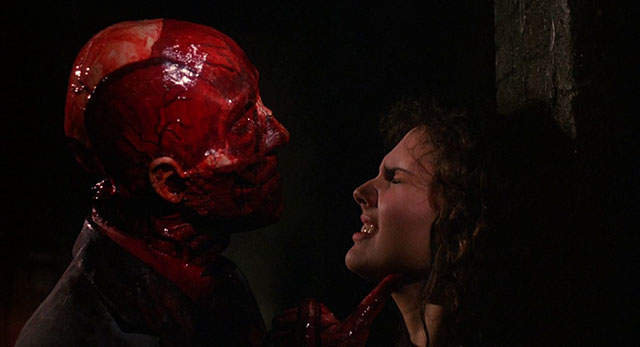
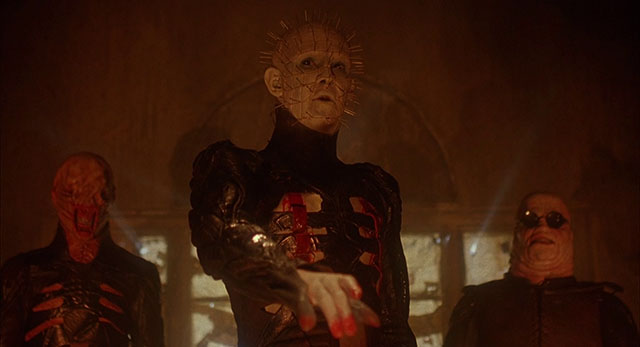
First time I’ve watched this in HD.

Larry: Andrew Robinson, a regular on Deep Space Nine, formerly a soap opera star, bad guy in Dirty Harry, also in Pumpkinhead 2 and Child’s Play 3

Julia: Clare Higgins, apparently I missed her in season 3 of Downton Abbey

Kirsty: Ashley Laurence returned in three sequels, including Hellseeker which I don’t remember too well, also in a Lovecraft movie called Lurking Fear with Jeffrey Combs

Frank: Sean Chapman was in Barker’s Transmutations, and much later a Charisma Carpenter movie called Psychosis

Besides playing Pinhead, Doug Bradley has been in Pumpkinhead 3 and Proteus, and appeared in Nightbreed with two other cenobites.

Clive always claims to have a bunch of movies in development, but nothing has come out since the burst of originals in 2006-2009: Dread, Book of Blood, Midnight Meat Train and two (not great) Masters of Horror episodes.

Oh this was awful! The worst, slowest, MST3K-worthy British (“made in Hollywood USA,” the end titles promise, but trust me) “horror” movie, back when horror meant anything out of the ordinary. And yeah the movie turns out to be about a 200-year-old frog who is lord of a castle, and that ain’t a bad concept, but nobody dies except the frog (one old woman is frightened, and a younger woman screams!) and nothing happens for the first 75 minutes except rich British people speak slowly and properly and act put out by things. Oh, and someone is menaced by an even worse rubber bat than the one in Black Sunday.

Also: the maze isn’t even really important.

Giant frog suicide:

Unwelcome houseguests:

Richard Carlson (of The Ghost Breakers and It Came From Outer Space) is to marry Veronica Hurst (a small part in Peeping Tom) but his uncle dies and Carlson disappears to tend to the family castle. Hurst arrives with her insufferable relative Katherine Emery (Isle of the Dead), and they worry for over an hour then invite some friends who worry more, then Hurst gets out of her room and sees the frog and it jumps to its death and the couple who’ve shown no affection for each other can finally get married. The second-to-last feature by Menzies, who made Things to Come in better days, adapted from a novel by Daniel Ullman (writer of a hundred westerns). I was surprised to see that a 3D version exists, since dull people worrying aloud in 3D is no more thrilling than in 2D.

Carlson conspicuously reading his teratology guide:

Narrator Emery begins the movie centered in-frame but her chair slowly sinks. Here she is at her lowest, pleased as punch after the giant frog suicide:

Everyone in a Poe adaptation is weak, white and willowy, and it’s expected that at least one of them will die of consumptive illness, as did Poe’s own wife, as we learned in the D.W. Griffith bio-pic. Here it’s Usher’s wife (played by Marguerite “wife of Abel” Gance), but not for a while. First, portrait-painting-obsessed Usher (Jean Debucourt, decades later the jeweler in Madame de…) has his “dear and only friend” over for the season, then mostly tends to his paintings (which move and blink) while his wife dies (shades of Dorian Gray).

I love how this silent film portrays music. Everything starts moving in slow-motion until Usher plays his guitar, then his playing is illustrated with quick cutaways to nature shots. Overall lots of camera movement for 1928, with crazy angles and ghostly superimpositions – a slow and moody film. Excellent looking except for the fake castle (in wide shots) and owl.

This is the third House of Usher movie on the blog after the Watson & Webber and the Ken Russell, but the first to tell the Poe story in a way I can follow. IMDB says assistant director Luis Bunuel quit over liberties taken with the adaptation. In the Poe story Madeline is his twin sister instead of his wife, but otherwise doesn’t seem too dissimilar. Epstein made this the year before his amazing Finis Terrae.

Ed Gonzalez in Slant:

The film’s tour-de-force is a hulking funeral procession of overlapping visual textures and animal-like camera movement, a startling vision of metaphysical passage and metamorphosis. With the castle’s dripping candles in ominous tow, the men proceed through land and water toward the netherworld of Usher’s catacombs, with Madeleine’s veil weighing them down like an arm digging into the ground; all the while, an owl keeps ominous watch and two toads get their groove on. Madeleine will not go gently into this sinister night, nor will Usher let her, insisting that her coffin remain unnailed, which, in effect, precipitates a supernatural spill between worlds.

“He used to think he was John Luke Truffaut”

My second super-stylish vampire love-affair flick this year after Only Lovers Left Alive. Also my second Cassavetes movie this Shocktober (see also: Rosemary’s Baby). Xan, daughter of John & Gena, appeared in Husbands at age 4. Sleek, sexy movie with great rumbly music, surprisingly shot by the DP of Momma’s Man.

This is more the standard vampire love-affair setup than the Jarmusch movie, though they both have a destructive sister character who shows up halfway through the story. Juna (Josephine de la Baume of Listen Up Philip) meets Paolo (Milo Ventimiglia, Stallone’s son in Rocky Balboa) at the video store and tries to warn him that she’s a vampire, but he’s into that, so she turns him and they move in together. She teaches him to hunt deer, but her sister Mimi (Roxane Mesquida, Fat Girl‘s older sister) starts killing every person living nearby (including, presumably, Paolo’s literary agent Michael Rapaport), bringing outside attention that concerns head vamp Xenia (Anna Mouglalis of Merci pour le Chocolat and Garrel’s Jealousy). Nobody directly stops Mimi, but she stays out too late and the housekeeper decides not to drag her inside before the sun comes out.

I love their widescreen house: