Two more sections from the amazing-looking Lumière blu-ray:

Chap 3: Enfances

La Petite fille et son chat (1900)

A horrific film introducing early filmmakers to the problem of making movies with animals. The action is a girl in a preposterous hat hand-feeding a hungry cat, but the cat loses interest halfway, ditches the film and has to be thrown back into frame. The girl’s a much better sport – in the second half you can see the cat clawing her arm, but she continues to act through the pain, pushing further back in her seat in case the animal goes for her eyes next.


Premiers pas de bébé (year unknown)

Kid in wind-inflated clown clothes walks unsteadily down the sidewalk, then falls down – a comedy or a tragedy, depending whether you like kids.


Pêche aux poissons rouges (1895)

Mustache man works hard to get a kid in a diaper-hat to reach for the fish, which she does occasionally in between trying to keep a steady foothold and trying to pull the whole thing over – kind of a failed attempt at a filmed action, but maybe film was super expensive so they released it anyhow.


Petit frère et petite sÅ“ur (1897)

Boy and girl swing in circles until they fall down, what fun. The film hasn’t run out yet, so he picks her up and they start again, with the girl shooting a “what? I thought we were finished” look into camera.


Enfant pêchant des crevettes (1896)

Kids in increasingly ridiculous hats skim the water with shrimp nets while their parents hover nearby.


Le goûter des bébés (1897)

Two girls at either ends of a table while young Casanova sits in between feeding them grapes. According to google, the title translates as The Taste of Babies.


Baignade en mer (1895)

Older kids dressed as escaped convicts jump off a rickety diving board into the sea.
I’ve seen some of these before (and taken the exact same screenshots).


Enfants jouant aux billes (1896)

A game of marbles, at an unfollowable distance even in this beautiful HD edition. The dirty kids in their adorable period garb are still worth watching, though.


Défilé de voitures de bébés à la pouponnière de Paris (1897)

Long train of nannies with babies in buggies.


Chapter 4: La France Qui Travaille

Ateliers de La Ciotat (1899)

What is happening? Spinning gears and flywheels, as workmen carry large things about.


Chaudière (1896)

Men climb down a ladder, then remove the ladder. What is that thing? Ah, English title is Loading a Boiler, not so thrilling.


Ouvriers réparant un trottoir en bitume (1897)

Spreading what looks like black tar on the ground – looks hot and miserable.


Défournage du Coke (1896)

I’ve seen this one a bunch of times, and it’s fascinating… super-hot coal residue, sliding slowly out from whatever contraption this is, one guy hosing it down, others hesitantly attacking it with poles, finally increasing the pole action towards the end.


Laveuses sur la rivière (1896)

There was a laundry shed for ladies along the river. Nicely framed shot – my favorite part is the men standing lazily above watching the laundry get done.


Transport d’une tourelle par un attelage de 60 chevaux (1896)

Sixty horses towing a massive whiskey barrel (or a turret, acc. to google translate). This film has a cut, because obviously the Lumières wanted to see the line of the horses then the giant object wheeling into view but a supervisor holds the line, so it seems they stopped shooting until it resumed.


Pêche aux sardines (1896)

Untangling fish from the net, which goes slowly because the fishermen keep turning around to look at the camera.


Les pompiers I: passage des pompes (1896)

So cool, horse-drawn firetruck passing through, as street traffic moves aside for them.


Attelage d’un camion (1896)

More horse-pulling action, this time a smaller team than a few films ago, pulling a less interesting load (concrete blocks).

I was going to watch more of these, loaded a Borzage thing and a Lubitsch thing on the laptop, but for months I haven’t felt like continuing, so I’m pulling the trigger.

His Wedding Night (1917 Roscoe Arbuckle)

Roscoe is a soda jerk who also keeps an eye on the perfume counter and gas pump. Gags about Al St. John trying to steal his girl, Buster Keaton delivering a wedding dress, and Roscoe putting chloroform in a perfume bottle to prevent customers from over-sampling the expensive stuff all come together magically in the end. Arbuckle’s a strong dude, picks up romantic rival Al and hurls him across a room. Arbuckle also sexually harasses a woman and a donkey, and pretty quickly learns to use his chloroform bottle for evil. Very nearly cinema’s first gay marriage before Keaton is unmasked.

Modeling:


The Rough House (1917, Roscoe Arbuckle)

A psychotic chef (Fuzzy St. John), hapless grocery delivery boy (Keaton) and an idiot manchild (Arbuckle) destroy a house. Then the chef is fired and Arbuckle is the new chef. Friends are invited to dinner, one is a thief, cops arrive, many people fall down, and the house is pretty much destroyed again. Main value to be found in this pile of randomly-edited violence is Arbuckle’s dancing dinner rolls, apparently stolen (and perfected) by Chaplin for The Gold Rush.


Dreamy Dud. He Resolves Not to Smoke (1915, Wallace Carlson)

Finally I am watching the movie with the greatest title of all time, and it’s a bit of a let-down… pretty much a tame Rarebit Fiend episode with a pipe-smoking boy and his pervert dog, full of horrible slang.

Urban Dictionary is conflicted about what this might mean:

The Exquisite Corpus (2015 Peter Tscherkassky)

More exquisite, sensorial film manipulations from the great Tscherkassky, this time with lots of nudity. And as always with his films, I had to watch it twice, and it’s completely incredible.

M. Sicinski:

The film’s odd mismatches of erotic styles and tendencies (70s Eurotrash, early stag loops, bucolic nudist films, hardcore porn, surprisingly genuine-looking lesbian expression) ultimately comprise some kind of whole. Tscherkassky never employs technique to put pornography at arm’s length. Indeed, in some ways his experimental treatment of the material actually heightens its capacity to titillate. Indeed, the sheer visual excess of bodies on film produces a highly singular new “film body,” a sort of structuralist orgy.

Tscherkassky in Cinema Scope: “My approach was to show the naked body of cinema. So it made sense to use films whose main goal was to show the human body.”

I never really have a fixed image of what the film is going to look like. It’s always about time. Time to study the footage and then learn it by heart, so it seeps into your memory and there it sits and waits for the ideas to come. The second aspect is the production time itself, when you sit in the darkroom, exposing your individual frames – frame by frame by frame – and that takes a lot of time, time during which the film grows. Time to memorize, to remember something completely differently than how you thought about it three years ago. That’s the beauty of my way, my style of filmmaking.

There’s a famous Roland Barthes quotation that the erotic takes place where the woven textile has ripped. You look inside of something that is not meant to be seen. I wanted to move from straight porn and transform it into something that might fit this Barthes quotation.


Watched a few, scattered animated shorts over the last couple months – since I didn’t have anything to pair with The Exquisite Corpus, here’s a round-up of those.

Harvie Krumpet (2003, Adam Elliot)

One night nobody felt like watching a full-length movie so I weirded them out with this instead. Harvie is a unique stop-motion guy, not so bright but armed with rules and bits of wisdom, like your Forrest Gumps and your Chance The Gardeners. And like those movies, this one won an oscar (impressively beating both Boundin’ and Destino). The award is well-deserved – it’s a bittersweet narrative of a vividly drawn, damaged character who ends up happily nude at a bus stop. “He knew it would never come, but… he didn’t mind.” I still haven’t watched Elliot’s feature Mary and Max, but now I’m more likely to.


The Danish Poet (2006, Torill Kove)

We liked Kove’s Me and My Moulton, so it was time to find her earlier oscar winner. And it’s just wonderful. Maybe not as visually stylized as the follow-up (can’t remember for sure), but a beautifully designed movie both in its visuals and story (a roundabout telling of how the narrator’s parents first met). Narrated by Liv Ullmann – another indie(?) short that beat both Pixar (Lifted) and Disney (The Little Match Girl) at the oscars.


Black Soul (2000, Martine Chartrand)

Beautiful paint on glass technique shows a mother taking her son through stories of black history, which are mostly nightmarish. Chartrand studied in Russia with Alexander Petrov, won the top prize for shorts in Berlin with this film.


Triangle (1994, Erica Russell)

Nude line-drawing dancers are interrupted by black-cloaked triangle person and a red ninja square. The dancers grow more and less abstract, combining and separating, the force of the triangle warping the very frame of the movie, until it settles as a happy, sexy threesome. Lovely work – every frame a painting, as they say. Oscar-nominated against The Monk and the Fish and Bob’s Birthday. Russell is from New Zealand and South Africa, and created a “dance trilogy” with this film in between Feet of Song (1988) and Soma (2001).


Snop / Candy (1991, Jan Konings)

Meaningless reminiscing about the popularity of candy when the narrator was young, with below-average animation. From a blu-ray of Norwegian animation that I suppose I won’t be running out to buy.


Protege (2000, Levni Yilmaz)

Drawing paper shot from the other side as the pencil finishes drawing each panel, just like The Mystery of Picasso, but with a monotone voiceover guy explaining his history of imitating people he thought cooler than himself. Cute, and I suppose it technically counts as animation. Since I don’t have the book this disc came with, I’m not sure if this short predates Lev’s long-running Tales of Mere Existence youtube series, or if it’s part of it.


Toy Story That Time Forgot (2014, Steve Purcell)

Another toy story is always nice but this is more of the same ol’ thing. Bonnie from part three is on a post-Christmas playdate at a spoiled boy’s house, neglecting his complete set of some fantasy war toy collection to play a VR videogame, and our gang discovers that the war creatures haven’t yet figured out that they’re toys. Reptilius Maximus (Kevin McKidd) and tree ornament Angel Kitty probably won’t make it to the next theatrical sequel. Purcell is credited as a writer/director of Brave, and with animation on some 1990 video games (Loom and Monkey Island, wow).

Watching shorts from the Flicker Alley blu-ray, part four.

Film that Rises to the Surface of Clarified Butter (1968 Owen Land)

Repetitive little piece in which people draw a character, then it comes to brief stop-motion life, then they ponder this, then it happens again with a constant, quiet burbling horror of a soundtrack. Not as much fun as I’m making it sound.


Our Lady of the Sphere (1969 Lawrence Jordan)

I was rather dismissive of this last time but I’m starting to find its variety of techniques and combinations of images and cutouts from old-time illustrations pretty charming. It’s certainly a funnier and more imaginative way to spend nine minutes than the last movie was. “Jordan orchestrates the film in terms of a rake’s progress” say the liners, but I couldn’t make out much of a story (though I could identify recurring characters, at least).

Mouseover to hit the bear:
image

Mouseover to BZZZZZZT the donkey:
image


DL2 (1970 Lawrence Janiak)

Differently colored patterns fill the screen to varying degrees, from starfields to spaghetti-o’s to shower-curtain dots to bright silly-string and confetti parties, all created by organically Begotten-ing strips of film. Chiming, percussive soundtrack. Hypnotic and strangely relaxing to watch, though next time maybe play my own music.


Love It, Leave It (1970 Tom Palazzolo)

Speech from a car show plays over a nudist festival. Speech honoring the military plays over clowns. Then the soundtrack goes into a hypno-loop of “love it, love it, love it, leave it” under images of contemporary America (sports and recreation, demonstrations and celebrations, people and get-togethers and riot police), the sound finally mutating into a patriotic song layered over itself like that remix I made of the Brave trailer. The liners say he had a “sharp eye for Americana,” true. And the last page of Cinema Scope #66 points out where more Palazzolo films can be found, if I get into an Americana mood later.


Transport (1970 Amy Greenfield)

One of those dance shorts where the camera moves with the dancers, only the movements here are not too exciting – small group of people lifting each other across a dirty field. And the sound is completely unbearable, a series of horrible tones like the ones they play in movies after a bomb goes off to indicate tinnitus in the lead character. Also, two minutes of opening credits in a six minute movie?


Sappho & Jerry, Parts 1-3 (1977 Bruce Posner)

Early film by one of the anthology project’s many film restorationists. Three two-minute pieces where Bruce takes existing film elements, combines, mutates and split-screens the living hell out of them, adding more simultaneous frames in each ensuing chapter. Great fun.

Part 1:

Part 2:

Part 3:


Ch’an (1983 Francis Lee)

Pans, zooms and crossfades of black and white watercolors, with some short bursts of animation. Nice texture closeups of the watercolor work. I preferred Lee’s 1941 from earlier on the disc (these are his first and last films).


Seasons… (2002 Solomon & Brakhage)

Gorgeous variety of textures and patterns, colors and rhythms. “Intentionally silent” doesn’t fly with me, so I played the second half of the new David Grubbs album, which I would highly recommend. If I understand correctly, Brakhage did the textures and patterns, and Solomon did the lighting and coloring? Bravo to both.

I dig this frame because it looks like a dragon crashing into an aerial antenna:

Watching shorts from the Flicker Alley blu-ray, part three.

Abstronic (1952 Bute & Nemeth)

Animation based around electronic imagery from oscilloscopes, set to two catchy tunes. What the future looks like.


Bells of Atlantis (1952 Ian Hugo)

Very abstract imagery. You can often tell he’s filming real objects (woman in hammock) but it’s been blue-filtered and overlaid with patterns to appear underwater. Pulsing and whooping electronic sounds by the Barron couple, visual effects by Len Lye and narration by Anaïs Nin – it’s a pretty cool movie, not a favorite, but made by remarkable collaborators.


Eaux d’artifice (1953 Kenneth Anger)

Seen this before. The imagery is supposed to be erotic but I always end up pondering fountain design and mechanics.


Evolution (1954 Jim Davis)

Wild, almost organic light patterns
Cellophane reflections give an electric glow.
Shifting light blobs that look like colored liquid being pressed under glass.


Gyromorphosis (1954 Hy Hirsh)

Hirsh filmed segments of a sculpture with colored lights and overlaid them spiraling around and inside each other. The result is spindly bits, lines and grids and spokes, all spinning in air like the visual representation of an Autechre song (it’s actually accompanied by some light chiming jazz).


Hurry, Hurry! (1957 Marie Menken)

Wriggling sperms behind a sheet of flames, set to battlefield sound effects covered in horrific scratching. Not nearly as much fun as her similarly-titled Go! Go! Go!. The liners say Menken was “physically imposing” and her relationship with her poet husband inspired Who’s Afraid of Virginia Woolf, which sounds just awful. Don’t I have a documentary about her somewhere?


NY, NY (1957 Francis Thompson)

Kaleidoscope-refracted fly-eyed process shots of NYC, with synched Disneyish orchestral music by Gene Forrell. An absolute stunner – maybe the best find of this collection. Film Quarterly reveals that Thompson worked on perfecting it for a decade, screening it at MOMA to “a thunderous ovation” in 1952, but still reworking it for five more years.


Castro Street (1966 Bruce Baillie)

Similar to the last film in a way: abstract-ish view of a city that ends up involving construction workers and transportation. Great sound layering on this one. I guess from watching Baillie’s Here I Am and Valentin de las Sierras I assumed he was less avant-garde and more a documentarian of the underclass.

Sitney:

Baillie occasionally uses slightly distorted images of the trains and the railroad yard with prismatic colors around the border of distinct shapes. He also uses images which were recorded by an improperly threaded camera so that they appear to jump or waver up and down on the screen.

Lucy Fischer, from an astounding 9-page analysis in Film Quarterly:

Castro Street is, above all else, a film of hyperbolic superimposition; from beginning to end it creates a uniform texture of densely enmeshed imagery … Rather than create a sense of superimposed images in dialectical conflict, Baillie works against this to create a sense of coherent union … As Baillie has phrased it in relation to Quick Billy, his matting strategy is one of overlaying imagery so that it “looks like it was all invented or occurring at the same moment.”


9 Variations on a Dance Theme (1966 Hilary Harris)

Dancer in a bare room does a short routine, then again from a different angle. When he starts with the extreme closeups, editing between angles and camera movements to match the dancer’s motions it gets really great. The liners: “informed by his notions of kinesthetics, in which images are structured around movement with the camera in constant motion.”

E. Callenbach in Film Quarterly:

The dancing is cool and straight, by a girl who wears long woolies and never bats an eye; she is not being Modern and not trying to express her soul, but doing a curious ritual action with its own internal logic and rhythm. Watching her is like watching a musician play; it has an immense technical interest as well as the delights of motion.

Watching shorts from the Flicker Alley blu-ray, part two.

Tarantella (1940 Bute & Nemeth)

Abstract designs move in time to music, a la An Optical Poem and some of the Len Lye films. Bold and colorful.

Lewis Jacobs in Film Quarterly:

At first glance, the Bute-Nemeth pictures seemed like an echo of the former German pioneer, Oscar Fischinger, one of the first to experiment with the problems of abstract motion and sound. Actually, they were variations on Fischinger’s method, but less rigid in their patterns and choice of objects, tactile in their forms; more sensuous in their use of light and color rhythms, more concerned with the problems of depth, more concerned with music complimenting rather than corresponding to the visuals … Fischinger worked with two-dimensional animated drawings; Bute and Nemeth used any three-dimensional substance at hand: ping-pong balls, paper cutouts, sculptured models, cellophane, rhinestones, buttons, all the odds and ends picked up at the five and ten cent store. Fischinger used flat lighting on flat surfaces; Bute and Nemeth employed ingenious lighting and camera effects by shooting through long-focus lenses, prisms, distorting mirrors, ice cubes, etc.


Pursuit of Happiness (1940 Rudy Burckhardt)

These NYC mini-docs keep getting better. This one is mostly focused on people and advertisements. Towards the end, Rudy goes nuts in the editing, rotating and slowing and superimposing and splitting images. “Intentionally silent,” which I cannot abide, so I played some Cyro Baptista.


1941 (1941 Francis Lee)

Flowing paint and broken glass, an abstract visual response to the bombing of Pearl Harbor made just before the filmmaker went to war.


Meshes of the Afternoon (1943 Maya Deren)

This is the best. Cocteau-like death-dream narrative from every perspective, with doubling, mirror-faces, slo-mo – all the effects used to great poetic purpose. Wrote (a bit) more here.

Deren:

This film is concerned with the interior experiences of an individual. It does not record an event which could be witnessed by other persons. Rather, it reproduces the way in which the subconscious of an individual will develop, interpret and elaborate an apparently simple and casual incident into a critical emotional experience.


Meditation on Violence (1948 Maya Deren)

A man practicing wutang and shaolin moves to flute music. Drums are added, and completely take over the soundtrack as the man warps to an outdoor setting with a sword and costume. A few token slo-mo and freeze shots then he’s back indoors. Apparently it’s much more complex than it looks and Deren had theories and charts to explain what she was doing, but Sitney calls it “a film overloaded by its philosophical burden.”


In the Street (1948 James Agee, et al)

Documentary of kids of all ages hanging out and playing in the street. Builds to a climax with a war of boys fighting with stockings filled with gravel, then chills out again, then a montage of close-ups. Costumes are involved, and rambly piano music accompanies.


Four in the Afternoon (1951 James Broughton)

Four vignettes set to Broughton poems. 1. Jump-roping woman imagines possible suitors. 2. Gardening man imagines finding a date. 3. Prancing woman in garden is pursued by even prancier man. 4. Sad man in rocking chair dreams of ballerinas past. This one has some nice reverse-action.

Sitney:

For each of the four film poems there is a distinctive cinematic trope; with Game Little Gladys it is stop-motion manifestation and disappearance of possible lovers; in the case of The Gardener’s Son it is a composition-in-depth with the boy in the foreground and the woman he desires in the background … The final section, The Aging Balletomane, may be the finest … Reverse motion is the trope of this episode.

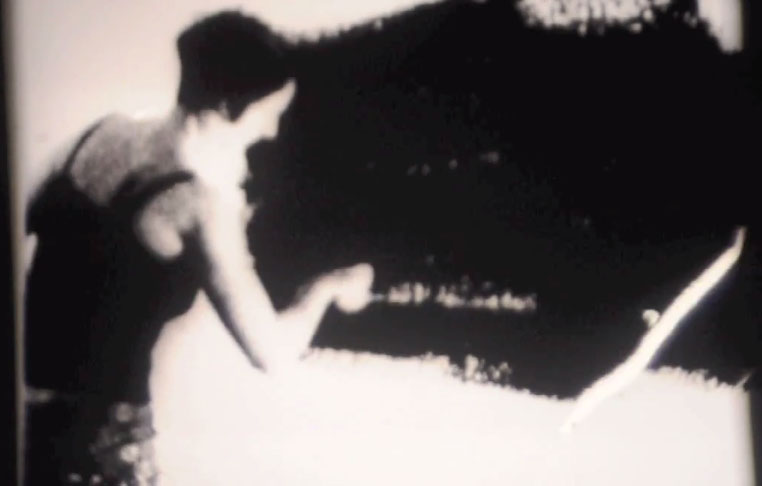
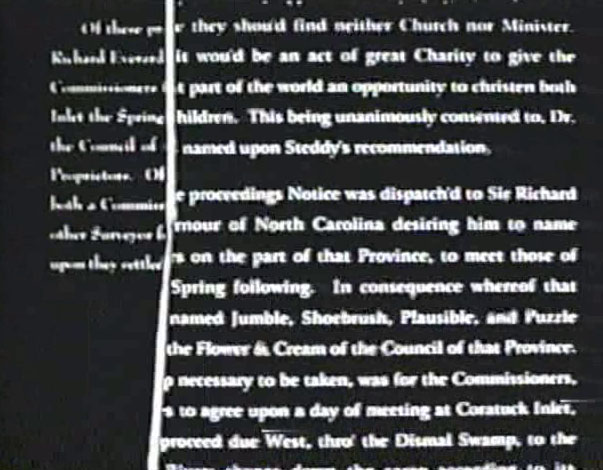
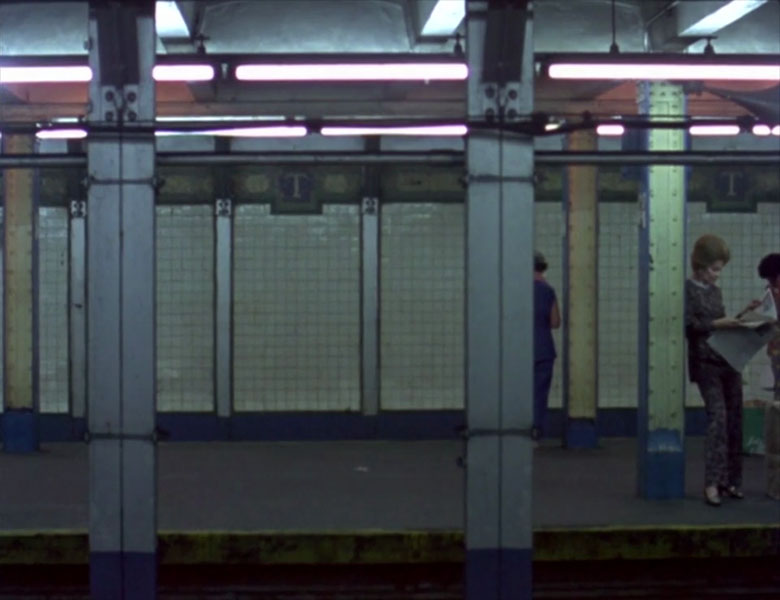
That Flicker Alley blu-ray set I threatened to buy at the beginning of the year, well I bought it. And besides being full of interesting avant-garde films beautifully preserved in high-def, it’s really well sequenced and presented. Gonna have to break this into a few screenings and posts since I’m taking so many screenshots.


Manhatta (1921 Sheeler & Strand)

City photography, mostly seaside and rooftop, floats by, with intertitles from a Whitman poem. Impossible to know how this looked in 1921 since by now I’ve seen hours and days of NYC photography. Buildings and ships still look like buildings and ships, so I was mostly interested in the few shots of people and traffic. Strand later photographed Redes and codirected Native Land.

Lewis Jacobs, writing in Film Quarterly in late 1947:

In technique the film was simple and direct, avoiding all the so-called “tricks” of photography and setting. In a sense it was the forerunner of the documentary school which rose in the United States in the middle 1930’s … The picture’s emphasis upon visual pattern within the real world was an innovation for the times.


Anemic Cinema (1926 Marcel Duchamp)

Alternates geometric spirals with word spirals (jokey French puns, I think). Peaceful. His buddy Man Ray helped out, and some prankster named Gustavo contributed a drone soundtrack.

In Visionary Film, Sitney calls it one of the “two fundamental works of the graphic cinema from the 1920s made without animation,” along with Ballet Mechanique.

Kristin Thompson:

Duchamp’s purpose was presumably to create an artwork with minimal means, including quasi-found objects, the disks he had made for another purpose. His idea is clearly reflected in the title, Anémic cinéma, which suggests a weakness or thinness of means. “Anémic” is also an anagram for “cinéma.”


Life and Death of 9413 (1927 Florey & Vorkapich)

Still one of my favorite shorts ever. I love that Florey & Vorkapich were already this cynical about Hollywood in the silent era – especially great is the “babababa” mouth-flapping in place of speech. Would be a good short to run before The Last Command.


Skyscraper Symphony (1929 Robert Florey)

New York buildings, photographed straight ahead and jutting out in all directions, making this an appropriate follow-up to the city documentary Manhatta and the expressionist angles of 9413. Donald Sosin contributes a very nice piano score. Florey directed a Marx Brothers movie the same year.


Mechanical Principles (1930 Ralph Steiner)

Pistons, meshing gears and other mechanics, beginning slow and simple and getting into crazier and faster gizmos. Really cool.


A Bronx Morning (1931 Jay Leyda)

More New York scenes, this one more social than the structural interests of the others. Leyda had documentary cinematography and editing pretty well figured out by age 20, worked with Steiner, later with Eisenstein and went on to write film histories.

How much does expert ladies hair bobbing cost to-day?


Lot in Sodom (1933 Watson & Webber)

Leagues beyond the previous films in visual poetry. Bodies collide in slow motion, mirrored and refracted. Eventually a plot takes shape when an angel appears to woolen-bearded Lot and tells him to get out of town before it’s destroyed by a rain of fire (there’s some other stuff I didn’t catch, not being familiar with the bible story). Like I wrote for the same directors’ Fall of the House of Usher, “I still don’t know exactly what happened, but boy was it awesome.”

Jacobs called it “the most distinguished experimental sound film of the period.”

Lot in Sodom used a technique similar to that of The Fall of the House of Usher, but far more skillfully and resourcefully. It drew upon all the means of camera, lenses, multiple exposure, distortions, dissolves, and editing to achieve a beauty of mobile images, of
dazzling light and shade, of melting rhythms, with an intensity of feeling that approached poetry. Its brilliant array of diaphanous shots and scenes … were so smoothly synthesized on the screen that the elements of each composition seemed to melt and flow into one another with extraordinary iridescence.


Poem 8 (1933 Emlen Etting)

Visual poetry with no narrative – the first time that had been done, according to Etting, who is wrong (Man Ray, Hans Richter, Ballet Mechanique). Rough on the technical side, but it works for me. Dig the first-person camera sipping a cocktail and making out with an undressing woman. I didn’t feel the new piano score by Rodney Sauer was appropriately poetic.


An Optical Poem (1938 Oskar Fischinger)

Floating shapes appear and move in sync with a Liszt song. Since it’s made with paper cutouts in stop-motion (which must have been aggravating) you can their shadows upon each other.


Thimble Theater (1938 Joseph Cornell)

Cornell and his posthumous editor Lawrence Jordan throw together a bunch of things and run circus music under them all. Too many kids in a paper flower… what looks like a Melies movie… a cartoon printed inverse and upside down… mountain goats… a man vs. kangaroo fight in slow-motion. Before Spike & Mike or Everything Is Terrible or Star Spangled to Death, Cornell was the original curator of clip shows of wonderous things.

A Gentle Spirit (1985)

Morphy, smeary animation beneath a crosshatched texture overlay. Time is ticking away and people appear still and sad, a slow-motion human drama with insect cameos, until music ramps up to a climactic chase scene. I couldn’t figure out the story, but I think Dumala assumed no viewer would be so uncultured as to be unfamiliar with the source Dostoevsky novel. Will have to watch this again after seeing the Bresson version (Une Femme Douce, “a young woman kills herself, leaving no explanation to her grief-stricken pawnbroker husband”), which sounds like a barrel of laughs. Some very cool effects in this, including a table transforming into a bed.


Walls (1988)

A man is trapped within some walls. Sometimes things (drawers, insects) appear on their featureless surfaces. I guess he goes mad from sensory deprivation, since his senses start freaking out, his eyes and ears transforming. I liked it better than the previous movie.

This would seem to be an inspiration for both Tool’s Prison Sex video and the movie Symbol. Dumala would further explore his interest in insects with Franz Kafka before returning to Dostoevsky for his half-hour opus.


Crime and Punishment (2000)

I don’t think it’s all drawing, looks like there are layers of filmed objects in there, though in standard-def it’s hard to tell. Of course there are insects – buzzing flies in every scene – and I recognize the basic Crime (with an axe, killing the pawnbroker and a witness), but the crime is finished with only seven minutes to go in the film, so there’s little Punishment. The killer sits at home feeling bad for a minute before Dumala goes outside to play with animals in the rain. Perhaps a mute witness to the crime kills himself at the end? There are some cool effects – I liked the liquid glimmer of nervous eyes in extreme close-up – but it’s so static it loses my attention repeatedly over the thirty minutes.

Raptor in the rain, a drop falling from its beak:

Still watching the nice HD collection of Looney Tunes


Duck! Rabbit, Duck! (1953, Chuck Jones)

The duck season/rabbit season short in which Daffy gets blown to bits a hundred times and Bugs causes chaos and confusion. Murderous fun. “I hope I didn’t hurt you too much when I killed you.” IMDB calls it the end of a Hunting Trilogy with Rabbit Fire and Rabbit Seasoning.


I Love To Singa (1936, Tex Avery)

“Enough is too much! Out of my house!” Forgot that Owl Jolson’s parents have heavy German accents… also forgot an excellent scene combining telegram lingo with sexual harassment.


A Tale of Two Kitties (1942, Robert Clampett)

Abbot & Costello cats try to steal a pink, featherless, smartass bird from its nest. Very quippy and gaggy, only loosely a story. Explicit Hays Office reference! “Lemme at him Babbit, I’ll moydalize him.” Pre-Tweety premiere of “I tawt I taw a putty tat”?


The Old Grey Hare (1944, Robert Clampett)

God listens to Elmer for some reason, and sends him to the year 2000, which has futuristic weapons and newspapers full of 1940’s references. Then we get a flashback within the flash-forward, so both elderly and baby versions of Elmer & Bugs.


Hare Tonic (1945, Chuck Jones)

In which Bugs convinces Elmer that he’s caught Rabbititis. I thought this was an old-model Elmer, but it’s made a year after the modern-Elmer Old Grey Hare, so what’s going on? The Elmer-torture is prompted not by hunting this time but by Elmer trying to buy fresh rabbit at the meat market, which at least proves that he intends to eat rabbits and isn’t just hunting them for the sport of it.


Fast and Furry-ous (1949, Chuck Jones)

Coyote and Road Runner origin story, setting up the template for many to come – and arguably never surpassed. I like that Road Runner doesn’t just zoom past the traps, but actively fucks with the coyote. I also like that there are complicated cloverleaf interchanges in the middle of the desert. My birds responded to the “meep meep”

My favorite invention, very Silver Surfer:


The Scarlet Pumpernickel (1950, Chuck Jones

Daffy begs his movie producer J.L. to give him a dramatic role for once, which is enacted by an all-star cast: Porky, Sylvester, Elmer, Chicken Hawk. Rated R for snuff usage and suicide.


Chow Hound (1951, Chuck Jones)

Red kitty has a whole string of “owners”, who all feed him, but the food is stolen by a bully dog, who finally overeats his way into the hospital.


Bewitched Bunny (1954, Chuck Jones)

Bugs is reading Hansel and Gretel when he runs into the kids themselves, with ridiculous German accents, and ends up being chased by the witch through her hilariously designed house, and nearly saved by Prince Charming, who got the wrong fairy tale. “Thanks large, mac.” Ends with maybe the rudest punchline ever.