I watched Raamat’s Lend a couple months ago, just getting to the rest of the disc.

Kutt / Hunter (1976)

More cross-fading animation. Whale-hunters dodge icebergs while tracking their prey. The whale wins. Nice water and Northern Lights effects.


Pold / Field (1978)

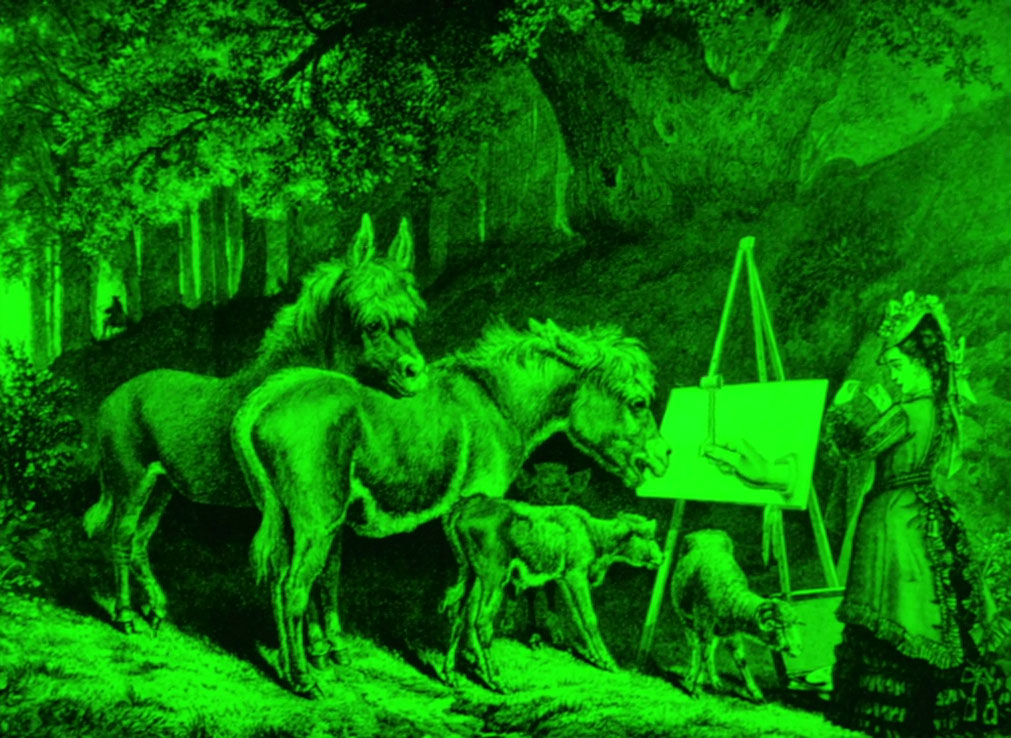
A black/white world, slow heavy labor, each frame crossfaded into next. Work horse dreams of a better life, escapes. I think he returns to the farm after getting hungry.


Varvilind / Colorful Bird (1974)

Bored future society starts to come alive with the addition of primary colors, as their world gradually becomes a groovy hippy paradise. A black cat threatens to make everything square and gray again, but the cool kids intervene, ending in a psychotic color trip. Maybe Estonia didn’t have the color green – the movie shows yellow and blue combining to make… blue. I like the silent-film opening titles, and how each of the Raamat shorts is so different-looking than the last.


Kilplased / Simpletons (1974)

White-suited loggers discover that logs roll downhill. A farmer tries to befriend some birds while his horse is eaten by wolves (he doesn’t see the wolves, so a cat is blamed). The men burn down their structure (silo?) and destroy their own fields while chasing a pig. At least they get to eat the pig. The cartooniest Raamat I’ve seen.

I like the way he draws bird feet:


Tyll the Giant (1980)

Tyll helps the puny humans rebuild after their towns are destroyed by demons, rescues them when rough seas overturn their boat and participates in brutal battles against their enemies. This doesn’t go over well with the devil lord who shoots boulders from his eyeballs, so he destroys Tyll’s home and murders his wife. In a final horrific battle (this is the most bloodshed I’ve seen in a cartoon since Metalocalypse), Tyll is beheaded, then a voiceover I didn’t understand (because I lack subtitles) gives an epilogue. A tremendous end to the Raamat party.

The Village (1993, Mark Baker)

Fun story with a fairly minimal drawing style. Small town is hateful and suspicious of each other until they have something to unite around: imprisoning and hanging their falsely-accused neighbor. After a rooftop fight, he manages to escape into the woods with his lover. I dig the decorative swarm of ants who end up complicating the plot. This won a pile of awards, also oscar-nominated against winner The Wrong Trousers.


His Comedy (1994, Paul Bush)

More an art piece than a short story – the poetic voiceover does nothing for me, and I couldn’t make out any sort of narrative. Maybe something religious or mythological? Ah, it’s all Dante quotes, as I should’ve known from the title. Cool looking, though – everything composed of wavy lines, with some parts (motion of bird flocks, fire, bombings) that appear rotoscoped. I liked Bush’s later, twitchy Episodes from the Life of Jekyll and Hyde.


Dreamland Express (1982, David Anderson)

Sleepwalker finds a train in the woods and takes it for a ride. All manner of wonderous imagery ensues. One of those animations that reminds you how limited and straightforward most animations are. Glad I didn’t skip this after realizing it’s by the same guy who made Deadsy. Won a Bafta (interesting thing that year: Burden of Dreams won an award; Fitzcarraldo was nominated but lost).

Cannes Month isn’t over until I say it is. Michaël Dudok de Wit’s The Red Turtle premiered two weeks ago to absolute raves (an A+ from indiewire) so I’m checking out his shorts.

The Monk and the Fish (1994)

A monk goes out of his damn mind trying to catch a fish. Great motion and poses, and this movie does one of my favorite things, having the main character always move to music. I believe it ends with the monk reaching a spiritual oneness with the fish. Won the César, nominated for the oscar.


Tom Sweep (1992)

Found in low quality on streaming sites – a proto-Monk/Fish short, with beleaguered bin-man Tom’s garbage-collecting movements set to music.


Father and Daughter (2000)

A terribly beautiful story about a girl whose father sets off in a rowboat and doesn’t return. Won the Oscar and the Bafta and the BAA and the Annecy and the Zagreb and deserved them all, although I certainly didn’t think so on oscar night when I was rooting for Don Hertzfeldt’s Rejected.


The Aroma of Tea (2006)

A dot moves rhythmically through painted patterns, again set to music. Aha, it was painted with tea.

World of Tomorrow is out on blu-ray!

I watched it again, along with the others.


The Meaning of Life (2005)

I was hard on this the first time I watched it, having expected another Rejected, and was dismissive the second time, but appreciating it more and more. Interesting visual effects illustrate Hertzfeldt’s nihilist meanderings, which would be explored from a more personal perspective in It’s Such a Beautiful Day and perfected in story and dialogue form in World of Tomorrow.


The Simpsons Open (2015)

I am simpson! I am simpson!

Give me your money. Give me your money.


World of Tomorrow extra (he teases a sequel in the interview):


Rejected (2000)

I didn’t mean to watch the movie that beat Rejected at the oscars on the same day, but that’s how it turned out.

Appreciate the paper effects in HD.


Lily and Jim (1997)

Been a good while since I watched this blind date story. “Women just don’t understand me! Come to think of it, this is a problem that a lot of women seem to have.”

“I really don’t like coffee… and actually I’m extremely allergic to the caffeine but, you know, I didn’t wanna ruin the evening or anything.”


Billy’s Balloon (1998)

Seen this a thousand times. The picture remaster isn’t revelatory because the miracle of the comedy is all in the audio and timing. Always worth watching again, tho.

Les Joyeux Microbes (1909)

Similar to Transfigurations, but now it’s a scientist trying to get an overacting scarf fella to look at different microbes under a microscope, each of which displays a different transmogrifying animated scene, usually involving cranky old people. Towards the end, one of the drawings becomes 3D, a drunk character’s paper arms wrapping around a prop bottle. Another wonderful detail: the final second of the film was presumably supposed to have the scarf guy storm out of the room, but the set door (which was working in the opening shot) bends, doesn’t open, Scarfie mooshing up against it until the film quickly cuts.


Japon de fantaisie (1909)

I guess it’s stop-motion using Japanese props. An insect lays an egg, hatches into a mask, which spews forth rats. Doesn’t seem like a very positive view of Japan… or maybe it’s a prequel to the Mothra films.


Clair de lune espagnol (1909)

These are getting more difficult to summarize now that Cohl has discovered intertitles and I don’t know French, but it looks like a matador gets rebuffed by a fan lady, so he leaps out a window… but is saved by a space-bound vessel. The man angrily shoots the moon with a shotgun, is challenged to a duel by moon men, then thrown back to earth, where the fan lady is now impressed with him. I liked the prop star that shoots sparks.


Le Songe du garçon de café aka Hasher’s Delirium (1910)

Waiter falls asleep during his shift, has loony prop-and-cartoon-based dreams. From all the bottles that appear, we can assume he’s a drunk. His appalled-looking cartoon dream-body is subjected to the ludovico technique, watching names of alcoholic drinks alternate with demons and horrors. Then he’s made to kick his own ass. Then he’s awakened in the most predictable fashion, given that just before falling asleep he gave a table of identical hat-wearing men four seltzer bottles.


Le Mobilier fidèle aka Automatic Moving Company (1910)

Debt-ridden Mr. Dubois hugs all his furniture one last time before it’s all repossessed and auctioned on a street corner. Later, each piece of furniture torments its new owner and flees (serves ’em right for taking advantage of poor Mr. Dubois, who cries and wails all through the auction), returning to Chez Dubois where they belong.

Two by Djibril Diop Mambety

Contras City (1968)

Playful travelogue doc of Dakar. Strange, and the humor and political content are mostly lost on us, a couple continents and decades removed. Ubu says it’s considered Africa’s first comedy film.

Uncredited description of this film online:

Djibril Diop Mambety’s deeply ironic and biting commentary on the divided city that was Dakar in 1969: on the one hand, colonial, affluent and pompous, on the other, indigenous, poor but genuine.

Would make good marathon viewing with other wry short travel docs: Vigo’s À Propos de Nice, Varda’s Du Coté de la Côte, Lindsay Anderson’s O Dreamland, Ivens’s A Valparaíso, Marker’s Sunday in Peking.

Woman looking at French magazines at the newsstand:


Badou Boy (1970)

Adventures of the Badou Boy, a thief who helps run a bus service while dodging the ineffectual Officer Al. There’s also a blind musician, a hat-and-cane fancyman (played by the director) and Badou’s white-hatted buddy Moussa, who I think helps him escape Al at the end. Or maybe Badou is caught – there are flash-forwards, so I’m not always sure where we are.

Officer Al:

Voices are fully overdubbed. Music and effects and voices sometimes seem to be working against the picture, instead of with it. That’s not a complaint – since Contras City opens with a classy symphonic song which then warps and slows to a halt, it’s clear that Mambety is purposely screwing around with sound possibilities. It’s also clear that he’d been watching some French New Wave pictures.

Also playing with the camera – here focus is on the driver’s hand instead of Badou:

Our festival of Senegalese movies got stalled after this. Contras City made Katy sleepy, and she was having none of Badou Boy.

Maybe not as New-Wave-influenced as I thought… Mambety:

It’s the way I dream. To do that, one must have a mad belief that everything is possible–you have to be mad to the point of being irresponsible. Because I know that cinema must be reinvented, reinvented each time, and whoever ventures into cinema also has a share in its reinvention.

Mark Cousins:

[Its] sonic complexity, its state of the nation-ness, its Joycean wandering, its allegorical fun, convinced me that Badou Boy is undisputedly a lost classic. It is as important to African cinema as, say, Le Sang d’un poete is to French cinema – perhaps more so. It reveals the origins of the aesthetic confidence, the joy in mocking, filming and thinking that can be seen in Touki Bouki.

I’ve been watching more shorts lately and posting then in thematic batches by director (Len Lye, Emile Cohl) and collection (Disney, Oscar-nominated) and time period (The Movies Begin, 1920’s & 1930’s). Here are some miscellaneous shorts that didn’t get their own thematic post.


False Aging (2008 Lewis Klahr)

Cut-out animation with a recurring yellow bird and a comic-book Adam & Eve. Looks charmingly handmade. Generally slow and dreamy but sometimes the objects flicker maniacally.

I think it’s about drugs. Soundtrack: clips from Valley of the Dolls, a Jefferson Airplane song, and John Cale reading Andy Warhol’s journals.

Klahr was ranked a top-five experimental filmmaker of the 2000’s by Film Comment, and is on the cover of this month’s Cinema Scope. “Klahr’s films construct archetypal narratives and mood trances out of the middle-class utopia we promised ourselves and never got” – M. Atkinson.


Lend/Flight (1973, Rein Raamat)

An ode to flight. Tiny red person rides some dandelion floof through the clouds, performs acrobatics up there, then comes plummetting down upon reaching the atmosphere’s edge. A series of new ideas for flying machines based on existing objects are proposed, scored by a groovy rock song, until finally a plane (and a rocket) is built, based instead on natural flying creatures. I love the color scheme and the multi-layered sky.

Raamat is known as the father of Estonian animation, founded his own animation studio in 1971. Writer Paul-Eerik Rummo was a poet who later became Minister of Culture. Music composer Rein Rannap is best known for judging Estonian Idol.


The Apple (1969, Kurt Weiler)

Whoa, this is amazing. Lively puppet stop-motion telling an anti-greed/ignorance parable – art vs. science vs. the state vs. religion – with rhyming (in German) narration. Kinda hard to explain, but involves rival scientists competing for attentions of the ruler, and trying not to get thrown in jail or burned at the stake for their ideas.

Oops:

One guy invents the drug “hormosexulin” which increases egg production from friendly bulbil creatures, and the ruler goes nuts with it, injects his henchmen, who also start laying eggs. Sometimes reminds me of Jirí Trnka’s The Hand, like when a traumatic scaffold collapse provokes genuinely disturbing cries of pain.

Placid Bulbil interrupts scientist face-off:


Riley’s First Date (2015, Josh Cooley)

Inside Out spinoff short, in which snotnosed boy (with Flea inside his head) comes to pick up Riley, sitting with her increasingly angry father while she gets ready. Mainly focused on the parents’ emotions, which according to one of the Inside Out reviews I read was the feature’s weak point, throwing out all the movie’s Riley-emotion lessons for easy retro-sitcom gender jokes. And there’s more of that here, but it’s still fun. Cooley has been in Pixar credits since The Incredibles, and taking over a spinoff short means he’s probably being groomed to codirect an upcoming feature sequel… yep, there’s his name on Toy Story 4.


Porter Springs 3 (1977, Henry Hills)

Distant trees swaying in the breeze for a minute… then what looks like a circular pan from the center of a lake sped up a hundred times. Then the trees, calmer, then the lake, crazier. If I’d known it was gonna be silent I’d have picked my own John Zorn track.


Gotham (1990, Henry Hills)

Shots of modern NYC mixed with clips from cop shows and set to a cartoony jazz track, awesome.


Goa Lawah (1992, Henry Hills)

Bats! A cave full of squeaking bats! They squabble when they get too close together while sleeping – just like our birds, who somehow didn’t respond to me playing four minutes of bat noises.


In an earlier post I reductively described actionism and watched Kurt Kren’s Leda and the Swan and Silver Action Brus. Checking out a few more from the Action Films disc.

6/64 Mama und Papa (Kurt Kren)

Hurling food and paint and dirt all over a naked woman, then Kren edits it all to pieces with no sound. He’s doing something wrong, because every time there’s an edit (so, 1-10 times per second) we see tape marks at the bottom of frame.


9/64 O Tannenbaum (Kurt Kren)

Naked man under a Christmas tree, naked woman in a shower, covered in food and paint and dirt. I’m sensing a pattern here. “Action” is by Otto Mühl in both films, and both feature men humping women with a balloon full of feathers between them.


16/67 20. September (Kurt Kren)

Remember Brus? Now he’s pissing and shitting in close-up, and now I realize why I didn’t watch the rest of this DVD last time I started it. Jesus, Kren. No screenshot for this one.


Hardwood Process (1996, David Gatten)

Flickering textures, crossfaded. Some Brakhagey slow/fast pattern-shifting. Some photographed action, slowed or sped, some filmstrip hacking. Texture fetish. Each section its own rhythm and style, separated with title cards:
“Day 203 – several hours in the library reading the history of”
“Day 296 – coming to terms with a new vocabulary, slowly”

Cafe Bar (1974, Alison De Vere)

Imaginative – couple sitting at a cafe table create and remove disguises, fight dinosaurs and minotaurs, turn into The Red Baron, trek across each other’s heads and ski down each other’s fronts. Looks like this was the first of a few essential animated films De Vere made.


Manipulation (1991, Daniel Greaves)

Covered this before in an Oscar-winning shorts roundup, but rewatching with much nicer picture quality. Generic dude is drawn by animator then discarded, but the dude becomes sentient, plays with drops of ink, worries about his 2D nature. Animator torments the dude for a while until he explodes with rage, becoming freed from his paper prison. It’s fully wonderful. Looks like Greaves put out a new short, Mr. Plastimime, since last time I watched this, playing last year’s Edinburgh fest.


Little Wolf (1992, An Vrombaut)

The littlest wolf in a sheep-hunting wolf parade gets himself stuck on the moon. The others try to get him down while the sheep interferes. I especially liked the “doyyng-doyyng” sound effects. The director is Belgian, has lately been making animated kids’ TV series. According to her website, she likes giraffes very much.


Oozat (1992, Darren Walsh)

I love stop-motion with human actors. Here they’ve got replaceable facemasks with different expressions. Dude meets some guys, drinks with them at the pub, shows a different face to the lady sitting next to him, eventually mixing up his faces. I think Walsh is the creator of Angry Kid, the red-haired Aardman stop-motion hooligan I used to see… somewhere. MTV? Cartoon Network? And he worked on a Black Mirror episode I haven’t watched yet.


Deadsy (1990, David Anderson)

I think Deadsy was a disturbed young man who became a rock star then a transsexual, his story told through beat-poem narration and a mishmash of animation techniques. Not my favorite. Writer/narrator Russell Hoban was a prolific sci-fi and childrens book author… not sure what happened to Anderson.


The Sandman (1991, Paul Berry)

Timburtonian stop-motion. Kid goes to bed and a moon-faced birdman stalks into his room and steals his eyeballs to feed to baby birdmen. Cool and creepy. Based on a tale of Hoffmann. You wouldn’t think this story had been adapted for film ten times, but according to IMDB you would be wrong. Oscar-nominated the year Mona Lisa Descending a Staircase won. Unsurprisingly, Berry was later an animator on The Nightmare Before Christmas.

The Wind Subsides (1997)

Beautiful, ragged animation, all flowing lines morphing one thing into another. Land becomes bull becomes man becomes cat, set to propulsive music by Goran Mikulec.


Faces (2002)

Paint and texture and scrawled line drawings, the frames fading into each other. Zooms into the heads of museum busts to retrieve World of Tomorrow-style dream-history images from within. Guess it’s more narrative than the last one, since it’s got a framing story.


Panther (1999)

A sad one – zoo panther paces its cage, dreams of home and escape. Inspired by a Rainer Maria Rilke poem.


Quercus (2004)

Cycles of nature and human warface, all smeary sketchbook lines, always morphing and changing. Coincidentally ends with a great Khalil Gibran quote, and I’ve got The Prophet on the way from netflix.