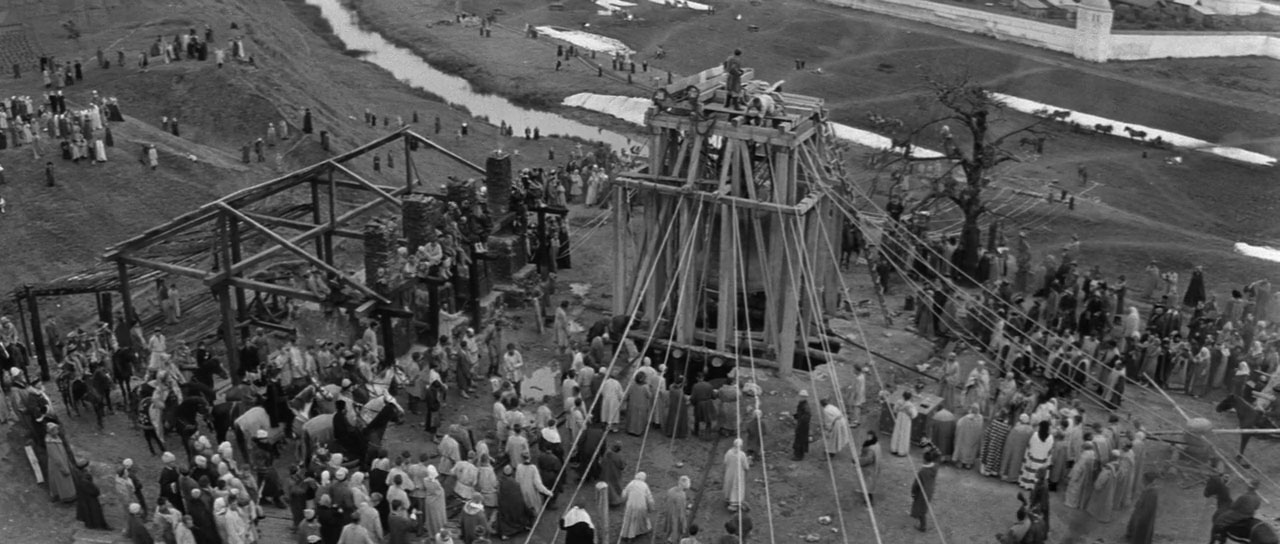
Japanese gang-war rap musical, opens with an epic long take, then blonde gang boss Mera (Ryôhei Suzuki of Kurosawa’s Seventh Code) explains the local gangs and neighborhoods to a noob cop he has stripped and threatened with a knife, and we already know what the movie is like: it’s gross and loud and sexist, and kinda fun as hell.

Mera ambushes his hated rivals, the peaceful gang Musashino led by Kai, and kills a guy, and his body is wheeled back home with a new girl in tow (Nana Seino). Meanwhile, Mera ally Lord Buppa (played by a pop-eyed Riki Takeuchi, a classic Miike star I haven’t seen since Battle Royale 2) is sent two elite fighters by the High Priest to recover HP’s missing daughter Erika (the new girl, obvs), and previously unknown gang the Waru is activated.

A holographic message from the wise High Priest:

Kai bands together all the Tokyo tribes, including the Gira Gira Girls and Neri Muthafuckaz and probably a couple more, to fight this new threat. It all looks impressively choreographed and real, neon lights and stunt fights, then a super-fake CG tank comes along and blows it. Still, for a full two hours of rap mayhem, this doesn’t lose steam. I’d been avoiding Sion Sono since Noriko’s Dinner Table, but this and Why Don’t You Play In Hell were fun, so maybe I should watch his four-hour masterpiece Love Exposure sometime.

From Showgirls to this, it’s my year to watch movies that are considered horrifically bad, but are actually kinda cool. I mean I’m not running out to buy Cat People posters for my dorm, but from its wordless mystical prologue on, it never hits a wrong note, and is slick looking with cool music (until the lame Bowie title track over the credits, sorry).

I guess Ruby Dee’s introduction, overexplaining why her character name is Female, pronounced fuh-MOLL-y, is a wrong note, but right after that, look it’s John Larroquette, and then a pretty woman hosing an elephant (this is Annette O’Toole, the Jessica Chastain of the original It). Okay, I guess the movie’s attempted reenactment of the Tourneur version‘s pool scene, seemingly written only as an excuse to show Annette naked, is another wrong note.

Comic relief guy loses an arm:

As soon as Nastassja Kinski arrives in New Orleans to meet her long-lost brother Malcolm McDowell (awesomely, lecherously creepy), he goes off to kill prostitutes in form of a leopard and gets captured. Kinski gets a zoo job to be near her leopard-brother, wants to date zookeeper John Heard (After Hours bartender) but sexual desire makes her get furry, and while she’s trying to figure this out, McDowell is pestering her: “we can live together as mates, just as our parents did.” John Heard somehow survives a night of full moon bondage sex, and she takes her late brother’s place as a zoo exhibit.

Based on a then-twenty-year-old novel, which somehow hasn’t been remade yet, but I suppose every movie about no-good men coming into money then turning into paranoid murderers is a remake in spirit. Damn good movie, but the true stories about the contested identity of the novel’s author are even better! John Huston’s fourth non-doc feature won oscars for himself and his dad, and his other movie that year won Claire Trevor an award.

A couple of downluck laborers overhear Walter Huston (just off playing “The Sinkiller” in Duel in the Sun) bragging about his prospectin’ skills, and they ask if he’d join them on an expedition. I didn’t know who was the bigger sucker, but it wasn’t the two Americans since Huston indeed had the knowledge and skills to find all the gold dust you please; it was jolly Huston for taking on these bozos as partners. I guess Tim Holt (prolific cowboy star, an Earp in My Darling Clementine) isn’t so bad. especially compared to his villainous partner Humphrey Bogart (what?) who becomes gold-crazed, tries to kill the others and finally gets murdered by banditos who lose all the gold dust to the wind (making The Killing another semi-remake).

This was just about a good enough movie to watch on a plane – which I did. I knew Chloë Grace got conned into being friends with lonely crackpot Isabelle Huppert, but not that Isabelle kidnaps and brainwashes her in the second half, murders private eye Stephen Rea sent by Chloë’s dad, then is defeated by Maika Monroe, who searches the subways until she finds a purse lure with Greta’s home address. When investigating, they’re told that Greta acts this way (the obsessive calling, not the kidnapping/murder) with everyone, and that she’s not even French (ha). Somehow only the third Neil Jordan movie I’ve seen – Mona Lisa was alright (so was this), and I’ve been meaning to watch The Company of Wolves.

Comically gentle music plays over the title Cannibal Holocaust, and I can’t tell if it’s irony or if this is just typical Italian-Horror dissonance. Then we open with a dude on an NYC skyscraper telling us that man is on the verge of conquering the galaxy, but blah blah. This movie has appeared on horror lists for decades, but I would never watch it, because ages ago we made the mistake of renting Umberto Lenzi’s knockoff Cannibal Ferox, which was so distasteful it put me off Italian cannibal horrors for years.

Professor Harold agrees to “journey into Amazonia” to find a disappeared film crew of four absolute losers, introduced via their own rushes: Alan is the director, Faye his “girlfriend and script girl,” and the two cameramen Jack and Martin are “inseparable friends.” This is set up as a found-footage doc, but the moment I meet these bozos I don’t buy a thing they say. It’s a clever conceit though, and as far as Italian courts of the early 1980’s could tell, this is how Americans really behave, so the movie-in-a-movie was assumed to be true and director Deodato was accused of murder.

“Hey professor, I recognize these teeth.” Dr. Harold and his army crew lose a man to a blowgun dart while while they are butchering natives, then they come across the teeth of Felipe, the movie crew’s guide. Meanwhile there’s footage of jumping monkeys, sloths and macaws, before we’re subjected to a mud-covered girl getting raped with some bloody object then murdered. It’s kind of a not-bad, actiony movie, except for the misogyny and probably racism. The prof’s crew is brought to the Tree People’s hideout and Harold decides to “become like them” and strips in the river, where he’s quickly surrounded by excited nude women. Have I mentioned that Harold is played by porn actor Robert Kerman? He also played a cop in Night of the Creeps, and IMDB says “then one day his female agent fired him for no clear reason.” Females, eh?

Porn Prof with Salvatore Basile, an assistant director on this and Cobra Verde:

The film crew is long dead but the prof returns to NYC with the footage from their would-be documentary titled The Green Inferno (yo, Eli Roth). A rookie Italian mistake, which should have been disqualifying in the murder trial: the “found footage” is dubbed. I turned away from the screen during the infamous turtle slaughter scene, which felt very long. Our film crew finds a village, and just frightens and torments people, then burns some villagers to death for no apparent reason except they’re horny and drunk on power, the director and his girl proceeding to then have sex in front of their cameramen and the entire village.

The Yanomamo freak out over a tape recorder:

“Been walking through the jungle for days with the harrowing feeling that we’re moving in circles” – this predates The Blair Witch Project by two decades. Their guide Felipe is bit in the foot by a snake and they quickly chop off his leg – not quick enough, I reckon. When they come across the Yanomamo “tree people,” they ingratiate themselves by immediately raping a woman, and when the script girl interferes (not to prevent the rape, but to protest that recording it wastes precious film) they assult her too. The tribe catches up with the crew, and when Jack is first on the menu, the cameramen don’t seem like “inseparable friends,” as the other enthusiastically films the butchering. Faye is gang-raped, of course, and the other two are quickly dispatched when discovered. The movie gets to have it both ways as Harold condemns the doc footage as inhuman. “I wonder who the real cannibals are,” as the camera meaningfully pans up to the NYC skyscrapers.

Our director Deodato was assistant director on Django, later known for making unsavory stuff like a Last House on the Left remake and this movie’s predecessor Jungle Holocaust. The writers worked on Devil Fish and Demons 5: Devil’s Veil. Composer Riz Ortolani has hundreds of credits, including Don’t Torture a Duckling and The Dead Are Alive. DP Sergio D’Offizi also shot Deported Women of the SS Special Section and Today We Kill, Tomorrow We Die!

Claire Diane on Letterboxd:

This film is an evil spell … I have no idea how to rate it, as conventional senses of quality really have no place with a film like this. It is profoundly repugnant and yet also seems somehow a pinnacle.

Man, the French sure love Joan of Arc, don’t they. I guess she appeared out of the blue, giving new hope to the troops and French king, and led some decisive battles which eventually caused them to drive out the British after a century of war. It’s a good legacy, but mostly in cinema I see her being interrogated and executed, exceptions being the first halves of the Rivette and the Dumont. And here we go again… I don’t necessarily love Bresson’s choices of subject matter or his morose characters, but something about his style really gets me. This was made earlier than I realized, between Pickpocket and Balthazar – the real test will be when I get a chance to rewatch the 1970’s movies.

Not much suspense for us – the movie is based on trial records and Tarantino hadn’t invented historical revisionism yet – but even within the film, her burning is made out to be a foregone conclusion, so there’s no real point to the interrogation.

Florence Delay went on to narrate Sans Soleil, the bishop went on to nothing at all, and the Jeans… were there really four guys named Jean questioning a woman named Joan? Music by Delphine Seyrig’s brother. The last Bresson film to be shot by L-H Burel, who’d worked on Abel Gance’s J’accuse! over forty years earlier, and the first to be edited by Germaine Artus, who gives us quick fades between scenes, little downtime before dialogue starts again. Won a prize at Cannes, where it played with Cléo from 5 to 7, L’Eclisse, The Exterminating Angel, and surprisingly, Mondo Cane.

For a two-hour movie it sure starts fast – there’s a “sea eruption” as the coast guard examines an abandoned craft, and a gushing leak in an undersea traffic tunnel, then a flurry of government workers reacting to the news, each worker rapidly introduced via subtitle, and this is all in the first two minutes. Little did I realize we’d mostly stick with these government workers for the next 118 minutes – this is a Godzilla movie told from the POV of the bureaucrats trying to devise a solution to the kaiju problem. I meant to watch this two years ago as part of a double-feature, but was so disappointed by the American remake, I cancelled. Should have carried on with the plan – despite its insistent focus on meetings, this is unique and excellent.

While the government works on their undersea-volcano theory, Godzilla’s tail shows up on the TV news, then as the PM is assuring the public there’s no danger of it coming onshore, it comes onshore. The fate of humanity may depend on the government’s response, but the higher-ups only listen to high-ranking officials, not anyone with actual knowledge or ideas. A scrappy young voice-of-reason deputy cabinet secretary named Rando (Hiroki Hasegawa, lead Fuck Bomber of Why Don’t You Play In Hell?, also in Before We Vanish) forms an impromptu committee of underrated functionaries to brainstorm solutions the old-guard leadership isn’t coming up with, making this the most Colonel Blimp-like of Godzilla movies.

Back to the giant monster movie at hand, the thing that comes onshore is… not Godzilla? I thought it might be a monster that G ends up fighting, but after struggling through the city and splashing blood everywhere, it collapses then suddenly evolves into the G we all know. Every time it stops and then rises again, it’s more powerful with new abilities – the fin-glowing, fire-breathing, purple-energy-releasing sequence is especially impressive.

When purple energy beams destroy the prime minister’s chopper, a know-nothing with seniority is made PM, and pretty easily convinced by the U.S. to let them nuke Tokyo. Sure he feels awful, but he has no ideas or power of his own, so it’s up to Rando, his team and his negotiations with the talented half-Japanese daughter of a U.S. senator. The movie is obvious about its politics and complaints – and again, it’s mostly meetings – but it’s also excellently paced and has outstanding monster-devastation scenes.

There are a million actors in this, each introduced with onscreen name and title, and I only kept track of a few. The PM is Ren Osugi, who shows up in every other Japanese movie I watch, and died last year. Kayoko is Satomi Ishihara of the Ring sequel Sadako 3D. Rando’s team includes Mikako Ichikawa of Anno’s live-action cartoon Cutie Honey, and Shinya Freakin’ Tsukamoto.

Not really horror, a disaster movie – made in response to the American version, which wasn’t good at all. This got a limited release in the US, where it mostly appealed to nerds on fansites, while in Japan it won best film and best director and was only outsold by Your Name. Hideaki Anno made this as a mental break between Evangelion films, the fourth of which is now five years delayed. Codirector Shinji Higuchi made Attack on Titan with some of the same cast, and directed sfx for the 1990’s Gamera movies. Anno might be following up with an Ultraman movie, and if he never finishes making the theatrical Evangelion series, I’m never gonna start watching it.

Publisher Guillaume Canet (writer/director of Tell No One) is married to TV actress Juliette Binoche, but we know she’s having an affair with writer Vincent Macaigne (The Innocents) because when her husband says the writer’s new book is about his affairs she perks up and asks if they’re recent affairs, and we know Guillaume is having an affair with his digital media director Christa Théret (a recent Man Who Laughs remake) because he’s gung ho about his company going fully digital even though this seems at odds with everything else he values. There’s a minor subplot about the publishing company being sold, which turns out a false rumor, or a power play by Guillaume’s boss.

“The blogosphere is heated”
“Tweets are modern day haiku”
“Now we have algorithms”

Assayas has made at least two incisive movies focusing on then-current technologies with Demonlover and Personal Shopper, and he’s covered inter-generational difference and relevance beautifully in Summer Hours and Clouds of Sils Maria, so it’s strange that this one feels so dated and inconsequential. IMDB says he began writing it in the mid-2000’s, so maybe that’s part of it. At the end they’re trying to get the “real” Juliette Binoche to voice their audiobook, then the writer’s girl announces she’s pregnant and Jonathan Richman’s “Here Come the Martian Martians” plays, and suddenly I’m wondering if the movie was meant to be a comedy.

A feature-length TV season, so every characters gets their moment, and it all feels squished and irrelevant, all “okay that’s out of the way, now here’s this.” Still mostly enjoyable, even for charlatans like me who quit the series after season 3.

Branson (the Irish chauffeur-turned-family-widower) is the star here, saving the king from assassination by Claire Foy’s husband, helping the princess (Kate Phillips of Peaky Blinders) figure out her marriage, and possibly falling in love with an heiress (Sense8 star Tuppence Middleton), the secret daughter of Imelda Staunton (great, her addition to the movie helps offset Elizabeth McGovern being reliably awful).

Eight years ago I introduced the characters – but where are they now?

Branson played Queen’s manager in Bohemian Rhapsody. Lady Mary starred in the series Godless, and was in that Jim Broadbent movie Sense of an Ending with her barely-in-the-movie husband Matthew Goode. Maggie Smith, who anticlimactically tells Mary she’s dying, is keeping it classy – after the Harry Potter and Marigold Hotel movies, she appeared in Sherlock Gnomes. I saw McGovern in The Commuter and she’ll star in a War of the Worlds miniseries with Gabriel Byrne. Lady Edith (pregnant again) is in another British period royalty drama series, and big daddy Hugh Bonneville is following Paddington 2 with a Christmas movie about a magic toymaker. Shaun’s mom followed The BFG with a Ricky Gervais series.

Bates (Mary Queen of Scots) and Anna (Bob the Builder) trick the royal servants so the locals can kowtow to the king personally, recruiting Carson (con-man movie The Good Liar) and Hughes (starring in Girlfriends with Miranda Richardson). Daisy (Iannucci’s David Copperfield movie) flirts with the plumber, is set to marry some footman. Thomas (netflix horror The Ritual) discovers a gay bar and gets into a side plot with some thudding dialogue, Molesley (plays a “ghost detective” on a British series) says some dumb things, and Patmore (an India-set period drama) does the usual. I was hoping the king and queen would be someone exciting, but she’s from Little Britain and he played Arthur Dent in the original Hitchhiker’s Guide, so, nope. The same writer & director made the dull-looking Elizabeth McGovern movie The Chaperone earlier this year.