The longest Palme d’or winner. Some similarities to Leviathan in style. That one seems angry about the individual’s plight against the corrupt state and religion (although the individual’s drinking problems aren’t helping any), but this one has more general, philosophical matters in mind: the ability of people from different classes to sympathize with each other, a single woman’s place in society, self-glorifying acts supposedly for the benefit of others, so on. Variety said it was “considerably more accessible” than the great Once Upon a Time in Anatolia – not sure that I’d agree, since I thought that one more explicitly explained what was on its mind.

Inspired, as are all Ceylan’s films apparently, by Chekhov stories. Aydin is a major landowner in a beautiful location. He’s made a hotel out of his family home carved into the side of the hills, where he lives with sister Necla and young wife Nihal. Discontent appears almost immediately, when out with his driver/assistant, their tenant’s son throws a rock at their Jeep window. Three hours later, after a series of very long conversations (I timed one at 19 minutes), it’s clear why nobody likes Aydin. M. Smith writes that “no contemporary director has a better compositional eye than Ceylan,” and that’s part of what keeps this 3+ hour talkfest compelling – it’s so beautiful. The endless speeches are tiring, but also draw you into the characters, until at the end, nothing much has happened and nobody has progressed from where they started, but it feels like the world has shaken.

B. Croll for Twitch:

At first, Aydin seems like a perfectly reasonable person … He’s happily married, charitable and polite. He’s good natured, cultured and hospitable to all. He seems on his face to be the agreeable avatar of contented middle-agedom, and yet by film’s end we recognize in him a malicious, almost tyrannical villainy.

G. Kenny:

The talk, for all its abstractions, gradually lays bare the poor regard with which most of the characters hold each other, and, at about the halfway point, when Aydin (played with glum tenacity by Haluk Bilginer) calls his put-upon spouse (Melisa Sözen) a “bored neurotic,” the fur really begins to fly. … The accumulation of images imbues the film with a kind of bleak coziness that brings to life the accusation that Aydin’s sister Necia (Demet Akbag) levels at him: “In order not to suffer, you prefer to fool yourself.” The strength of Winter Sleep is not so much in what any of the characters say as much as what it needs its near-monumental length to actually show: which is the way the most seemingly banal circumstances can throw you into a dark night of the soul before you even know what’s going on, a state of wide-awake despair so calamitous one has no choice but to make a companion of it.

Personal history by Chodorov – I know the name because I was once subscribed to his FrameWorks email list. His dad Stephan was a filmmaker, so Pip grew up surrounded by independent film and artists. He’s got interviews with the big names: Mekas, Kubelka, Jacobs, Breer, Snow… and Hans Richter, so I guess some of the interviews were archival and I didn’t take great notes. He takes a fun, enthusiast approach rather than the history-book implied by the title, and any excuse to revisit this work is a good one.

Includes some short films (in their entirety?):

Free Radicals (1958, Len Lye) – tremendous, white scratches on black, edited rhythmically to an African drum group in ever-changing patterns.

Recreation (1956, Robert Breer) – seen this before, I don’t get the Noel Burch narration but the visuals are fast and exciting.

Rainbow Dance (1936, Len Lye) – insanely complicated color and effects for the mid-1930’s.

And the section of Brakhage’s Dante Quartet called Existence Is Song (I forgot the Quartet sections were titled).

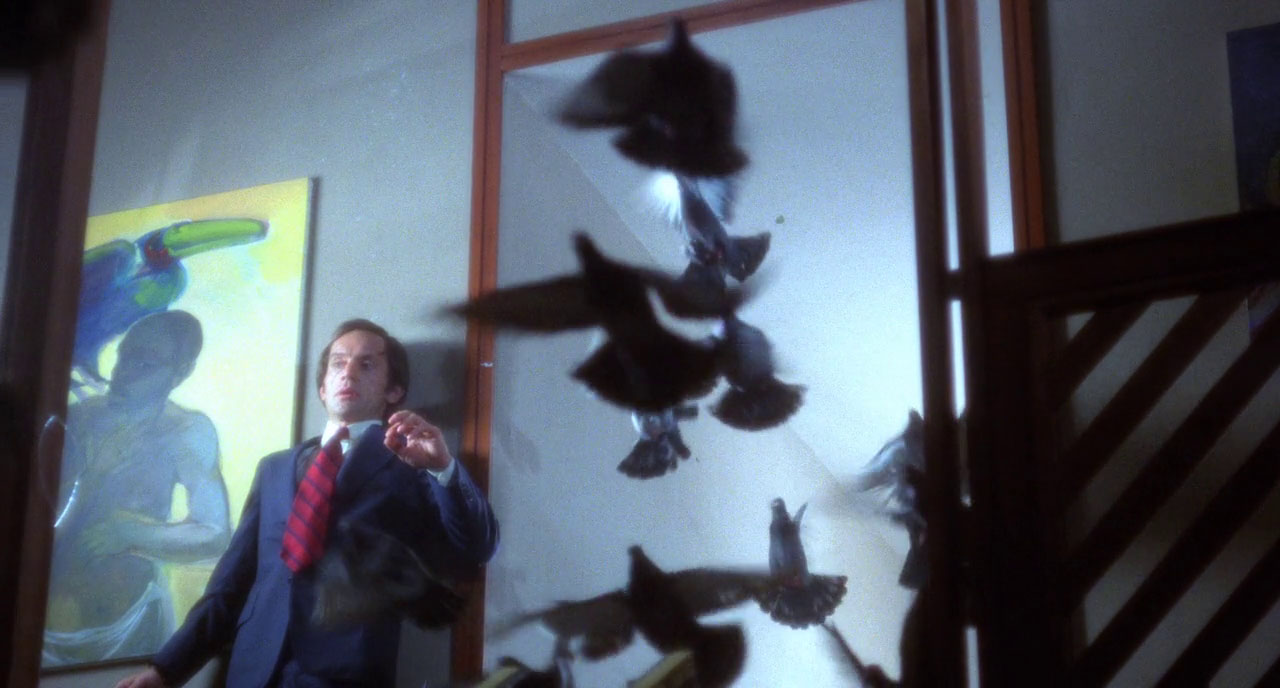
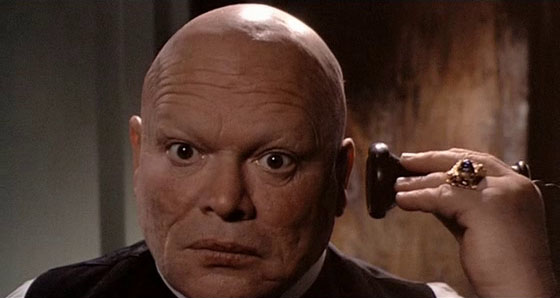
“Deliberately paced, lacking narrative momentum” reads a positive review. I found it very strange (even having seen some of Oliveira’s other films) in an exciting way. It would be easy to write an accurate plot description for netflix, something like “a respected old actor (Michel Piccoli) becomes the guardian of his grandson after losing the rest of his family in an accident, and begins to redefine his life’s priorities.” But that wouldn’t begin to convey the film itself. For instance, Oliveira opens on Piccoli starring onstage in Exit The King alongside Catherine Deneuve and Leonor Silveira. Piccoli plays this scene facing almost entirely away from camera. We see the men backstage who’ve come to deliver the news about his wife and daughter’s fatal car accident, but the men speak to nobody and the scene keeps playing out, watching the back of Piccoli’s head, for about the first fifth of the movie’s runtime. So it’s clear that “narrative momentum” is not what Oliveira was going for.

A while later, Piccoli’s actor has kept working since the accident, a nanny caring for his grandson most of the time. Then he’s (badly) cast in a film of Ulysses directed by John Malkovich. After fumbling a few passes at the English dialogue, he speaks the title and ditches the movie.

R.I.P.

“This is a film about objects. It refers to another film about objects.”

“Negritude is an anti-racist racism. It is memory and imagination.”

We used to have this bowl!

“Western countries routinely deny Africans access to these artworks through enforced localization – no western country will grant an African a visa merely to visit a museum in Europe or America.”

Wanted to like this because of the Marker connection – it’s a response film to Statues Also Die. But it’s not for me (it’s for others!). Perhaps these others are people in the art world or postcolonialist academics with a high tolerance for black screens and long pauses.

And whatever this is:

The movie devises itself as it goes, lists off its theories and experiments. Not as elegant as a Marker film. Wonder what Campbell thinks of the opening of Timbuktu.

Chess Nuts (1932)

Where I last left off with Betty Boop cartoons: a less-than-thrilling circus romp with Koko the Clown from 1932, but previous to that was the insane and wonderful Bimbo’s Initiation. All three characters are back in this one. I think Bimbo is a dog, but he’s pretty uninteresting, like Mickey Mouse minus the voice and ears. Anyway this opens with a live-action chess game then turns into the animated world of the chess pieces. Queen Boop is kidnapped by a wicked king and Bimbo comes to the rescue. No lipsync on dialogue, Popeye-style, except during songs. These are the ideal cartoon shorts – fun and extremely inventive, never content to have a character walk from here to there without trying something new (“what if he’s high-stepping but his shoes glide forth independently of his feet?”)

The Betty Boop Limited (1932)

The crew travels by train to their next short-film adventure. Betty sings a song. Train hits a cow, which transforms into bottles of milk, in a scene I played over and over.

Betty Boop, M.D. (1932)

Betty and gang sell snake oil to townspeople, who experience psychosomatic symptoms.

Betty Boop’s Bamboo Isle (1932)

Okay I was surprised that Boop is blacked up until I realized it’s a damn cartoon and that she’s no more “white” than anything else, so I relaxed for a second then “white” Bimbo blacks up to escape capture by the earringed and bone-haired island natives, so I suppose that’s license to be offended but there’s too much else going on… like Betty doing a topless hula dance (apparently rotoscoped from the live-action dance that opens the short). Sure she’s got a lei covering her boops, but still. Took a wikipedia sidetrack and discovered that animator Shamus Culhane married Chico Marx’s daughter, so there’s your Boop/Marx connection.

Betty Boop’s Birthday Party (1933)

Watched one with Katy, who enjoyed it more than she expected to. Betty hangs out at home with all her sentient objects, like the Beauty and the Beast castle gone haywire, when her friends (Bimbo, Koko, a hundred others) show up to throw her a surprise birthday party ending in a huge food fight. Of course it ends with Betty hugging George Washington.

All these Boops were by Dave Fleischer, and I also managed to watch one other short…

Good Mothers (1942, Carl Theodor Dreyer)

Work-for-hire shorts made for government organizations by great filmmakers don’t tend to be essential. This one was pretty surprising, though – an ad for the Mother’s Aid group, which convinces young mothers not to have abortions (“Erna has listened to reason and has decided to give birth to her child”). They also convince Erna not to give up her kid for adoption by forcing a waiting period before she decides, during which she bonds with the kid. But Erna can’t afford a child… no worries, Mother’s Aid teaches her how to make her own clothes, and make baby toys out of paper. There’s no further mention of the job Erna was afraid of losing by having the baby, or where she finds time to work, raise the kid and make all these paper toys. Finally they teach Erna songs to sing her kid. I didn’t realize this was a primary problem for mothers, not knowing what songs to sing, but Mother’s Aid wants particular songs: “Poor little negro boy / he is black from tip to toe.”

Dreyer made this just before Day of Wrath, and given his own upbringing (unmarried mother, orphanages, adoption) and conservative leanings, I’m sure it’s of interest to biographers at least. More importantly, it was Dreyer’s re-entry into Danish cinema, proof that he could produce an appealing film inexpensively, after his reputation of excess in the silent era, and after the success of this short he worked on ten more government shorts over the next decade.

Baby power!

It’s stupid to chuckle at foreign words, but I can’t help it when the end title card for a short about pregnant unmarried women reads:

Premiered accompanying a feature by Christen Jul, the cowriter of Dreyer’s previous film Vampyr.

Marion Cotillard has been on sick leave with the depression, returns to her solar-panel factory where the boss has decided that they got along just fine without her, so he’s eliminating her job and giving everyone a bonus. If she can convince half of ’em to give up their bonus over the weekend, she gets her job back. Cruel setup, and she’s not up for the task, decides to overdose on sleeping pills instead, but then her husband (Fabrizio Rongione of half their other films) and a couple sympathetic coworkers help get her back on track.

Those Dardennes keep the pace moving, don’t follow-cam the back of Marion’s head for extended periods like they did the star of L’Enfant. Overall more believable that the earlier film too, all conversational realism. Ending is a win for Marion’s self-esteem, at least. She’s a vote short, so the boss, impressed by the effort, offers to give her the job of an immigrant coworker whose contract is up for renewal, and she takes the high road and refuses, says she’ll find a job elsewhere.

R. Collin:

If the Dardennes’ last film, The Kid with a Bike, was their modern-day reworking of Vittorio De Sica’s neorealist classic Bicycle Thieves, consider this their Umberto D. It’s a film about the dignity that meaningful work confers; and the way in which an economic downturn can effect other equally ruinous slumps, both social and emotional.

Luc Dardenne:

The question or dilemma posed in the film is the same as the other [Dardenne] films, in essence. Someone has been ostracized, excluded, or forcefully removed from the community, and is trying to re-enter. The moral dilemma is not hers initially, but it falls to the others. In the end, it’s a similar situation, no more or less urgent, but complicated by new forms of labor.

I’ve probably seen this before, but most memory of it was long-gone. Entirely set in jury room, deliberating a murder charge for an 18-year-old accused of stabbing his father. Evidence sounded convincing enough to everyone in the jury except Henry Fonda, who calmly (not angrily – there are really only two or three angry men) expresses doubt in one detail at a time, gradually tearing apart the prosecution’s case and his fellow jurors’ prejudices.

TV director Lumet taking the original TV screenplay into theaters with Jean Vigo’s former cinematographer Boris Kaufman (Dziga Vertov’s brother). In order of their innocence vote: Juror #8 Fonda was in The Tin Star and The Wrong Man around the same time. #9 (old man with a cold): Joseph Sweeney, mostly did TV. #5 (nervous, says he grew up poor): The Odd Couple star Jack Klugman. #11 (watch maker, foreigner): George Voskovec of a version of Uncle Vany which nobody has seen. #2 (soft-spoken, glasses): John Fiedler, voice of Pooh’s friend Piglet. #6 (painter): Edward Binns, also of murder-trial films Compulsion and Beyond a Reasonable Doubt. #7 (striped suit, didn’t want to be late for a ball game but it gets rained-out anyway): Jack Warden of Heaven Can Wait and All The President’s Men. #12 (you don’t hear from him much): Robert Webber of Bring Me the Head of Alfredo Garcia. #1 (the foreman): Martin Balsam, detective in Psycho, Col. Cathcart in Catch-22. #10 (older racist angry guy): Ed Begley of Sweet Bird of Youth and Billion Dollar Brain. #4 (glasses): early TV star E.G. Marshall, later of the other one-man Creepshow segment, the guy with a cockroach phobia. #3 (lead angry man): Lee J. Cobb, lead baddie in Man of the West.

Cobb vs. Fonda:

Won the Golden Bear at Berlin Film Fest but the oscars preferred Bridge on the River Kwai.

Not having seen either Little Women or The Women before, I used to get them mixed up. Now, having seen both within a week of each other, then delaying a month before writing about them, they’ll probably remain mixed up. We double-featured this with the free Valentine’s Day screening of The Philadelphia Story at Filmstreams, kicking off their Katharine Hepburn retrospective month.

Civil War-era family drama spanning about a decade, which is why twentysomething Joan Bennett is unconvincing as a pre-teen at the start of the film. Four sisters are growing up while their dad is off at war (he returns alive towards the end), falling in love with the next-door neighbors, dealing with wartime cutbacks, their perfect mom and their forbidding aunt. Ends with three weddings and a funeral.

Rich, sheltered neighbor boy Laurie (Douglass Montgomery) and an energetic Hepburn have a thing for each other, but won’t commit, and he ends up with younger Joan Bennett (women in the painting in Scarlet Street) after a summer together in europe. Hepburn moves to the big city to be a writer, marries older professor Paul Lukas (of Dodsworth and Strange Cargo). Can’t remember much about Meg (I Walked With a Zombie star Frances Dee) – maybe she’s the humble one – who likes Laurie’s tutor. And sweet, artistic Beth (Jean Parker of The Gunfighter and Beyond Tomorrow), who loved to play piano and look after babies sick with scarlet fever, dies of scarlet fever. Won a writing oscar, and Hepburn got best actress the same year for a different movie.

Woman who was supposed to play Aunt March died in the middle of the shoot, so retakes were required. While paging through Chicago Tribune articles to find out whether the movie killed her (it did not), I came across some great headlines: “Woman Dies of Poisoned Food Left by Suicide”… “U.S. Jury Frees Mayor on Rum Charge”… “Twelve Killed, Two Made Blind by Poison Booze”… “Hoodlum Slain as Judges Join War on Gunmen”.

AKA Live.Rinse.Repeat. I didn’t recognise a mustachioed Bill Paxton in charge of the fighting unit which disgraced PR guy Tom Cruise gets sent to. After Tom’s gruesome melty death from the acid blood of a rare alien beast, he gains its power to re-live a day over and over again, retaining memories from previous iterations. So it’s a less romantic Groundhog Day, but instead of the occasional comic death scene, it’s constant death scenes, Cruise having to get every single detail exactly right or else die, often at the hands of lesser aliens, or shot by teammate Emily Blunt (Looper), who built a super-soldier reputation because she once had the same Groundhog Day alien-blood power.

Liman made Swingers and Jumper. Based on a novel, adapted by Chris McQuarrie (Jack Reacher, The Usual Suspects) and the Butterworths (James Brown bio Get On Up).

Tom Cruise face-melt: