Another 3-hour Adam Curtis documentary (no Yo La Tengo songs this time) and again it’s one of the most amazing, revelatory things I’ll watch all year. This time I didn’t take notes like I did with The Trap, so I’ll just have to take my word for it. I do remember that the founder of neoconservatism was a huge fan of television, especially Gunsmoke and Perry Mason. And that Al Qaeda doesn’t exist – or it didn’t until we invented it – I remember that. I wish I’d watched this when it came out. But however depressing it is that I’ve spent the last five years not knowing most of this stuff, that’s balanced by the joy of watching it when neo-cons aren’t in power in the U.S. at the moment.

SEPT 2021: Watched again, shortly before 9/11 XX – it holds up. Katy showed the third hour to her students and blew some minds.

image

Claudette Colbert (pre-Palm Beach Story) is half broke, flees Monte Carlo for Paris then, stalked by her cab driver Don Ameche (who had the same mustache 50 years later in Coming To America), wins an awful lot of money on the craps table and loses it all a few seconds later.

image

Now truly broke, she sneaks into a fancy dinner party and hides in the back room playing cards, catching the eye of John Barrymore, five years after Twentieth Century and just as insane and hilarious in this one, but in a much quieter way, acting mostly with his eyes. As his cheating wife, Mary Astor is as comfortable acting rich and desirable as she is in The Palm Beach Story, but she’s less loopy here.

image

In fact, the whole atmosphere is quieter and less loopy than most so-called screwball comedies. Maybe the writers intended for this film to have more energy, more of a visual punch. I’m not sure, but Leisen’s (mis)treatment of Billy Wilder’s script caused an exasperated Wilder to become a director himself with The Major and The Minor – the same thing that happened a couple years earlier with Preston Sturges (Leisen’s Easy Living -> Sturges’s The Great McGinty). Can’t say that I see Wilder’s problem… the movie is pretty wonderful.

image

Barrymore is on to Colbert’s ruse, so he hires her to seduce his wife’s boyfriend away from her, in a comic-but-touching attempt to save his marriage. She pretty much succeeds, but Don Ameche holds a city-wide manhunt to find her and somehow they end up together because stalking = romance in early Hollywood cinema.

They’re not major characters – I just liked the hat:
image

A la Easy Living, it’s a movie where a regular girl is picked off the street and showered with money and nice clothes by a millionaire. Katy loves when that happens.

David Boxwell is comparing it to Rules of the Game:

In both films, the aristocrats walk away from the convulsive messes they make; but Midnight ultimately valorizes, in a predictable way for a Hollywood film, the ’30s populism embodied in Don Ameche’s character, the taxi driver Tibor Czerny. The film endorses the entrepreneur who arises from the working classes, since Tibor rejects whatever aristocratic heritage he has and is content to hustle just enough business to live happily. Indeed, it’s difficult to remember that he isn’t American, and Ameche, like the other American actors playing Europeans, makes no effort to adopt a foreign accent. And this being screwball comedy, Midnight lauds his eventual mastery over the knowing, independent, rootless American ‘gold-digger,’ whose material acquisitiveness sets the film’s comic plot spinning into high gear. …

The ease with which Midnight resolves the conflicts it sets in motion stands in stark contrast to the traumas of expulsion and death endured by some of the characters in Renoir’s film. In effect, if both films are ultimately about the degree to which a culture has the confidence to survive the inevitable upheaval of war, Midnight is an optimistic fantasy reassuring audiences of the superiority of American culture, however much it’s displaced onto a Europe that really consists of the process photography of a tourist’s Paris and some plaster Art Deco sets on the Paramount lot.

The highlight for me here was Edith Scob. I only know her as the virgin Mary in Bunuel’s The Milky Way forty years ago, but she was totally recognizable as the deathbed matriarch here. I mean, yeah Juliette Binoche is always good, but Charles Berling (Scob’s costar in Ruiz’s Comedy of Innocence) was more the star here (and blonde L’Enfant star Jérémie Renier played their brother).

I heard this was a great movie, but right before it started I realized what I’d gotten myself into… an acclaimed family-secrets drama – surely another underwhelming handi-cam video a la A Christmas Tale or Rachel Getting Married. But no, fortunately this was the kind of filmmaking I can get behind, everything in order, with shaky cameras and close-ups only where necessary. Kind of surprising, really, that the director of hyperkinetic Irma Vep and Demonlover makes a classical-style family drama, but I’d seen Clean so I wasn’t too amazed. Another thing compared to the other recent dramas is that everything is supremely understated in this. Its themes are obvious, but they don’t come out in big emotional climaxes. The big payoff shot, Berling’s daughter framed in front of the family home, telling her boyfriend that she’s kinda sad that her grandmother is dead and the place is being sold, is tear-free and quickly interrupted and didn’t really hit me until a few minutes later in the parking lot.

Opening scene has three siblings at their mother’s house with Berling & Renier’s wives and kids (Binoche is too much the high-powered businesswoman to have time for a husband or kids), Scob talking privately about what will happen to the house and her possessions after she dies. Next scene a few months later, predictably, she is dead and the kids spend the rest of the movie deciding what to do with her house and possessions. It’s decided pretty easily that everything will be sold and the loyal servant (Isabelle Sadoyan, also a servant in Blue) will be dismissed, so there’s not much conflict, more the family members coming to terms with the property sale, the kids becoming the oldest living generation in their family.

What’s up with Donen always having a co-director? Abbott was 70 at the time, and unless this is a misprint he lived to be 107.

A pre-Pillow Talk Doris Day is a workers’ union representative named Babe in a pajama factory, and Broadway actor John Raitt is the new middle manager Sid (but everyone calls him Sorokin – they’re into weird nicknames in this movie) who fires her. Seems like a fine setup for a romantic comedy if you ask me. I liked this, though I got complained at for falling asleep and had to finish it the next day. Katy didn’t like the songs, and a musical lives or dies by its songs, so it died. We both noticed the color was dull and drab, but IMDB people all rave about the bright colors, so maybe there’s a better DVD out there.

So yeah, Sid has to fire Babe, but she’s still on the union committee demanding a seven-and-a-half cent hourly raise, causing slowdowns and sabotage to shake up the owner, Mr. Hasler. This causes the committee (which consists of Babe, a heavy girl named Mae, a glasses guy who likes Mae, and a twitty nasal-voiced Marilyn-wannabe) to break into song and dance.

Sid also likes Babe, but doesn’t get much ground there. So he takes to stalking her friend Gladys (Carol Haney), the boss’s assistant, until he gets the key to the safe where the books are kept. I think he catches the boss embezzling money which had been earmarked for an employee raise six months earlier, and negotiates that they get their raise (non-retroactively) and nobody gets in trouble… which is sort of a copout, but maybe the movie didn’t want to appear too pro-union. Of course this means Sid gets the girl.

I told Katy that Carol Haney reminded me of Shirley MacLaine in Artists & Models. MacLaine was Haney’s understudy for this role on Broadway! I am good. Haney was great in this, and attention-grabbing with her dance to “Steam Heat” and singing on “Hernando’s Hideaway,” but this was her final film and she died of illness not long afterwards. Mae, unsurprisingly, didn’t have much of a Hollywood career, playing roles such as “angry lady”, “housing lady” and “fat lady.” Nasal-lady Barbara Nichols’ short life in film included Sweet Smell of Success and Beyond a Reasonable Doubt.

Sid Sorokin was nothing special, but Doris Day really came to life in this one. I liked Haney’s songs and the weird union plot and the neon signs that label everything in the pajama factory. Wasn’t keen on the playful comic romp of Gladys’s jealous husband Heinz chasing her around with a knife at the end, but overall found it a better-than-average musical.

Supposedly part of a comic deadpan losers trilogy, but given what little I’ve seen of Kaurismaki’s cinema (Hamlet Goes Business and two shorts) it seems you could grab any three movies and call those his comic deadpan losers trilogy. This wasn’t awfully comic, either. I remember laughing a bit in the first half hour, but after our hero goes to jail and gets increasingly hopeless and depressed, nobody would call it a comedy anymore.

Koistinen is a loser security guard with a good heart and little apparent sense, no interests and no friends. One day a hot blonde starts pursuing him. They date, she asks questions about his job, finally drugs him, steals his keys and hands them over to her actual gangster boyfriend who robs the jewelry store Koistinen was supposed to be protecting. K. spends some time in jail (framed for participating in the heist), gets out, lands in a halfway house, is fired from an even more menial job as a dishwasher (again prompted by the fatale girl’s boyfriend) and in the last minute is found destitute on the streets by the snack bar girl who always liked him and given a happy, hopeful final couple of seconds (in the film, not in his life – he survives).

I was enjoying the rock songs. I thought one of ’em was in the same style as “Rich Little Bitch” from Hamlet Goes Business, until I realized it’s the exact same song. He used the same song (and prominently) in two movies twenty years apart. Movie is great to look at, and very Jarmusch-cool (although I know it’s actually vice-versa) but the story is kinda minor and depressing.

V. Rizov:

Newcomers to Kaurismäki should understand that a character’s facial expressions give almost no clue as to what’s going on; everyone has a poker face that makes Buster Keaton look thoroughly emotive. A visit to Kaurismäki’s land of perpetual misery is always perversely comic — the characters and situations shoot past miserabilist drudgery quickly: The worse things get, the funnier they are. But Kaurismäki’s sentimentality is a double-edged sword, as it prevents his movies from being shallow one-note exercises but can also suck the life from them.

I. Johnston:

Underneath it all, and in spite of a popular tendency to read his films along hip-cool-quirky lines, Kaurismaki is an old-fashioned romantic, layering his films with a charming retro appeal. There’s a wider political-ideological connotation to this, a deliberate disassociation from the values of the globalised monetarist contemporary world in favour of those “loser” heroes of his who simply fail (where they don’t more overtly refuse) to adapt to the demands of that world. Kaurismaki loves his characters, those few — in the case of Lights in the Dusk, Koistinen and Aila — who maintain values of humanity, authenticity, love, and moral action. And the director places them in a social environment that seems out of kilter with the modern world: hence, the retro décor, the pop songs from years past, the tango music, and the old-fashioned rock’n’roll (hip-hop’s made no impact here).

The snack bar girl apparently plays the lead in that movie about the photographer for which I saw trailers for three months before it came and went quietly one week at the Landmark.

Katy told me Jack Black was in a depression after this movie failed, so I felt bad for skipping it and thought I’d rent it to cheer the guy up. Maybe it’s director Liam Lynch who’s in a depression… if your feature debut bombs, do you get a second chance? I hope he’s at least working on a second album (and more music videos).

The celeb cameos are as good as you could hope for – meaning the film isn’t weighed down by the awkward injection of whichever actors would say yes, but they actually have funny parts that work with the movie. Amy Poehler as a waitress: (“do we have to pay for all these refills?”, “No, you’re so pretty you get everything for free.”), Neil Hamburger gets about one line, Dave Grohl was apparently the devil, Tim Robbins is surprisingly good at silly comedy under lots of makeup – only Ben Stiller is a problem as a prophetic Guitar Center employee, and even that is only because his scene goes on too long.

After an outstanding musical intro (a kid who is perfect as a young Jack Black with Meat Loaf as his metal-disapproving father), the D members meet and perform open mic nights, but in order to win the big open-mic grand prize they’ll need the titular pick made from satan’s horn. It’s a mix of some original episodes (biggest fan Lee is in the movie; they borrow then trash his car) and music videos (the final scene is basically the “Tribute” video with a less catchy song, and there’s a hilarious shroomy Sasquatch sequence). Kept me entertained.

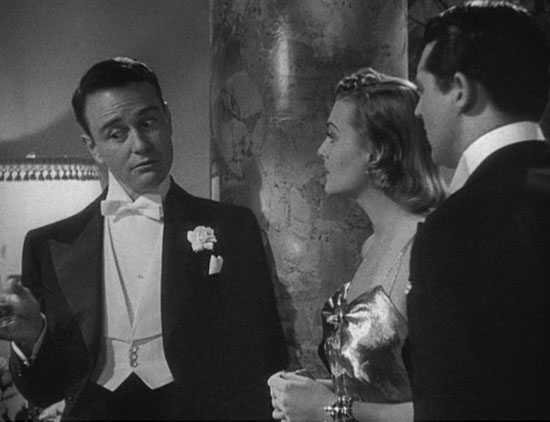
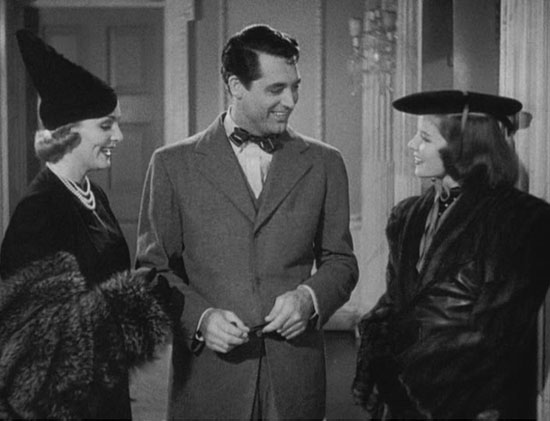
Dreamer Johnny (Cary Grant, a year after The Awful Truth) is supposed to marry Julia (Doris Nolan, who wasn’t in the movies for long) but finds that he has more in common with her sister Linda (Katharine Hepburn, a few months after Bringing Up Baby and somewhat less manic). After his upcoming vacation with fiancee and friends E. Everett Horton (Astaire’s straight man in The Gay Divorcee) and Jean Dixon (the heroine’s sister in My Man Godfrey) Johnny plans to quit his job and spend a year rethinking what to do with his life. Turns out this is quite unacceptable to Julia, who has big plans for Johnny’s career in her father’s footsteps. Out of love for the girl, Johnny nearly accepts this boring and restricted new life for himself, but wait, free-spirit Hepburn, similarly imprisoned by class/career expectations, is also in love with him, so he and she go off on holiday together.

Cary, stuck between his witch-hatted old fiancee and flat-hatted new fiancee:
image

KH impersonating her stuffed giraffe:
image

Lew Ayres (Dr. Kildare himself) plays the girls’ tragicomic drunk brother. I thought he was E. Everett Horton the whole time because it turns out I don’t know who E.E.H. is. This was a remake of a 1930 version in which E.E.H. plays the same character he does here. Katy and I liked it a whole bunch, but I was looking forward to seeing a holiday, and the movie takes place between two holidays. I thought I’d seen this before, but may have been confusing it with Charade – a color movie starring Grant and a different Hepburn filmed 25 years later, oops.

Tragicomic Lew Ayres:
image

EEH and Jean Dixon vs. the butler:
image

It’s fun to see the pre-Awful Truth days when every corporate headquarters didn’t have an Official Michael Moore Policy and when Moore was thrown out of an event not because of who he is but because one of Ralph Nader’s relatives was with him. It’s also fun to see what a good movie Moore can make when he devotes all his time and energy to a single cause instead of bouncing from one populist hot topic to the next (Columbine, Fahrenheit) or tackling issues that are too large to fit in a movie (Sicko). He stays (mostly) in Michigan, covers a couple years’ worth of plant closings, visits and revisits local people (the eviction deputy, for one) and tries to get answers from (and stir up debate against) the corporate overlords and policies seen to be the cause of the problems. We’d been meaning to watch this for a long time, and thought the week of G.M.’s collapse (and Moore’s latest email about it) made for good timing.

These days when I hear “Sam Raimi’s got a new movie” I’m not all that excited. When I hear he’s got a new horror movie it sounds slightly desperate so I’ll wait for reviews. When the reviews are all positive I run out to see it. But I am hereby calling bullshit on those reviews, because this isn’t a great movie, or a creative revitalization – it’s a generic horror flick. Alison Lohman (the lead reporter who I don’t remember liking much in Where The Truth Lies, also in Big Fish) gets gypsy curse, spends the whole film understanding then trying to rid herself of said curse, puts boyfriend (Justin “Mac Guy” Long) and spirit guide in danger (not to mention getting herself in all sorts of embarrassing situations), and so on. It’s funny/horrifying that she does get dragged to hell in the final minute, her screaming face melting off as demon claws pull her beneath the molten rocks, but the 99 minutes before that weren’t worth the payoff. What’s worse is the visual style… I don’t mind missing those Evil Dead low-budget hallmarks like the anamorphic lens spin, the stop-motion and camera-speed effects and the slow 360-degree “where’d the danger go?” pan, and I don’t miss Bruce Campbell (not after My Name Is Bruce), but these things are replaced by a movie consisting of close-ups 85% of the time, as if shot by a damned TV director or an indie neo-realist. I mean, the movie had its effective shocks and a sad/hilarious old gypsy woman and David Paymer, so I don’t regret watching it, but I do regret that it wasn’t a whole lot better.