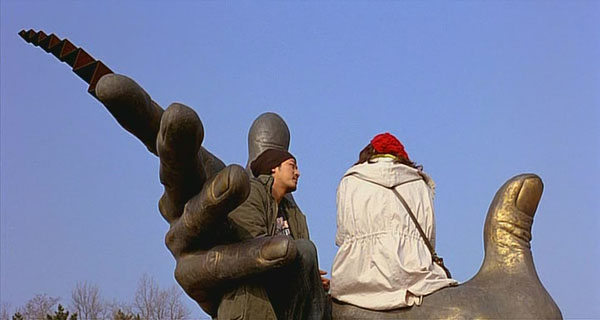
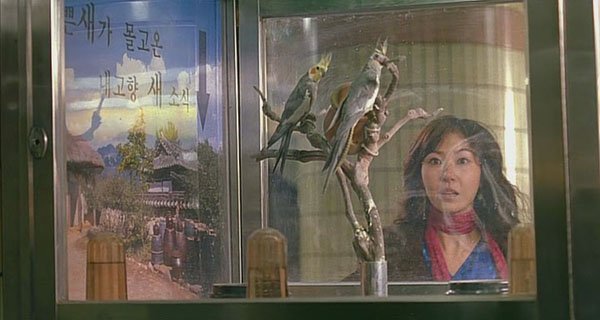
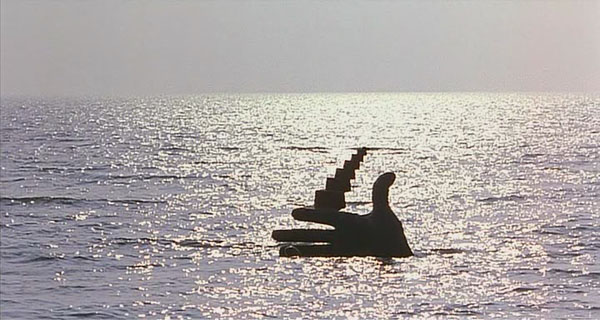
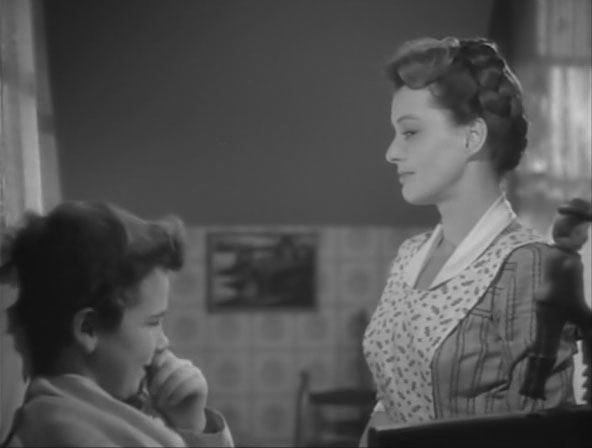
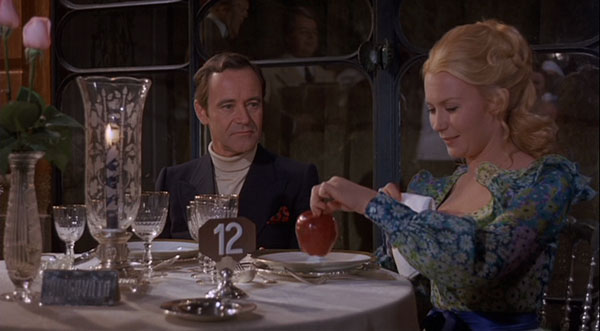
Okay, I am dumbfounded. Just gonna have to look up what others said about this. There were lavish erotic song-and-dance scenes (remember: this is the director of Goodbye Dragon Inn), watermelons, a country-wide water shortage, a friendship between a quirky girl and a porn actin’ dude, and a crazily offensive ending.

image

Apparently it was a giant hit in Taiwan. Not here, I’m guessing. Reading the rave review in Reverse Shot, I’m thinking if this was an American indie movie by a filmmaker with no history, it’d be dismissed as an amusing, well-shot quirkfest-turned-rude. I did kinda enjoy it, but the ending left me with a bad taste in my mouth (HA HA HA). So I disliked both of Tsai’s features I’ve watched, but I’ll inevitably watch more of them, because I am a big sucker.

image

M. Koresky:

If the method to all this madness seems a little hard to decipher, then the final 20 minutes are a terrifying crystallization. The mild courting between Lee and Chen finally intersects with the pervasive sexual exploitation going on upstairs. Yet Tsai’s final, truly shocking images are not bolstered by casual moralizing; rather, we realize we’ve been watching the literal deterioration of a civilization. It’s in the face of Chen Shiang-chyi, and her growing moral awareness, that Tsai finds his emotional outlet. In one of the film’s sole moving shots (if not the only one, but only a second viewing can corroborate this), the camera creeps ever closer to her horrified face as she watches a particularly nasty porn scenario being enacted on the other side of a windowed wall. Her witnessing isn’t voyeurism as much as it is coming to terms with social decline (which she had been staving off through out the rest of the film, endlessly re-filling bottled water and hoarding melons). Here there is no way to reclaim what’s been lost; her head becomes nearly literally impaled on a penis. Nearly dystopic in its portrait of decline, The Wayward Cloud shows Tsai giving up a little restraint. It may be slightly out of control, but the mess suits Tsai well.

image

A.O. Scott:

Mr. Tsai’s placid camera seems unusually restless; the number of zooms and pans reaches double figures. At least as shocking are the fantastically costumed, sloppily choreographed musical numbers, by far the noisiest and most kinetic moments in his oeuvre. These departures, and the explicit sex, suggest an impulse to break new formal ground, but they are also evidence of imaginative fatigue.

Hsiao-Kang was selling watches on the street in “What Time Is It There?” when he encountered Shiang-chyi (Chen Shiang-chyi). In “The Wayward Cloud,” Shiang-chyi has returned from Paris (or so we must infer) to a drab apartment building in Taipei. She spends her time scavenging for water and inhabiting the wide, static shots that are Mr. Tsai’s most consistent signature. She and Hsiao-Kang cross paths and edge toward a glum, twitchy romance, consummated in a final sequence that has already become something of a conversation piece.

With this scene, Mr. Tsai joins the ranks of filmmakers — not all of them French — who have trampled the boundary that separates simulated on-screen sex from the real thing. (A long close-up erases any ambiguity …) But the display is less shocking for its sexual frankness than for its aesthetic crudity. It feels willed, aggressive and unconvincing — clammy rather than cool — in a way that suggests artistic frustration rather than discovery. The water shortage may be a metaphor for the director’s creative desiccation, which his admirers can only hope is temporary.

image

K. Uhlich:

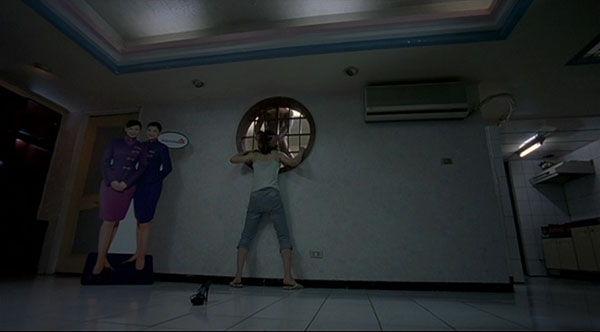
Tsai’s comical sense of alienation, heightened by several ribald musical interludes, makes for uneasy bedfellows with his politically charged and quite baldly apparent thesis: that Taiwan itself is a wayward cloud, trapped between various and sundry pan-Asian interests and influences. If that reads as didactic as it felt to write then we’re one step closer to grasping the film’s highly problematic nature, not that Tsai makes much of an attempt to cloak it. One need only look at the infamous final sex sequence (which, in addition to Lee and Chen, features a comatose Japanese porn star and a Chinese airline stewardess cutout—theoretical signposts both—placed perfectly on opposite sides of a dividing wall) to experience the solidity and conviction of Tsai’s intent.

image

N. Lee:

The Wayward Cloud’s sexual explicitness goes hand in hand with a shift from nuanced melancholy and stealth monumentalism toward garish, befuddled negativity. The result feels … ill-suited to Tsai’s delicate sensibility. … Tsai newbies are encouraged to start anywhere but here and work their way though the contemplative angst of Rebels of the Neon Gods, the plaintive geometry of Vive L’Amour, the moist musical apocalypse of The Hole, and the chic sentimentalism of What Time Is It There?, the most overrated of Tsai’s films, yet an essential prelude to the hardcore what-the-fuck (and why-the-fuck, and who-the-fuck) of The Wayward Cloud.
image

“Will they lead the same sorry lives that we have?”

image

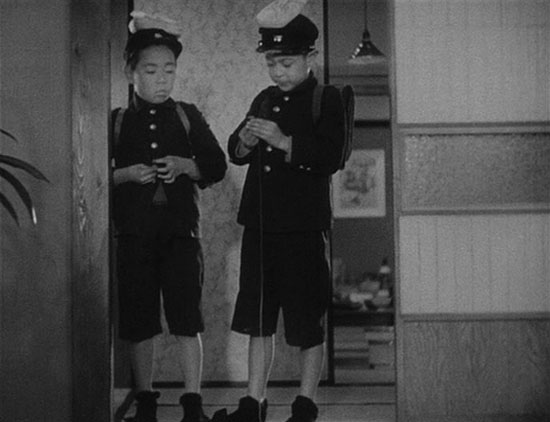
The Eclipse box set title is “Three Family Comedies” but I’d forgotten that Ozu even made comedies until the opening titles played over a drawing of a kid holding his crotch. Then my realization “oh, this will be a zany comedy featuring kids doing dirty stuff” turned out to be off base. Sure, kids are the protagonists, and it features some comedy, but it all leads to the quote above (spoken by the kids’ father) which belongs firmly in drama territory.

image

Dad’s got a new job so he moves the family close to work. Actually he moves ’em into the suburb where his boss lives, and it comes out later that dad is kind of a suck-up. The kids are intimidated by a pretty mild gang from their school until they learn to use their wooden shoes as weapons and they dominate the group. It’s kinda like the beginning of 2001: A Space Odyssey but with Japanese schoolchildren instead of apes.

image

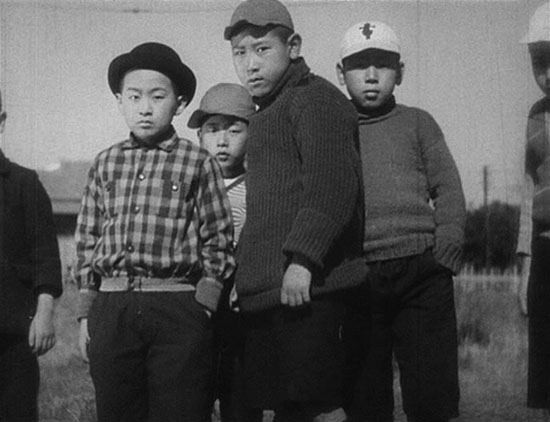
Most of the movie seems to be this low-key power struggle with the kids which includes searching for sparrow eggs to eat raw (to prove strength) and trying to get an ‘E’ (for ‘excellent’) in calligraphy at school. A scene at the boss’s house is the turning point. Everyone is watching the boss’s home movies in which our kids’ dad is making funny faces and cracking everyone up – everyone but his kids who are ashamed that their father is playing the fool. The older boy (Ryoichi) goes home, calls dad a yellowbelly and trashes the house until he gets spanked. Moods improve later and the movie ends with the kids relatively cheery again and getting along with the boss’s son (who dresses like Oddjob).

image

One scene I didn’t get: the bully kids find a valuable coin, pool their money to make change, then hand over the change to a policeman and walk away bummed out. What happened?

image

A scene in dad’s office where the camera follows a contagious yawn made me yawn too. Yes, there is camera movement in an Ozu film. Movie is obsessed with trains and streetcars too – there’s one passing behind the action whenever possible.

image

Apparently Ozu’s Good Morning nearly thirty years later was a semi-remake.

TCM:

I Was Born, But…, which Ozu developed from his own story, is a social satire of comic delights and melancholy resignation to the innocence lost as the boys face up to the compromises that await them. The film won first prize at the Kinema Jumpo awards – the first of six such prizes he would eventually win – and is regarded as Ozu’s first genuine masterpiece.

Michael Koresky:

“I started to make a film about children and ended up with a film about grown-ups,” said Ozu, speaking to the film’s dark side. Because of this, Shochiku didn’t know what to do with the picture, even delaying its release for two months. This potent mix of comedy and pathos within the domestic space would, of course, continue to dominate Ozu’s oeuvre in the coming decades—and while the age disparity between the generations would grow smaller, the resentment gap would grow even wider.

Ringleader Lauren Bacall (pre-Written on the Wind) rents a super-expensive apartment (belonging to a millionaire on the run because of tax troubles, played by David Wayne of Losey’s M remake, but that’s only barely important) along with friend Marilyn Monroe (four months after Gentlemen Prefer Blondes) and hanger-on Betty Grable (post-The Beautiful Blonde from Bashful Bend, in one of her final film roles). They’re all attractive models, so the idea is they’ll start frequenting hangouts of the rich and famous in order to, duh, marry a millionaire. I thought the point of the apartment was men coming over to pick them up for dates will think they’re already wealthy (not gold-diggers) but when it takes longer than expected to get hitched they sell all the furniture to pay their rent, so the place looks kinda desolate.

image

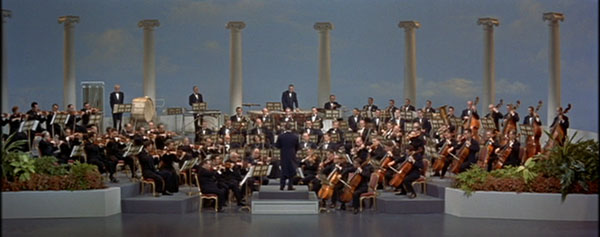
I thought the movie would be a musical, especially when it opened with an overture – but Katy thinks that was just to show off the mighty Cinemascope process (D.P. Joseph MacDonald would later shoot ‘scope favorites House of Bamboo and Will Success Spoil Rock Hunter), and I thought it might’ve been a prestige thing for extremely oscar-winning composer Alfred Newman (father of Thomas, uncle of Randy). Looks like Katy was right – this was the first Cinemascope movie to be filmed (though somehow it was released second, after The Robe). Anyway, not a musical, just a girl comedy.

Cinemascope!!
image

Bacall is being stalked by Cameron Mitchell (Hell and High Water, Ride in the Whirlwind), who she suspects to be a gas pump jockey but is really one of the richest men in the world (she finds out after they’re married… oh, the 50’s).

A lotta Marilyn:
image

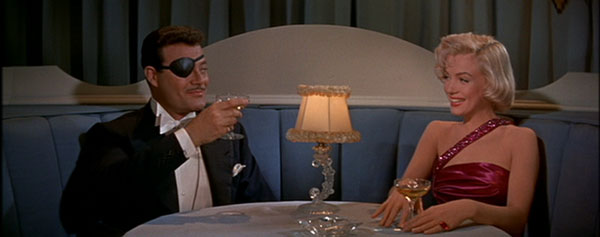
The movie would’ve been 50% better without Betty Grable, whose every scene is annoying. She goes off to a cabin with a married man then gets all whiny about it then catches the measles then falls for a forest ranger. Her character was the stupid one, a welcome change for Marilyn I’m sure – though M. wasn’t too bright either. Marilyn’s gimmick is she’s blind without her glasses but vainly refuses to wear them. She gets involved with a fake-eyepatch-wearing scam artist while Bacall flirts with an elder William Powell (he’s still got the mustache), who invites them to the party where Betty meets the married guy – I’m way out of order now. Anyway, Bacall almost marries Powell but they call it off with a few minutes to spare because she’s not convinced by her initial millionaire-lust anymore and she’s in love with her gas jockey. Also, Marilyn marries David Wayne at some point.

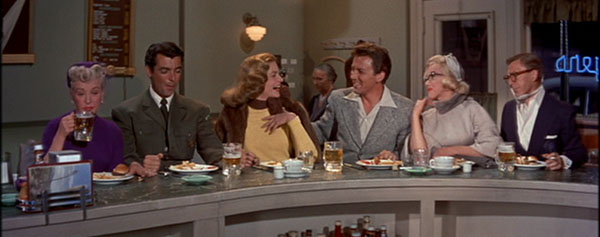
The girls with their false-alarm boyfriends:
image
image
image

Cute movie, better than it looked like it’d be, but nothing brilliant. TCM agrees, “entertaining but insubstantial.” Director Negulesco also made the 1950’s Titanic and writer/producer Nunnally Johnson wrote some John Ford films in the 30’s and 40’s.

The girls with their new husbands:
image

“Sorry for always having the same boring face.”

image

Ji-woo is a guy with a bitchy, paranoid girlfriend who thinks he’s lost interest in her so she decides to get massive plastic surgery.

image

Months after her sudden disappearance he starts dating this new girl who is actually his old girl Seh-hee with her new face. She doesn’t know how to respond… if you’re super-jealous and your boyfriend is attracted to you in disguise, are you happy or angry?

image

It’s not working for them, so he disappears and gets a new face as well.

image

He never identifies himself, so she spends a year wondering if everyone she meets is him – finally chases down a guy who she’s sure is her man until he runs into traffic and gets killed.

image

She runs back to the plastic surgery place, bumping into herself from earlier in the movie. A weird ending. Seriously good movie though, moving and beautiful. Spiritually more in the vein of his 3-Iron with some of the outrageous craziness of Bad Guy, but none of the mad crappiness of that one.

image

M.Z. Seitz:

Mr. Kim flips between soapy melodrama and dry, self-aware comedy. The effect is thrilling and disorienting, like walking on a trampoline. … Time has been described as a comedy about the hollowness of relationships in a global consumerist culture, and it certainly is. The film’s three lead performances, by Mr. Ha as Ji-woo and by Ms. Seong and Ms. Park as the two incarnations of his lover, are fearlessly honest, so attuned to contemporary anxieties about sex, love and social status that the characters’ unhappiness is as squirm-inducing as the movie’s close-ups of sliced flesh. But while the film’s cultural context is of the moment, its depiction of romantic desperation is timeless. Many scenes end on the same uneasy note, a mix of cynical dissatisfaction and desperate, almost childlike neediness.

M. D’Angelo:

That both Seh/See-hee and Ji-woo actually talk—there’s more dialogue here than in all of Kim’s previous films put together—is something of a mixed blessing. On the one hand, the mute shtick, introduced in The Isle and honed in Bad Guy, 3-iron, and Spring, Summer, Fall, Winter . . . and Spring, was getting decidedly stale. On the other hand, ordinary human conversation is clearly not Kim’s forte. Seh-hee’s initial fit of jealousy, in particular, is so cartoonishly strident that it sets entirely the wrong tone, giving the impression of a poor shmuck tormented by a vindictive harpy.

Those aware that cosmetic surgery is endemic in South Korea are liable to jump to the conclusion that Kim intends Time as some sort of clumsy exposé. But he didn’t choose that title lightly. Save for a clinical opening-credits sequence, the film’s incisions are exclusively psychosexual. Duration’s corrosive effect on long-term relationships has rarely been depicted with such bracing candor. Simply put, Time is about the eternal war between infatuation and familiarity, and our irreconcilable need to find both in the same person. In other words, it’s a parable about the root of human unhappiness.

Written by Dave “Staggering Genius” Eggers and his wife.

Maya Rudolph (whom I sorta halfway remember from Idiocracy) and John Krasinski (who I totally don’t remember from Smiley Face) star (star!) in an uplifting family comedy from Sam Mendes. Family! Comedy! Sam Mendes! Yes, somebody is dumped and another couple is working through their fifth miscarriage, but our doom-proof heroes walk through it all, unencumbered by hostility or financial need, all the way to their happy ending.

Starpower: Catherine O’Hara and Jeff Daniels play John K.’s parents in one scene, Maggie Gyllenhaal is hilarious as a former friend gone hippy-dippy stroller-phobe with her new-age guru husband, and Allison “Juno’s mom” Janney is Maya’s caustic, terrible ex-boss.

Movie made Katy and I feel good.

Poyraz (2006, Belma Bas)
Rural people sure live quaint and handsomely photographed lives!
Nuri Bilge Ceylan was thanked in the credits

Why Play Leapfrog (1949, John Sutherland/MGM)
Let’s hear it for capitalism! Clever cartoon describes why inflation is okay and raw material costs don’t mean much. A boring explanation of why America is so darned great that ends by telling factory workers to be more efficient and come up with smart cost-saving ideas which will lead to greater pay increases.

Balance (1989, Christoph & Wolfgang Lauenstein)
Ominous stop-motion – five mute guys with numbers on their shirts and telescoping fishing poles in their shirts are on a balanced platform suspended in space. One catches a sort of music box and the others get greedy, leading to a fight which ends with one guy on the far end of the platform from the box.

Broken Down Film (1985, Osamu Tezuka)
It’s a popeye-like cowboy cartoon except that the film’s projection problems (hair in the gate, scratches, countdown leader, etc) are part of the story. Cute.

and a few from the Unseen Cinema box set…

Paris Exposition Films (1900, James White)
Some one-minute films at the Eiffel Tower a decade after its construction. Best part is this guy on the left side of the screenshot. People were walking up to the camera and this guy saw his chance for stardom, so he prepares himself for some manuever (maybe a backflip) but blows it, stopping instead to shake hands with an acquaintance offscreen as the film runs out.
image

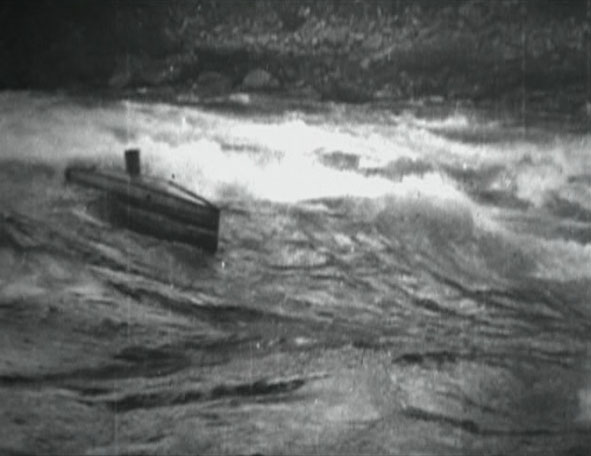
Captain Nissen Going Through Whirlpool Rapids, Niagara Falls (1901, Edison Co.)
It takes longer to type the title than to watch the film, which is of some submarine-looking craft bobbing in a river. Found a wonderful tale online of Nissen’s stupid death four years later, but unsure if it’s true.
image

Down The Hudson (1903, Frederick Armitage & AE Weed)
Much more interesting than the submarine thing – New York riverfront over a hundred years ago. I assume lots more of this stuff will be on disc five.
image

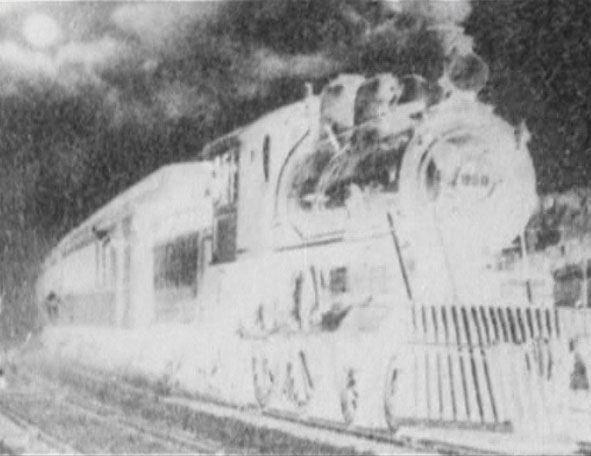
The Ghost Train (1903)
Oooh, someone learned to invert the black/white image AND to matte a moon into the upper corner. This is one of my favorites because it is neat-looking and twenty seconds long. If only you could say the same for Transformers 2.
image

Westinghouse Works, Panorama View, Street Car Motor Room (1904, Billy Bitzer)
Long factory tracking shot reminds me of the beginning of Manufactured Landscapes. Unlike in ML, all the workers stop and look at the camera.
image

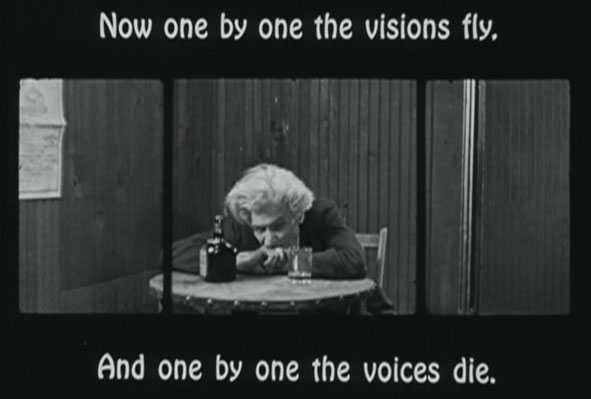
In Youth, Beside the Lonely Sea (1925-ish)
Crazy three-panel layout illustrating the poem told with text above and below the picture. Lots of ghostly superimpositions. This was so damn cool I had to lay down for a while.
image

image

June 2014:
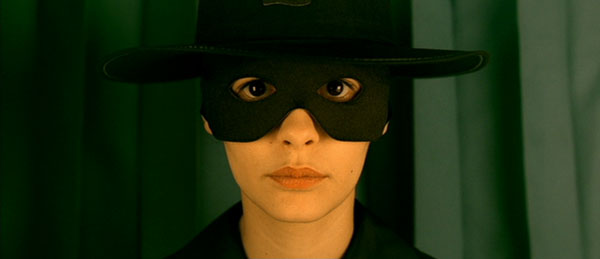
From a year when I was watching more movies than ever, and starting to get obsessed with my favorite filmmakers. Visually distinctive films that became instant all-time faves included Mulholland Drive, Pulse, The Royal Tenenbaums, Artificial Intelligence, Monsters Inc., Donnie Darko, Winged Migration, and Amelie. I’d caught up with Jeunet’s previous features on video (including the brilliant Alien Resurrection), always impressed by the atmospheric fantasy worlds, rube goldberg devices, intensely detailed production design, playful editing, cartoon camera angles and rubber-faced Dominique Pinon. With Amelie, he took his fantasy visions and hurled them into the present-day real world, creating a romance flick that keeps forgetting to be romantic because it (like the protagonist) is too easily distracted by everyday wonders.

July 2009:
image

image

The cigarette-counter lady in Amelie played a lead in Not On The Lips. She did look awfully familiar.

Our narrator was the VHS-watching realtor in Hearts/Private Fears

And holy crap, Katy knew just from the trailer that the veggie-stand guy starred in Angel-A.

image

image

Another post-Civil-War American small-town drama – I kept flashing back to John Ford’s Judge Priest movies. Our hero this time is more priest than judge. Pastor Joel McRae (I’d forgotten he was a cowboy actor when not appearing in Preston Sturges films) comes to town in the wild old days, marries Ellen Drew (same year as Baron of Arizona, still the queen of not making a strong impression) and whips the town into shape.

image

A bunch of years later they’ve inherited a nephew (13-yr-old Dean Stockwell), our protagonist who shows us around the rest of the colorful town. They’ve got a friend called Uncle Famous, there’s a guy named Chloroform (his mom liked the word), Alan Hale (father of the Skipper) is hardworking but godless farmer Jed, and Pastor Joel’s best friend is the town doctor (Lewis Stone, better known as Andy Hardy’s dad). Well, when the doctor dies his son takes over as doctor, and the son doesn’t like mixing his scientific work with the pastor’s religious work.

Serious young doctor (dancer James Mitchell) with love interest Amanda Blake (later a Gunsmoke star):
image

There’s lots of work for doctor and pastor since young Dean catches typhoid fever from the school well and soon all the kids in town have got it. The pastor cancels church service to avoid spreading disease, and the new doctor becomes the prime influence in town; people stop calling for the pastor’s services. Joel gets a little credit for eventually finding the source of the illness and alerting everyone, but maybe he could’ve talked to his son sooner. Kids were thought not to have any information worth knowing in the 40’s-50’s, let alone the turn of the century.

image

More trouble: Uncle Famous (Puerto Rican Juano Hernandez, later of Kiss Me Deadly) is being menaced by a mine owner who first offers to buy Famous’s land for more than it’s worth, then trashes the place and ruins his crops and offers to buy it for less (farmer Jed helps him rebuild), then sends the KKK cross-burning lynch mob after him. Big climax comes when pastor Joel protects Famous by reading a fake will deeding all his possessions to the masked mob members, shaming them into going home.

image

image

image

Happy ending: Famous is safe, the illness is passing, doctor and pastor are reconciled and Farmer Jed and his family all come to church the next sunday.

Early in the movie Jack Lambert is a town bully – but instead of a Forty Guns situation, after Joel McRae whups his ass into the mud he sits and laughs. We’re all still friends here. Nicely sets the tone of the town – even the bad guys here are good at heart – which makes the klan-turnaround ending ring more true.
image

I can’t tell much about Tourneur judging from this and Out of the Past and Cat People – all very different but quite good movies. It’s weird watching this so soon after The Sun Shines Bright – another post-civil-war movie named after a song lyric and featuring people playing Dixie and a racial-barrier-crossing white authority figure. Safe to say I liked this a whole lot, even if I’m not anxious to watch it again.

M. Grost:

Stars in My Crown contains a ferocious attack on racism. It is one of the boldest of the post-war films, that supported the growing Civil Rights movement of the time.

This film is like Out of the Past, in that it shows evil forces laying siege to people in small towns. Both towns are idyllic places, filled with small businesses and homes. In both towns people love to fish, something that is treated as a source of friendship between grown-ups and kids. But the gangsters of the one film, and the typhoid and race hatred in the other, threaten to destroy the possibilities of harmony.

[Tourneur] is as exhaustive as Fritz Lang, in trying to find every interesting image possible in a scene, then staging the scene around it.

Not the last film by Billy Wilder, though it feels like someone’s last film – he later made two Lemmon/Matthau comedies and a William Holden drama.

Katy disagreed with the romantic comedy term, saying just because a few funny things happen doesn’t mean it’s a comedy, and suggests the term dramedy as a solution. Long, static master shots are probably praised to the heavens by the critics responsible for landing this on the TSP1000 list for being elegant, masterfully composed, or god forbid, “rigorous”. I found that it sucked energy away from a too-slow movie, which was already disappointing for not being a comedy as advertised. That’ll teach me to trust the IMDB genre listings.

One of multiple chances to see Jack Lemmon naked:
image

Okay, so it is a comedy, it’s just not very funny. Jack Lemmon travels to a vacation resort in Italy to pick up his father who died in a car crash and he meets Juliet Mills (mostly a TV actress, but she’d starred in a British comedy film a decade earlier) who is there to pick up her mother who died in the same crash. Jack is acting like a terrible, entitled jerk American but Juliet finally manages to corner him and tell him that their parents were having an annual affair at this hotel. It’s only a matter of time before she softens Jack and begins carrying on their parents’ affair with him – not that she does much besides smile and look like she’s having a great time. Oh, and there’s a half-hearted side plot when the Trotta family whose grapevines were destroyed by the car crash steal the bodies for ransom.

The Trotta family:
image

The hotel maid is your typical fiery, hot-tempered, lovestruck movie Italian woman – she kills her husband (boyfriend?) for plotting to leave her, so when a U.S. government man shows up to help Jack, acting like the asshole Jack had been seventy minutes prior, Jack gives the guy a coffin with the dead Italian in it, and he and Juliet bury their parents together in Italy. It’s actually kinda sweet. “Avanti!” we learn at the beginning means “come in!” for door-knocking servants and hotel personnel, and inevitably for our romantic couple.

A big deal is made of Juliet being overweight:
image

Carlucci, who runs the hotel and makes sure Lemmon has everything he needs, was played by Clive Revill, a New Zealander in a fake mustache who went on to voice the Emperor in Empire Strikes Back. Crude American diplomat Edward Andrews’ final role was in Gremlins. And at least one of the vineyard Trotta family was in a Fellini movie.

Carlucci with Jack:
image