One more Criterion musical watched after last month‘s spree, and this one has the most interesting story. Envisioned as an On The Town sequel with Gene Kelly, but Sinatra and Munshin got replaced by Michael Kidd (choreographer of Seven Brides) as a short burger chef and Dan Dailey (Ethel Merman’s partner in There’s No Business) as a tall corporate sadsack. The three play war buddies who promise to reunite after ten years, and they come through but don’t like each other/themselves much anymore. Through Dan’s advertising job their story catches the attention of Cyd Charisse (her boxing-ring song is the best scene), who tricks them into appearing on live TV with overbearing host Dolores Gray (Kismet the same year). The show coincides with boxing promoter Gene Kelly’s ambush by some gangsters angry that he has messed up their fixed fights, the cameras catch the ensuing brawl and confession, and the guys realize that they still like each other/themselves as long as violence is involved. A drunken dance with trashcan-lid shoes goes on for hours, and Kelly shows up Melvin with a roller skate dance where you can tell the skates aren’t locked.
Author: Brandon
Brandon's the guy who runs this site.
American Factory (2019, Bognar & Reichert)
See, when I stay consistently five weeks behind on the blog, I lose all the details, and can only say that we watched the doc where the Chinese company reopens a closed American factory, and their different cultures and approaches to work and management and safety cause many funny and poignant moments, which is the same thing I would’ve said from the trailer or plot description. But truly, we watched this, and it was good. We were surprised that the Fuyao CEO allowed the film crew access to his visits and conversations, and to visit the Chinese factory. Reichert has been making docs for fifty years, Bognar for thirty, and now they’re oscar-nominated for filming the reopening of the same factory they were oscar-nominated for filming shutting down in late 2008.
For Sama (2019, Waad Al-Kateab & Ed Watts)
The award-candidate docs returned to the Landmark, and we caught up with this and Honeyland, and watched American Factory at home – and all three got oscar nominations a week later. I was in a terrible mood after watching the reporter/activist filmmaker and her doctor husband try to raise a baby and run a hospital in an Aleppo warzone while losing all their friends and neighbors to bombings, and so didn’t properly appreciate the playful carnage of John Wick 3 when watching it some hours later.
John Wick 2 & 3 (2017-19, Chad Stahelski)
John Wick Chapter 2 (2017)
A cigar-chomping, weirdly Jon Benjamin-looking drug lord awaits the return of Wick, who steals back his car and immediately totals it. Then Wick calls John Leguizamo to fix the car, and buries his guns under concrete – gonna be a peaceful movie!
“No one gets out and comes back without repercussions.” Oops, Wick is retired and refuses to honor some old blood oath with a dude named Santino (Italian Riccardo Scamarcio of Loro and Go Go Tales), so baddies blow up his house – but the dog survives this time! Back to the hotel, Cedric Daniels shows him to Ian McShane.

Off to Rome, which also has a Hotel Continental – the movie is expanding its mythology to Avengers-level proportions. Also, Wick is “the ghost, the boogeyman,” but wherever he goes everyone knows him by name. Sent to kill mafia boss Gianna (Claudia Gerini of an upcoming Diabolik remake), he gets new guns from Peter Serafinowicz and bulletproof suits, meets Franco Nero, then goes to a rock show (like a more chill Sleigh Bells) and follows Gianna to the hot tub, where she helps him execute her. This doesn’t go over well with her bodyguard Common, and after an exhausting fight where Wick videogames dozens of dudes, they end up back at the hotel.


Open contract on Wick, underground homeless anti-assassin league, a couple of boss fights with handheld weapons. I dug the silencer shootout, but the Lady From Shanghai hall of mirrors ending is really something special. Big news, Keanu getting (expensive) assistance from his Matrix costar Larry Fishburne. Finally, the movie’s mythology is strong, since the only time I felt shocked was when Wick shot the baddie on sacred Continental ground.


–
John Wick Chapter 3 (2019)
“We’re the same, you know.”
Wow, I’d just finished watching Chaplin shorts, and this opens with a Buster Keaton scene projected on the side of a building, which I suppose connects the ensuing motorcycle chase/crash to the slapstick tradition. Picks up exactly where the last one left off, a wounded Wick given an hour headstart before every assassin in the world comes after him. Ian and Larry and Cedric are gonna be fired for collaboration, but if Wick can complete a task for the Nomad King, his excommunication will be reversed… along the way we meet Derek, Halle Berry, Anjelica Huston, boss of bosses Asia Dillon (Billions), and one of the stars of Double Dragon.

I dunno, I was in a bad mood. It seemed like part 2 opened the Wickiverse further, then part 3 closed it abruptly, becoming a parody of itself (I also wrote “movie promotes fascism”). It’s more videogamey than ever – of course Wick teams with Ian and Cedric for a climactic shootout against faceless bureaucrat invaders, but the writers seem like they’re either making this out of contractual obligation or they’ve developed a bad drug problem since the last one. The lighting is the main thing it’s got going for it – super cool lighting.
Blood and Black Lace (1964, Mario Bava)
I felt bad for skipping Bava this Shocktober – it’s been a near-annual tradition to watch one of his overrated movies – so I watched this in December to cool down after A Hidden Life. Extremely cool opening titles, at least – bold colors in low light, each actor posing for their credit with mannequins and flowers and birdcages. Maybe I should quit while I’m ahead…
We open with Drug Fiend Franco (Dante DiPaolo, a townsman in Seven Brides) bothering model Nicole outside a fashion house. “Have you tried asking Isabella,” she suggests, and in the next scene Isabella is battered and murdered by a faceless rorschach dude.
Isabella’s final stroll:

Fun scene where Nicole finds her late friend’s diary, tells everyone, then each person in the room wordlessly conveys “I am gonna steal that fuckin diary.” You see, they are all druggies and criminals with guilty consciences, which makes them all potential killers or victims – very Knives Out. Nicole goes to Franco’s house, which is infested with fancy furniture and vases, where the killer flicks the lights off and on, and somehow sneaks up on her wearing a suit of armor. I lose track of which beautiful woman is which for a while, as they’re all murdered by Rorschach… spiked glove to the face, hot furnace to the face, pillow to the face, you name it.
L-R: someone (Cristiana?), designer Cesare (Luciano Pigozzi of Exterminators of the Year 3000), Franco, Nicole

The police arrest all the men, but the killings continue, so the investigator gives up, and multiple-murderers Cristiana (Hungarian Eva Bartok in her final European role before retirement) and boyfriend Cameron Mitchell (four years before Ride in the Whirlwind) celebrate getting away with it… after one more murder, which they pull off, but then turn on each other.
Recovering the diary that doomed Mary Arden tried to destroy:

Mad killer Cristiana:

One could call this the finale in Mario Bava’s Black Trilogy after Black Sunday in 1960 and Black Sabbath in 1963, except that these are fake titles invented by U.S. distributors, and also Bava made six other movies in between. This one was actually named something like Six Women for the Murderer.
A Hidden Life (2019, Terrence Malick)
“Don’t they know evil when they see it?”
“We are used to it now.
Main guy is August Diehl (title star of The Young Karl Marx) and wife Fani is Valerie Pachner, whose The Ground Beneath My Feet premiered a few months earlier. Very happy to see Franz Rogowski as a fellow prisoner in the second half – that guy is in both of my favorite movies of 2019.
Bilge Ebiri in Vulture:
You won’t find the delirious, extended montages of Knight of Cups or the galactic scope of Tree of Life here. Instead, Franz winds up in a series of almost philosophical dialogues, with priests, bureaucrats, prisoners, neighbors. Actually, it’s probably more accurate to call these loose monologues, since Franz remains mostly quiet throughout. But his very presence poses a question to these individuals about the problem of evil. “Which side are you on, and why?” he might as well be asking.
After Franz’s execution, the town seems to behave more tenderly towards the new widow. This is either my wishful thinking or Malick’s, since Bilge says of the real family: “the Jägerstätters were treated as outcasts and traitors by fellow Austrians well into the 1990s.”
Khrustalyov, My Car! (1998, Aleksei German)
The opening abduction scene will make more sense eventually, and even then, it wasn’t until I started playing the commentary that I could say with any confidence what’s happening in the open. The household scene that follows quickly reminded that we’re in the hands of the Hard to be a God director – full of movement and talking, bustling activity in every corner of long roving camera takes.

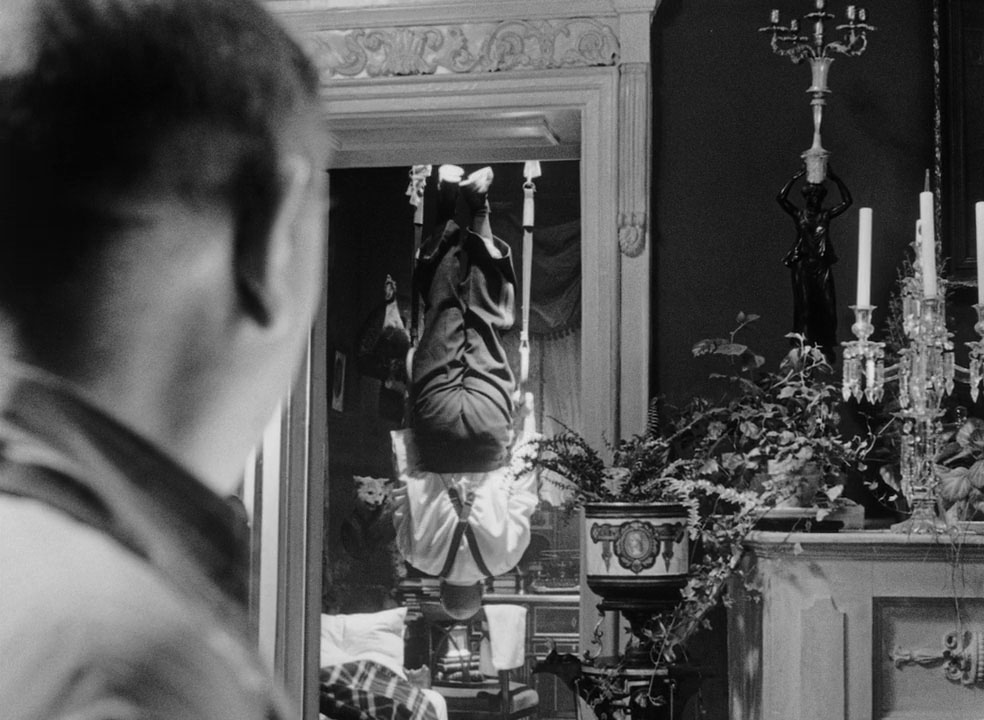
Yuri is a military doctor in 1953, bald with a mustache, an important man who will be brought low by forces that we twenty-first-century non-Soviets can hardly fathom without audio explanation. It’s sure entertaining though, and practically as foul and brutish as God. Sound effects are good – dubbing is bad, but I’m constantly checking subtitles since the movie never shuts up for a second, so we’ll call it even.
Birdie!

Learned from the commentary: the movie is in two parts since they could get double budget if it was submitted as two films. One character with a cane umbrella would be seen as a hilarious foreigner by Russian audiences since he wears galoshes. There are major literature and poetry references throughout (I caught Viy and Sadko). German didn’t look through the camera viewfinder or select lenses, considered cinematographer Vladimir Ilin a co-author of the film, “the lighting cameraman has to be an artist too.”


The doctor gets home, but his son in voiceover says he never saw his father again… there was a double in the film, being trained what to say in case he was captured, and other doubles and siblings, so maybe I got some characters confused, and I only played the first hour of the commentary. It involves antisemitism, the death of Stalin, and a scandal called The Doctor’s Plot, which refuses to make sense no matter how much I read about it. To be clear though, the movie’s power comes through fine even not knowing what’s happening – in fact, I wonder if it’s the whole point not to know. “Poetry floats up in my memory like sailboats in the fog, along with salami.” The doctor ends up on a train, tormenting the abducted man from the opening scene, and looking intense:

German:
Another part of the population was starving in the gulag, but we ignored that reality; we only knew ours, and I can assure you that from that point of view, living in a totalitarian regime isn’t all bad. People who don’t want to know lead an adorable life. That’s why even today a lot of people in our country yearn for totalitarianism.
Booksmart (2019, Olivia Wilde)
I had low expectations because of Olivia Wilde’s tiresome Regal Cinema shorts, which I’ve started using as an opportunity to check twitter before the feature begins, to make sure we haven’t gone to war, or that someone in the movie I’m about to watch hasn’t been caught sexually harassing anyone. But this was good!
It’s not perfectly realistic (WAY too woke, per letterboxd), but is Better Off Dead realistic? Granted, Booksmart is no Better Off Dead – it’s just a version of the only high school movie plot that screenwriters can think of (loser has limited time to get a date with crush) but it’s girls this time, one of them is gay, and they end up with different people than they intended. It’s supposed to be extra-funny that the shitty villain from Colossal plays their principal, but I’m not sure why – Katy says he’s married to the director.
Writers include David Mamet’s PA, the creator of a TV show where Kyle MacLachlan plays “Dr. Frost,” the writer/director of The Spy Who Dumped Me, and the writer of the upcoming Tom & Jerry reboot, which I dearly hope will look like that Lion King remake.
Berlin and Opus I-IV (1920’s, Walter Ruttmann)
Berlin: Symphony of a Great City (1927)
Opens with exciting abstractions, sunrise and shapes seen through blinds, then we catch a
train into Berlin and it chills out for a while, the depopulated city reminding me creepily of In My Room before people start to wake up and head to work (more trains), then the movie amps up again, the mass production lines looking very much like the ones I see on the Machine Pix twitter feed 100 years later. This movie probably works better as a city-story than Man with the Movie Camera does, though I love the fanciful effects and meta-scenes of the latter.

German Harold Lloyd:

In act II, telephone users and operators are compared to chattering monkeys and fighting dogs. I’d noticed a brief animal comparison in act I and shrugged it off, since a “symphony of a great city” wouldn’t do that to its people? Lunch, siesta, play – then hurry back to work, with a focus on newspapers. Motion of the day is exaggerated by strapping a camera to a rollercoaster.


Ruttmann died in WWII. He worked with Lotte Reiniger and Leni Riefenstahl, apparently knew Oskar Fischinger, and made a dream sequence in Fritz Lang’s Die Nibelungen. Music by Eisenstein collaborator Edmund Meisel, cinematography by Murnau’s DP Karl Freund, conceived by Caligari writer Carl Mayer – everyone in silent cinema knew each other.

I also watched Ruttmann’s earlier Opus series…
–
Opus I (1921)
Ghostly motion blobs against a dirty dark background
About four different motions, mirrored, colored and repeated
A third of the way through, new shapes and variations, and more at a time
Next part adds dyed searchlights and sun pendulums and tumblecubes
The shapes never quite interacting, just almost

–
Opus II (1921)
The same shapes on more charcoaly textures, and with more interaction between shapes
Black and white with some soft blue and a shock of red towards the end

–
Opus III (1924)
Some new cube overlays and color pulsations look almost 3D
Factory-machinery rectangles then a blue field with 3D blob rotation in the center
The same Red ending as II

–
Opus IV (1925)
Pulsing horizontal blinds with walking verticals mixed in later – faster and faster till pale purple blobs take over, then the traditional red ending. More advanced music on this one, by Helga Pogatschar – I hadn’t noticed that each film has a different musician. Rewatching the opening of Berlin, there are the blinds and the blobs, like a mini Opus V.
