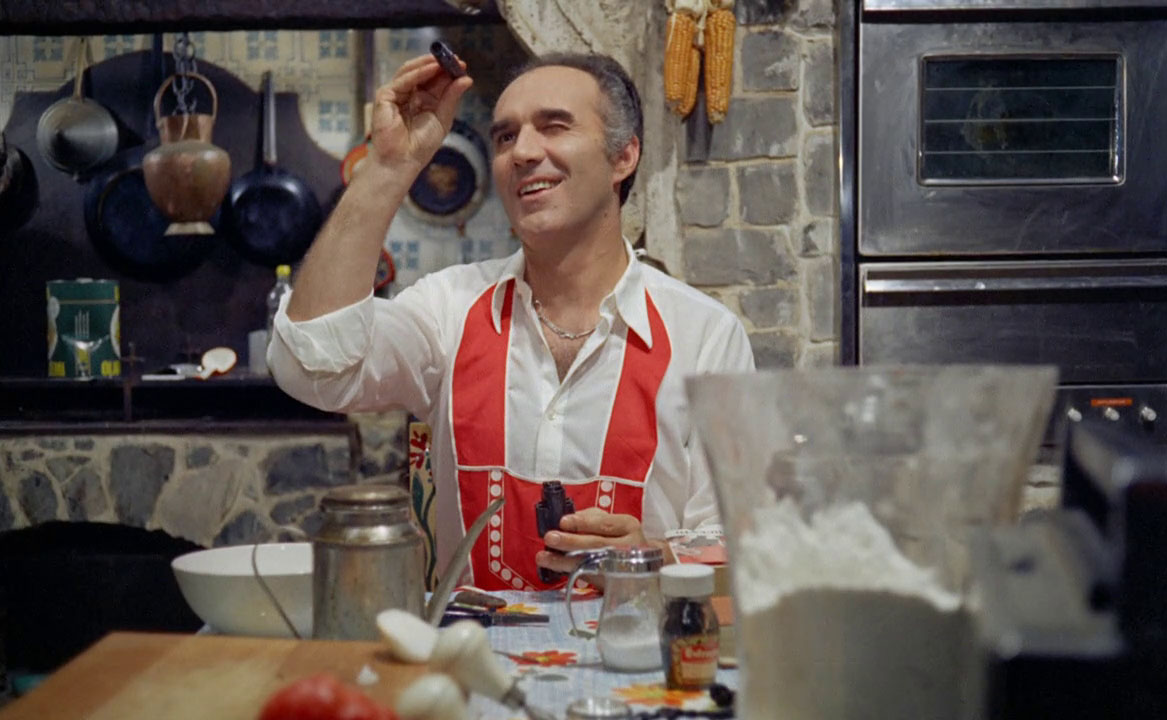
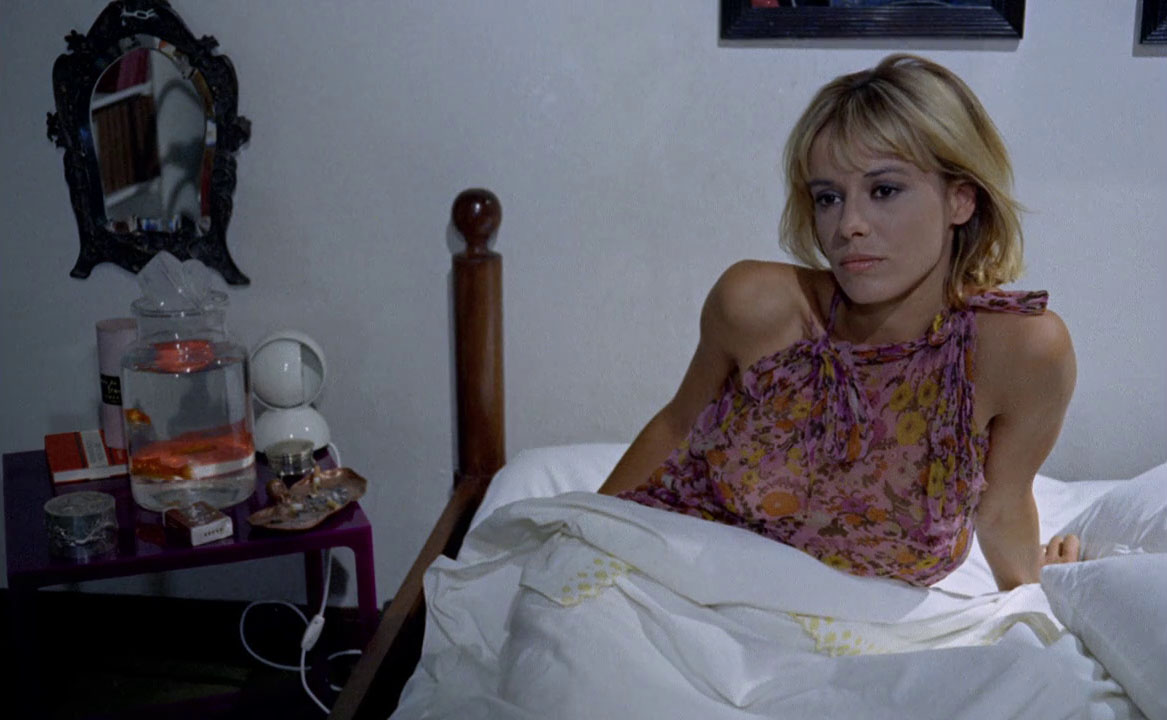
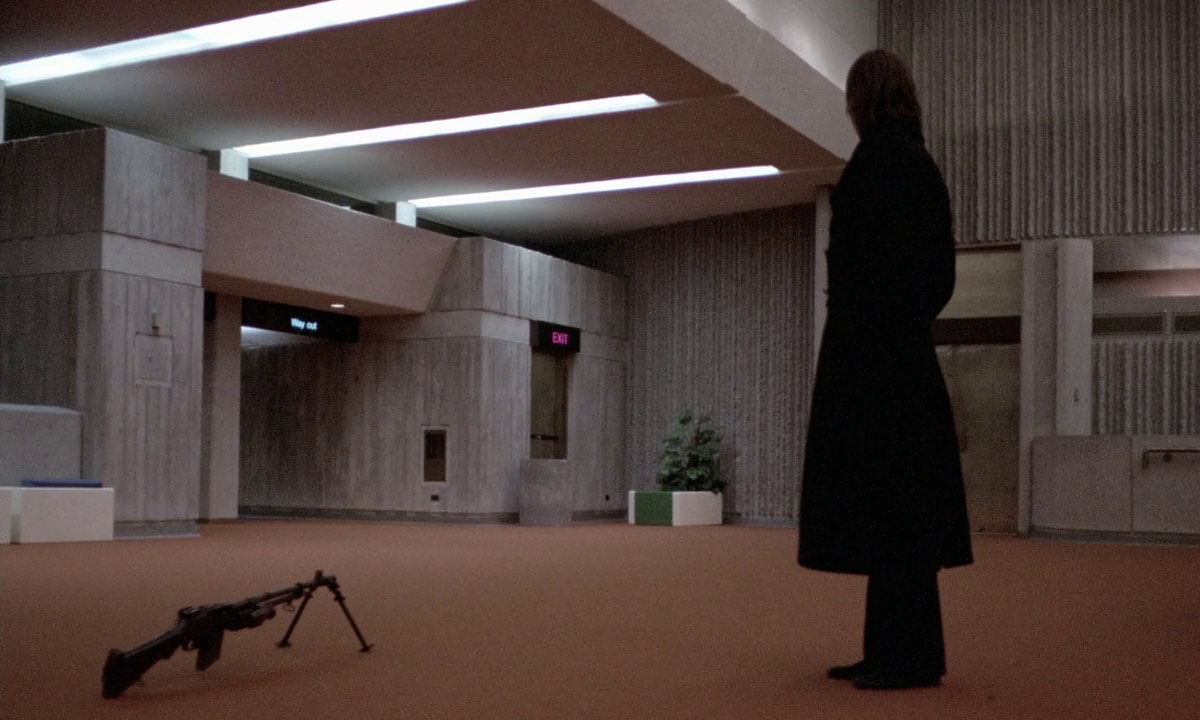
There is in fact a spider, also a cat and a couple dogs, and MVP: an owl in a tree. Mainly it’s a breakup movie, Lisa moving out of Mara’s place into her own new place, family and friends and neighbors turning out to help, and Mara lurking and sulking. Doesn’t exactly have a strong narrative drive – it does have that surprising sense of discovery in the camera angles and scene structure that I loved in The Strange Little Cat. For the first half I was thinking “ehh there’s not much here,” and in the second half: “I’m German now and everyone in this movie is my friend.” Speaking of German, while listening to the words I learned that Hans Zimmer’s last name is Room, and Carolee Schneemann’s is Snowman.

Blake in ‘Scope:

Character motivation and cause-and-effect logic is either nonexistent or gets buried beneath myriad layers of movement and spoken phrases that may or may not make any sense to us. We can only get caught up and washed along in the film’s beautiful display of things resuming, moving along, never being the same again … A cut in a Zürcher film, especially this one, is almost always a revealing, never a suture. It exposes the mark that we heard being etched; the angle that reconfigures our understanding of the spatial dynamics of the setting or environment; the beholder that we and/or the character couldn’t sense was present watching what we were watching — the subject we never knew our gaze belonged to. There’s an acknowledgment, shot to shot, cut to cut, that there is more to the world than what we can presently see or say that we know … And at the present moment, I can think of few worthier undertakings for a narrative cinema practice than one that challenges and is curious about the ways that humans perceive themselves, others, and the perceptions of others.

Somehow the most delightful and enjoyable of the Cote movies I’ve seen, even though this one is just people standing still in fields, and the others were kinda a thriller and kinda a nature doc. He’s an unusual filmmaker – per AS Hamrah “Côté has made over a dozen low-budget, semi-conceptual films in Canada since 2005 and shows no sign of letting up. Each of his movies is a bracing delight designed to perk up an audience by asking it to see and listen in some new way.”

Early-Villeneuve star Maxim Gaudette is our lead, facing off vs. a different woman in every scene – first his sister, then both wife and girlfriend. He’s a thief, living in his car, dodging taxes, giving circuitous answers. Scenes are connected by whip pans, or pillow shots, or a girl named Aurora walking around the wilderness – turns out she’s following him, since he smashed her car windows and stole her laptop. At the end, his wife says something like “it’s a simple question and I forbid you from complicating it” – I could use that line.

with sister, Ghost Town Anthology’s Larissa Corriveau

with girlfriend Eve Duranceau (and chaperone)

There’s something odd to the frames, a mild Sokurov light-bending effect, and there seems to be a smear on the lens in a different spot in each shot. Then again, nothing falls apart faster in streaming video than wide shots of trees on a breezy day, so this looked pretty bad, that might be the problem. “I’m going to the cinema. I’ll sit in the first row. That way I’ll see the movie before anyone else.”

with victim, Éléonore Loiselle

Writer M. Night doing good work with the premise, not so good with the dialogue and details – and Director M. Night just going to town with the photography. Love the roving wide-angle long takes especially, but the whole thing looks ravishing. DP Michael Gioulakis also shot Us and It Follows and Under the Silver Lake, and is currently one of my favorite people.

AKA Old Beach: The Beach That Makes People Old, but most of them die one-by-one from various misfortunes, only Gael and Vicky make it to cute-elderly status. Dr. Rufus Sewell goes mad, or was mad from the start, and stabs Underground Railroad star Aaron Pierre before Vicky gives him fast-action blood poisoning. Sewell’s wife Abbey Lee (one of the Fury Road wives) has brittle bones and dies in agony chasing the kids through a cave. Ken Leung (cop in Saw) simply drowns trying to escape. Nikki Amuka-Bird (Jupiter Ascending) has fatal seizures, funny since the mad scientists studying curative drugs in unwilling time-accelerated test subjects call her case a success. The kids are more complicated since they’re played by multiple actors, but most notably by siblings Alex “Hereditary” Wolff and Thomasin “Soho” McKenzie, and as Alex’s short-lived girlfriend: Beth March of Little Women.

Adam Nayman sums up my pleasure in talking about a different film: “The fun of Malignant is watching Wan apply such sophisticated technique to ridiculously dumb material.” Also wrote down a line from Social Hygiene the next night: “Stupid and useless things are often the most beautiful.” Great movie.

Game of Death (1978, Robert Clouse)

Time for the post-Bruce-Lee movies in the Bruce Lee box set. Bruce had filmed about ten minutes of fights for this one, then he inconveniently died. The American studio knew Bruce was profitable, and that’s all they knew, so they cobbled together a new movie, blatantly using stand-ins and cutting reaction shots from other movies. Once they simply pasted a still photo of Bruce’s face over another guy. It’s full of callbacks to the previous movies (thanks to a films-with-the-film subplot), but anyone who enjoyed those is gonna be sad about this one. Even doc footage from Bruce’s actual funeral is used, when lead character “Billy Lo” is supposed to be faking his own death. And this is all in service of a third-rate crime thriller. 1 star for the music, 1 for Sammo Hung, zero for the rest.

After filming a scene, Billy is calmly threatened by a white suited gangster who wants protection money. He works for an evil bald guy who’s somehow involved in both a record pressing plant (which threatens Billy’s girlfriend’s music career) and a championship fight in Macao (their star fighter is Carl: Robert Wall from Enter the Dragon, who died last week). The gangster protection money plot had already been used in Way of the Dragon (and the Chang Cheh movie I just watched), but so what, it’s a plot, and movies need those.

Billy’s in hiding, letting the gangsters think he’s dead, which gives all the non-Bruce actors an excuse to wear heavy disguises. Carl cheats and beats Sammo Hung in the ring, but Sammo puts on a good showcase, then Billy slaughters Carl in the lockers. The girlfriend (Colleen Camp) inevitably gets kidnapped, and a stuntman wearing Bruce’s yellow tracksuit and a dark helmet fights some motorcycle dudes in a warehouse. Finally, the one true Bruce fights some dudes (including the absurdly tall Kareem Abdul-Jabbar), and it’s glorious for a few minutes. He never even touches the old bald gangster (Dean Jagger, the sheriff of Forty Guns), who falls off a roof while running away, the credits rolling before he even hit the ground.

Movie magic via still photo:


Game of Death II (1981, Ng See-yuen)

The only sense that this is a sequel is it’s playing the stand-in game with old Bruce footage (the film stock still doesn’t match). Bruce is hilariously dubbed by some cowboy-ass American. He chills with an ass-kicking abbot then gets an incriminating film from some girl. At a friend’s funeral, he’s shot and falls to his death while chasing a helicopter that was stealing his friend’s casket(!), and now Bruce’s sad brother Bobby takes over as the lead, like Bruce took over from James Tien in The Big Boss – but not exactly like that, since Tong Lung is playing both brothers here. Now with an hour to go, the movie doesn’t have to pretend to star Bruce Lee anymore, and can cut loose. The dubbing is atrocious, but the Chinese/Koreans in charge of this movie have got more respect for Bruce’s legacy and more filmmaking and fighting talent than the doofus Americans in part one.

Lewis trying to be intense despite the cute monkey:

Bobby gets intel from a white monk that the evil Lewis and his scarfaced brother, masters of the Palace of Death, are responsible, so he heads on down. Lewis can’t be that evil – he keeps pet peacocks and monkeys. The Whatever Brothers (I didn’t catch their names) challenge Bobby, and he proves his mettle, then a sudden blonde girl gets suddenly naked, tries to kill him, then a guy in a lion suit joins in! Movie is already kinda nutty, and that’s before Bobby descends to the subterranean MST3K sci-fi lair with spacesuited harpoon-armed flunkies and electrified floors. Lewis is found dead, the scarface guy is suspected so Bobby beats his ass, but Bruce’s “dead” friend, who was stealing his own coffin to avoid discovery, is behind the whole thing. Friend/enemy Chin Ku is Jeong-lee Hwang of Drunken Master, the abbot was in Temple of Doom and Sammo’s Enter the Fat Dragon.


Bruce Lee: The Man and the Legend (1973, Shih Wu)

Polishing off the Criterion box set with a return to the shameless, shoddy quality of Game of Death 1, this time in documentary form. Opens with ten minutes of news film from Bruce’s funeral, which doesn’t sound like such a long time but really felt like it, making me realize I am not cut out to watch Loznitsa’s State Funeral. Then a chronological run through his life and career, with lots of slow zooms into photographs, and a narrator who sounds like he’s from some MST3K short, like How to Go on a Date. Why is the dialogue in the movie Bruce was in as a child covered up with horn music? Why does the English narrator sometimes talk over people speaking English, telling us the same story at a slightly different pace? When Bruce defeats Bob Baker in Fist of Fury, “Baker studied for seven years under Bruce, but he is still no match for his teacher,” the narrator confusing an actor’s skill with a scripted scenario. It closes with then-unreleased Game of Death footage – in fact, Enter The Dragon wasn’t even out yet – in Hong Kong, this quickie doc beat it into theaters by a week. Shih Wu was an assistant director on A Better Tomorrow III, which I’ll probably end up watching eventually.

The country’s got West Side Story Remake fever, but we’ve stayed home, trying to avoid catching any other kinds of fever – and after pulling the plug on The Terror, I need a new exercise-bike show to watch, so I gave this a try, in two parts. What better way to encourage movement than to watch a propulsive road movie?

Dennis Weaver (TV’s McCloud) is chased and terrorized by a big-ass truck. His thoughts via voiceover try to apply reason to the situation, but there’s no reason to be found – the truck is dangerously toying with him. It tries to push him into a train, drives right through a phone booth where he’s calling the cops (and some roadside snake aquariums), tailgates him at dangerous speeds. Will this emasculated modern man outdrive and outsmart the giant machine? Yes! Not without difficulty – the movie is partly a PSA for proper automotive maintenance, per the advice of your mechanic, so I feel pretty good that I changed both my air filters the day before viewing.

Written by Twilight Zone vet Richard Matheson, and I thought of the Zone a few times, when the world seems to be stacked against Weaver, diner locals and schoolbus children all making fun of him, and only he senses the danger, or is maybe imagining it, and directed to hell and back by young Spielberg.

Learning about a San Franciscan fave of the Anthology Film Archives and the Visionary Film book I keep at my bedside. I’ve skimmed Broughton’s own filmmaking book Making Light of It, which I bought because of its great title, but my book collection is a shambles and I can’t find it right now.

He hangs out with other poets, including Anais Nin, starts filming with The Potted Psalm, then Mother’s Day is his solo debut. He goes to Europe with his first films and makes The Pleasure Garden in England, which goes to Cannes, where he’s presented an award by his hero (and mine) Jean Cocteau… is offered commercial film work, but turns it down, and doesn’t make another film for 15 years.

Lotta stock footage with talking heads. I respect that the doc tells its own story instead of sticking to strict chronological order, but don’t respect that it motion-graphics one of Broughton’s poems. It spends more time on his love affairs than his post-1960’s work (he had a kid with Pauline Kael, then cheerfully proclaimed homosexuality late in life).

I’d only previously seen his Four in the Afternoon, and the collab with Sidney Peterson – the hope was to watch a bunch more after this doc, but only got to one.


Loony Tom (1951, James Broughton)

Tom will not rest until he has kissed every girl in the countryside. A straightforward randy romp, with piano music and a spoken poem at the top and tail. Broughton’s friend Kermit was quite good at being a silent comedy star.

My third in a trilogy of White Nights adaptations. I belatedly discovered that James Gray’s Two Lovers is also a loose/partial adaptation, too late, will save it for my next Dostoevsky binge. All three are set in their own present-day, displaying current technology – Bresson’s tape recorder, Visconti’s jukebox, now Vecchiali’s cellphone.

He’s nasty in this one, but after a prologue where he insults an older man, he meets the girl and the dialogue veers close to the original. Video-looking long takes here, the actors standing still, one of them usually hidden in shadow. Besides the phone, her backstory monologue is interrupted by a couple things. Her voice fades out into the waves, then back in, repeating from earlier than where we left off but with the camera on him instead, reminding me of the Francisca repetitions. Also, he starts correctly guessing details of her story, as if he’s read this book before.

The long dance scene seems to reference the Visconti more than the novel. A b/w sidetrack conversation between him and his stepmom feels like filler, even if it does reference the cobwebs from the story and prove he wasn’t lying about being named Fyodor.

This played Locarno with La Sapienza and Horse Money. Vecchiali is a lesser-known Cahiers critic-turned-director, and I’ve heard his 1970’s work is good. Our lead actress is a Vecchiali regular, and our guy played the two Remis in Two Remis.

After watching the Bresson with no context, I read the Dostoevsky story it adapted, then sought out more films of the same story. Marcello is introduced socializing in this one – that doesn’t seem right. Of course, being Marcello, he can’t help but be more suave than the repressed protagonist of the story, but he’s been thoroughly movie-starred here, dancing and fighting. At least the sudden mood swings from laughter to tears are accurate to the novel. It’d make an interesting screenwriting workshop – sometimes it uses the same language as the novel to describe the same events and sometimes it does the opposite.

Great atmosphere, unbelievable set of a wintry outdoor canal city. The central bridge is only 15′ long, far from the Pont-Neuf, but the Criterion essay points out how it functions symbolically. I understand lighting is important, but shouldn’t the Italians have invented location shooting instead of making hugely complex soundstage sets if they weren’t even gonna record sound? The city of Venice didn’t hold it against him – the movie won a silver lion, second place to Aparajito (no love for Throne of Blood). Marcello is second billed, the year before Big Deal on Madonna Street, to Maria Schell, who’d just won best actress at Venice for a René Clément picture. Judging from Senso and The Leopard, I prefer modern Visconti over his period pieces.

Flashback of Schell with lodger/lover Jean Marais:

Hank Williams on the radio in a tumbleweed Texas town. Watched the night of P-Bog’s passing – lately I’ve really enjoyed his films, so I probably shouldn’t have started out with The Cat’s Meow. This got all the award nominations in its time. For such an auteurist filmmaker, it’s so actor-focused, discovering at least four future stars and pitting them against established and veteran actors.

Cybill and Randy:

Young Timothy Bottoms has an affair with his coach’s wife. The boys buy a prostitute for Mute Billy and it goes poorly. Ben Johnson, the pool hall and picture show proprietor who is everybody’s role model, dies suddenly offscreen. Jeff Bridges punches his friend’s eye out then joins the army. Everything’s shabby and everyone’s stuck – would be interesting to see the sequel made 20 years later.

Officially P-Bog’s follow-up to Targets, though he also made a John Ford doc and helped Corman with some MST3k-bait. DP Robert Surtees, who worked not with John Ford but a bunch of big directors through the 1950’s, shot the hell out of it. Written by Larry McMurtry, who also died in the past year, and filmed in his hometown.