Earlier I wrote: “Movie was good. Not holy-wow-mindblowing, but Cronie knows how to shoot a movie, so despite any narrative failings the whole thing was a raw pleasure to watch.”

And it’s not a “failed” narrative, but everyone seems to agree that there isn’t much there. Cronenberg seems to have bought a barebones nothing-special script about the Russian mafia in London (written by nothing-special author Steve Knight of Dirty Pretty Things and Amazing Grace) and given it a few Cronenberg touches (an extreme fight scene, heavy focus on tattoos), then directed the hell out of it. Ever since re-watching Existenz recently I’ve been thinking about how watchable his films are, how I feel a high-quality tension from them that I never think to analyze in terms of camera placement and shot length, but just relish and enjoy. So while it’s no History of Violence in his overall career, it’s not a disappointment either. The guy does not know how to disappoint.

The great acting doesn’t hurt, either. Viggo Mortensen is back from HoV, playing a deep-undercover cop infiltrating the Russian mob. Naomi Watts (remember King Kong?) is an overly concerned hospital midwife trying to find a family member of the young girl who died giving birth so it won’t go up for adoption. Armin Mueller-Stahl (X-Files, 13th Floor) is the mob head and secret father of the baby. In the intense-unstable-closeted role is mobster son Vincent Cassel (Blueberry, La Haine, Brotherhood of the Wolf), and as Naomi’s racist russian uncle is Jerzy Skolimowski, a Polish 60’s filmmaker (who also acted in Before Night Falls and Mars Attacks) currently shooting his first film in 17 years with Isabelle Huppert and Dennis Hopper [edit 2011: this was cancelled and he made Four Nights With Anna instead].

At the center of the story is the dead girl’s diary which implicates Armin and Vincent but is written in Russian. Jerzy translates it, so Viggo has to kill him (actually sends him to a hotel, being a cop and all). In the end, presumably Armin is locked up on a rape charge, with Vincent in charge of the family (he gets to live despite almost murdering a baby) and Viggo about to take it down from the inside, Naomi’s family happily together again.

As for Cronenbergian script touches, you’ve got your naked sauna knife fight, your life written on your body in tattoo form, your finger-chopping body-disposal man and three other big bloody scenes. And since, despite all my writing online I still haven’t learned how to analyze and discuss a movie, I can’t put my finger on why (couldn’t be empty boosterism of my favorite directors, could it?), but I feel it’s a quality movie, exquisitely filmed and paced, and thrilling to watch.

Interestingly, in Reverse Shot’s review, Andrew Tracy directly addresses the question I ask above, saying it is boosterism, and that it’s hurtful to the world of film criticism to pretend that Eastern Promises is a good movie. He says “unequivocal praise or panning is the unfortunate rule of these latter days of criticism”, then aggravatingly calls it “a failed film”. I don’t know that anyone considers it a masterpiece, and by the AV Club rating system I’d only give it a B or B+, but I reserve the term “failure” for a D-grade or below. “Failed film” sounds like “if it isn’t great, it’s rubbish”, and a good B+ thriller with some great acting and a few outstanding scenes isn’t rubbish. Rather it’s a movie I’m very glad I saw, instead of going to The Brave One or Shoot ’em Up or Halloween, all recent additions to my endless to-rent list.

Nice one from Reverse Shot:

With the aid of Mortensen’s granitic face and body—which is not simply a given quality but an acted entity—Cronenberg depicts flesh as armour, the shell of a man who lives entirely through his outward gestures. Mortensen’s impeccable overcoat, suit, gloves, and slicked-back hair are further layers of a constructed identity that begins with the skin, which itself is covered with the tattoos relating the story of his life to his underworld masters. The progressive stripping, both literal and metaphorical, of Nikolai throughout the film reveals not the person beneath the artifice, but the meticulously constructed series of artifices which constitute the person himself.
There were two goals here. I nervously wanted to revisit one of my favorite movies from the 80’s and see if it still holds up for me personally (it did), and I wanted to show it off to Katy and see if she’d like it half as much as I do (she doesn’t).

Reverse Shot deconstructs:
“Though it’s hard to outright accuse Oz of actively perpetuating racism… his insistence on exaggerating the Motown aspects of the three girls and the svengali qualities of Audrey II seem a light mask for the white fear of a black threat ready to corrupt the safe American dream. When weighing Audrey II and the doo-wop girls against the cartoonishly antiseptic suburbia about which the protagonists fantasize, the fight against the plant takes on epic proportion, and an unpleasant metaphorical cast.”

I still dig the music and the movie, campy and racist though it may be. James Belushi, John Candy and Bill Murray are kind of wedged in there, but Christopher Guest’s wide-eyed easily-impressed rose-buying customer slides in perfectly. One of the doo-wop girls played Chris Rock’s mom (?) on “Everybody Hates Chris” and another was on “Martin” and a recent Damon Wayans show. Mr. Mushnik, who died in 1992, was in the 1978 “Heaven Can Wait”. Ellen Greene was Mathilda’s Mother in “The Professional” and appears these days on Heroes and Pushing Daisies. I don’t get why Rick Moranis didn’t outlast the 80’s – he does voices for Disney cartoons now.

EDIT: Dec 2011
Katy likes it better now, thanks to some soundtrack exposure. Maria enjoyed the songs. I dig the fake skies and long shots (with some subtle off-camera costume changes and transformations), but now that I know the ending was changed after test screenings, I can’t help but see the cheap, last-minute alterations (like Audrey 2’s stock-footage explosion) when the whole movie had been meticulously composed up until then. Gotta look up the deleted ending on youtube some time.

EDIT: Sept 2021
This time we showed it to Katy’s mom, who liked it so much that she wants to watch the Roger Corman version next, against my advice. Went with the theatrical version since it was $4 to rent and the director’s cut was $20, but maybe someday.

This is now the most recent Godard film I’ve seen up until Notre Musique 40 years later. Wow. Came out the same year as Masculin Feminin AND Alphaville. Same year as Simon Of The Desert. Right after Umbrellas of Cherbourg, The Soft Skin and The Naked Kiss… and before Blow-Up, Balthazar, The War Is Over, The Nun and Tokyo Drifter.

Unfortunately, I didn’t write about this right after seeing it. Now it’s almost a month later, and I remember nothing but a mash of genres, a funny musical scene, some low-key crime and body disposal, a parrot, a funny Samuel Fuller cameo, and a bunch of too-cool people on an adventure. I think in the end, Pierrot shoots the girl and blows himself up. I liked the movie better than Jimmy and Katy did.

I missed Jean-Pierre Léaud in the cinema scene. Anna Karina (of The Nun and a buncha other 60’s Godard films) and Jean-Paul Belmondo (of Breathless, A Woman is a Woman, Magnet of Doom, Le Voleur and Stavisky) star.

Janus Films’ description: “After abandoning his wife at a Parisian party, bored Ferdinand (Jean-Paul Belmondo) flees his bourgeois existence with his babysitter and ex-lover, Marianne (Anna Karina). Taking it on the lam to the south of France, the couple becomes an existential Bonnie and Clyde, battling gunrunners, gas station attendants, and American tourists as they come face to face with their own roles as characters in a pop-cultural landscape. A profound turning point in Godard’s cinema, Pierrot le fou recalls the gangster cool of Breathless and Band of Outsiders while also pointing towards the increasingly essayistic, apocalyptic visions of Two or Three Things I Know About Her and Weekend.”

“I saw Pierrot le fou by chance … I decided to make movies the same night.” – Chantal Akerman

Frank Tashlin wrote, directed and produced Looney Tunes shorts before turning to comedy features (many of them with Jerry Lewis, a cartoon of a man), and his movies can be very cartoonish… in a good way, of course.

This one is sort of a loose ride through some current pop hits, with full-length songs like “Be Bop a Lula” (Gene Vincent), “She’s Got It” (Little Richard), “Blue Monday” (Fats Domino) and “You’ll Never Never Know” (The Platters) lip-synched on screen by their respective performers. The plot has washed-up agent Tom Ewell (from The Seven Year Itch) trying to make ultra-curvy Jayne Mansfield a singing star at the request of her thug boyfriend Fatso Murdock (Edmond O’Brien)… but Tom and Jayne fall for each other, and Jayne can’t sing. Ends up with everyone happy, Tom and Jayne together, Fatso a TV star with his hit song “Rock Around The Rockpile”, and Fatso’s rival gang of jukebox mercenaries signing him instead of shooting him.

Some really well done comic parts, but mostly the movie is there for the music. A good movie, would watch again for sure. Katy protested that it wasn’t a proper musical, but still kinda enjoyed it.

Katy might have misinterpreted my comment that I hate the characters and don’t like the story but thought the movie was pretty good. Well, I’m not here to expain, only to repeat.

Big wide colorful movie with long motion camera shots, some catchy musical numbers, definitely preferable to the non-musical version of the Pygmalion story.

Audrey Hepburn is the best part as Eliza Doolittle, cute and expressive. She nails the early scenes where she’s gotta howl hideously. Got no problem with actors Rex Harrison (lead actor in Unfaithfully Yours) as the thoroughly unlikeable Henry Higgins or Wilfrid Hyde-White (of The Browning Version, The Third Man, Let’s Make Love) as Henry’s more pleasant colleague, though their non-singing scenes were a little wearisome since I don’t like either one of ’em and I know how it’s all going to end up. More enjoyable (but with less screen time) were Stanley Holloway (of Brief Encounter) as Eliza’s singing, drunken father and Gladys Cooper (of The Pirate and Rebecca) as Henry’s posh mother.

I guess George Bernard Shaw is mostly known for this story, though I wouldn’t know why. Alan Jay Lerner, who made the musical version, also did Camelot, Gigi, Brigadoon, Paint Your Wagon and An American In Paris. Director Cukor did a lotta things, incl. musicals A Star Is Born, Let’s Make Love and Les Girls, and almost directed Gone With The Wind. He won his only Oscar for this movie. Pretty much everyone involved in this was at least nominated, except for Audrey (Julie Andrews, who played Eliza on Broadway but wasn’t offered the movie part, won for Mary Poppins).

Good songs: “why can’t the english learn to speak english”… “i could have danced all night”… “with a little bit of luck”… some lesser ones: “you did it” and “get me to the church on time”.

Funny, at the end Eliza has been “bettered”, become classier, can’t go back to the street where she lived, the flower shops, and (until the final scene) she is miserable for it. And her formerly poor, happy-go-lucky drunken father has come into money unexpectedly and is miserable for it. Second musical I’ve seen in a row (after Hallelujah I’m a Bum) where people get rich and wish they hadn’t.

I get Henry’s character and his lame “i’ve grown accustomed to her face” late realization song, but I don’t get what Eliza’s still doing with him at the end of the film. Not a very romantic romance movie. When it comes to movies about obsessively re-shaping young women, I prefer Vertigo.

Almost exclusively composed of out-of-context scenes from other movies, mostly American with some exceptions (Zabriskie Point). I was surprised to see a scene from “Shockproof” (since I just watched it and had never heard of it before it was restored earlier this year), respectful mention of “Killer of Sheep” (again, this came out before all the recent tours and restorations) and an early scene from Sam Fuller rarity “The Crimson Kimono”.

The voiceover calls attention to the use of the city of Los Angeles in all these scenes, the backgrounds and cityscapes, the falsehoods and misrepresentations, and you quickly learn to watch each clip for the city it displays, not for the intended dramatic content. He talks about the documentary moments in fiction films, the way you can chart the changes in a certain neighborhood (and the eventual demolition of the whole area) through movies that were shot on location there over a period of decades.

One of the better movies about the movie industry, that’s for sure. I never had much interest in Los Angeles, and it’s not like the movie made me a big fan, but subject matter aside, it’s a fascinating idea for a movie, and meticulously put together. Entertaining as hell (didn’t mind the 3-hour length). A few jokes here and there, but mostly a straightlaced essay film. Wouldn’t really have to see it again unless I visit L.A., but I guess I could go for an upgraded version, since I watched a bootleg AVI of a bootleg VHS.

A pretty good Richard Pryor stand-up act. This got a theatrical run in early ’79, and is on Jonathan Rosenbaum’s list of his 1,000 favorite movies. I love a good stand-up act, and I guess if I had a better memory for jokes, I could fold my favorite stand-up acts in with my favorite movies… but I really consider them to be separate beasts. Comedians still get theatrical runs once in a while (Sarah Silverman “Jesus Is Magic”), but I hardly ever think of them as cinematic. Even my favorite Spalding Gray monologue films (“Monster in a Box”, “Gray’s Anatomy”) I have a hard time reconciling with my other favorite films… I prefer to think of them as illustrated audio-books (sorry, Steven Soderbergh and Jonathan Demme).

I know Pryor was a groundbreaking comic, so I cringed when he got into the “black people walk differently than white people” part of his act. Not exactly original anymore, and not nearly on the same level as an average Chappelle Show episode. The more observational stuff, crowd interaction, stories of growing up, mostly great. Still, last week I rented Louis C.K. “Shameless” (directed by Steven J. Santos, an awards-show stage manager) and laughed more. Didn’t even think to add it to my “films” list. I think I only added those Ricky Gervais stand-up specials to the list because they were directed by the guy who did the Alan Partridge series.

Jeff Margolis directed the Academy Awards show for the first half of the 90’s, then moved onto the Miss America Pagent and Country Music Awards. I guess he’s the guy in the control booth who says “camera two on my mark… and… mark.”

I still want to check out the other Pryor concert movies sometime (chronologically, from directors of playboy videos, the hanna-barbera happy hour, and pryor himself) and maybe his TV special and series (from dir. of Mr. Show!).

Lewis Milestone, having just made “all quiet on the western front” and “the front page”, turns his attention to an anti-capitalist Al Jolson musical. Why not? It’s no more weird than going from “Frankenstein” to “Show Boat”.

IMDB reviewer puts it thusly: “The best way to appreciate this odd film is to put one’s self back in the early 30’s, the Depression era. The drama glamorizes life on the streets and parks, probably to make the ordinary hard-up person feel better about his own financially depressed plight. It also played into the prevailing poverty consciousness of the mass public.”

Written by Ben Hecht, one of the biggest screenwriters of the 20’s through 60’s. Music by Rodgers & Hart (pre-Hammerstein). Most of the musical scenes are pretty unexciting, people having halfheartedly-rhyming conversations, vaguely sung with background music not matching up… but there are a couple good songs including the title number.

image

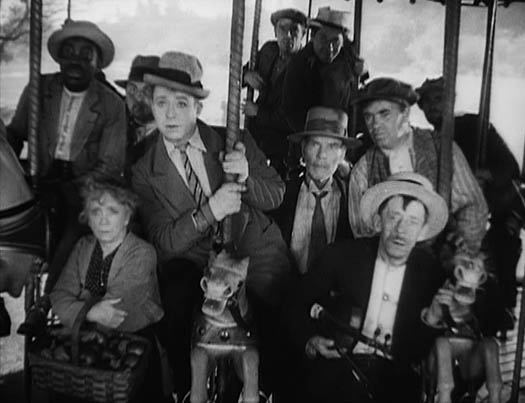
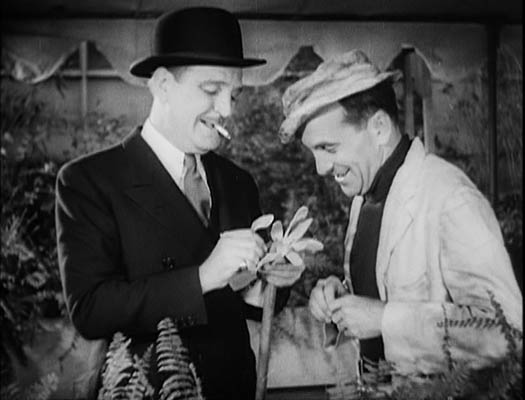
Al Jolson (above, right) is the “mayor of central park”, proud to be a bum. Money is a curse, you see, and the happy denizens of the park (where the weather is always fair) are better off without it. The actual mayor of New York (above, left, oscar-nom Frank Morgan of “wizard of oz” and “shop around the corner”) has love troubles, mistakenly thinking his girlfriend was cheating, he’s lost without her. When she jumps in the river, Jolson saves her. She has a convenient bout of amnesia and they fall for each other. Jolson cleans up, gets a job to support the girl… finally learns who she is, leads the mayor to her like a good friend, goes back to his happy-go-lucky ways.

image

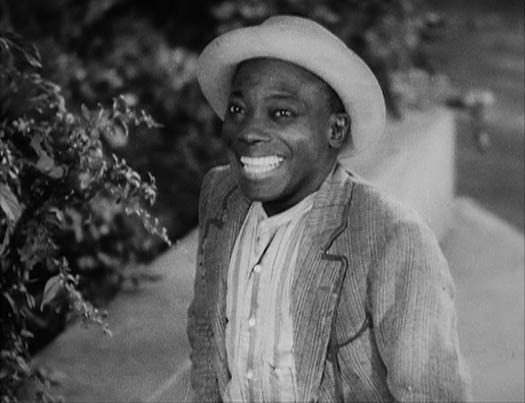
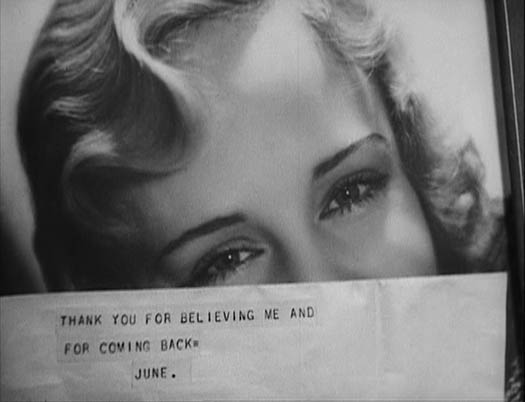
Funny that the mayor leaves June (Madge Evans of “pennies from heaven”) when he suspects she’s with another man, and desperately takes her back when she’s actually, provably with another man. Silent comic Harry Langdon plays Egghead, hardworking socialist trash collector, and Edgar Connor is Acorn, Jolson’s black friend/servant – they’re my two favorite parts of the movie. I must’ve missed the homoerotic tension between Acorn and Jolson that Rosenbaum mentions.

image

Rosenbaum: “Rodgers and Hart scored this one too, and once again it’s closer to operetta than to the usual song-and-dance stuff. It’s hard to know whether the remarkable inventiveness comes from the story (Ben Hecht), screenplay (S.N. Behrman), preproduction director (Harry d’Abbadie d’Arrast) or final director (Milestone). Who thought up the devastating montage parody of Eisenstein timed to the American anthem, or an illustration of economic deflation via throwaway dialogue during a tracking shot across a bank floor, or the notion of a Trotskyite trash collector played by Harry Langdon? And what about the rhyming dialogue, or the homoerotic relationship between a black and a white tramp? We know that a portion of the parable-like plot involving the mayor of New York (Frank Morgan), his amnesiac mistress (Madge Evans), and the mayor of New York’s homeless (Al Jolson) was lifted from Chaplin’s City Lights, but who put it all together with such bittersweet conviction? This was one of Jolson’s rare commercial flops, but it’s so sad and peculiar that one isn’t surprised. Even though it’s a fantasy, the Depression in all its grief comes alive here as in few other pictures.

image

The long-awaited continuation of my Marker-a-thon!

Dedicated “to the happy many”

“The Lovely Month of May”, in two parts:
Part 1, “prayer from the top of the eiffel tower”
Part 2, “the return of fantomas”

“It happened in may 1962. For some it was the first springtime of peace.”

A series of interviews with Parisians at/about the end of the Algerian War. A little provocative, but more of an inquisitive survey than a personal statement.

Marker as interviewer recommends Cleo from 5 to 7 to a guy who sells suits, then tries recommending Marienbad. Guy replies “but it’s something you’ve gotta understand.” “Don’t you understand things?” “Sure, but why should I take the trouble? I pay, don’t I? Sitting in a movie to rack my brains?”

Narration: “The mayor of Paris would have a lot to do, but there is no mayor of Paris”

Someone petting the head of a baby owl, narration untranslated.

Sometimes there are whole sections that aren’t subtitled or translated. Sigh…

The interviewees are asked about money, politics, world events, their daily lives. Some prodding to get the more apolitical citizens to talk about politics, or to talk about why they don’t want to. There’s a shift to more specific issues in part two. More about racism and prejudice, poking around about the Algerian War. This is the same year Alain Resnais was making a very different film concerning the Algerian War, Muriel.

Not very cinematically interesting, I guess, but today it’s a fascinating look back at a certain time and place (May ’62, Paris) and a general survey on people’s thoughts, hopes, fears and prejudices. I wonder what Parisians thought when the film came out. Can’t imagine they raved about it. He’s asking questions that lots of people didn’t want to be asked, seems like he’s throwing social problems into the faces of the Parisian viewer. I’ll bet foreigners were more intrigued.

A long interview with an Algerian ends with spoken statistics about that particular May over time-lapse photography of the busy streets. “But for the 5,056 people in the prisons of Paris, each day of May was exactly the same.”

“As long as poverty exists, you are not rich. As long as despair exists, you are not happy. As long as prisons exist, you are not free.”

A surprisingly affecting movie… I liked it more than I thought I would. Movie ran only 1:58, forty-five minutes shorter than the IMDB runtime, so that’s further incentive to see a more complete and better translated version if/when I can find one.

Marker: “What I wanted to come out of the film is a sort of call to make contact with others, and for both the people in the film and the spectators, it’s the possibility of doing something with others that at one extreme creates a society or a civilization… but can simply provide love, friendship, sympathy.”

From Catherine Lupton’s book:
“Immersing himself in groundbreaking new developments in camera and sound equipment that allowed human encounters to be filmed with greater ease and spontaneity, Marker brought the interview centre stage in the filming of Le Joli Mai, a less-than-flattering depiction of French social attitudes at the close of the Algerian War.”

“Marker stated that one of his ground rules was to avoid selecting the participants or manipulating the interviews… in order to confirm a ready-made conclusion… Another was to refuse to regard participants as stock examples of social or character stereotypes. ‘People exist with their complexity, their own consistency, their own personal opacity and one has absolutely no right to reduce them to what you want them to be.’ Le Joli Mai does grant its participants the space to be themselves, and to speak fully on the topics and questions proposed by the interviewer, without reducing their contributions to caricatured soundbites. Even when the film makes pointedly critical montage interventions into a discourse that it evidently regards as misguided or fatuous, it still retains the texture and substance of the interviewee’s speech, so that it is possible for the spectator to measure Marker’s reaction against the statements or attitudes that have prompted it.”

Marker produced this film and Le Jetee simultaneously, a film which turned “the documentary adventure of Le Joli Mai inside-out, distilling its subterranean fears and anxieties about the future into an elegaic masterpiece of speculative fiction.” His new filmmaking identity “might be the critical conscience of contemporary France, or the cosmonaut of human memory.” “In his self-curated retrospective at the Cinematheque Francaise in 1998, the earliest of his films that Marker elected to show were La Jetee and Le Joli Mai. He went on record to state that he regards his earlier films as rough and rudimentary drafts and no longer wishes to inflict them on the cinema-going public.”

“The camera operator Pierre L’homme is credited as co-director in recognition of his central role in creating the film’s mobile, responsive visual images.” Pierre later shot Army of Shadows, Mr. Freedom, a Bresson feature, a Godard short, and The Mother and the Whore before working with Marker (and Yves Montaud) again on The Loneliness of the Long-Distance Singer in 1974. Narrator Yves was in Let’s Make Love, The War Is Over, Tout va bien and Le cercle rouge, and narrator Simone Signoret I know from Army of Shadows and La Ronde. Composer Michel Legrand did a James Bond movie, F For Fake, some Jacques Demy (incl. the musicals!), some Varda and Godard.