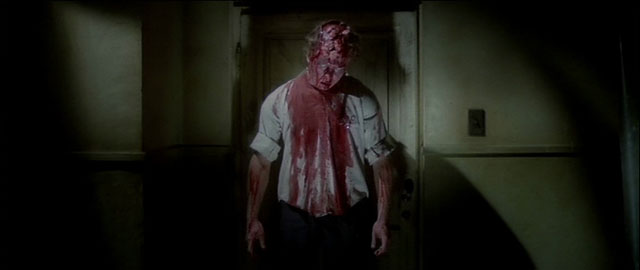
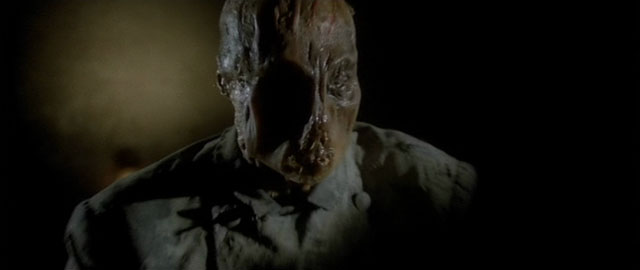
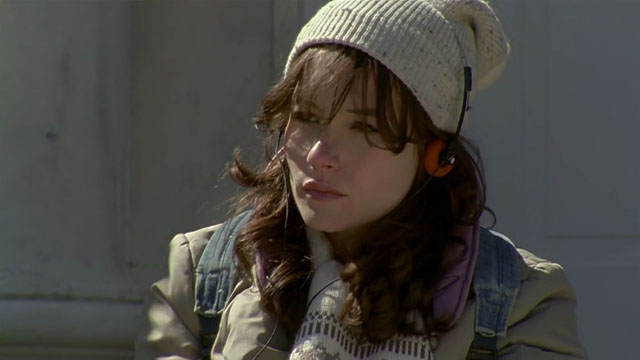
Yes, we celebrated the receipt of a Netflix Streaming disc for our Wii by spontaneously watching a Goldie Hawn movie. I thought it’d be a Jonathan Demme movie, but it turned out not to be – Demme has disowned this version. As he told The Guardian: “It turned out very poorly, yeah. We did a film and I hope that very few people here have seen it!”

In this, the Goldie version (Demme’s cut was reportedly available on bootleg VHS in the 80’s, but seems impossible to find now), Hawn goes off to work at the airplane factory when hubby Ed Harris goes to war to fight the dirty Japs who bombed the harbor. Hawn teams up, eventually and reluctantly, with rebel girl Hazel (Christine Lahti of Housekeeping, Running On Empty) and rebel boy Kurt Russell (lately of The Thing). Their friendship and her new self-sufficiency lead Goldie to redefine herself as a person. Then somehow she ends up back at home with hubby Ed, Kurt reading a wistfully-voiceovered note from Goldie as he rides away to tour with his new band.

Apparently it used to be more of an ensemble piece than a Goldie showcase, so side characters like coworker Holly Hunter (in what would’ve been her first major role if it had stayed major) and Fred Ward (as Hazel’s complicatedly sleazy ex) had beefier parts. Even in its diminished state, though, Katy and I liked it quite a bit.

Demme to The Guardian:

We had this hard-nosed feminist, all women together thing, and Kurt Russell was supposed to be a bastard, and suddenly all these scenes were being rewritten, and I found myself in a very awkward position because I had to co-operate with these new scenes. I actually had to shoot them, otherwise I would have been in violation of my contract, and so in order to protect the movie that I thought we were making I had to shoot these very bad scenes.

Demme doesn’t finger Robert Towne as the emergency rewriter, though he’s strongly rumored to be the one. Towne had once written Chinatown, but having just done the craptastic Deal of the Century he owed the studio a favor. Demme goes on to tell the story of how Ed Harris saved Stop Making Sense, for which we should all be forever grateful.

Falkenau, The Impossible (1988, Emil Weiss)

Weiss seems to love Sam Fuller, but he’s not on Fuller’s wavelength, unable to have much of a conversation with the man. So this doc (which is an hour long, but I crammed it in the shorts section anyway) admirably fulfills its purpose by screening all of Fuller’s WWII concentration camp cleanup footage while Sam narrates, taking him to the site of the camp in present-day and asking for his thoughts. That would’ve been more than enough, but Weiss leaves us with a one-sided (Sam likes to talk) silly-ass conversation about fictional representation of war, which would’ve been better left out. I’m most of the way through Sam’s autobiography, one of the greatest books I’ll ever read, where Fuller says this doc screened at Cannes and was praised for its straightforwardness.


Cry For Bobo (2001, David Cairns)

Poor and desperate, a man resorts to thievery to get by. He’s caught and imprisoned, then shot to death after escaping, as his wife and kid leave town, trying to start a new life without him. It’d be a miserable little story if the main characters weren’t clowns. Hilarious, reference-heavy, and better than I’d expected – and I had expected greatness. Already watched twice and trying to get Katy to see it (she hates clowns).


The Possibility of Hope (2007, Alfonso Cuarón)

Zizek:
“We no longer live in a world. ‘World’ means when you have a meaningful experience of what reality is which is rooted in your community, in its language, and it is clear that the true most radical impact of global capitalism is that we lack this basic literally ‘world view,’ a meaningful experience of totality. Because of this, today the main mode of politics is fear.”

Naomi Klein:
“More and more we see the progression of this economic model through disasters. So we’re now in a cycle where the economic model itself is so destructive to the planet that the number of disasters is increasing, both financial disasters and natural disasters.”

James Lovelock:
“If you live in the middle of Europe or here in America, things are going to get very bad indeed.”

Of course the “hope” part comes at the very end, as it does with all recent doom-gloom climate-change global-meltdown documentaries, and the hope in this one, despite the film’s title, isn’t all that hopeful. Start preparing now for how badly the future will suck – and it will suck. An Inconvenient Truth supposedly has a credit-time list of ways you can help the planet, Home encourages us to build windmills and go vegan, Wake Up Freak Out says we must act politically, and there’s always the hope during Collapse that the subject is just wrong, or that he’s a crackpot. Not so much here. If I’ve avoided talking about the filmmaking, well it’s basically a radio show with distracting visuals, much of it b-roll from Children of Men.


Night Mayor (2009, Guy Maddin)

Pronounce it similarly to “nightmare.” An inventor, a Bosnian immigrant, harnesses the “music” of the Aurora Borealis and converts it into dreamlike images which are sent across phone lines to his fellow Canadians using his Telemelodium. Even more/cooler junkpile inventions than in the electric chair short, some nudity (not as much as in Glorious or The Little White Cloud That Cried) and some delicious nonsequiturs. Clean narration by the accented inventor and two of his kids, along with excellent string music. At the end, the government shuts down his project, so he turns his attention from the skies to the seas, considers visualising whale songs.


One Minute Racist (2007, Caveh Zahedi)

Sweet three-minute cartoon story about the slippery slope of racism narrated by CZ, who codirected with a couple animators. Story of a student who doesn’t like asians because they’re too uptight and a paranoid library security guard who threatens to confirm the stereotype.


Talking Heads (1980, Krzysztof Kieslowski)
“What is your year of birth?”
“Who are you?”
“What do you most wish for?”
These three questions are asked to a one-year-old, then a two-year-old, and so on. The final answer: “I’m one hundred years old. What do I want? To live longer. Much longer.”

Most people seem to have thought about the questions for a while – possibly while the camera and lighting crew buzzed about their head, since the film looks like a lesson in how to effectively shoot subjects, professional but no-frills, by cinematographers Jacek Petrycki (No End, Camera Buff) and Piotr Kwiatkowski (second camera on the Three Colors). As a result, the answers come out seeming like a beauty pageant. Everyone wants more honesty and fairness, for everybody to just get along. The answers from kids under ten and adults over seventy are the best.


Born Free (2010, Romain Gavras)

I don’t count music videos as “shorts” or things would get too complicated, but then, I don’t really count this as a music video. M.I.A.’s music isn’t far enough up front, and the video (by Costa-Gavras’s son) is twice as long as the song. It’s a little piece wherein red-headed kids are rounded up by violent cops, beaten, shot and made to run through a minefield. Probably trying to make a point about tolerance and freedom, but for messages of tolerance I preferred the climactic speech in Cry For Bobo, also featuring overzealous cops: “First they came for the mimes, then the jugglers, then the bearded ladies. Next time, it were you.”


Hotel Torgo (2004, buncha dudes)

Buncha dudes head for El Paso and interview the last guy who remembers working on Manos: The Hands of Fate. There’s no real point to this, but the guy is very good-natured about it. Learned that Torgo was high all the time, which shouldn’t come as a surprise but somehow still does.

Opens with a medium shot of young Vicente getting slapped, but despite the violence it gives more of a Bela Tarr feeling than of Sam Fuller’s Naked Kiss. “What shall I tell Nino?,” he asks. “That I’m dead,” replies his father, ironic because the father soon will be dead but that’s the one thing Vicente never tells Nino. V drives home in what looks like a motorscooter with a tiny van chassis set atop it, is told by his girlfriend Clara that Nino has gone missing (he’s out playing with friend Rosa). Dark, beautiful black-and-white close-ups of Clara, Rosa and Nino, each shot seeming to be in its own little world, nothing explained until later. I didn’t even follow any of this until watching for the second time.

V and Clara are fighting to be their own independent family with Nino, against the influence of the father (who dies [of illness?] early on), dad’s illegal-business partners who begin stalking Vicente, and an uncle who visits for Christmas then decides to forcibly adopt Nino after discovering Nino’s dad to be missing. What does happen to the father, anyway? He comes home upset, looking for something. Acts sick. One night V rushes to the pharmacy, breaks in and rifles the shelves looking for something before stopping, resigned. The next scene he and Clara are burying dad. Between this movie and Casa de Lava, Costa doesn’t seem interested in connecting the dots between plot points, but more in giving a cinematic experience that doesn’t strictly depend on story. This one comes across as a dream euro-art film: an elliptical black-and-white adaptation of a crime drama with poetry in the dialogue, the kind of movie that no longer existed in 1989, if it ever had.

Costa has an odd way of presenting conflict without building tension in the usual ways, so when Vincente fights the almost-comical gangsters and when Nino is taken by his uncle (Luis Miguel Cintra: big in Oliveira movies, including A Talking Picture), and when a body is discovered floating in the river (accompanied by a wonderous shot, shadows of a crowd upon the water) I never felt like the stakes were very high. The movie is full of close-ups but they’re more picturesque than emotionally intimate – whole story feels distant. I’m not complaining, just curious.

G. Kenny doesn’t think so:

Every single shot in O Sangue is beautiful, incredibly sharp and well-defined, suffused with ache and sensuality. The multi-leveled cinematic references—to Murnau’s Sunrise, to the films of Val Lewton, which Costa will reference even more explicitly in his next feature Casa de Lava, to Antonioni and to Bertolucci and to Bellochio; they’re all here, maybe encyclopedically so, and yet they never feel self-conscious, or decadent.

Whoa, I got a sense of Sunrise but missed all the others. Even the Sunrise reference I wasn’t sure about – I chalked it up to the fact that I’m always thinking of Sunrise. I also thought about Shoot The Piano Player and Thieves After Dark, hoping it wouldn’t end like those movies with somebody shot to death.

The uncle and his wife:

more Kenny:

As a relatively late convert to Costa, I find the picture endlessly fascinating and intriguing. To put it in the vocabulary of a punk rocker, it’s as if he started with Rocket to Russia and worked backwards to The Ramones. If you don’t speak punk rock, here’s what Robert Christgau said about Russia: “Having revealed how much you can take out and still have rock and roll, they now explore how much you can put back in and still have Ramones.” O Sangue can be seen as Costa/cinema with stuff put back in: moving camera, a particular use of music, and so on.

You said it, Mr. Kenny – every shot just sparkles (and the DVD is exceptional). Costa worked with three cinematographers: Acacio de Almeida (Ruiz’s City of Pirates, Treasure Island and That Day), Elso Roque (Oliveira’s Vainglory of Command and Francisca) and Martin Schafer (Wenders’ Lightning Over Water and Kings of the Road). Lead lovers Ines de Medeiros (Lucia in Rivette’s Gang of Four) and Pedro Hestnes (later in Ruiz’s Love Torn in Dream) work well with the careful compositions, posing silently half the time, and bursting into motion when needed.

J. Quandt:

One of those first films that feels like the unleashing of pent-up forces — long nurtured visual ideas, banked homages to favorite films and directors, a romanticism unseen since early Leos CaraxO Sangue was also something of a false start, in the sense that its dreamy, nocturnal tone, conspicuous cinephilia, and showboating camera work did not establish Costa’s true path, which was towards a spare, materialist cinema.

Statements like this make me worry that I might not like Costa’s later acclaimed minimalist works, since I liked O Sangue an awful lot. Jimmy has already warned that Colossal Youth is boring and he couldn’t finish it. I’ll bet he’d like this one, though.

from A. Martin’s booklet essay:

From the very first moments of his first feature Blood, Pedro Costa forces us to see something new and singular in cinema, rather than something generic and familiar. The black-and-white cinematography … pushes far beyond a fashionable effect of high contrast, and into something visionary: whites that burn, blacks that devour. Immediately, faces are disfigured, bodies deformed by this richly oneiric work on light, darkness, shadow and staging. Carl Dreyer in Gertrud gave cinema something that Jacques Rivette (among others) celebrated: bodies that ‘disappear in the splice’, that live and die from shot to shot, thus pursuing a strange half-life in the interstices between reels, scenes, shots, even frames. Costa takes this poetic of light and shade, of appearance and disappearance – the poetic of Dreyer, Murnau, Tourneur – and radicalises it still further. In Blood, there is a constant, trembling tension: when a scene ends, when a door closes, when a back is turned to camera, will the character we are looking at ever return? People disappear in the splices, a sickly father dies between scenes, transforming in an instant from speaking and (barely) breathing body to heavy corpse. Blood is a special first feature – the first features of not-yet auteurs themselves forming a particular cinematic genre, especially in retrospect. Perhaps it was from Huillet and Straub’s Class Relations that Costa learnt the priceless lesson of screen fiction, worthy of Sam Fuller: start the piece instantly, with a gaze, a gesture, a movement, some displacement of air and energy, something dropped like a heavy stone to shatter the calm of pre-fiction equilibrium. To set the motor of the intrigue going – even if that intrigue will be so shadowy, so shrouded in questions that go to the very heart of its status as a depiction of the real.

comments by Philippe Azoury from the DVD extras:

“The project, let’s say, of these three characters, is to escape authority. and for Costa the project of the film, even more ambitious, is to escape from the authority of the narrative, that is, to imagine a mise en scene where each shot claims its own territory, in which each shot forces its own presence…”

“The father, this father that has been gotten rid of, is it his body that is fished out? It’s not impossible. The film is, let’s say, obscure about the question.” And I thought it was the father too, but using the magic of the rewind button I see that the dead man has a thick moustache and Vicente’s dad had none.

Speaking about the constant referencing of other films, he says “the film tells of this way of breaking with one’s inheritance, of finishing with this inheritance once and for all. … the film could be understood as a kind of work of total devastation, an undermining of references, a bit punk, this gesture, in which we once and for all cut things off, but in truth we don’t do anything like that…”

He says Vincente commits patricide, but that’s not true, is it?

The DVD also includes two Jeanne Balibar songs, presumably from Ne Change Rien. She sings “Torture” in English, barely lit with a static camera, then rehearses backstage.

Rare 16mm print from Emory’s own collection. I was wary when the first word onscreen read “Strring,” but the subtitles turned out to be good.

Chin has frizzy hair, large glasses, has been dating round-headed fabric-store worker Lon since high school and they don’t seem very close anymore. Also they wear bad suits in every scene. Chin works assisting Ms. Mei, is getting a raise in her first scene at work, and the company is getting bought out (due to financial ruin from a 10 cm surveying error) in the next.

Her boyfriend Lon seems depressed, trades videotapes of baseball games with his former coach Mr. Lai. Lon’s ex Gwan is getting divorced, and Chin’s coworker Ko, also getting divorced, wants to hang out with Chin. Chin’s dad is inappropriate (and a financial mess, and former abuser), mom is evasive and withdrawn, and sister lives in a graffiti-laden high-rise (prominently scrawled: “Duran take youself”) with other kids. Lon runs into Kim, a cabbie friend with a flake wife and three unattended kids.

As the movie progresses (takes place over a few months), more and more money problems and relationship problems are revealed and intensified, not just from our central couple but everybody. The mood is occasionally lightened with a few jokes or some laughable 80’s fashion but there’s an air of constant unease. Things start to go bad when Lon gets into a bar brawl (to a Michael Jackson song, which may account for the movie’s unavailability on video), then Chin throws him out after he sees his ex, who is visiting from Tokyo.

Chin is being stalked by ex-coworker Ko at this point, and I wish I’d paid more attention to what he looked like, then maybe I’d be sure if he’s the one who stabs Lon to death at the end. Of Yang’s films I’ve only seen this, A Brighter Summer Day and Yi Yi, and each ends with a death. “Once it’s over, forget it. Understand?,” Lon says to the motorcycling assailant, who then follows Lon’s cab until the inevitable confrontation. Movie gets slightly metaphysical there at the end – he has a dying dream sequence reflected in an unplugged television, then it cuts from Lon, smoking, to the smoke above his head – beautifully done. Back to Chin, still unaware of her boyfriend’s fate, who is finally getting her job back, meeting her ex-and-future boss Ms. Mei in an empty, white office building, recalling the empty white apartment the couple was about to rent in the first scene.

Articles online mention visual distancing effects: characters peering through blinds, shots through mirrors, Chin’s ever-present sunglasses, one interaction shown only with shadows on a wall. They also mention Lon’s fantasies of playing baseball when he was younger, which I’d thought would be a bigger deal than it was. From skimming a couple articles I figured he’d be like the insufferable skateboard-head-injury guy in Little Children, but it’s more of a gently aimless pre-middle-aged malaise.

There’s a karaoke bar, but nothing that stands out as much as the karaoke scene in A Brighter Summer Day – better is a dance club where the power goes out in the middle of “Footloose” as Chin sits alone in the corner.

Written by Yang, Hou and T’ien-wen Chu (cowriter of Three Times, among others) and shot by Wei-han Yang, who worked with Yang again on Yi Yi but nothing in between.

Lead actress Chin Tsai married the director, was in a Stanley Kwan movie the following year which sounds pretty good, then nothing else. Hou Hsiao-hsien (Lon) was already a writer/director – his A Time to Live and a Time to Die came out the same year. Nien-Jen Wu (cabbie Kim) and I-Chen Ko (was he the stalker?) were also writer/directors… it’s an accomplished cast.

Update from shinbowi3 on twitter: the film’s original title “literally translates as Pure Plum and Bamboo Horse. This is a chinese phrase that colloquially describes a love born from childhood friendship. This title frames the film as more personal and I LOVE IT.”

CA Newsreel has blurbs by Jonathan Demme and Charles Burnett, so this was seen when it came out even if it hasn’t been seen since. “Saaraba presents an unsparing indictment of a corrupt older generation intoxicated with Western consumerism and of alienated urban youth addicted to drugs, sex and millenarian politics.”

Good looking movie, with more traditionally beautiful shots than in countryman Ousmane Sembene’s 1970’s movies (I haven’t seen his only 80’s film yet). At the time we were watching it, I thought I liked it pretty well. Katy was glad to be watching African movies again. We could both follow the story without any problems. But a couple days later we realized neither of us could remember anything about it. Saaraba had vanished! Now, a couple weeks later, my blogging task is hopeless. If not for Jonathan Demme’s pull-quote and this amazing screen-shot I took, the movie may cease to exist.

image

Well that’s not completely true. I can tell you it opens with our hero Tamsir returning to Dakar after years spent abroad, determined to live a proper African existence and reject the West. He has a pothead friend and likes a girl named Lissa. She’s promised by her parents to marry a fat man (“the MP”), but things go sour when Tamsir knocks her up. Either her dad or his dad needs to perform a sacrifice to save the herd (really don’t remember this part). T’s dad dies at some point. Demba, the cool dude shown above, spends the whole movie trying to fix his motorcycle so he can ride away to Saaraba (paradise), but I think he rides into a ditch and gets killed… or does he kill Tamsir’s dad? No, I am almost sure Demba dies.

image

The writer/director’s only listed film. Some of the crew was German. IMDB lists no acting credits, but I looked some of them up and found a couple Sembene crossovers: Elhadj Abdoulaye Seck of Xala and Omar Seck of Guelwaar. The American University, whatever that is, says this was the director’s thesis film.

Forbak is going to build a pleasure palace but WWI interferes and his girl marries another guy. When he opens his castle, diminished from its original plan, he invites all his friends to stay locked inside and drink a potion of forgetfulness, awakening to blissful ignorance and holding a chastely sensual orgy. For some reason Forbak’s sinister, wheelchair-bound father is pleased by all this. Forbak’s lost love Livia agrees to stay out of curiosity but doesn’t drink the potion, spying on the goings-on afterward, while her naive husband Raoul drinks and dies for reasons unknown halfway through the experiment.

Forbak casts a spell:
image

Sounds like another oddball movie along the lines of Je t’aime, je t’aime – but wait, there’s more! Decades later, present-day, the castle is being used as a progressive (read: new-agey) school under crabby headmistress Holberg, and the site of an educators’ conference. Local guy Robert throws toys around and acts like Natalie Portman when she’s doing something nobody has ever done before in Garden State, visitor Elizabeth acts the uptight moralist who believes in true love, Nora the confident modern woman and Walter the elder celebrity. The conference devolves into squabbling and the importance and methods of education becomes secondary to guessing who will hook up with whom (Nora bets Elizabeth falls for Robert, but Liz rides off with Walter in the end).

Robert and his son… and who’s that guy on the left? Big head, stiff hair… looks familiar.
image

Scenes alternate, with a wildcard movie thrown into the middle… Melies-tribute tableaux fantasy shots involving kings and monsters and children and swords, dwarfs and damsels in distress.

The king orders more people beheaded… note stingray at bottom. The same plaster stingrays are staggered up the walls in the present-day scenes within the castle.
image

Weird movie, puzzling but fully enjoyable. Possibly the turning-point movie where Resnais went from anguished memory-obsessed time-traveling Muriel mode to stagey comedic ensemble Not On The Lips mode. The musical thing started here for sure – there are singsongy intros and everyone seems about to burst into song, but they do not… and then finally Elizabeth relieves the musical tension with a couple full songs. For me it recalled Rivette’s Love on the Ground more than any Resnais movie. Maybe it was the wacky architecture, the castle in which grown-ups perform a childish drama.

“The age of happiness is beginning,” they tell us, “Love! Happiness!” chanted forever. English title was “Life is a Bed of Roses” but the subtitles tell us “Life is a Fairy Tale” and the strict translation seems to be “Life is a Novel.” Closing lines: kids saying “as my father said, life isn’t a fairy tale.” Resnais’ only time with cinematographer Bruno Nuytten (who worked with Marguerite Duras and Claude Berri) and his second of three with writer Jean Gruault.

Bonheur:
image

Lots of familiar faces in this one! In the WWI-era scenes, idealist Ruggero Raimondi (so he’s not familiar, an opera singer) vies with Andre Dussollier (another link with Love on the Ground, later in Coeurs) for the hand of Fanny Ardant (star of two then-current Truffaut films).

Fanny Ardant and Andre Dussollier:
image

In present-day, Vittorio Gassman (then of a couple by Robert Altman, before that a hundred Italian films) is the bearded celeb Walter, Geraldine Chaplin (another Rivette/Altman connection), funny with her falsely “bad” French is Nora, Sabine Azéma (married redhead in Not On The Lips, caretaker/realtor in Coeurs) is timid Elizabeth, Pierre Arditi is the charming/ridiculous Robert and Robert Manuel (in Rififi back in the day) is the group organizer.

Walter… and there’s that guy again on the left:
image

Resnais:

The theme of the film is “Can we create happiness for ourselves without hurting others?” It isn’t easy. The second theme, even though it’s bad to have two in a story, is “Are there really any grown-ups?”

Dying mother in demonland performs one last song:
image

Stylus:

vacillates between three superficially unrelated vignettes, one set in medieval times, one in 1914, and one in the present day. The first has operatic tableaux in the place of a narrative; the second is a Poe-esque cautionary tale on the spiritual rebirth of high society, and the third an airy romantic farce. This is no Three Times: the three are linked by the locale of a castle, but otherwise thematic parallels are unclear—“love and happiness,” the casts in all three chant, but isn’t this a rather dime-store way of threading segments together?

Eager to discover why Resnais had employed such seemingly arbitrary affectations, I rushed home and googled the film, and was giddy upon the realization that the three parts were tributes to three of Resnais’ favorite French filmmakers: Georges Méliès, Marcel L’Herbier, and Eric Rohmer.

Fanny decides not to drink the kool-aid:
image

D. Ehrenstein:
“Rather than a novelist as was his practice in the past, Resnais worked with veteran scriptwriter Jean Grualt, whose credits include Jules and Jim, Les Carabiniers, The Story of Adele H, The Rise of Louis XIV and Paris Belongs to Us.”

Scale model vs. World War One:
image

Resnais at a film fest press conference:
“I never had the idea that the audience should go out of the theater scratching its head and asking questions about the meaning of the film … The important thing for us is that we wanted to make a comedy.” Also says the film expresses “‘variations on the theme of dominance.”

Robert’s springheaded son and his cronies:
image

NY Times

Although ”Life Is a Bed of Roses” has a deliberately distancing, non-realistic style, and although its uniquely skewed logic effectively prevents the audience from trying to regard it rationally, the film winds up more purely confounding than can have been intended. Arch little asides, like the abundant choral flourishes, cannot help but feel pointless without a clear sense of what they are departures from.

About the title, Mr. Resnais explained that ”Life Is a Novel” is its French equivalent. French parents, he said, often tell their children that ”life is not a novel,” in the same way that American parents declare ”life is not a bed of roses.”

Sabine Azéma as Elizabeth:
image

Cineaste calls it a “fascinating misfire” and says “it would take as long to summarize the plot(s) as it takes to watch the movie.”

DVD Talk (unless they’re quoting Kino) guesses at intentions:
“Through parody and “civilized” snobbism the French director also critiques the foundations of modern intellectualism, those who thrive on it.”

Pleasure blanket:
image

Films de France:
“Both Forbek and the seminar’s organisers are striving for similar things, the creation of a better world. Both are doomed to failure.”

Surogat (1961, Dusan Vukotic)
Slightly naughty beach picture about a fat guy who brings inflatable ball, boat, car, food and girl. Real great anything-goes animation. Disney, Friz Freling and Chuck Jones must’ve cancelled each other out, giving the award to the underdog foreigner.
image

The Crunch Bird (1971, Ted Petok)
“Crunch bird, my ass!” Ugh, punchline shorts. Was there no competition this year? I would’ve awarded Thank You Mask Man over this. From a co-writer of What’s Up Tiger Lily, this beat a comic Canadian short about evolution and an adaptation of an Oscar Wilde fairy tale (OW wrote fairy tales?).
image

The Sand Castle (1977, Co Hoedeman)
A desert man with arms and legs but no body creates clay creatures to help him build a giant sand castle. All stop-motion, the short that (probably deservedly) beat Doonesbury at the oscars.
image

Every Child (1979, Eugene Fedorenko)
More of a foley demonstration than a proper cartoon. The animation is there I guess, though slightly Squiggle-visioney. Wow, someone sings the Umbrellas of Cherbourg theme. So the foley guys are telling the story of an unwanted baby… to a baby. One foley guy went on to voice the French version of Chief Quimby on Inspector Gadget. This beat a short called Dream Doll which I’d like to see, apparently an X-rated spoof of The Red Balloon.
image

Tango (1981, Zbigniew Rybczynski)
An empty room, simple tango music. A kid (looks like stop-motion cut-out photographs) throws a ball into the room, comes in, throws the ball outside, leaves, repeat. Then another person is added, then another and another, none of them interacting with each other until the very end. How’d they do it? Beat out some stop-motion from the great Will Vinton and a half-hour piece about a snowman.
image

The Man Who Planted Trees (1987, Frédéric Back)
Just about the happiest thing ever, so lovely it made my head hurt. Story of a lonely shepherd who singlehandedly reforests an entire region of France. I looked it up, hoping that it’s a true story, and unbelievably it is. Narrated by the familiar voice of Christopher Plummer and animated with lush, colorful sketches. The romantic short from the creators of Bob & Margaret and a big of head-morphing Bill Plympton hilarity never stood a chance against this beauty.
image

A Greek Tragedy (1985, Nicole Van Goethem)
The characters are man/pillars holding up a stone wall that has fallen into ruins. When it finally collapses, the pillars are free to frolic. The kind of simple cuteness you’d see at a festival with three of four similar pieces, not the kind I’d think would win a major award. Hard times in 1986. Actually this beat Luxo Jr. somehow. I guess computer animation wasn’t in style until ’88. At the same time, it’s nice
image

Tin Toy (1988, John Lasseter)
A one-man-band toy escapes the wrath of a slimy toddler, then grudgingly returns to cheer it up when it’s crying only to be ignored in favor of an empty box and a paper bag. Clear precedent to Toy Story. 1988 computer technology was not up to the task of accurate baby rendering, but it’s still pretty cool looking. It beat a Tex Avery-style short from the future director of FernGully and Cordell Baker’s great The Cat Came Back.
image

Manipulation (1991, Daniel Greaves)
A good ol’ artist’s-hands-interacting-with-drawing-table short, somewhere between Duck Amuck and Rejected. Funny how one of the most recent shorts is the one available in the lowest quality. The line-drawing guy turns 3D at the end, which I think was done in claymation. Very inventive and fun. Apparently Greaves’ Flatworld is also a must-see. No U.S. shorts in this year’s competition – this UK film beat out two Canadian pieces (including long-time fave Blackfly).
image

Mona Lisa Descending a Staircase (1992, Joan C. Gratz)
Really wonderful little animated film which would probably be the greatest thing ever if I was an art history major. Since I only knew about five of the paintings which were mighty-morphing into each other, I probably attribute more of the film’s beauty to its director than I probably should. Oh wait, it won the oscar so I guess I’m not the only one who was impressed.
image

Then again, some of it is just silliness.
image

Quest (1996, Tyron Montgomery)
A man made of sand navigates increasingly more difficult and dangerous worlds of paper, rock, metal and water. The end is the beginning – would work as a looping DVD or art installation. Nice stop-motion, like The Sand Castle but I liked this one better, Thought it was anti-technology for a while, but now I think its just trying to say the world is a dangerous place. Competition included an Aardman, a Canadian piece I’ve seen but don’t remember, and a stop-motion short from a future Pixar animator.
image

Musco (1997, Michael Smith & Joshua White)
A fake 1984 infomercial for a music-oriented lighting equipment company. I don’t get it. It was part of an art installation, and I don’t get those in general, maybe because I don’t live in New York.
image

Flash Back (1985, Pascal Aubier)
Two-minute short – soldier is killed in combat, life flashes before his eyes represented by photos going back in time until to the earliest baby picture. Guess Pascal had to find an actor with lots of family photos for this.
image

The Apparition (1985, Pascal Aubier)
A guy’s bathroom light makes the Virgin Mary appear in a church across town. Aubier ought to be at least as popular as Don Hertzfeldt.
image

Un ballo in maschera (1987, Nicolas Roeg)
Things I like:
1. That the king is played by a woman (Theresa Russell) with a mustache
2. That the action takes place in an ellipsis (“…but”) between the opening and closing text (“King Zog Shot Back!”)

Nice piece, set to music by Giuseppe Verdi. First segment of the anthology film Aria, which I must watch the rest of when I’m not so tired (next segment put me to sleep in a couple minutes).
image

Universal Hotel (1986, Peter Thompson)
“1980, I have a strange dream. Between the fortress and the cathedral is the universal hotel.” Slow, calm analysis of photos and reports about a nazi experiment where prisoners were frozen then revival was attempted using boiling water, microwaves and “animal heat.” “I make statements about the photographs which cannot be proven. I speak with uncertainty.” Increasingly intense, with narrated dreams illustrated with photography tricks, a murder-mystery without an ending. Last line: “they come while I’m asleep.” Scary, and I would not have watched this right now had I known nazis were involved, but now I’m glad I did.
image

Universal Citizen (1987, Peter Thompson)
Now in Guatemala, Peter talks with a concentration camp survivor who told himself he would move to the tropics if he survived. He did, so he does, laying in a hammock, floating in the warm water, working on the sun roof of his house, listening to Armenian records and refusing to be filmed. Mayan ruins. This time the dream/nightmare scenes lack narration. Ends with a joke (and a shot from the beginning of the other film). Oh wait, no it ends with depression after the credits. I preferred the joke.
image

Bunker of the Last Gunshots (1981, Jeunet et Caro)
There’s an insurrection inside the bunker. A timer count backwards, people have gas masks and eyegear and prosthetic limbs, there are shootings, eletroshock, cryogenics, there is complicated machinery, tubes and wires and hidden cameras. Possibly they are Germans, it is possibly post-apocalyptic, and the soldiers possibly go crazy and kill each other. I am not entirely sure of the politics, but it’s a neat little flick, definitely full of the clutter style of their later features.
image

Opening Night of Close-Up (1996, Nanni Moretti)
That’s just what it’s about. The nervous cinephile (Moretti himself) who runs an Italian theater is opening Kiarostami’s Close-Up and wants everything to be just right.
image

World of Glory (1991, Roy Andersson)
“This is my brother. My little brother. I suppose he is my only true friend, so to speak. [both look away uncomfortably]” I just checked and yeah, Roy Andersson is the acclaimed deadpan comedic filmmaker who made Songs from the Second Floor and You, The Living. I’d believe it, and be almost excited to see those two after viewing this short, a guy grimly introducing us to his sad life, with he and others looking slowly into the camera as if we’re to blame for all this – except why did it start with a mini-reenactment of the holocaust? The whole rest of the movie I’m wondering that… he won’t let go of the “blood of christ” wine pot at mass and it’s supposed to be a funny scene but I’m thinking “the holocaust?!?”
image

Reverse Shot explains:

World of Glory locates a society — ostensibly the director’s native Sweden, but easy interchangeable with any modern European country — so paralyzed by ennui, anxiety, and desperation that its inhabitants are apparitions. The main character is a thin, pasty man who takes us on a guided tour of his life — his loveless marriage, his stultifying job, his pathetic day-to-day activities. It was not until the second time I saw the film that I realized that this character had been present in the first shot: dead center of the frame, turning away from the proceedings every so often to fix us with his gaze. His meek, self-effacing misery in the later scenes thus comes into sharper relief: a person who does not act to avert tragedy endures beneath its weight.

image

Je vous salue, Sarajevo (1993, Jean-Luc Godard)
“Culture is the rule, and art is the exception. … The rule is to want the death of the exception, so the rule for Cultural Europe is to organize the death of the art of living, which still flourishes.” This two-minute piece is a montage made from a single photograph, with voiceover. Directly to the point, I like it better than almost all of Histoire(s) du cinema.
image

Origins of the 21st Century (2000, Jean-Luc Godard)
A bummer of a film, montaging footage from news videos and feature films (The Shining, The Nutty Professor, Le Plaisir) over quiet music with the occasional commentary or block lettering, war and death, pain and happiness and a few plays-on-words.
image

If 6 was 9 (1995, Eija-Liisa Ahtila)
Sex, split-screens and supermarkets. More people looking into the camera confessionally, but all about sex this time, not too similar to Today.
image

Can’t figure what a full hour-long Ahtila film would be like, but she’s made two of them so I’ll find out eventually.
image

Zig-Zag (1980, Raul Ruiz)
Ruiz had adapted Kafka’s Penal Colony ten years earlier so surely he knows he’s making another Kafkaesque film here. A man named H. “realizes he is the victim of the worst type of nightmare: a didactic nightmare” when, late for an appointment, he finds himself part of a global board game at the mercy of pairs of dice. The game keeps changing scale, zooming out, so H. has to travel further distances more quickly – from walking to taxi to train to plane. Rosenbaum (who says it’s Borgesian not Kafkaesque) says it was made to promote a map exhibition in Paris, which to me just makes it more strange than if it was promoting nothing at all. “The history of cartography [is] the business of labyrinth destruction.”
image

Either H. or the mysterious gamer was played by Pascal Bonitzer, cowriter of some of Rivette’s best films. “We now live in the pure instantaneous future.”
image

The Bridegroom, The Comedienne, and the Pimp (1968, Straub/Huillet)
Four minutes in, it’s just been a long car ride in the rain with opera music playing (there was no sound at all for the first two minutes) and I am very suspicious.

Five minutes in, cut to a stage set, with German words on the wall and a clattering wood floor. Rivette (or Michael Snow) would be pleased. A fast-paced stagey farce follows. Blackout, next scene but the camera hasn’t moved, hasn’t even cut for all I know. Actors include Fassbinder regular Irm Hermann, composer Peer Raben, and future superstar Hanna Schygulla (who I’ve recently seen in The Edge of Heaven, Werckmeister Harmonies and 101 Nights of Simon Cinema).

Bang, cut, new location, and back out on the street. An action scene. Jimmy Powell is marrying Lilith Ungerer (star of a couple Fassbinder films). They go home, the pimp (Fassbinder himself, early in his career) is there, she shoots him and gives a speech as the music returns. All affectless acting.
image

So, what was that all about? Well the title refers to the cinematic drama in the third section, that much is clear. And the actress and the pimp were in the stage play in the middle. IMDB fellow says “The film has its roots in a theatre production of a play by the Austrian playwright Ferdinand Bruckner which Straub had been asked to direct by a German theatre company. He considered the play too verbose and cut its length from several hours down to just ten minutes, and it is the production of this play which forms the centrepiece of the film.” As for the beginning, the same guy says it’s a “Munich street frequented by prostitutes.” F. Croce calls it a “mysterious, structuralist gag” and notes that “filmic subversion can prompt political revolution, and transcendence.” No revolution or transcendence here – I just thought it was a weird little movie made by an overacademic sweater-wearing type. Was only Straub’s fourth work – let’s check out his tenth, which is half as long.
image

Every Revolution is a Throw of the Dice (1977, Straub/Huillet)
It’s in French this time. Actors sit in a half-circle near the memorial site for the Commune members and recite a poem. I’m mistrustful of the English subtitle translation of the poem, and there’s not much in the movie besides the poem (the recitants are as expressionless as in the previous film, maybe even more so), so there’s not much of value for me here. Actors include Huillet herself, Michel Delahaye (the ethnologist in Out 1) and Marilù Parolini (writer of Duelle, Noroit, Love on the Ground), shot by William Lubtchansky and dedicated (in part) to Jacques Rivette.
image

Mongoloid (1977, Bruce Conner)
Music video for a Devo song using (I’m assuming) all found footage (science films, TV ads and the like).
image

Mea Culpa (1981, Bruce Conner)
Dots, cubes, light fields and… whatever this is. Conner goes abstract! The music sounds like 1981’s version of the future. Aha, it’s Byrne and Eno, so it WAS the future. I didn’t know that Conner died last year, did I?
image

(nostalgia) (1971, Hollis Frampton)
of a photo of a man blowing smoke rings:
“Looking at the photography recently it reminded me, unaccountably, of a photograph of another artist squirting water out of his mouth, which is undoubtedly art. Blowing smoke rings seems more of a craft. Ordinarily, only opera singers make art with their mouths.”
image

So far I really like Hollis Frampton. His Lemon and Zorns Lemma were brilliant, and now (nostalgia) is too. Anyway this is the one where Frampton films a photograph being slowly destroyed on an electric burner while Michael Snow reads narration describing the next photograph that we’ll see. It’s important to know that Snow is the uncredited narrator for a humorous bit in the middle. The movie also has a funny twist ending that I wasn’t expecting. This would be part one of Frampton’s seven-part Hapax Legomena series. I have the strange urge to remake it using photographs of my own, but I lack an electric burner and a film/video camera.

Gloria (1979, Hollis Frampton)
Remembrance of a grandmother, Frampton-style, meaning annoyingly hard to watch and strictly organized. Clip from an ancient silent film, then sixteen facts about gramma (“3. That she kept pigs in the house, but never more than one at a time. Each such pig wore a green baize tinker’s cap.”) then a too-long bagpipe song over an ugly pea-green screen, and the rest of the silent film. Or as a smartypants would put it, he “juxtaposes nineteenth-century concerns with contemporary forms through the interfacing of a work of early cinema with a videographic display of textual material.” I prefer my version.
image

Prelude #1 (1996, Stan Brakhage)
I don’t think that I enjoy watching low-res faded videos of Brakhage movies. I’ll wait for the next DVD set to come out (or the next Film Love screening). As a side note, I cannot believe that Raitre plays stuff like this. Just imagine: art on television. Picture a single TV station anywhere devoted to showing art. Can you? Can you?!? I feel like screaming!!
image

NYC (1976, Jeff Scher)
Shots of the city sped-up, rapidly edited, reverse printed and hand colored, two minutes long with a jazzy tune underneath. Super, and short enough to watch twice (so I watched it twice).
image

Milk of Amnesia (1992, Jeff Scher)
I’m thinking it’s short scenes from film and television, rotoscoped, with every frame drawn in different colors, with some frames drawn on non-white paper (a postcard, some newspaper). Warren Sonbert is thanked in the credits. I would also like to thank Warren Sonbert.
image

Yours (1997, Jeff Scher)
An obscure musical short from the 30’s or 40’s overlaid with rapidly-changing patterns and images from advertisements. Descriptions and screenshots can do these no justice.
image

Frame (2002, n:ja)
Black and white linear geometry illustrating a Radian song. I can’t tell if it’s torn up by interlacing effects or it’s supposed to look that way. Give me Autechre’s Gantz Graf over this any day. Between this and Mongoloid and the Jeff Scher shorts, I’m not sure where to draw the line between short-film and music-video. Not that it’s a dreadfully important question, but I’m in enough trouble tracking all the films I have/haven’t seen without adding every music video by every band I like onto the list. Although maybe videos should be given more credit… I’m sure Chris Cunningham’s video for Squarepusher’s Come On My Selector would beat 90% of the movies I watched that year.
image