Thought I’d kick off SHOCKtober this year with Miike’s epic vampire TV- movie which I bought on DVD years ago but never actually watched. Bad move: either it was too stupid or I was not drunk enough to enjoy it properly. I think the problem is simply that it’s a giggling teenage sparkly-vampire flick and I am in my thirties.

Dig the shadow:

Opens with some guy who doesn’t matter getting his whole gang’s ass kicked by a teen girl in motorcycle gear – Riona, I think, who is friends with Mahn (Ayana Sakai of Battle Royale II and Devilman), I think. I didn’t take very good notes here, so I’ll omit the words “I think” (also “teen”) from now on, or else you’ll see them everywhere. Together they’re some kind of Teen Girl Squad who practice sweet fight moves, and maybe kill vampires. Not sure if vampires were a big deal before the scope of this movie, but presumably they fought something in Tennen Shojo Mahn, the previous chapter of this series. Both movies came out the same year as Audition and Dead or Alive and Silver and a couple others, so these didn’t exactly receive Miike’s full attention.

Mahn and Riona, I think:

Vampires have sparkly blood, of course, but they can walk in the daylight and go places they’re not invited and other stuff. Local hunk Yuya runs the city’s dreamiest fashion modeling agency (despite being nineteen) and is the public face of the vampire organization, while his buddy Kamio lurks moodily atop a skyscraper wishing for more power. Then there’s a winged “Saint Vampire” who controls them all from behind an Argentoesque red curtain.

Vamp boys:

Saint V:

Cheap cheap cheap looking movie. Reviews say it has amazing FX for television, but these reviewers have low expectations. The girls aren’t great actors either, but the fight scenes are surprisingly okay.

More intrigue: the girls’ friend Maki (who is big into donating blood – don’t ask) wants to be beautiful like top model Maria (played by porn star Shiori Fujitani), so gets bitten and joins the vamp club, immediately becoming a bitch to her former friends. Head vamp Yuya is a misogynist who is “taking revenge on all women”, though despite his big talk he kinda seems nice And Mahn meets a bullied young boy who happens to be Yuya’s little friend. She gives him a time-killing training montage set to some bland mid-tempo pop songs, teaching him not to be such a little wuss, while Yuya (who could’ve taught the kid himself) looks on disapprovingly. Everyone gets facile back-stories, including characters I won’t bother to mention. And this beardy preacher (Shingo Tsurumi of Freeze Me and Dead or Alive) shows up, embarrassing everyone whenever he’s on screen:

“Mahn, I wish I’d met you earlier… I might not have hated all women.”

Things Of Slight Interest: The word “vampire” isn’t spoken for the first hour. Kamio has a Dr. Claw-via-Minority Report virtual TV (below) that shows him what’s happening anywhere in the city. Only virgins can become vampires, so one girl’s dad tries (unsuccessfully and pathetically) to rape her in order to save her. And vampires are immune to garlic, crosses and sunlight but grow weak when they hear piano music. That one was never explained.

Turns out only the saints have eternal life. Girls become super beautiful and powerful when bitten, but only live 500 days after that, so Maria has an electric death scene on the beach. The girls decide to act, so their former friend won’t suffer the same fate. Then the grand vampire turns out to be the long-lost dad of one of the girls, or maybe of Taichi, I wasn’t paying attention. Some shit goes down and he dies easily, then Yuya stabs Kamio and himself and has a dull, protracted death scene

Maria on the beach:

Based on a comic, obviously, from the writer of Stop The Bitch Campaign, and adapted by the writer of Andromedia and (surprisingly) Visitor Q. So, not a killer Miike adaptation, but we do get a couple cool moments reminiscent of Big Bang Love:

“All style, no substance.”
“That’s what dreams are made of.”

Dr. M, der Spieler:
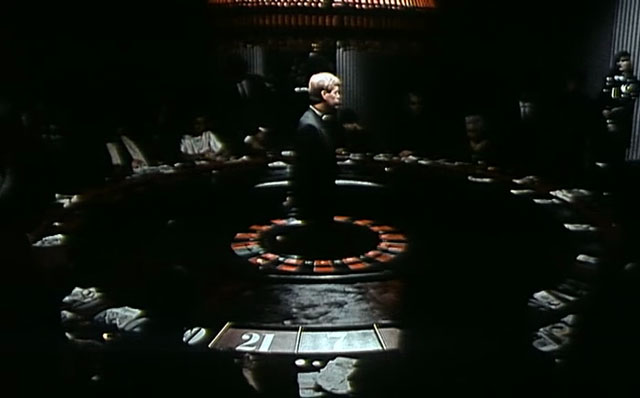
In between two highly-regarded Isabelle Huppert-starring late works by Chabrol, I watched this ambitious, now-obscure Fritz Lang homage. Almost the only mentions of it online appear in sentences such as: “Chabrol’s career wasn’t perfect; he also made disastrous flops for foreign distributors, such as the forgotten turd Dr. M.” So I was excited about the Mabuse connections (they were very slim) and M connections (there weren’t any), but kept very low expectations – then the movie turned out to be quite good.

It never tops the great opening: 3 minutes of cross-cutting between four tense, unexplained segments, each ending with a death, with a TV broadcast keeping time between locations. Looks like a high enough budget, judging from the scale of the fire and explosions that follow. So why did an interesting, high-tension sci-fi movie with good explosions turn into a failure? Well, the storyline and the actors aren’t actually all that amazingly good, rather made-for-TV quality. But more importantly, it’s set in a future where Germany was still divided by the Berlin Wall, which fell many months before the movie was released – so all of the script’s east/west occupation metaphors were seen as laughable by the time it shirked into theaters.

I’m not sure that Flashdance’s Jennifer Beals was the most bankable international star for a prestige picture, either. Beals was also in Sam Fuller’s Madonna and the Dragon in 1990, and Chabrol himself had appeared in Fuller’s Thieves After Dark a few years prior. Here she plays the spokeswoman for a vacation getaway company – Theratos – which advertises incessantly all over the city, cheapo-Blade-Runner-style. Movie was shot in Berlin and has that 70’s-80’s grimy film look, and also stars falsely-gruff-voiced German actor Jan Niklas as our rebel lieutenant hero. So maybe I overestimated the film’s budget.

Jennifer Beals:

Beals is introduced in a nuclear mosh-pit dance club. My favorite fanciful sci-fi detail in the movie is more social than technological – there’s a woman in her seventies drinking at the bar in the club amongst strobe lights and deafening thrash music. The city (or at least the TV news) is obsessed with a recent series of suicides, and Claus, the cop on the case, finds a connection to Beals, in that each suicide was darkly obsessed with her, taking photographs and advertisements with her face and mangling them. Meanwhile, her omnipresent ads for Theratos (pronounced somewhat like Toronto) has language like “drift off, let yourself go, leave it all behind, time to go” as the cops unveil more suicide victims – shades of They Live.

Claus and his partner Stieglitz (Benoit Regent: Binoche’s lover in Blue and the guy who stalks all the girls of Rivette’s Gang of Four for some reason I don’t recall) are the only two cops on the case of the suicides, and eventually, like more than halfway into the movie, they make the incredible discovery that the vortex-turtle medallions found on all the suicide victims are from Theratos! That’s right, the very logo of the company that seems to be the only advertiser in the nation, and they discover this halfway through the movie. Look, you can see it on the wall-mounted motion billboards:

But maybe the reason these two dull-wits are running the investigation is that their superiors are actually the evildoers behind the whole conspiracy. Mustachioed ham Doctor Marsfeldt (Alan Bates of Georgy Girl and the Mel Gibson Hamlet) is our Mabuse substitute, complete with a Dr-Claw-in-Inspector-Gadget array of video screens that can see anything in the city, and balding Captain Engler is his enforcer within the police. I can’t recall if Marsfeldt has some sort of government position or what power he holds over the police, exactly, but he turns out to be the owner of Theratos and father of Jennifer Beals – two things I would’ve thought would be public knowledge about the biggest company and most visible public figure in town.

Dr. M:

Filmed in English, in Berlin, so the rest of the not-great actors have a range of accents and delivery – including Peter Fitz (the lead guy’s sad-mouthed uncle in Werckmeister Harmonies), Hanns Zischler (Germany Year 90 Nine Zero, Kings of the Road) and William Berger (Devil Fish). Zischler plays Moser (pronounced Moo-zuh, reminded of Ma-bu-zuh) – not sure who he was exactly, but he got close to exposing mad doctor Marsfeldt before getting shot in the back by a LASER, one of the few reminders that we are in the future.

Return of the Jedi? No! It’s Dr. M – now with lasers!

I looked up Theratos online but the closest I found was Thanatos, the Greek death demon. I did find David Kalat’s “The Strange Case of Dr. Mabuse,” which has a whole chapter on the movie – counts as the most in-depth writing on the film to be found online, even if Google Books only has half the pages of that chapter. “Theratos is owned by Marsfeldt’s Mater Media. Like a nuclear explosion in which the atomic reaction generates the fuel that keeps itself blazing, Marsfeldt is sitting pretty on a recursive catastrophe. The more people commit suicide, the more desperate the citizens become to escape the city, the more they mob the Theratos offices to book vacations. The more people visit Theratos, the more people commit suicide. And as the cycle consumes more and more unwitting Berliners, Marsfeldt’s companies – Mater Media and Theratos – make gargantuan profits.”

The floating cult of theratos:

Kalat says it’s the last Mabuse movie to date, but as much as I want to believe, I wouldn’t even call it a Mabuse movie. There is, briefly, a character blatantly named Herr Lang. It’s definitely a stylish, intriguingly plotted movie, even if I have story detail problems and the dialogue is sometimes weak. The second-to-last Chabrol feature shot by cinematographer Jean Rabier, who also worked with Varda and Demy.

Engler and Claus:

Oh, anyway at the end the gruff cop hero (whose pregnant wife died 2 years ago, just to give his character some inner pain) saves the girl from crazies and they go off to Theratos, which isn’t as cool a getaway spot as promised by her own ads (as one attendee puts it after being isolated from his wife, “If you can’t screw on vacation, when CAN you screw?”). The cop and Beals do screw at some point, while Dr. M simultaneously watches disaster and atrocity footage on his fuzzy b/w TV – an unnecessarily disturbing detail. Eventually they break into the TV studio and Beals takes to the airwaves, saying some new agey babble about positivity that somehow undoes all the propaganda of the late-night talk hosts (have I mentioned them?) and her own Theratos ad campaign, as across the city people put down their suicide weapons and go on with their lives.

Chabrol:
“Dr. M stresses the fact that we are continuously manipulated… and that political speak has invaded every circle. … This is why, faced with steely-hearted strategy experts and computer brains, I hope that my film will be stimulating, since it does homage to lucidity as our only defensive weapon.”

First of three Chabrol memorial screenings in September. I remember liking his Le Beau Serge and L’Enfer from the dark pre-blog days, and since then I’ve greatly enjoyed La Rupture and been slightly disappointed in A Girl Cut In Two. Obviously for such a Rivette/Truffaut/Varda/Rohmer/Marker/Godard (not to mention Hitchcock) fan as myself, that’s not enough attention paid to a founding New Waver with over 50 films to his name.

The Guardian’s headline the day Chabrol’s death was announced read “Claude Chabrol anatomised the French middle class with a twist of the scalpel,” which could almost be a poster description of this movie, but maybe changed to “with a blast of the shotgun.” Immediately after watching it was impossible to avoid comparing it to Funny Games – they’re not similar in plot so much as in impact.

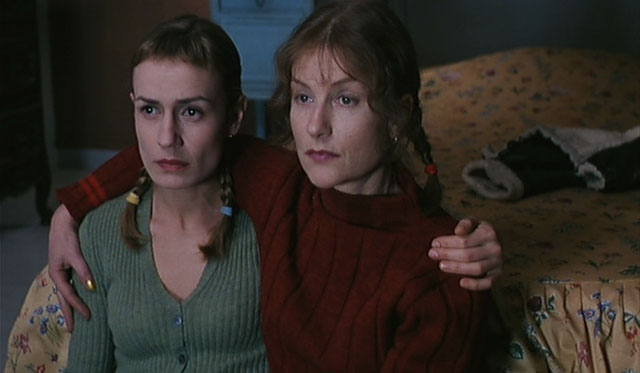
The great Isabelle Huppert (I wonder if Haneke had felt the Funny Games connection when he cast her in The Piano Teacher) got much attention and acclaim for this movie, but younger Sandrine Bonnaire (just off Joan the Maid) is the central character. She takes a housekeeper job for the Lelievre family (Jacqueline Bisset of Day for Night and Under the Volcano and Jean-Pierre Cassel, the amoral baddie in La Rupture), which she performs dutifully and quietly, keeping her personal life to herself, until she starts spending more time with fiery friend Huppert, a postal clerk long suspected by Cassel to be reading the family’s mail.

The two women egg each other on, growing more defiant in the faces of authority (Bonnaire’s employers, the church where Huppert volunteers) and more disturbingly, finding out about each others’ dark, possibly murderous pasts. Seems like a hard place to keep secrets, and Bonnaire’s past has managed to follow her into these distant suburbs. But the one thing she doesn’t want discovered is her illiteracy, so when the family daughter (Virginie Ledoyen of Cold Water & 8 Women) finds out and threatens to tell, it’s the beginning of the end.

Possibly dyslexic Bonnaire trying to read a note… filmed in a mirror (nice touch)

Sure I noticed the blatant introduction of shotguns into the movie earlier (Cassel cleans them in prep for a hunting outing) but I didn’t quite think it would come to this: Bonnaire and Huppert sneak into the house after Bonnaire has been fired for threatening the daughter, and they quietly trash the place while the family watches opera on television, each pretending to enjoy the opera for the sake of the others (that’s how it seemed to me anyway – and I think Cassel really does enjoy it). Then, when discovered stalking the kitchen with shotguns in hand, they blow away the entire family. Also didn’t see coming, despite the blatant early introduction of Huppert’s car troubles, that her getaway stalls in the middle of the road and she’s killed by oncoming traffic (her former employer the priest drove the other vehicle). Killer finale: as Bonnaire walks past the accident scene, emergency workers play the tape machine recovered from Huppert’s car, which was set up by the family son to record the opera but instead faithfully recorded the entire crime.

NY Times: “When Sophie arrives by train to begin her new job, she turns up on the wrong side of the tracks. This film takes quiet, devilish pleasure in every such hint of something awry. For instance, there is the impassive way that Sophie behaves around the Lelievres, and how it contrasts with her coarse, ravenous manner when she’s eating alone.” Senses of Cinema: “In crime fiction, criminal behaviour is often not so much a result of free agency as something determined by psychological and social factors. However, in Chabrol, the urge to explain crime is undermined by the competing view that evil itself is unexplainable. Sophie and Jeanne’s illicit behaviour is not simply a compulsive backlash against class inequality but a curiously ordained ritual.”

Bonnaire likes to watch movies on the TV in her room – I recognized Stéphane Audran from La Rupture in one of them, and sure enough it’s 1970’s Chabrol film Wedding In Blood they are viewing.

All I’ve seen from Luc Besson since The Fifth Element has been trailers for The Messenger and Angel-A, so I’ve been thinking of him as this slick-ass hyper-stylist, forgetting the earlier action grit of The Professional. Well, this one takes The Professional, drops a load of dirt on its head and plants it firmly in the 80’s. So it’s got that pre-Reservoir Dogs, pre-CGI version of hyper-stylization, which from today’s perspective makes it hard to discern from its anonymously-directed peers like Predator or License to Kill.

Or maybe I wasn’t paying enough attention because I was busy being horrified by the lead character (Anne Parillaud, who somehow went on to be a Catherine Breillat regular), introduced as a strung-out nihilist who shoots a cop in the face. I wonder if the TV remake used that scene. The movie proceeds to stretch believability even more than Predator, as the government (personified in “Bob”: Tchéky Karyo of The Patriot, Wing Commander) gives her weapons and trains her to be a secret assassin. I thought it really came to life whenever Jean Reno was onscreen, but maybe I’m just a big Jean Reno fan.

1. A deep-voiced white kid Rafael is the only peacenik in his New Mexico high school, spurred on by a hippie teacher. His parents will hear nothing of it (“There was a time for national debate. It’s over”) so he leaves home.

2. Fernanda’s kids are abducted and killed on the first day of school by local racists. The cops are unhelpful jerks, and the kids aren’t found for a month. Fernanda herself is held for two months under suspicion of murder, disappears when released, goes wandering, is found by a woman with a house full of finches.

3. Ex-Marine Carlos returns from war, finds his job gone, is full of uncontrollable lusty rage.

So, a indie film over two hours long, shot on 16mm, full of 1990’s politics but released soon after September 2001. This was destined to be ignored, but accidentally destined to be extremely relevant to the decade that followed.

Freeze frames, long refreshingly unscripted-feeling dialogue scenes, and of course some scenes of trees and the whispering wind. Plus extended concert segments by Naseer Shemma, an Iraqi musician who performs his celebrated composition dedicated to civilians killed when American planes bombed a shelter.

Michael Sicinski in Cinema Scope:

Mad Songs is a political film that encompasses multiple stories, but does so following a film historical road less travelled – beginning with DW Griffith’s A Corner in Wheat and leading most recently to Fast Food Nation. The stories never intersect; instead they examine the problems of a time and place (the suburban US during the first Gulf War) almost geologically, by taking samples from discrete layers of American life.

Part of what makes Mad Songs so poignant, and at the same time incredibly strange, is the hope and earnestness with which it concludes. No film I’m aware of has given so much space to peace activists, sitting in meetings and testifying about the transformative power of nonviolent resistance. To a generation of critics and cinephiles reared on post-noir cynicism, Gianvito’s treatises surely sounded like transmissions from another planet.

Gianvito:

When I first began to conceive the project that became The Mad Songs of Fernanda Hussein, around 1993 I believe, it grew purely out of seething rage over the events of the 1991 Gulf War, the mainstream suppression of those events, and concern over the continuing support of lethal sanctions and military “containment” of Iraq. By the time I saw the film to completion the entire situation had only grown graver and more infuriating.

“We live in a democracy. You can’t just take a little baby gator.”

Thanks heaps to the White Elephant Blogathon for making me watch this.

Original announcement
List of reviews
My pick was The Gate (link is dead)


“Scott Shaw Presents…”

Shaw is behind fifty direct-to-video movies that sounds awesome but are almost certainly not: Samurai Vampire Bikers from Hell, Lingerie Kickboxer, Max Hell Frog Warrior and more.

“A film by Donald G. Jackson…”

Jackson also voices the gator. IMDB says he died in 2003, but he is so productive, he continued making movies through 2009.

“Roller
Gator”

Hmmm, the title is on two lines, so is it “Roller Gator” or “Rollergator”? Since the director is partying in b-movie heaven with Ed Wood and Dennis Hopper, we may never know for sure. Aspect ratio is unknown as well – I’m watching a 4:3 frame inside a widescreen window, thanks to Amazon.

Roller (not pictured: gator)

Supposedly Joe Estevez (who has previously explored these themes in Legend of the Roller Blade Seven, Gator King, and Return of the Roller Blade Seven) is running an amusement park, but I’m pretty sure the filmmakers just paid admission (or hopped the fence – I wouldn’t put it past them) and shot Joe shouting dialogue to himself on what looks like a late-80’s camcorder.

Suddenly a ninja is playing loud acoustic guitar while a girl frolics on the beach. Or is that a rifle the ninja is holding? Then who is playing the guitar? Enter the grating voice of the Rollergator, shouting from a cave near the frolicking girl. Oh, special-effects be damned, the gator is just gonna be a hand puppet.

“You’re an alligator. You’re a purple alligator. But you’re purple, and you can talk”. Immediate references to Barney and the electric boogaloo follow. One thing I can say for the alligator puppet – it’s a better actor than this girl (played by Sandra Shuker, also of: nothing), who is apparently going to be our protagonist. I’m not seeing how this even qualifies as a movie. It wouldn’t make the cut at Mystery Science Theater 3000 (on which I’ve seen two previous Joe Estevez flicks: Werewolf and Soultaker) for lack of any qualities whatsoever.

Joe Estevez, also of Lethal Orbit, Fatal Justice and Murder-in-Law, with gator:

Finally the movie kicks it up, with a drum track, some rollerblading, and dutch angles on the ninja.

I wanted to get a motion capture of this scene – after narrowly escaping the least-competent “ninja” ever, the girl rocks slowly on a coin-op ride for 2-year-olds, leaning on the gator exactly like it’s a stuffed animal (which it is) and looking just depressed.

Also, I can no longer make out her dialogue over the guitar music, not that I’m complaining. I think they might’ve left the guitarist in charge of the movie’s final sound mix. Back to Joe Estevez (of Horrorween, Killa Zombies and Caesar and Otto’s Summer Camp Massacre), who talks to his nephew Reggie about locating the gator, which Joe thinks will draw customers to his park, and I just noticed Joe’s cute little ponytail.

Speaking of the amusement park, they get a lot of mileage out of simply filming stuff there: rides, games, displays. Saves money on sets, production design and story, I suppose – although not on talent, since sometimes Joe Estevez (of Hercules in Hollywood, Las Vegas Psycho and The Rockville Slayer) and Reggie are shown joylessly sitting on the rides. The credits claim production design by Sergio Kurosawa, a name that I’m positive was made-up since I didn’t notice any production design. Effects (and I didn’t see any of those either) by Tom Irvin, whose IMDB trivia page tells a heartwarming story of how Clive Barker’s Lord of Illusions helped reunite him with his estranged father. I’m glad that movie served a purpose besides wasting my time.

This facial expression will be referenced later:

The gator is trying to hide from a “crooked carnival owner”, so they go straight to a carnival, agree to talk to carnival worker Reggie’s boss, then act surprised when it turns out to be crooked carnival owner Chi Chi (Joe Estevez of Necronaut, Zombiegeddon and Crimes of the Chupacabra). Oh shit, Joe is having a heart attack! Wait, is this in the script, or is it really happening? Oh he’s okay. Contract negotiations break down and PJ leaves with the gator, taking him to her completely unfurnished apartment. Again with the production design.

Enter the mythical Swamp Farmer (played by mythical Ed Wood actor Conrad Brooks, also of Beast of Yucca Flats, Curse of the Queerwolf and F.A.R.T.: The Movie), who wanders the urban swamp chattering to himself.

Note: lens hood visible in upper-left corner:

There isn’t even an attempt at action – everyone just saunters around, even the supposed ninja, although she does have some high-kicking nunchuck moves. Oh wait, this isn’t the ninja, its the “karate instructor” – my mistake. Her motivation: “I’m gonna return [the gator] to Mr. Dennis, who’s gonna turn him over to the police.” Is Mr. Dennis supposed to be Joe Estevez (of Koreatown, Mexican American and Spanish Fly)? I thought his name was Chi Chi. Chi Chi Dennis? Oh, now the karate lady has turned on her boss and joined PJ and the gator. That was easy.

Our team is joined by another rollerblading girl, this one with a slingshot, who says things like “this is so fly!” The ensuing chase scene is the most exciting bit of the movie so far, seeming to move at more of a light jog than the usual aimless, depressed stroll – I credit the blaring surf guitar on the soundtrack for energizing things. Back at the office, Joe Estevez (of PrimeMates, No Dogs Allowed and Toad Warrior) is not amused that the karate instructor has defected.

Is the cameraman three feet tall? There are telephone lines in every shot:

After a painfully long conversation between slingshot gal and a “friend of pj” who turns out to be the ninja in disguise (or is it out of disguise), the ninja gets away with a decoy backpack and Slingshot tries her best to come up with an appropriate facial expression. Joe Estevez (of Pacino Is Missing, Not Another B Movie and 14 Ways to Wear Lipstick) has an uncomfortable chat with the ninja, then the gator & girl discuss how to find the Swamp Farmer (have I mentioned him lately? Looks like he’s now roaming around abandoned movie sets). A tearful reunion between Farmer and Gator follows.

Finally, after an attempt at a beautiful sunset coda (it’s daylight again a minute later), Joe Estevez (of Green Diggity Dog, Motorcycle Cheering Mommas and Blood Slaves of the Vampire Wolf) has somehow received the “curse of the gator.”

A piss-poor movie which even makes Curse of the Puppet Master look good by comparison. Hardly anyone seems to be trying at all, and the attempts at comedy, drama, entertainment and “rap” music are laughable (except the comedy – that’d be unlaughable).

Rollergator theme song by Elizabeth Mehr (whose band Baby Alive won some MTV award in 1994, claimed she “would like to enlighten the world, and hopefully bring change, peace, and unity through music”) and performed by Magic Man (google suggests this could be a 2009 French electronica duo, a hit rock song by Heart, a Billy Zane movie, or a member of the United States Men’s National soccer team – each seems equally likely).

Fortunately, this dark prophecy has not yet come to pass:

Great cinematographer William Lubtchansky died this month. I mostly know his Jacques Rivette movies (plus a Varda short and The Regular Lovers), so here’s another side of his work: something by “the Straubs,” the first one of their films I’ve enjoyed watching after a couple false starts.

A dude (credited as “the son” but I believe named Silvestro) talks with an orange seller about meals. A man on the train complains about the poor. Yelling, always yelling! Everyone is yelling. He’s on a trip, stops to have conversations with people he meets (appropriately, this is based on a book called Conversations in Sicily) which sound like recitations. It wasn’t until I rewatched some scenes from this within Costa’s documentary that I appreciated the recitations, their strange cadence – the first time I was just reading the subtitles, following the conversation, but apparently there’s more to it than the words being spoken. More on the fate of Sicilians, and some over-my-head philosophy. The sound sometimes disappears.

The shots at the end of each segment are getting longer. Oooh, a pan! The same one twice! A long pan across a landscape and back, repeated twice, and I don’t understand. Silvestro lands at his mom’s house, listens to her talk about when he was a kid, what they did and what they ate (snails), then about his grandfather, “a great socialist.” She puts down his father and her husband – I wasn’t sure if she remarried and she’s cutting down two men, or if it was just the one – for his/their weakness. Anyway, the man goes outside and meets an awesome knife sharpener. One of them declares “the world is beautiful!” and the movie ends as they face each other listing off beautiful things.

Some official synopsis says that Silvestro “comes face to face with reality, corruption, and treachery, that differ from his memories as a child with a mother lost between abstract fury and an awareness of his incapacity to comprehend the human condition.” I don’t get how the movie is communist, or even whether it’s supposed to be. I liked the style, though, and the length and pacing, the unconventional-seeming editing choices (although in the doc they act like there’s only one way to edit a movie correctly, that it’s obvious, as they struggle for hours to choose the exact frame on which to cut).

NY Times calls it “austere and pretentiously minimalistic”:

Here, at odd moments, it pans slowly back and forth across a particular setting as if to emphasize the filmmakers’ blank emotional and editorial slate. For in the Straub-Huillet esthetic, truth is to supposed to be revealed as much through accident, inference and subtext as through what is actually said.

The Straubs seem to be insulting me for liking this movie more than their others… from an interview:

JMS: Yes, one of the main reason Sicilia worked, is that the bourgeoisie likes to have a protagonist with an initatic journey, and preferably to find back his/her mother, etc. That’s why Bach worked. One can’t change the vices of the bourgeoisie…
Int: So Bourgeoise needs a hero?
JMS: A hero, I don’t know, but they need to hook up on something…
DH: they abhor liberty, for themselves and for others…

Fuck liberty.

Senses of Cinema lays it all out:

Straub-Huillet eschew dubbing in favour of direct sound, to the extent that background noises and even the static noise caused by wind rustling on a microphone are kept in their integrity, and the original sound of each individual image is retained. This, of course, has a huge impact on editing, as cuts cannot be made arbitrarily, but have to defer to the exigencies of the sound: Straub-Huillet will thus linger on an empty space in order to capture the fading footsteps of a character exiting the scene. Similarly, they reject all manipulation of the image in post-production (colour-matching, etc.).

Equally notorious is what in French criticism has come to be known as the “Plan straubien” (“Straubian shot”), which can roughly be defined as a pan or tracking shot of a landscape lasting up to several minutes in duration. While these shots have greatly contributed to the notion of Straub-films as boring and unwatchable, they are crucial for Straub-Huillet’s “pedagogic” project of “teaching people how to see and hear”.

Their position as authors is attenuated by the fact that their films are almost exclusively taken from pre-existing texts – whether literary, dramatic, musical or essayistic. Indeed, only a few lines of dialogue in their entire corpus are their own invention. As Youssef Ishaghpour notes, however, their films are best seen not as adaptations, but as “documentaries of a special type: on works”

Senses also says that “the texture and sensuality of their films mean that they still demand to be seen on actual film stock, in an actual cinema.” Too bad for me, I guess.

I began to watch this, trying to remember what the filmmaker said about a song he misused in the film, but all I could think of was the magic Rolling Stones LP in Royal Tenenbaums that plays two songs in a row which never appear in that order. Then I hear a Rage Against The Machine song in the background of Ossos, so I thought about that for a while. Then gradually I realized there’s a movie playing and I should pay attention, but it was still a while before I figured out what’s going on.

Basically, this is the direction I’d feared Costa’s movies would take, after reading a bit about his career and watching the other two. It’s L’enfant with better camerawork (that’s good!) and slowed down (that’s bad). Nuno Vaz (we’ll call him Nuno – IMDB doesn’t know his name either) eventually comes home to check on his girl Tina and their new baby, but she decides to gas herself in the living room, and he lays down oblivious to sleep. She wakes up and saves him, instead of vice versa. Or I think that’s what happens. Tina (actress Mariya Lipkina) helps her sister Clothilde (non-actress Vanda Duarte) as a house cleaner. So Nuno goes off to sell the baby and/or use the baby to elicit sympathy from passers-by to get money/food while Tina turns on the gas at her employer’s place and tries again to kill herself.

Mostly static camera setups (and of course the celebrated minutes-long tracking shot of Nuno walking with the baby in a trash bag) showing suicidal, baby-selling poor people – not my thing. But it gets better. And the music bit finally comes when Tina blasts a killer live version of Wire’s “Lowdown”, Costa’s problem in hindsight being that her character wouldn’t actually have the access or inclination to obtain Wire bootlegs in the slums of Lisbon. Costa: “Definitely they didn’t all listen to Wire. What was playing all the time was hip hop, rap or Metallica and Pantera, things that I will never put in my films. So I brought the CD first to the community, and I played the track “Lowdown” before the shoot, and everyone who heard it wanted a copy of the CD. After that, they all had CDs of Wire and the Buzzcocks.”

Ines:

Anyway, Nuno seems to be pretty helpless – Clothilde is the strong one of the trio. Nuno is feeding his baby like a bird, pre-chewing its food, when it’s taken away from him and sent to the hospital. He hangs out with a nurse who wanted to help (Nurse Eduarda: Isabel Ruth, in bunches of Oliveira films), stays in her apartment, but gets surly when he’s offered too much, still got his pride. Eduarda meets the girls through Nuno, and I think has sex with Clothilde’s husband while excitedly slumming in their neighborhood. Meanwhile, Nuno tries again to sell the baby, this time to local prostitute Ines de Medeiros (returning from the last two movies). Clothilde eventually catches Nuno sleeping (without the baby), turns on the gas and leaves, possibly murdering him.

Clothilde’s husband with Nurse Eduarda:

More weirdness: the girl with strong eyebrows from Casa de Lava, whose real name is Clotilde, shows up as a neighbor. Eduarda has her privacy (until she starts handing out apartment keys to everyone she meets) but the slum dwellers do not – Clothilde is having sex with her husband when Tina shows up at the open window over their heads to visit. And Nuno keeps lying to the girls, telling them the baby is gone, that it’s dead.

Ossos played in Venice along with Chinese Box and Zhang Yimou’s Keep Cool, but Takeshi’s Fireworks took the prize, although this won best cinematography for D.P. Emmanuel Machuel (returning from Casa de Lava). I warmed up to it, eventually digging the mystery, the characters’ shifting connections, and the sweet camerawork – all things Costa would work to eliminate from his next movie, damn him.

Inexactly quoting Costa from his English-language interview with Jean-Pierre Gorin, about his early, mostly discarded script for Ossos: “I felt that I should start with my feelings, not their feelings, even if these feelings are very obscure, very dark. It was my feelings about that place, things that had to do with my sensibility, political things, moral things, observation. So I didn’t have the dialogue for this film, and for that, I needed time.” He mentions Cloverfield at one point, which threw me, unable to keep the idea of Cloverfield and Ossos in my head at the same time.

In the DVD extras, Jeff Wall talks about the unknowability of the main characters, points out minor actors who open up the film’s world, and discusses parallels to Bresson. A very useful little essay, the one extra that most convinced me that I might want to watch this movie again sometime.

Joao Benard da Costa:

Whereas Pedro Costa’s two previous films were liquid works, referencing blood and lava, this one, with its very title, ushers us into a new reality, precisely the one that gave the film its title: Bones. Pedro Costa has said somewhere “Bones are the first thing one sees of bodies,” and indeed without bones the body would not exist. It would collapse. Yet bones are also the last part of the body to perish. … Whereas flesh is a luxury, a pleasure – hence the so-called “pleasures of the flesh” – bones are what you throw to the dogs. Bones are what animals gnaw at, what remains, the tough part. This film, which is extremely tough, is a film about toughness itself. … But this film by no means wallows in misery. It couldn’t be further from a pessimistic film. It isn’t even an offshoot of neorealism, or even a realist film where we observe the poor and feel sorry for them. On the contrary, here we find people with a startling sense of dignity and a remarkable toughness, an almost tangible grit.

Opens with low-light shots of lava. Close-ups of thickly eyebrowed women! From the start it’s cutting faster than O Sangue. The color isn’t as self-consciously gorgeous as the black-and-white in the other movie but we still get some heavy shot compositions and strange moments.

Construction worker Leao (the intimidating Isaach De Bankolé of Limits of Control) fell, putting himself in a 2-month coma. The hospital got an anonymous letter along with a check, so he is discharged to fly home to Cape Verde, joined by nurse Mariana (Inês de Medeiros of O Sangue). She stays a few days, is almost raped on the beach, saved by a dog.

Edith (Scob, of Summer Hours, Comedy of Innocence) is the local white woman and owner of the dog. Her son (Pedro Hestnes, star of O Sangue but unrecognizable to me) is confrontational to Mariana. A boy named Tano, possibly Mariana’s attacker, maybe kills the dog? Leao finally wakes up, his first words being “my land.” A grey-haired local guy named Bassoe plays the violin, as Mariana glows in the sunset, falling more in love with this island. But many scenes are in very low light, relationships and plot points are undefined, and the movie is becoming more oblique into the second half.

Connections! Edith’s friend says “juventude em marcha!” (the original title of Colossal Youth), and when Mariana asks Leo to “try to remember something,” his first word is “sangue.”

Tano is drunk? How old is he, anyway? Is Leao the son of the violinist? Didn’t Bassoe say he was going to Portugal – why is he still here? Why is Mariana? I started to find it all more annoyingly frustrating than deliciously mysterious, but apart from the plot I enjoyed the visual experience until the end.

Fred Patton: “An arsenal of symbolism, audio-visual disjunction, and insinuating edits work to paint a portrait of the social landscape.”

R. Brody: “a politically savvy homage to Jacques Tourneur’s 1943 horror film, I Walked with a Zombie, in which postcolonial decay is invested with both metaphysical and erotic allure.”

I’d heard about the Zombie connection, and so watched it a day earlier. I suppose Mariana/Ines is Nurse Betsy and Leao/Isaach is the zombie wife, but then neither of the two brothers exist, just their mother Edith Scob. The connection gives critics something to talk about, at least, but the director seems to have thought better of the idea.

from the marvellous Cinema Scope interview:

I had this idea—which was a stupid idea—of doing a remake of a film called I Walked With A Zombie by Jacques Tourneur, who made a lot of films here [in America] like Cat People, Anne of the Indies, Way of a Gaucho. He was a great artisan. I decided to make something around my memory of that film; a film that has zombies, volcanoes, ghosts, crazy women, dogs, various strange nights, a lot of confusion and mystery. You will see that it’s not at all like I Walked With A Zombie; it’s something else.

M. Guillen [note that the film’s English title was Down To Earth – and he disagrees with me over which Zombie character Edith Scob is performing]:

Scob accepted Costa’s strange invitation to reconfigure the role of Tourneur’s entranced Jessica; the lost, White woman under the spell of the island.

Costa cautions that Casa de Lava is a confusing film that leaves the viewer a bit lost. He attributes this to the fact that he himself started losing himself consciously during the shoot, sharing Mariana’s role in the narrative. The story revolves around the arrival of a young nurse on the island who has accompanied the comatose body of an injured laborer Leão. As Costa previously specified, the body of Leão supplies the “dead weight” that thematically runs throughout his films. Mariana’s inability to find anyone willing to claim the body creates the film’s texture of gravitas. The film’s narrative slows down for having no immediate resolution.

Describing [the island of Fogo, where this film was shot], Marker [in Sans Soleil] writes: “I saw it immediately as a setting for science fiction: the landscape of another planet. Or rather no, let it be the landscape of our own planet for someone who comes from elsewhere, from very far away.” This underscores Mariana’s own “alien” quality among the islanders. Perhaps, after all, there is some sense to the translation Down to Earth? As Daniel Kasman summizes: “Inês Medeiros’ existential experience on the island is the film’s primary grounding.”

Long Pauses:

Costa’s own description of Casa de Lava reads like a ghost story:

“In the beginning there is noise, desperation and abuse. Mariana wants to get out of hell. She reaches out her hand to a half dead man, Leao. It’s only natural, Mariana is full of life and thinks that maybe the two of them can escape from hell together. On the way, she believes that she is bringing the dead man to the world of the living. Seven days and nights later, she realises she was wrong. She brought a living man among the dead.”

Like a mash-up of Jacques Tourneur’s I Walked with a Zombie and Claire Denis’s Chocolat, Casa de Lava concerns a young woman, Mariana (Ines de Medeiros), whose exotic notions about the Other are tested and refuted by first-hand experience.

Mariana can’t help but be seduced by the Otherness of Cape Verde. … The music is one more seducer that tricks Mariana into believing that she is the object of desire. It’s also one more language that she invariably misinterprets. Mariana only realizes her mistake — that she has “brought a living man among the dead” — in the film’s closing sequence. Appropriately, the final images in the film resist simple interpretation. Without spoiling the plot, I’ll say only that Mariana witnesses two events that shatter the illusions that had sustained her during her week in Cape Verde: that she was a source of health and healing for the wounded people there, and that she held sexualized power over them. At her moment of awakening, Costa frames Mariana in a still close-up and, for only a few seconds, brings back the non-diegetic viola music. When the music ends, so does her story.

Pedro Hestnes at right:

Edith Scob at right:

J. Rosenbaum:

There are at least four other Andrades listed in the cast of Casa de Lava, all of them playing children of Bassoé [Raul Andrade] – one of many factors that suggests that the film, like all of Costa’s other films, is an intricate mixture of fact and fiction. Costa told Mark Peranson in Cinema Scope (issue no. 22) that the film was originally scripted, but “at one point I just left the script behind, because I thought that if I’m going to try to shoot this girl in this new place that’s foreign and dangerous, then I have to shoot it from her point of view,” and “There was a lot of improvisation each day” – one indication among many that Mariana (Inês Medeiros), the lead character, largely functions as Costa’s surrogate in the film. Nearly all the ethical questions and ambiguities posed about her involvement with the islands’ residents are those raised by Costa’s involvement – that is to say, his filmmaking – as well. And improvisation is perhaps the most obvious way of raising the existential stakes of these issues. As Costa notes, he and Isaach De Bankolé even came to blows over the latter’s objections as a professional actor to his character Leao having to remain in a coma for most or all of the film. (It’s also my impression – gleaned from the account of a friend who attended Costa’s discussion of the film in Los Angeles – that Leao, like his rough counterpart in I Walked with a Zombie, never would have come out of his coma at all if it hadn’t been for Bankolé’s objections.)

Casa de Lava may be the film of Costa’s that poses the most constant and furious tug of war between Hollywood narrative and the nonnarrative portraiture of both places and people, staging an almost epic battle between the two. These warring modes become almost magically fused whenever there is a landscape shot with one or more human figures; every time this happens, the film moves into high gear. … Typically, … we’re either told too little about what’s happening in order to be able to follow the story or everything we could possibly want to know – in both cases in a rather mannerist fashion.

Much later in the film, the son (Pedro Hestnes) of a white islander, Edite (Edith Scob), gives a similarly telegraphic account of his mother, himself, and the allotment of funds, again to Mariana, over his father’s grave: “She came after him. She was 20 years old. She was half his age. I never met him. He was a political prisoner. Afterwards, she never went home. She’s been here for years with me. People help her. She likes them, they like her. We live here. Now we get a check every month, his pension, to pay everyone back. They know, they all wait. They all want to leave.”