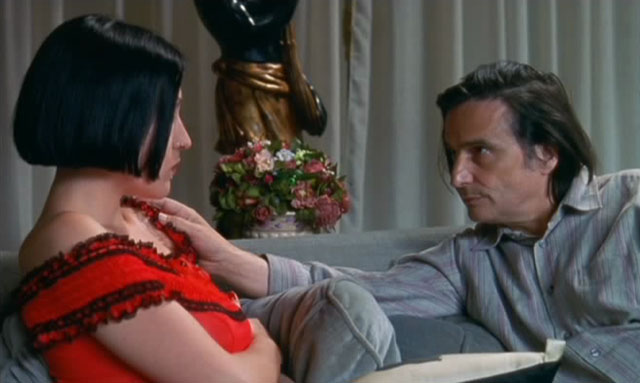
Melancholy character drama about a washed-up pornographer. Technically speaking it’s a very nice movie, though it would help if I knew or cared what the story was about.

Pornographer and subject:

Jean-Pierre Leaud is the title character Jacques, having a rough patch with his career, his woman (Dominique Blanc of Belvaux’s Trilogy) and his son (Jeremie Renier, star of L’enfant), who is in love with Alice Houri (star of Nenette and Boni). At the beginning a narrator sums up Jacques’s career, telling us he never completed his final film The Animal in 1984 (the outline of which reminds me of Borowczyk’s nude-girl hunt The Beast). But the movie isn’t set in ’84, so I’m thinking it’s about Jacques trying (failing) to come out of retirement, with his producer (Andre Marcon, Roland in Up, Down, Fragile) taking over in the middle of his comeback shoot, leaving Jacques jobless and lost again. Ends with Jacques giving an interview to Catherine Mouchet (star of Alain Cavalier’s Therese).

Twin Peaks reference: girl dancing backwards with red curtains

M. Sicinski:

If The Pornographer has one major flaw, it’s that Bonello invests too much stock in Jacques’s integrity as an artist. Although the film is fairly clear-eyed about the kitsch factor within his most sincere ideas … The Pornographer is still indebted to certain romanticist pieties regarding art vs. commerce.

J. Renier:

The Guardian:

Essentially, the film is about the brutalisation of feeling. Leaud’s performance, a study in weary hope over experience, is as expressive as anything he has done in years. His director isn’t exactly an admirable man, but according to Bonello, whose criticism of French society is scathing, the world is worse than he is.

The Adventures of James and David (2002, Bertrand Bonello)

I still don’t think I have a good sense of Bonello’s style after watching The Pornographer and this silly short about two brothers (played by two brothers). David is a hairdresser who just opened his own place, and James is a DJ in a “Canadian electronica collective” (LOL 2002). They must not have been close, since James barely realizes his brother has financed, remodeled and opened an entire salon. Anyway, David gives James a terrible haircut (worse than the one in Cosmopolis) and that’s the joke, then it says “end of episode one,” and I don’t think there were any more episodes.

Cindy, The Doll Is Mine (2005, Bertrand Bonello)

Photographer (not pornographer) and subject, both played by Asia Argento (I didn’t realize this until the credits). Subject is told to try different poses, patient photographer only shoots when ready, finally asks if subject can cry, “because I think it would move me.” After a snack break, subject puts on a Blonde Redhead track, and manages to cry, which manages to move the photographer. All told, I liked this better than the previous two Bonellos.

Asia 1:

Asia 2:

Sports Night season 1 (1998-99)

Good Aaron Sorkin show. Casey (Peter Krause of Six Feet Under) and darker-haired Dan (Josh Charles of Muppets From Space) are anchors of a sports show run by Felicity Huffman (of Transamerica and apparently Magnolia) and Robert Guillaume (Benson, Rafiki in The Lion King). Casey likes Felicity, who is engaged to Ted McGinley, and Dan likes Teri Polo (mom in The Hole), who is married. The only stable relationship is Felicity’s assistant Sabrina Lloyd (Harley’s The Girl From Monday) with new guy Joshua Malina (a Sorkin regular).

Asylum (1996)

Edgar Wright’s first series – and he has four others that I’ve never heard of between this and Spaced. Cowritten with the cast, overall uneven with a slim overarching story and characters that get tiresome if you watch the episodes too close together.

Simon Pegg is a pizza boy called to an asylum then imprisoned there. Jessica Stevenson plays the sadistic head nurse and a daytime-TV-addict inmate. Mighty Boosh star Julian Barratt is a talkative, pretentious artist (and the highlight of the show). Standup comic Adam Bloom is a Lenny Bruce obsessive, Paul Morocco a mute juggler, Norman Lovett (of Red Dwarf) the head doctor and Mick O’Connor (whose only other credit is The Falls) the receptionist. Each episode ends with a music video, which I kinda loved.

Big Train season 1 (1998)

Excellent sketch comedy show starring Simon Pegg (between Asylum and Spaced), Mark Heap (Brian in Spaced) and Kevin Eldon (a dim officer in Hot Fuzz), with Julia Davis (Nighty Night) and Amelia Bullmore (Jam and I’m Alan Partridge).

Weird to hear a Tortoise song scoring a fake TV ad in episode 3, and to see a parody of the intro to A Matter of Life and Death. Lots of animated (barely) footage of the staring-contest world finals.

Cowriters Arthur Mathews and Graham Linehan worked on The Fast Show, and with Christopher Morris on Jam and Brass Eye. Still need to watch Morris’s feature Four Lions

Arrested Development season 3 (2005-06)

So very good. I love how it ends with none of the characters having learned anything at all. Appearances by Justine Bateman, Judge Reinhold and a long section with Charlize Theron.

Scott Walker: 30 Century Man (2006)

Since I didn’t watch this with the release of The Drift like I was supposed to, I watched it with the release of his follow-up album. Wow. Some records I need to get: Night Flight, Climate of Hunter, the Ute Lemper album. Scott worked on Pola X so they show some behind-the-scenes bits of the warehouse performance and motorcycle crash.

The Pee-Wee Herman Show on Broadway (2011)

Apparently, Pee Wee is better remembered than revisited.

Also watched Maria Bamford‘s stand-up thing recorded at her house with no audience – weird and awesome. She’s got a new one with her parents as the audience, which sounds even better.

The Queen of Versailles (2012, Lauren Greenfield)

Katy watched on netflix in a couple installments – I think I was there for all of it, but not too sure. Belongs in the Movies I Only Sorta Watched category. Pretty fascinating, starting as a document of the loony mega-rich couple building the largest house in America, until the housing crisis delays their plans and threatens his timeshare business. Wonderful to see things from the 1% perspective, especially when they’re in what they consider to be desperate financial straits (though the wife has a five-shopping-cart trip to walmart and visits the warehouses where their extraneous crap is stored), repeatedly referring to themselves as normal people who got screwed by the banks.

Pictures at an Exhibition (2008)

Tour through a simple 3D computer gallery, stopping to view each of Marker’s mash-up portraits, some of which I’ve seen before in Immemory. Posted on Marker’s youtube page a few years ago. Gentle, repetitive piano music by Arvo Part. Probably named after the piano suite by Mussorgsky.

Silent Movie (1995)

Nine minutes of classical-Hollywood-evoking footage of a glamorously-lit, black-and-white Catherine Belkhodja, star of Level Five, first in motion smoking a cigarette in different poses, then as a series of stills. The stills of Catherine with eyes closed then open can’t help but evoke La Jetee. This was part of a video installation for the Wexner Center in Ohio, along with essays and photos and posters and more videos – “a highly personal response to the one-hundredth anniversary of the invention of cinema.”

I also rewatched We Maintain It Is Possible, and liked it better than last time, and the English version of Chats Perches.

“The owl is to the cat as the angel is to the man.”

A surprisingly sweet movie. Will Ferrell is an elf-adopted human in Santa’s workshop who goes to New York to find his real dad, James Caan, falling for toy store drone Zooey Deschanel on the way. Bob Newhart is lovable as Will’s elf stepfather. Everyone learns a little something about the spirit of Christmas, except Peter Dinklage. From the writer of the same year’s Haunted Mansion.

Similar to Collapse, in that both are documentaries set in a room where a single subject is speaking to the camera, and both are completely terrifying. Collapse left me aimlessly afraid of the end of the world, this one offers a clear action item: Never go to Mexico.

A former “sicario” (drug cartel enforcer) who has escaped with his family tells about his youth (driving cars full of drugs over the border before he was even old enough to drive), training (at the police academy, where 25% of graduates are already working for the cartels) and 20-year career as a kidnapper, torturer and murderer at the behest of an unworthy man, as the now church-going ex-sicario realizes. The drug business basically runs the government, police, and even military, if this guy is to be believed. Never go to Mexico.

M. Peranson:

More so than Police, Adjective, the film that came to mind when watching El Sicario is the still relevant Chambre 666, wherein Wim Wenders set up a stationary camera in Room 666 of the Hotel Martinez during the 1982 Cannes film festival and asked filmmakers like Godard, Fassbinder, Herzog and Spielberg the question: “Is cinema a language about to get lost, an art about to die?” It’s no coincidence that the directors are framed, like the sicario often is, next to a television set.

Not all mumblecore comedies of young-adult awkwardness come from the States, apparently. This one is from German filmmaker Ade, one of Cinema Scope’s 50 Under 50.

Melanie moves to a new town where she knows nobody, starting work as a teacher, breaking up with her boyfriend (who helps her move). She is enthusiastic to the point of desperation – gives all her neighbors gifts to introduce herself. She dodges a fellow teacher who wants to hang out with her, manages to make friends with a woman named Tina across the courtyard instead. But Tina has friends, throws parties, is in a relationship, deals with personal problems, and doesn’t want to hang out with Melanie 100% of the time – so Melanie becomes more and more desperate and stalkerish.

Adult life isn’t going too well. She even goes to a petting zoo and gets pushed around by little horses. Nothing intensely interesting happens until the final scene, where Melanie goes for a drive alone listening to Grandaddy and decides to crawl into the backseat and stare out the side window while the car is still going.

Pretty good little indie movie – I don’t get all the excitement, but I’ll take Cinema Scope’s word for it and watch her next movie. She’s also recently worked on Ulrich Kohler and Miguel Gomes movies I wanted to see. M. Peranson in Cinema Scope says this was her “DV student-film debut” and mentions that Melanie’s accent is a source of humor for native Germans.

Odd movie, weirdly off-center compositions with tops cut off. Opens with three siblings, insulated in a suburban house their entire lives, being taught fake vocabulary words (“a sea is a leather armchair with wooden arms”). Dad brings a female security guard called Christina from town to have dispassionate sex with the son. The girls kill time by playing fun games, like testing homemade anesthetics (“the one who wakes up first will be the winner”).

Everybody loves Christina:

The girl from outside brings new ideas, and the kids start to act differently, attacking each other with knives and hammers. An unknown creature (neighbor’s kitty) comes over the fence, and the boy defends his family using garden shears.

Dad finds out that one girl (none of the kids have names) got hollywood videos from security guard Christina and developed a killer Rocky impression. He punishes the guilty parties appropriately, beating his daughter with the videotape duct-taped to his hand, then nailing Christina with her VCR. “I hope your kids have bad influences and develop a bad personality. I wish this with all my heart as punishment for the evil you have caused my family.”

Rocky:

Dad tells them a person is ready to leave the house when their dogtooth comes out. Predictably, his daughter knocks out her own tooth, then hides in the trunk of his car to escape. The other daughter is having sex with her brother (if the kids are even related, and not kidnapped or something).

A Cannes winner and oscar nominee. The mom appeared in the other bizarro incestual Greek movie I’ve seen, Singapore Sling. The movie doesn’t explain much, goes in its own entertaining direction instead of trying to psychoanalyze and present backstory.

Lanthimos is one of Cinema Scope’s 50 Under 50, but I’ve avoided reading his entry because it contains possible spoilers about his follow-up, Alps.

Film Quarterly:

Dadaism delighted in exaggerating the pompous absurdity of the ceremonies that authority needs in order to legitimate itself, and Lanthimos’s anatomization of patriarchal power in Dogtooth partakes of the same spirit of coldly savage caricature. The father in the film is not the underside of the Law so much as its parodic extension.

Futurama season 7 (2010)

The first season on Cartoon Network (after the four movies) feels like the show never left. Particularly excellent episodes were the first one (explaining the few years’ absence and the crew’s sorta-survival from a massive crash) and a time-travel story.

The Thick of It season 2 (2007)

A weird “season” in two hour-long chunks, showing our government goons from season one and their opposition group (“the nutters”) who think they’ll be taking power when the prime minister resigns. Fewer jokes, insults and comprehensible situations to someone as dumb about British politics as I am. Season four just aired, exciting.

Screenwipe season 5 (2008)

I can’t seem to stop watching this, even though it’s irrelevant to my life and I don’t get most of the jokes. I just like Charlie Brooker. Best was the episode on children’s programming, less good was the humor-free double-length one on TV writing. Also checked out the special Gameswipe, an unhelpful hour introducing video games to people who are afraid of them.

Patterns (Jan 12, 1955)

A workplace drama that put writer Rod Serling on the map. It was a huge hit, re-broadcast (re-performed, since it’s done live) the next month and turned into a film the following year with the same director, Fielder Cook (from Atlanta).

New executive Staples arrives at the office, gets introduced to big boss Everett Sloane (Welles’s scheming employer in The Lady From Shanghai) and nervous coworker Ed Begley. The boss intends for Staples to take Begley’s place, but has to get rid of Begley first – can’t just fire him, so he tries to force the guy out, finally succeeding when Begley has a heart attack after a ruthless attack at a board meeting. Staples protests, thinks of himself as a good man recognizing corruption in the system, but he and his wife want this position and promotion too badly so he goes along with it. Nicely mobile camera, with bigger sets than Marty.

Ghost Train, the first episode of Amazing Stories, directed by Spielberg in 1985 – which I watched when it premiered. Lukas Haas, the main kid in Mars Attacks! is the boy whose grandpa (Roberts Blossom: scary neighbor in Home Alone) awaits the train that he derailed 75 years ago, killing everyone aboard. The train coming through the family’s house is impressive – the rest is a bit too Spielbergian-lite, but an improvement on his Twilight Zone episode.

Also watched an (cr)apocalyptic double-feature of Cloverfield and The Day After Tomorrow with Rifftrax.

Robin Williams is an unpublished author and a disrespected high-school poetry teacher. He’s got a beautiful young girlfriend and a shitty, hateful, porn-obsessed son Kyle (Daryl Sabara, one of the Spy Kids), who dies during an autoerotic asphyxiation session staring at cellphone photos up his dad’s girlfriend’s dress – so Robin stages it as a suicide and writes a note.

Upon reading the suicide note, everyone suddenly sees the “real” Kyle:

Except friend Andrew, who sees some kinda weirdo poet:

The note becomes huge news on campus and soon everyone is acting like Kyle and his dad are heroes. Kyle’s “journal” (hastily written by Robin) is locally published, and his story inspires everyone: a closeted homosexual athlete, the goth girl considering suicide, the guidance counselor nobody talks to… everyone except Kyle’s best (only) friend, who sees through the ruse and tries to talk to Robin, who’s too busy dealing with his new celebrity.

Bobcat plays the chauffeur who takes Robin (and his self-obsessed girl) to a TV studio to discuss the inspirational journal (Tom Kenny and Jill Talley cameos), and national publishers express interest in the journal and in Robin’s novels, but he finally confesses the lie and goes home to watch Night of the Living Dead with his group of misfits: the lonely next-door neighbor and Kyle’s one friend. Amazing blend of humor and pathos, like when Robin starts crying in front of a porno-mag street vendor.

Girlfriend Alexie Gilmore and coworker Henry Simmons (of NYPD Blue)