The Benaki Museum (2013, Athina Tsangari)

Lovely seven-minute advertisement for a Greek museum narrated by Willem Dafoe, children acting as curators, interacting with ancient artworks.

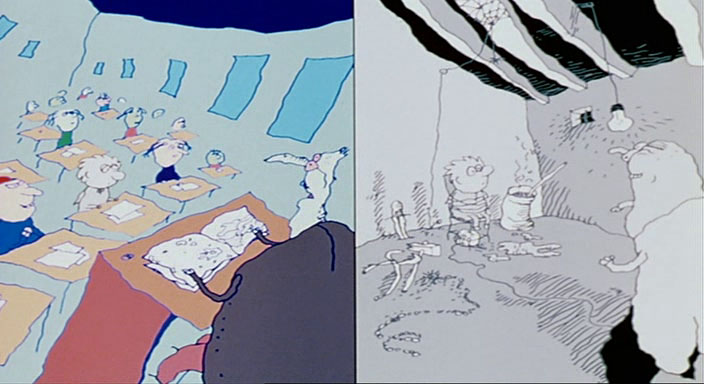
The Boy Who Saw the Iceberg (2000, Paul Driessen)

Crazy… split-screen with a boy’s ordinary day on the left and his imagination (which usually involves being captured and making a daring escape on the right. Then he and his family die when travelling on a boat that hits an iceberg. The imagination side takes another minute to adjust to this ending. Animation is fluid, doodly and wonderful. Driessen is Dutch, has a long career of award-winning shorts.
The Lost Thing (2010, Tan & Ruhemann)

Dude is collecting bottlecaps when he finds a Lost Thing (sort of an armored contraption with mechanical parts, jingle bells and tentacles), seeks its origins, finally returns it to a secret area in the city where crazy mecha-organic beasts all live. Won the oscar, same year as Day & Night. Tan created the source book, Ruhemann lately produced something called Chuck Norris vs. Communism.

Zerox and Mylar (1995, Joel Brinkerhoff)

Wicked one-minute claymation thing. Cat wants to lure mouse, paints his hand like a lady mouse, but mouse traps the lady-mouse-hand and has his way with it/her. Brinkerhoff is obviously a madman, apparently worked on Marvin the Martian in the Third Dimension, which is on one of the Looney Tunes blu-rays.

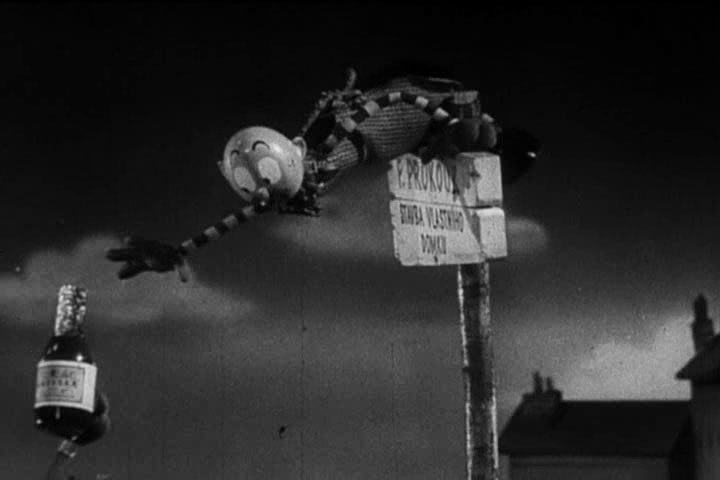
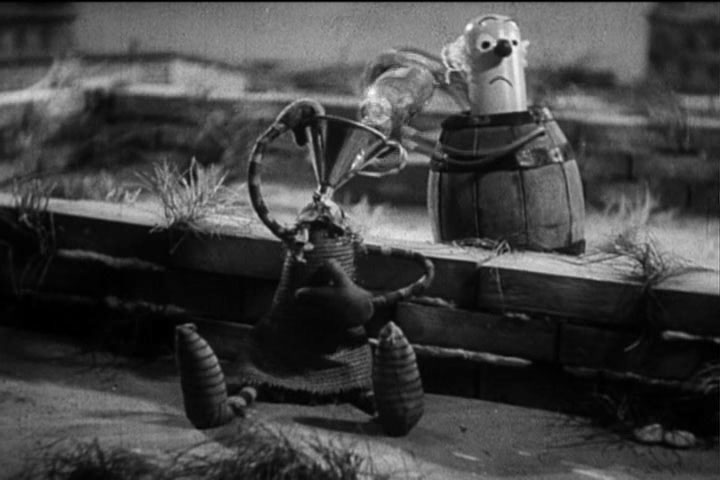
The Temptation of Mr. Prokouk (1947, Karel Zeman)

Mr. Prokouk is building his own house when he’s tempted by the evils of alcohol. After going on a massive bender and literally losing his head, he recovers, murders the ghostly barrel-shaped liquor salesman who got Prokouk hooked on the stuff, and continues with the house building. I dig the little birds who build a nest on his sign.
Mr. Schwarzwald’s and Mr. Edgar’s Last Trick (1964, Jan Svankmajer)

Svankmajer’s first short! Stop-motion, live actors, painting and puppetry, all very well blended, with extreme close-ups, frequent zooms and super fast edits. So JS was accomplished at making great-looking, creepy films from the very start. Two wooden-mask-faced magicians take turns performing elabotate tricks, aggressively shaking hands after each one, until the handshake turns lethal and they tear each other apart.

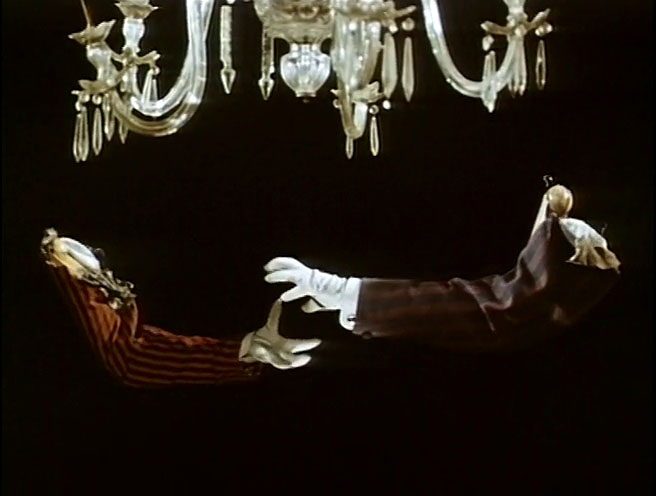
Your Acquaintance aka The Journalist (1927, Lev Kuleshov)

A 15-minute excerpt from a feature. Possibly Kuleshov’s follow-up to the great Dura Lex – IMDB isn’t so clear on Russian cinema. Aleksandra Khokhlova (Kuleshov’s wife, crazy Edith from Dura Lex) is a newspaper columnist who gets fired for turning in an article late while she was distracted by a handsome rich man. That’s about all I got from this fragment, plot-wise.

Edition Filmmuseum:

She is a modern woman, in-your-face and interesting in both the way she dresses and the way she handles the men who surround her in her everyday working life: she writes almost all of them off as wimps but the one she loves, a functionary, proves to be a conformist: disappointment ensues … The mise-en-scène is unique, with razor-sharp contours and extreme lighting provided on the one hand by Aleksandr Rodchenko with his constructivist design of the materialistic world, and on the other hand by cameraman Konstantin Kuznecov with his “svetotvorchestvo” (light-making) already known from [Dura Lex].

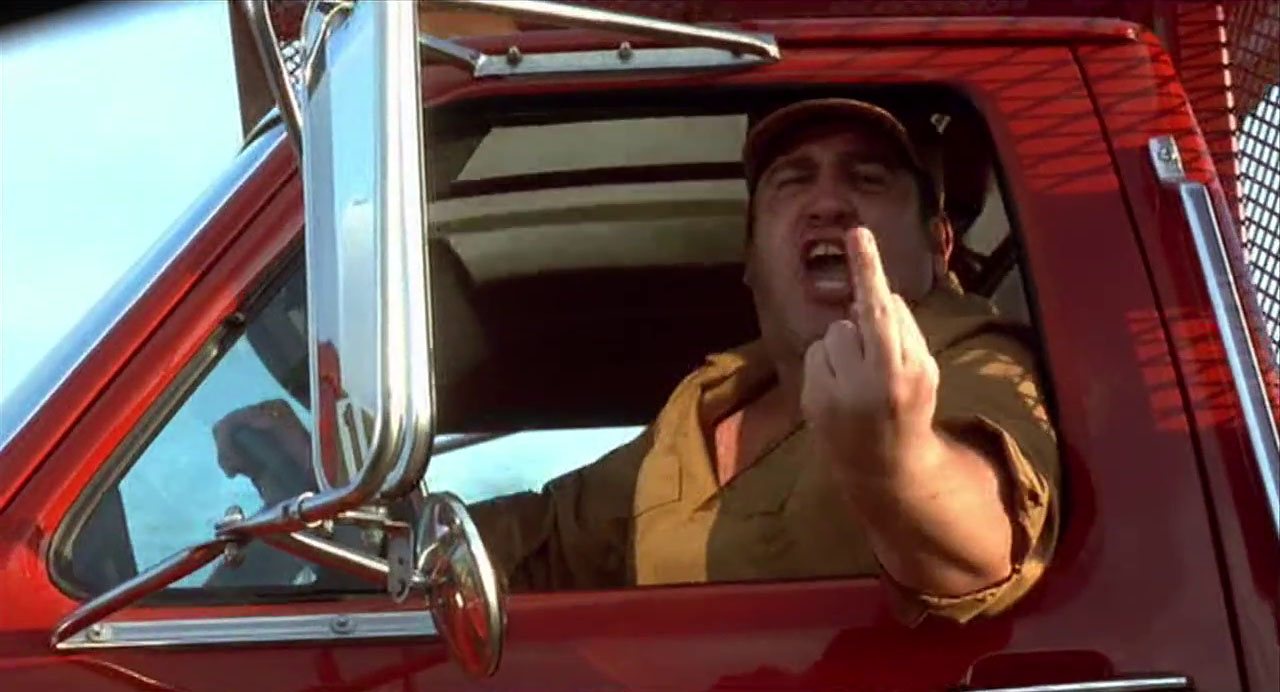
The Tony Longo Trilogy (2014, Thom Andersen)

A found-footage piece, Andersen taking three films and isolating only the scenes with imposing character actor Tony Longo in them. Tony is an ineffective doorman in The Takeover, is seeking Justin Theroux in Mulholland Dr., and fights with Rob Lowe before being murdered by Jim Belushi in Living in Peril. Why was Thom Andersen watching Tony Longo movies? Tony died soon after this came out, unrelated to the fact that IMDB says he was once struck in the mouth by lightning.
Cinema Scope:

What makes the videos in The Tony Longo Trilogy both exciting and frivolous is that it’s not terribly difficult to imagine Andersen repeating the operation for Tony Longo’s other hundred-odd screen credits, or, to push the idea to its limit, for anyone who’s ever appeared in a motion picture.

Riot (2015, Nathan Silver)

Home movies of 9-year-old Nathan reenacting the LA riots in his back yard wearing a Ren & Stimpy shirt

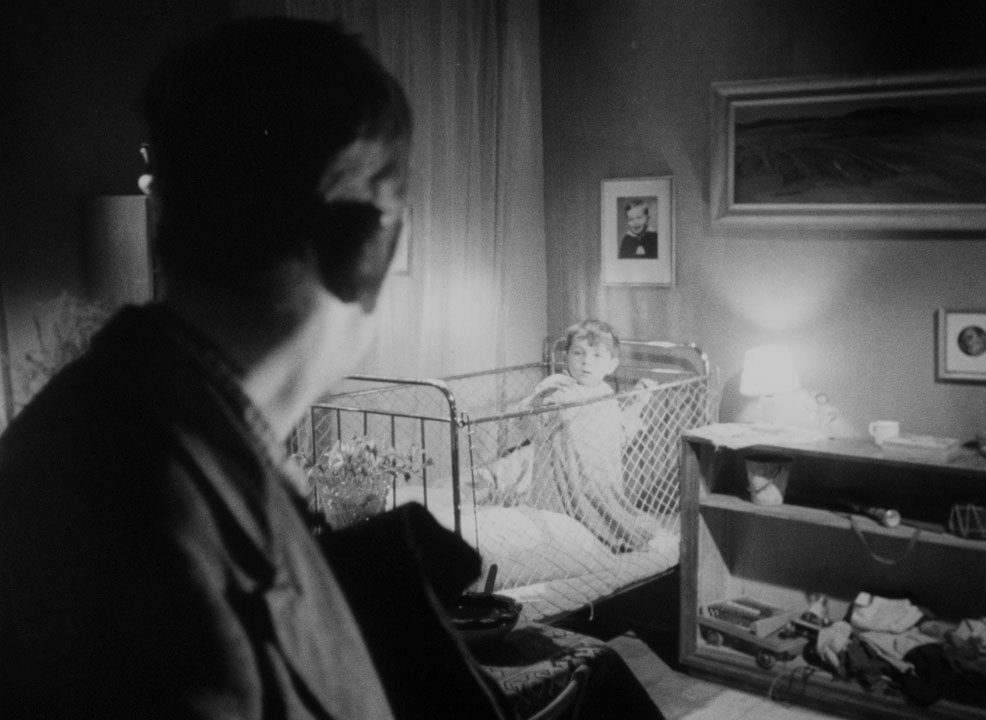
Uncle (1959, Jaromil Jires)

Kid in crib makes friends with the thief breaking into his house. Jires’s second short, still in film school. Uncle Vlastimil Brodsky was already an established actor, would later star in many Jiri Menzel films and Autumn Spring.
Tramwaj (1966, Krzysztof Kieslowski)
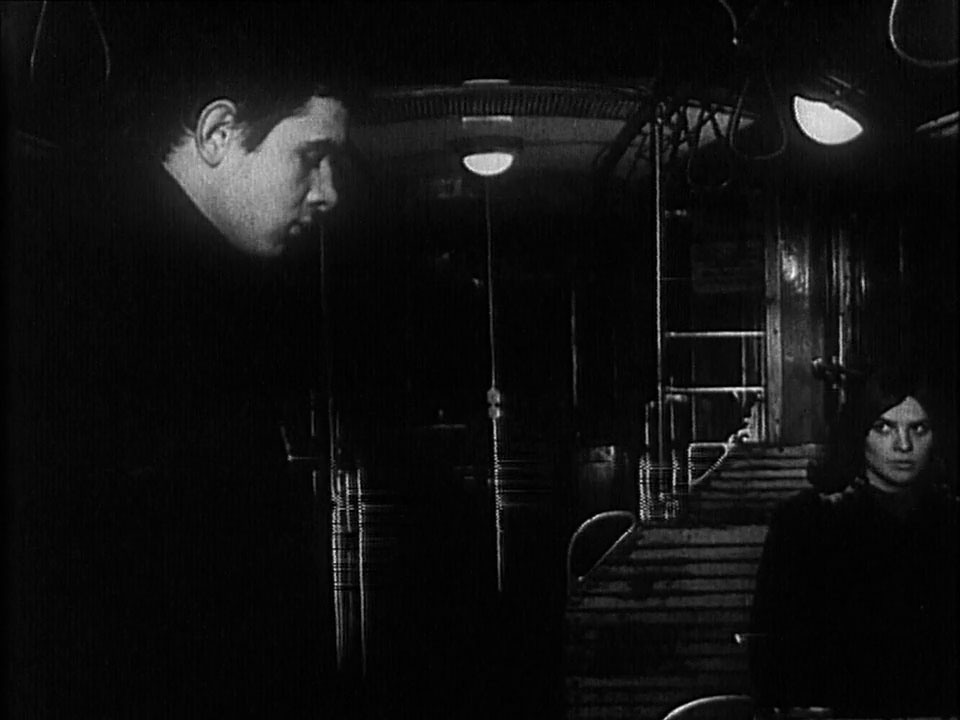
Silent… guy is miserable at a party, so leaves and gets on a dismal night train where he tries to impress a sleepy girl. One of Kieslowski’s first shorts, made in film school.
Logorama (2009, Alaux & Houplain & de Crecy)

Fantastic concept, a world made only of corporate logos. The writing and voice acting could’ve been better though. After creating this graphic-design logo monstrosity, they fill it with some sub-Tarantino cops-and-robbers shootout stuff, Michelin cops fighting a rogue Ronald McDonald. Logorama beat A Matter of Loaf and Death at the oscars, also won awards at Cannes and the Cesars. Two of the directors went on to make a tie-in short to a Tom Clancy video game series. David Fincher did a voice, along with the writer of Se7en and a guy with small roles in half of Fincher’s movies.

Sniffer (2006, Bobbie Peers)

Sniffer works as a deodorant tester in a world where people wear metal boots to keep from floating off. One day after seeing a pigeon crash into a window, Sniffer decides it’d be nice to float off, and unstraps his boots. Norwegian, I think.

The Foundry (2007, Aki Kaurismaki)

Seen this before in an anthology but now it’s available in HD so I watched again.

More consistently great than part one, with higher high points (Robert Morgan!). I’m tempted to make a playlist of ABCs highlights and edit myself a super-anthology but I’ll wait until part three comes out next year.


Amateur
Imagined scenario of cool, efficient sniper in the air vents taking out his target, then reality of tight insect-infested ducts full of nails. Great ending. Director EL Katz also made Cheap Thrills.


Badger
Directed by and starring Julian “Howard Moon” Barratt. Asshole nature-doc spokesman (Barratt) is abusive to his crew, gets eaten by badgers.


Capital Punishment
Local gang of vigilantes take a dude suspected of killing a girl out to the woods and clumsily behead him. Meanwhile the girl turns out to have run away, is fine. Director Julian Gilbey made A Lonely Place To Die, which is probably better than Wingard’s A Horrible Way To Die.


Deloused
I probably would’ve skipped ABCs of Death 2 had I not heard that Robert Morgan was involved. This was… inexplicable… and amazing, and ultimately makes the entire anthology worthwhile. Involves insects and beheadings and knife-arms.

Equilibrium
Funny and well put-together, with single long takes simulating time passing. Couple of idiots stranded on a beach are unexpectedly joined by a pretty girl. Jealousy ensues, then they return to bliss by killing the girl. Alejandro Brugués made the Cuban Juan of the Dead.

Falling
Israel/Palestine, woman whose parachute is stuck in a tree convinces a rifle-toting kid to cut her down, he accidentally shoots himself in the head. Nicely shot, anyway. Directors Keshales and Papushado made Israeli horrors Rabies and Big Bad Wolves (a Tarantino fave).


Grandad
Grandad is tired of his disrespectful grandson living with him. Jim Hosking is working on something called The Greasy Strangler next. Grandad Nicholas Amer has been around, worked with Peter Greenaway, Jacques Demy and Terence Davies.


Head Games
During a makeout session, a couple’s facial features go to war with each other in classic Plympton style. One of two Bill Plympton anthology segments from this year – we missed The Prophet.


Invincible
Old woman will not die, siblings want her inheritance and try everything to kill her. Stylishly shot (as are most of these, so it’s maybe not worth writing that anymore). Erik Matti (Philippines) got awards for crime flick On The Job last year.


Jesus
I think it’s supposed to be payback on a couple of dudes who torture and murder homosexuals, but when the kidnapped gay guy displays his demonic powers I’m not sure what’s going on anymore. Dennison Ramalho wrote latter-day Coffin Joe sequel Embodiment of Evil and actor Francisco Barreiro is showing up everywhere this month.


Knell
Initial scene where girl witnesses supernatural globe over the building across the street followed by people in every apartment turning violent was like Rear Window meets The Screwfly Solution, then it continues in the direction of total doom. Directors Buozyte and Samper are apparently Lithuanian, also made a surreal sci-fi thing called Vanishing Waves.


Legacy
Guy to be sacrificed is being set free and is arguing with this decision, and I lose the plot after that, but there are groovy, cheap Metalocalypse-looking gore effects. Lancelot Oduwa Imasuen is Nigerian, has made a million movies so far since 2003.


Masticate
Drugged-out flesh-eating fat man goes on rampage before he’s killed by cop, all in slow-motion and set to a jangly pop song. Robert Boocheck made a short that apparently played in an anthology called Seven Hells.


Nexus
Cleverly timed and editing, goes for tension instead of twist ending since we figure out early on that the distracted cabbie is gonna hit the guy dressed as Frankenstein. Larry Fessenden made Habit and Wendigo and The Last Winter, all of which have been on my to-watch list forever and just came out on blu-ray.


Ohlocracy (mob rule)
After the cure for zombiesm is found, human zombie-killers are sentenced to death by a kangaroo court. Hajime Ohata made the non-Kafka movie called Metamorphosis.


P-P-P-P Scary!
Poppy, Kirby and Bart look like escaped convicts, have big noses, meet a face-morphing guy who does a jig, blows out their candles and murders them inexplicably. Todd Rohal made The Catechism Cataclysm, and I might’ve guessed this was him.


Questionnaire
While a guy correctly answers questions on an intelligence test, we see flash-forwards to the “career opportunities” the interviewer has in mind for him (brain transplant with gorilla). I watched Rodney Ascher’s The Nightmare just last week.


Roulette
German game of Russian Roulette ends with the sixth-chamber guy shooting his beloved instead of himself, as some unknown evil approaches. Marvin Kren made Rammbock and Blood Glacier.


Split
Like a remake of Suspense but with more baby murdering. Hammer-wielding intruder destroys family of cheating husband(s) during a phone call.
Juan Martinez Moreno made horror-comedy Game of Werewolves.


Torture Porn
Girl in porn audition turns out to be Cthulhu, I guess. Jen and Sylvia Soska are identical twins who made American Mary and Dead Hooker in a Trunk.


Utopia
Self-driving incineration machines deal with non-beautiful people. Vincenzo Natali made Cube and Splice.


Vacation
Dude is on phone with girlfriend when dude’s friend reveals they’ve been doing drugs and prostitutes while on vacation. The friend is disrespectful, and one prostitute stabs him many times with a screwdriver. Jerome Sable made last year’s Meat Loaf-starring Stage Fright.


Wish
Kids go inside their off-brand Masters of the Universe playset, discover it’s horrible in there. Steven Kostanski made Manborg, which looks similarly wonderful.


Xylophone
Kid won’t stop playing her damned toy xylophone while babysitter Beatrice Dalle (of Inside, the first actor I’ve recognized since Julian Barratt in letter B) is trying to listen to opera records. Julien Maury and Alexandre Bustillo made Inside, of course. Credits say Beatrice is the grandmother not the babysitter, which makes sense since babysitters should leave antique record players alone.


Youth
Miyuki hates her mom and stepdad, imagines them dying in tremendous ways. Soichi Umezawa is a longtime makeup artist who worked on Bright Future and Dr. Akagi.


Zygote
Dad abandons pregnant mom with a 13-year supply of a root that delays labor. Horribleness ensues. Chris Nash has made a bunch of shorts.

As mentioned in the shorts post, Bill Plympton came to town, presenting his feature Cheatin’. I’ve always loved his work, but from vague memories of The Tune and I Married a Strange Person I’ve assumed his shorts to be far above the features. This week changed everything, as I caught up with the great Idiots and Angels on DVD and saw the beautiful Cheatin’ on the big screen.

Cheatin’ (2013)

I memorized the trailer, and rest of the movie did not disappoint.

Sure there’s a lot of cheatin’, but it’s all based on a terrible misunderstanding.

Bought on blu-ray, so will watch again and write more (with screenshots).


Idiots and Angels (2008)

First of all, any movie that uses “Kommienezuspadt” by Tom Waits is alright by me. Stylish as ever, a scribble-noir in shades of brown and gray with flashbacks and imagination sequences and inventive transitions – and no spoken dialogue.

It’s the kind of story that calls for animation. Bitter gun salesman wastes his evenings at a lonely bar until he starts growing angel wings. He’d like to get rid of the do-gooder, perpetually re-growing wings, and the man’s doctor and greedy bartender would like the wings for themselves. There’s a shooting, a resurrection, a spate of pub bombings, argument over a girl, and crazy bird dreams.

Bill Plympton came to town! I prepped by rewatching his Dog Days DVD, various shorts from other sources, and the feature Idiots & Angels.

Guard Dog (2004)

One of the first films he made without a film camera: colored pencil on paper, scanned into computer.

Guide Dog (2006)

Inspired by Charles Addams, a cartoonist who focused on death and violence. The DVD commentaries seem straightforward, but then he says he assumes he didn’t get complaints from blind people about Guide Dog because they didn’t see the film.

Hot Dog (2008)

Don’t know why I was harsh to some of these shorts in past posts, since the Plympton dog is one of my favorite animated characters. Think I overdosed on Plympton shorts a few years back and had to decompress.

Shut-Eye Hotel (2007)

Cops check in to Shut-Eye Hotel to figure out why clients who stay on the top floor wake up without heads. The culprit: a pillow with teeth. Bill says this was his first use of computer animation, but it didn’t work out financially, and he was testing out a color scheme he’d use in Idiots & Angels.

Spiral (2005)

“You think it’s easy bein’ abstract?” A circle, square and triangle are performing a repetitive abstract dance until the audience starts shooting at them. Inspired by an exasperating (and state-funded) screening of a Paul Glabicki short twenty years prior.

Santa, The Fascist Years (2008)

“They called it blitzenkrieg.” Narrated, animated newsreel of when Santa turned to weapon manufacture, invading neighboring countries to obtain raw materials. Nice Great Dictator reference.

The Fan and the Flower (2005)

Great love story from sitcom writer Dan O’Shannon.

How to Make Love to a Woman (1995)

First, finding the right woman. Then body parts, kissing, hugging, etc, all calmly explained by a narrator, always ending in grievous harm to the man onscreen.

Push Comes To Shove (1991)

Two guys hurt each other in ever more inventive ways.
Didn’t this used to run on MTV?
One of my favorites.

The Exciting Life of a Tree (2000)

Tree’s-eye-view of dangerous forest life.

Luv Race (2008)

Live event combining a dating game with a track race. Where’d this come from? Apparently a commissioned film, no credits. Chrome tried to translate the page at gauguins.com, came up with “Bill Plympton (Bill Plympton). This is the American NY resident, but is not Bill Clinton, you can find those.”

Also watched a couple musical segments from The Tune (1992) including No Nose Blues (“Talk is cheap, oh but so are you”) and Flooby Nooby (all puns, with a huckster singer who hilariously can’t handle the song’s whistling chorus) … a 2001 TV special for Cartoon Network called 12 Tiny Christmas Tales … and a great Weird Al video.

Don’t Download This Song:

Don’t think there was any dialogue. Tired of the daily grind, Shaun encourages a revolt on the farm, but when the farmer ends up in the nearby city with memory loss, accidentally becoming a fashionable hairstylist, the sheep try to rescue him with help from a stray dog. The second movie I’ve seen this year with the animal control dept. as the villain. Great animation, slick and fast-paced and full of gags. Starzak directed the Creature Comforts series and much of the Shaun the Sheep series, and Burton cowrote Curse of the Were-Rabbit and Madagascar.

Whew. Pixar is back in a big way. Happy Amy Poehler leads a Herman’s Head of emotions inside a girl’s brain, and when the girl’s family moves across the country, shaking up her life (see also: Coraline, Totoro) and crumbling the “islands” that represent her core personalities, Sad Phyllis Smith (of Butter) slowly gains influence. And weirdly, that’s the “happy” ending, that it’s okay to be sad. Maybe too much frantic running around through the long-term memories department in the second half, but mostly it’s brilliant.

Jen Chaney:

Eventually, in another moment that will cause 3-D lenses to get misty, Joy sees that in many of the supposedly purely happy Riley memories, melancholy and disappointment were present, too. Light can’t exist without dark: It’s something most grown-ups know, but when Joy finally understands this, it feels as though we olds are really getting it for the first time, too.

Tasha Robinson:

The script makes the stakes bigger than whether one 11-year-old can learn to be happy again. Joy and her fellow emotions conflict on how to react to Riley’s circumstances, but they all care deeply about her, and worry about where she’s headed. And through their passionate concern, Docter builds the audience’s deep engagement with how Riley feels, how she expresses it, whether she can make herself understood to other people around her, and where her feelings take her. … Pixar vets will remember the profound emotions brought up by the opening sequences of Up, the final scenes of Toy Story 3 and Monsters, Inc., and so many other watershed moments in the company’s library of films. Inside Out not only evokes that profundity of emotion, it does it with emotions capable of examining their own response.

And I quote heavily from The Dissolve, my favorite film site, because I had these articles bookmarked to read after I saw Inside Out, and by the time I saw it, the site had shut down, causing Sadness to start touching all my film-criticism memory balls.

Lava (2014, James Murphy)

Two volcanoes sing each other a song of longing, looking for somebody to love-a (lava). Tasha: “The story doesn’t make a whole lot of sense. But hey, at least those sad volcanos get to date each other, right?” And at least Katy liked it.


EDIT: Watched Inside Out again on New Year’s Eve 2017/18

World of Tomorrow (2015, Don Hertzfeldt)

Emily Prime is contacted by her third-generation clone, discussing memory, robots, love and life in the outernet of the future.

Only 16 minutes long but I watched it seven times.

Choose You (2013, Spike Jonze & Chris Milk)

Written by Lena Dunham and directed by Spike Jonze – and yet it’s terrible? I think that’s because it’s a corporate-sponsored short made for a music video awards show. Anyway, subtitled and censored, club dude’s ex-gf is now dating DJ Michael Shannon, some girl he doesn’t even know freaks out about this, then Jason Schwartzmann hosts a choose-your-own-adventure ending and double suicide is chosen.

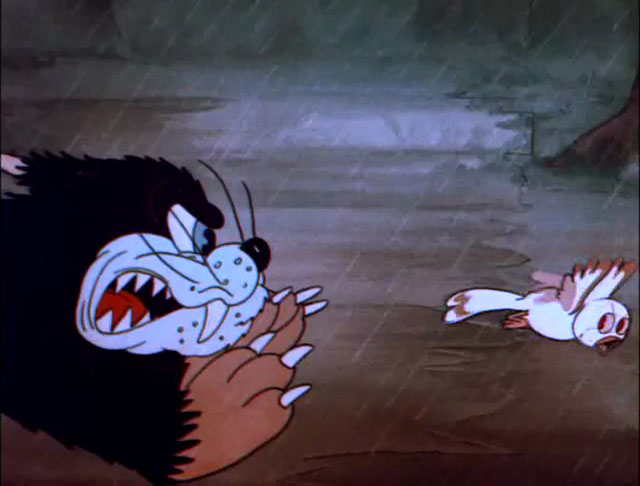
The Discontented Canary (1934, Rudolf Ising)

A sad caged canary gets his chance to escape, but nature beats the hell out of him, so he returns home, learning to appreciate his captivity. At least he wasn’t hit by lightning like the feral cat. Moral: life is just horrible.

The Alphabet (1968, David Lynch)

Now in high-def!

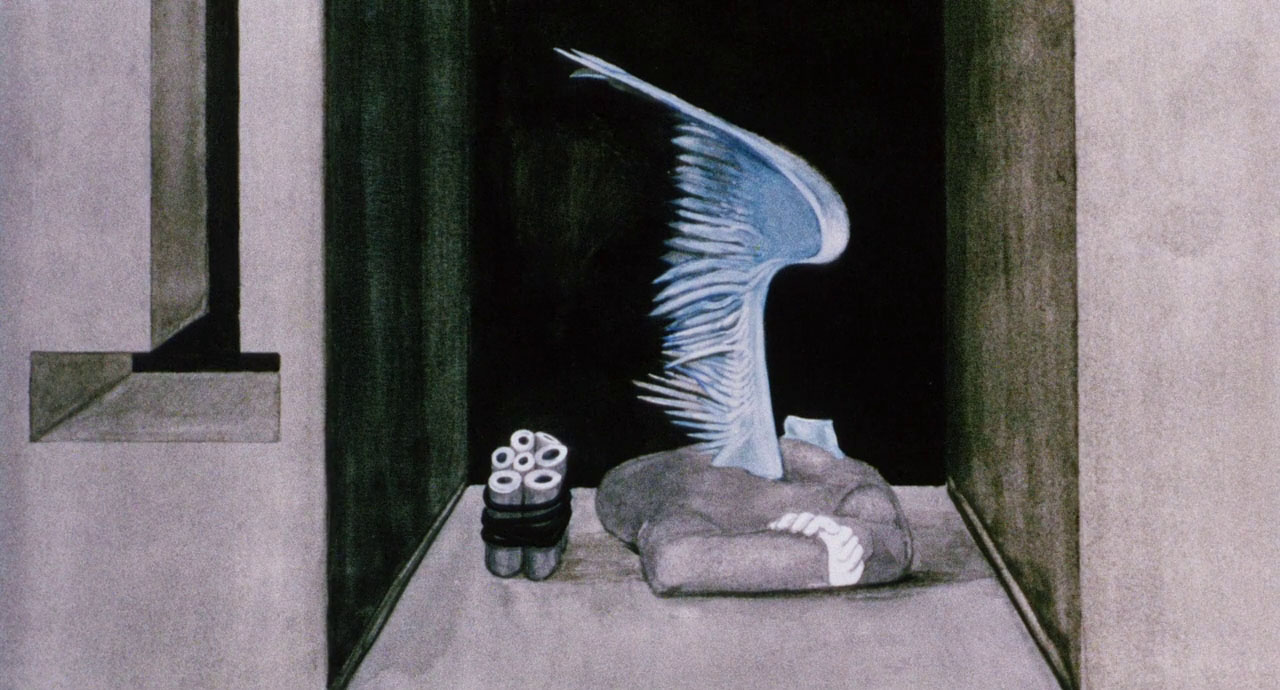
Les jeux des anges (1965, Walerian Borowczyk)

Heads roll.
Pipe organ becomes firing squad.
Angel wings.
Infinite scrolling.

Mouseover for decay:
image

The Sinking of the Lusitania (1918, Winsor McCay)

Didn’t realize this was a WWI propaganda film. “Germany, once a great and powerful nation, had done a dastardly deed in a dastardly way.”

Intro explaining how difficult the movie was to create, and plenty of title cards, so the nine minute short has maybe four minutes of animation. But the animation is real good stuff, all water and smoke.

We Give Pink Stamps (1965, Friz Freleng)

Absurd fun in a department store as the Pink Panther torments the night janitor.

Closed Mondays (1974, Will Vinton & Bob Gardiner)

Great claymation. Wino wanders into an art gallery, hallucinates (?) all the paintings and sculptures coming to life.

Night Mail (1936 Wright & Watt)

I’ve heard this is one of the greatest short documentaries. True, it’s admirably put together, showing all the moving parts in a great, manned machine that moves the mail across England and Scotland really damn fast. And it makes you marvel at the heights of human endeavor. And it ends with a post office rap song. So yeah I was gonna say it’s just a doc about a mail train, but I guess I see their point.

Monster (2005 Jennifer Kent)

Beginnings of The Babadook (there’s a pop-up book and everything). Monster-doll grows into full monster and attacks son, mom screams at it, tells it to go to its room.

Fears (2015, Nata Metlukh)

Terrific 2-minute animated short linked by Primal.
A man literally embraces his fears.

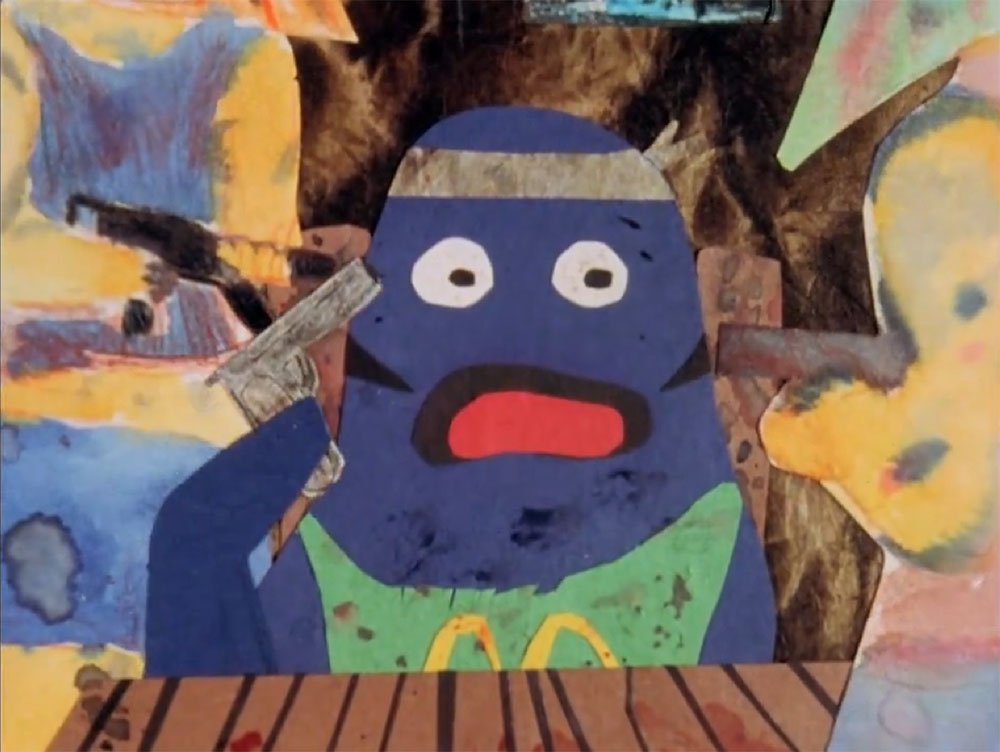
Restaurant Dogs (1994, Eli Roth)

Student film in which an evil brigade of fast-food restaurant mascots is bloodily defeated by a young dude who’s given a mission from the Burger King himself to save his daughter the Dairy Queen. Something like that, anyway. I thought the guy only wanted to buy a milkshake, and suspected he was drunk, so I’m surprised he signed up for the murderous mission so quickly.

Given all the trademarked properties being mixed with nazi images via Terry Gilliam-style cut-out animation, I thought I’d better watch this as soon as I heard about it, rather than wait until our corporate overlords remove it from the internet like they did the Soderbergh cut of 2001: A Space Odyssey which I’d been meaning to watch. Besides Reservoir Dogs, there’s some Deer Hunter and Apocalypse Now in the grimace/hamburglar flashback scene.

Ritual (1979, Joseph Bernard)

Under three minutes, viewed online as a trailer for the new Bernard blu-ray, which I obviously need. Drawings, figures, people and scenes and stuttering colors cut together into changing rhythms and overlays. My favorite bit has an overlay of two scenes, one of which is cutting, an effect I don’t see often.

Stop-motion cut-out animation of psychoanalytic dream-imagery.

Yes there’s a story – a married man attempts to carry on an affair with a woman in his dreams – but it’s the imagery and editing tricks and invention and sidetracks (eggs, fruit, flowers, suit-wearing coworker with dog head, fighting Freud and Jung portraits, reptiles, tongues, doppelgangers) that kept us endlessly entertained. Svankmajer’s features tend to feel overlong with their obsessions and repetitions but this one (though it opens with an extended apology from the director) was completely wonderful.

The most inventive “live-action cartoon” movie?

The bright, color-manipulated sets ensure that we don’t take the action seriously for even a second – which is good, since the movie is a fairly faithful adaptation of the horrendous Speed Racer series, in which the mysterious Racer X is actually Speed’s brother. The movie’s main contribution (besides toning down the part of Chim-Chim) is a twist: Racer X turns out not to be Speed’s brother! But wait, another twist: Racer X is really Speed’s brother!

Not toned-down: Spritle

Evil racers with dollars in their eyes:

Speed is Emile Hirsch, having a big year with this between Into the Wild and Milk, with Christina Ricci as Trixie. His overqualified parents: Susan Sarandon and John Goodman (dressed like Super Mario). Rain (I’m a Cyborg But That’s OK) is a friend/enemy/informant/fall guy, Royalton (Al Gore-looking Roger Allam of The Angels’ Share and V for Vendetta) is the corporate baddie, and Matthew Fox (TV’s Lost) is Racer X, who is emphatically not Speed’s brother (yes he is!)!!!