1. Only movie in recent memory that makes me hope for a special-edition DVD so I can sit and watch making-of featurettes all night long to answer the record number of “HOW did they DO that”s which hit me during the screening.

2. Best use of 3D that I have ever seen. Implemented not to throw stuff at the audience’s face, but to bring us into the movie’s world and immerse us in all the handcrafted marvels within.

3. And a good, extremely imaginative story on top of that. The plotting gets a little video-game problem-solvey towards the end and Coraline’s own character could use more exploration, but hey, even WALL-E had problems. No need to nitpick when there’s so much here worth appreciating.

Mopey-teen title character deals with her new home and inattentive parents. Meets a talkative, twitchy boy with the disturbing-in-a-kids-movie name of Whyborn, a flea-training circus strongman neighbor, and two candy-appreciating, dog-collecting women who are also washed-up performers. Then Coraline finds a doorway into John Malkovich’s head, where dad is robotically nice (and sings just like They Might Be Giants), the performing neighbors are impossibly entertaining, and Whyborn shuts up… all catering to Coraline’s desire that everything should center around her. Fortunately, a stray cat fills her in on the diabolical reality involving an interdimensional witch who steals the eyes of children, and even more fortunately, the witch stupidly allows Coraline to bargain and cheat her way home, leading to a happy ending where C. has learned to better appreciate her real life.

Also: the armatures were fantastic! Guy named Jeremy Spake was their armaturist… I imagine we’ll be seeing big things from him in the future.

Flight of the Conchords: A Texan Odyssey
Short doc of the duo band at SXSW. Funny! Seen below massaging the feet of Peaches.
image

Wallace and Gromit in A Matter of Loaf and Death (2008, Nick Park)
This was as fast-paced as the action scenes in the Wallace & Gromit full-length, and packed full of jokes and puns. Our heroes are bakers now, and a former bread company model, now grown fat on breads and pastries, is out for revenge on the bakery world. She gets cozy with Wallace, plotting to murder him with a giant cartoon bomb (among other things) while Gromit and the woman’s terrified pet poodle try to ruin her plans. Lovely movie, probably inspired by the name of cowriter Bob Baker and/or voice actor Peter Sallis’s appearance in the movie Who Is Killing The Great Chefs of Europe. Must check out Nick Park’s series Shaun The Sheep.
image

Living in a Reversed World
Educational doc. Sadistic Austrian professor, trying to prove a point about perception, gets students to wear special mirror/prism glasses which reverse left/right or up/down and see if they can adjust. They can. He also puts goggles on a chicken, which I don’t think is a good idea.
image

The Contraption (1977, James Dearden)
Closeups of construction. What’s he building in there? What the hell… is he building in there? Turns out to be a giant mousetrap for our suicidal handyman. Dearden later made Matt Dillon thriller A Kiss Before Dying. Contraption-builder Richard O’Brien had lately been in Rocky Horror, would play Mr. Hand in Dark City. Tied for best short at the Berlin fest… this is pretty neat, but I wouldn’t have thought it an award-winner.
image

Cameras Take Five (2003, Stephen Woloshen)
Abstract hand-drawn animation set to Dave Brubeck’s Take Five. Liked it, not super busy, didn’t think people were doing stuff like this anymore.
image

Herb Alpert and the Tijuana Brass Double Feature (1966, Hubleys)
John & Faith animate two short musical numbers to Spanish Flea and Tijuana Taxi. Not slick like the Doonesbury short, homemade-looking. Cute pieces though (predictably about a flea and a taxi). Beat out a Pink Panther short and an anti-smoking PSA for the oscar. Rough year for animation, I guess. Lost at Cannes to a documentary on Holland (not by Bert Haanstra).
image

The Tortoise and the Hare (1935, Wilfred Jackson)
Hare is kinda an asshole – supposedly his character was stolen by Warners as a prototype for Bugs Bunny. This plays like the other Silly Symphonies, not as good as the Three Little Pigs though.
image

A Perfect Place (2008, Derrick Scocchera)
Sharp b-w cinematography and two very dryly comic actors (Mark Boone Jr. of Memento & Thin Red Line and Bill Moseley of all the Rob Zombie films) make for a good movie. In the first second, MBJ “kills” an acquaintance who was cheating at cards, then they spend the next 25 min trying to dispose of the body. Not the usual over-the-top situations either, movie keeps it cool. I guessed early on that the cheat wasn’t really dead but that didn’t make it less enjoyable. Dig the theme song by Mike Patton.
image

MANT! (1993, Joe Dante)
Tracigally not a full feature. All the scenes shot for the film-in-a-film of Dante’s awesome Matinee were assembled into this short included with the laserdisc.
image

Three excellent shorts by Norman McLaren. Fiddle-de-dee (1947, painted to an upbeat fiddle tune), Boogie-Doodle (1948, drawn with pen to a piano boogie) and Serenal (1959, etched and hand-colored to a Trinidadian string quartet number)

Fiddle-de-dee:
image

Boogie-Doodle:
image

Serenal:
image

Wow, remember the ambition of vol. 2? Those days are gone. I guess half of these were good, which is fine for a shorts program, but the bad ones were worse than ever.

A good one: oscar-nominated This Way Up:
image

Not worth going into: Corky Quakenbush’s claymation Yompi The Crotch-Biting Sloup and Dave Carter’s construction-paper Psychotown – each of which annoyed me the first time, then came back to annoy me two more times.

Voodoo:
image

Lame in the “let’s record a dull conversation then animate it” approach were Operator (man calls information and gets God’s number), John and Karen (relationship trouble between a penguin and polar bear) and Angry Unpaid Hooker (this and Psychotown are stupid enough to make me worry about The Animation Show’s future). Professor Nieto Show (class watches brazilian insects that play soccer) and Jeu (things spin and morph into each other kaleidoscopically, like a Gondry video but more pixellated) were pretty alright.

Blind Spot:
image

Bill Plympton’s Hot Dog is fine, but I’m ready for something new from him. Cocotte Minute (chickens race in a dangerous kitchen) and Blind Spot (old woman is blamed for deadly robbery because of poor security-camera placement) were inventive little violent-death shorts, and I liked Usavich (two rabbits take a totally mad car ride) much more than I should. Forgetfulness is an illustrated Billy Collins poem. I already can’t remember Burning Safari, something to do with monkeys and robots.

Mr. Schwartz, Mr. Hazen & Mr. Horlocker:
image

My faves were Mr. Schwartz, Mr. Hazen & Mr. Horlocker (cop arrives at an apartment for a noise complaint and gets confusing reactions from the residents), This Way Up (two undertakers have a hell of a time making their delivery – I liked the rube goldberg bit near the beginning better than the climactic trip through hell), Key Lime Pie (hardboiled tough guy with a weak heart is over the moon about pie) and of course PES’s Western Spaghetti.

Key Lime Pie:
image

Last time I saw a filmmaker personally touring his film trilogy around the country it was Crispin Glover, whose new one is called It Is Fine! Everything Is Fine. Hertzfeldt’s first two are called Everything Will Be OK and I Am So Proud Of You. Similarities end there, though.

Kicked it off with The Meaning of Life, which I hadn’t seen in a while but didn’t remember liking. Removed from the post-Rejected anticipation and taken in context of his recent introspective films, it’s not bad at all, just a bit one-note. We all die, and we are only one step in the evolutionary chain, not necessarily the best and final form of life. Wotever, Mr. Hertzfeldt. Looks super-nice on 35mm. I said mean things last time I saw it.

He played Rejected and Billy’s Balloon, both of which I have memorized and I think most of the crowd has too. Broke up the next two movies with Intermission in the 3rd Dimension, a fluffy piece of ridiculousness which I think both Don and the crowd wish he’d do more of.

Everything Will Be OK and I Am So Proud Of You are the first two parts of a planned trilogy about Bill. The first section focuses on Bill’s unnamed illness, his inability to function in everyday life. The second flashes back and forth through time exploring Bill’s childhood, present, old age, and ancestors and all the awful ways they all died. They’re good movies, and I love the look of the peephole split-screens. I mostly feel they’re depressing midlife-crisis movies, but there’s just (barely) enough warmth and love in there to keep it from falling apart.

Allures (1961, Jordan Belson)
I don’t know Belson very well, but this reminds me of my favorite parts of Norman McLaren and Len Lye, abstract animation set to music. Not frenetic, slow swirls and twirls, overlapped colored light patterns set to sparse music with dark electronic manipulation (composed by Belson and Oscar-nom musician/humorist Henry Jacobs). Must see again.
image
Allures (c) Jordan Belson

Finger-Fan (1982, Linda Christanell)
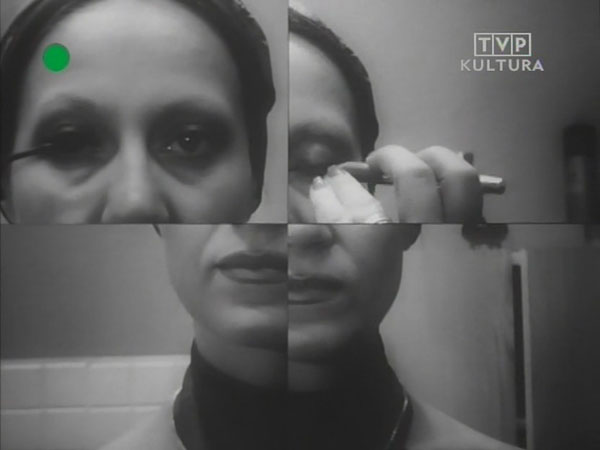
Austrian title is FINGERFÄCHER so I thought I’d get something racy for my lunch hour, but no, we’ve got some hands fanning out some fabric on a table… a finger-fan. Synopsis says “objects tell a random story – objects are bearers of obsessions-issuing energy as fetishes,” which might be badly translated or it might not… with the avant-garde it is hard to tell. Camera shoots some objects and photographs, a mirror re-directs part of the frame, there are some basic stop-motion and optical effects, and I remain unimpressed but lightly amused.
image

La Cravate (1957, Alejandro Jodorowsky)
Glad it was short, I couldn’t have taken much more of that accordian score. Goofy mimes swap heads at the head-swap shop while a guy with a silly tie tries to land a girl. Strong, bright colors. I guess the concept of swapping heads can be kind of dark, but otherwise this is like a kid’s fairytale compared to El Topo. Fun movie.
image

The House With Closed Shutters (1910, DW Griffith)
A Dixie-loyal young girl runs a message to the confederate front lines after her supposed-to-be-messenger brother comes home drunk and afraid. When she’s killed (because she was playing like a kid in no man’s land), their mother covers it up by acting like her son was killed and forbidding her “daughter” to ever leave the house or open the shutters. Decades later his old friends walk by the house, he swings the shutters open and dies from the shock.

Dead guy on chair (left) while his mother orders the friends to leave
image

Suspense. (1913, Lois Weber & Philips Smalley)
After the servant quits and leaves the key under the mat, a vagabond takes the opportunity to enter the house, eat a sandwich and stab the woman and her baby to death with a knife. Or he would – but she calls her husband who races home from work in a stolen car followed closely by the cops (who, as cops do in silent movies, shoot their guns constantly not worrying about the casual damage they might cause – not to mention that it hardly seems fair to shoot a guy dead for stealing a car). Worth watching for the titular suspense, and the reaction of the guy whose car the husband stole when he finally catches up and sees the wife & baby safe: a big “well whattaya know” shrug to camera and a pat on the husband’s back. Co-director Weber played the wife.

Sweet split-screen:
image

Return of Reason (1923, Man Ray)
Whirling carnival lights at night, nails and tiny beads exposed directly on the film, a tic-tac-toe structure twirling on a string, all in stark black and white. Ends with negative image of a topless woman with psychedelic light patterns on her body.
image

The Starfish (1928, Man Ray)
A reputedly beautiful woman is shown behind distorting glass. A man holds a starfish in a jar. Terrifying close-up of starfish. Mirrors, split-screens and superimpositions. This is nice – how come poets don’t make movies anymore? Adaptation of a poem by Robert Desnos.

image

image

Emak-Bakia / Leave Me Alone (1926, Man Ray)
Twirling, swirling light patterns, spinning prisms, a girl with painted eyelids (paging Mr. Cocteau), broken dice, a tad of stop motion. The notes say Ray uses ‘all the tricks that might annoy certain spectators,’ and eighty years later he has annoyed me. Or maybe I’ve just watched too many of his movies in a row. I’d seen no films by Man Ray, then poof, I’ve seen half of them. Good stuff.

image

Oooh look, her painted lids are half-closed so you can see all four eyes:
image

The Life and Death of 9413: A Hollywood Extra (1928, Robert Florey & Slavko Vorkapich)
Far and away the greatest of these shorts. Intense shadowy miniatures interspersed with close-up photography of actors tells the story of a young hopeful actor defeated by the ruthless Hollywood star system. After he dies, he rises to heaven, where there is always open casting. A predecessor to Mulholland Dr.? Incredible-looking homemade film, very expressionist-influenced. Florey went on to direct 60+ features before moving to television, Vorkapich edited montage sequences for Hollywood films in the 30’s, and assistant cinematographer Gregg Toland shot Citizen Kane.

image

image

Rhythmus 21 (1921, Hans Richter)
“generally regarded as the first abstract animated film”, wow! Squares of light and dark get bigger/smaller, more complex patterns start to appear, pretty slow movement, never gets outrageously intricate, but if it’s the first film of its kind, it’s a great start.
image

Three Little Pigs (1933, Burt Gillett)
Musical short feat. “Who’s afraid of the big bad wolf” song. Great sound work by Carl Stalling. Uncle Walt did the voice of the brickhouse pig, one of only a couple credited non-Mickey voice roles. OMG, inside the brick house there’s a framed picture of sausage links on the wall with the caption “father”.
image

Mirror of Holland (1951, Bert Haanstra)
Greeeeat movie. He shoots reflections of Holland on the river, then flips the camera so they’re rightside-up. Looks for cool subjects and cool effects off the water. All woodwind and harp music, no narration, gorgeous. Didn’t know there was a golden palm for shorts at Cannes, but this won it.
image

Quiet As Kept (2007, Charles Burnett)
“That little-ass FEMA check sure don’t go very far”
Actors are real actorly, especially the kid (he’s in Ned’s Declassified). Video is real videoey. Script is real good, a sketch about a family of black New Orleans ex-residents post-Katrina, but the movie is ehhh. Oops, All Movie Guide calls it a documentary – bozos. Can’t find anyone talking about this online, probably because when Killer of Sheep came out on DVD, everyone got in line to praise it and didn’t want to look out-of-touch by talking about the not-great shorts it was packaged with.
image

Mr. Frenhofer and the Minotaur (1949, Sidney Peterson)
Distorted film of actors, string music, and voiceover, none of which has anything to do with the other. “To pose, or not to? I love him, I love him not? Or rather, since I love him less already, why not? An old man mad about paint, Frenhofer…” Yep, definitely from the same source as La Belle Noiseuse. “Once upon a time there was an old man who had been painting one painting for ten years. His name was Frenho… for what? … He started looking for a model to compare. All he wanted was the most beautiful woman in the world to prove to himself that his painting was more beautiful than any possible woman.” It’s all in here: Marianne’s man (also a painter) offering up her modeling services, Porbus the art dealer.

The script/narration is pretty swell but I wouldn’t be following if not for having seen the Rivette, and the visual is just nothing to me… a clock, a fencing match, cats, blurry nonsense, movie would be just as good with a black screen. Sorry, Sidney Peterson. Hmmm, at the end a fencer stabs the painter.
image

Eurydice – She, So Beloved (2007, Bros. Quay)
Very underlit ballet. Kinda dull. I preferred The Phantom Museum (and Dracula: Pages from a Virgin’s Diary).
image

Victory Over The Sun (2007, Michael Robinson)
Weirdly shaped monuments and the whispering wind. Would probably help if I could understand what the chanting people are saying. There’s some abstract 3D Animation thrown in. Towards the end goes into sound from some cartoon… Transformers? Some very familiar symphonic music. Pretty nice… I didn’t love it by any means, but I like it better than the disappointing Light Is Waiting.

Waaait, I looked this up online and found all sorts of stuff about it, something about being shot on the former sites of Worlds Fairs, but now I can’t find where I wrote that down.
image

The Wizard of Speed and Time (1979, Mike Jittlov)
Oh My God. This is three minutes of pure joy. Now that I have found this movie, I will watch it always. It’s my new The Heart of the World, using jaw-dropping stop-motion to express pure cinema love. The look is dated, but the music is swell, and Mike is a grinning god.
image

Two of my comic/horror heroes, John Landis and Joe Dante, make a Twilight Zone movie alone with Steven “Raiders/E.T.” Spielberg and George “Mad Max” Miller. The result could’ve been a masterpiece, but you know how anthology films always turn out… nobody does their best work, and half the episodes are always weak.

John Landis’s untitled episode has a very unlikeable Vic Morrow getting his supernatural comeuppance, becoming a Jew in nazi germany, a black man at a klan rally, a victim of the vietnam war, then back to germany, after making racist, hateful comments to his buddies (both of whom have been in John Carpenter films). It’s a grimy, unpleasant episode, a bad way to start the series, and of course it’s incomplete due to the untimely decapitation-by-helicopter of the lead actor during shooting. Landis was tried and acquitted for Morrow’s death, as well as an assistant director who Alan Smithee’d himself in the credits. Landis’s intro to the movie almost makes up for the Morrow segment – Dan Aykroyd and Albert Brooks in a car singing TV theme songs for seven long minutes while the audience wonders if they’re in the wrong theater. If they’d have gone from that part right into the Spielberg, we would’ve had an improved 75-minute movie, and Landis’s longer piece would’ve achieved legendary status. Better that everyone wonders about a possible lost masterpiece than get to see the disappointing reality.

Vic Morrow: last known photo
image

Spielberg offers nothing but a big name to sell tickets and some Scatman Crothers. Explores the young-again themes he’d later revisit with Hook – Scatman gets some old folks to play kick the can at midnight and they turn young again – most opt to go back the way they were, but the British guy stays young and runs off into the night. Bill Quinn (of Dead & Buried, which I should be watching right now but I’ve stupidly turned on Organ which I don’t think I’ll finish) looks sadly after him wishing he’d gone out to play and turned young instead of being an old grump. Overly saccharine flick, maybe meant as an antidote to the unrelenting hatred of the previous piece, but maybe we’d have been better off with neither. Hmmm, but then we’ve got a great 50-minute movie, too short for theaters.

Murray Matheson in his final role, with the Scatman three years after The Shining
image

Dante had made The Howling and Piranha, but not yet the creatures-and-cartoons Explorers or Gremlins, so this was a sign of things to come. SFX master Rob Bottin, fresh off John Carpenter’s The Thing, created the ‘toon extravaganza at the end. Dante’s segment has the most sinister ending here – the woman and the kid drive off into the world to unleash unknown havoc. Unlike Spielberg, Dante has actual malice and danger behind the cute TV-and-toon-influenced worlds he creates. Anthony’s sister played by Nancy Cartwright (in her film debut), who would be a saturday morning cartoon regular three years later, followed by a 20+ year stint as Bart Simpson, plays the sister who gets beamed into the television. Kathleen Quinlan (later oscar-nom for Apollo 13) was the teacher, and Jeremy Licht (who spent six years on a Jason Bateman TV show) played Anthony. Dante faves Dick Miller and Kevin McCarthy show up as a scuzzy diner operator and Anthony’s terrified “uncle”.

I wonder what happens to Kevin McCarthy after the kid leaves the house
image

George Miller tries to go over the top of the Joe Dante piece, and maybe even succeeds, with Nightmare at 20,000 Feet starring John Lithgow. Lightning and wind, loopy camera angles, a plane monster, and an outrageous performance by Lithgow (as good as Raising Cain) keep this one humming. I forgot Lithgow ends up being taken away by an ambulance driven by Dan Aykroyd, ha.

Lithgow, acting sane while the stewardess is watching
image

I must’ve watched this a whole lot of times on HBO in the 80’s – I remembered almost all of it. DVD quality isn’t great, or maybe the film quality wasn’t all that to begin with. Half the movie looks dingy, slightly under-lit. The sound was nice though, and I cranked it. Good thing the disc has chapter stops – I think next time I’ll go from the intro straight to Good Life and 20,000 Feet – two stories which were also well done on The Simpsons, coincidentally.

Seemed like a good time to watch the season 3 episode of the original Twilight Zone starring Buster Keaton, “Once Upon a Time” from 1961, the final credited work directed by Norman McLeod (who worked with Marx Bros., Lloyd and Keaton), written by Richard Matheson (Nightmare at 20,000 Feet). Keaton, a scientist’s janitor in 1890, tired of noise and inflation, uses a time-helmet to transport to the year 1960, where he meets another scientist (Stanley Adams of Breakfast at Tiffany’s and High School Big Shot) who desperately wants to live in the past, a simpler time. The helmet is stolen, broken and repaired, while Keaton steals some new pants and discovers traffic, television and vacuum cleaners. They both travel to 1890, where the scientist is miserable for lack of transistors and TV dinners. Pretty nice episode, obviously not creepy in any way, but then neither was that Spielberg thing.

His first good role in nine years:
image

Gymnopedies (1965, Larry Jordan)
An egg floats around on different backdrops interacting with various objects, all cut-out animation a la Gilliam or Borowczyk, set to calm piano music. Feels more like a proof of concept than anything else – if there was a narrative present, I didn’t catch it. Cute, though.
image

Lipstick (1999, Pascal Aubier)
Single 6-minute shot beginning under a bed, unsubtitled. Family is getting ready to leave for a trip, the mother is briefly visited by her lover who comes in through the window. Aubier was assistant director on some French New Wave classics in the 60’s, now an actor and a director of (mostly) comic shorts. Liked this a lot (and not only because of the naked dancing), will have to check out more of his stuff.
image

Ark (2007, Grzegorz Jonkajtys)
Iffy-looking 3D animation tells apocalyptic story with a twist ending. Our guy wasn’t really the lead scientist onboard an ark of the last surviving humans searching the oceans for new land, just a crazy old man in a convalescent home. Ha! Bah.
image

Happy-End (1996, Peter Tscherkassky)
Found footage of a couple sitting down for dinner, toasting the camera, drinking… and drinking and drinking! Dancing, drinking, sitting, more drinking. Different days, different clothes, edited together, eventually with scenes superimposed atop each other, a haunted distortion of a French pop song as the soundtrack.
image

Two Solutions To One Problem (1975, Abbas Kiarostami)
Very short with narrator, two kids get in a fight over a torn book. We tally the damages then rewind, and instead of starting a fight, they help repair the book and remain friends. Nice.
image

Blah Blah Blah (2006, Dietmar Brehm)
Liquor bottles. Close-ups of objects with strong textures, overexposed porno, an action film in extreme-fast-forward, long pause on an ashtray, back to the liquor bottles, etc. Audio is a quietly rainy/windy day with a metronome hit every three seconds. Looks like old 8mm or 16mm color with some monochrome sections. Pretty alright, probably better in a theater surrounded by like-minded shorts instead of following up a cute Kiarostami piece.
image

A Girl, She is 100% (1983, Naoto Yamakawa)
Wow, that wasn’t very good at all. They must’ve thought it’d be the simplest Haruki Murakami story to film. Straightforward, with some good still photography and some bad acting by our IMDB-unknown hero, closing with some rockin’ 80’s music.
image

Foutaisies (1989, Jean-Pierre Jeunet)
Young Dominique Pinon with 80’s hair tells us about the things he likes and does not like. Very Amelie-feeling, with Delicatessen opening titles (and Deli‘s lead actress).
image

image

image

The Hitman (2001, Ruben Fleischer)
Mary Lynn Rajskub decides to be a hitman, but her first mark (Paul F. Tompkins) decides not to go through with it and asks her out instead. Just your typical indie comedy short. From the director of Girls Guitar Club, whose film career didn’t take off, I guess.

What Is That (2001, Run Wrake)
Buncha funny animated business involving insects and meat and ringing sounds. Cute, but only three minutes long and pretty inconsequential… not up to Rabbit level. Guess it’s an early work.
image

Film Noir (2005, Osbert Parker)
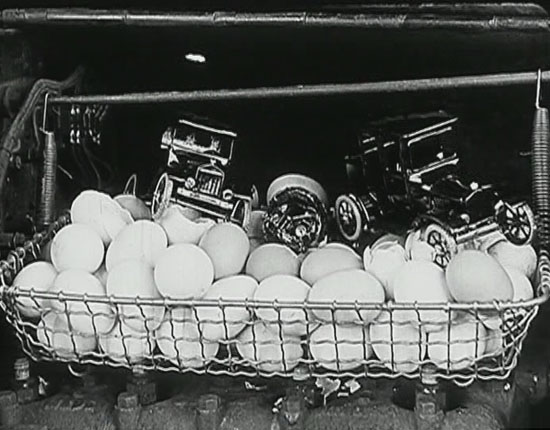
Awesome, very short. Like Fast Film but slower. Some After-Effects-lookin’ animation combined with models and lots of cutouts – not trying to tell a story, just cool visuals/mood. Ahhh, the internet reveals that it was all created in-camera – impressive!
image

image

image

Banquize (2005, Claude Barras)
Boyer’s French Dictionary: “banquize – heap of floating ice frozen together in close masses.” Might be called Banquise, actually. Simple animation, fat kid wears his snow clothes in summer, dreams of living on banquize and playing with penguins. One day trying to hitchhike there he drops dead from heat/dehydration. Hmm.
image

Herakles (1962, Werner Herzog)
Herzog’s very first film, six years before his first feature. This was really good, and not like anything else I’ve seen by WH. Pretty simple structure so I’ll let wikipedia take it below.
image

The film relates to six of the twelve labours of Heracles. The film starts with shots of young male bodybuilders working out in a gym, posing on a stage and flexing their muscles. Each of the labours are then announced by on-screen text in the form of a question, followed by related scenes of modern challenges intercut with the bodybuilders. The audio track of the film is saxophone jazz and sounds from a gym.

The question “Will he clean the Augean stables?” is followed by scenes of a garbage dump, “Will he kill the Lernaean Hydra?” is followed by a huge line of stopped traffic on a motorway and people walking around outside their cars, “Will he tame the Mares of Diomedes?” is followed by scenes of car racing and several race crashes including a crash into the spectators and shots of the subsequent disaster and piles of bodies, “Will he defeat the Amazonians?” is followed by scores of young women marching in uniform, “Will he conquer the giants?” is followed by shots of rubble of a destroyed apartment building and men in uniform searching the wreckage, “Will he resist the Stymphalian birds?” is followed by jets flying in formation, shooting missiles and dropping bombs on training targets. The last shot of the film is of a bodybuilder’s buttocks as he goes off the stage through the stage curtains.

image

Matta (1985, Chris Marker)
“What I am showing here is no exhibition. It is an appeal: Come and play with me! It’s a very lively game, but nothing happens.” Simple interview with Chilean artist Matta (not surprisingly an Allende supporter), an original member of the surrealist group, talking coherently about his art and all art, human beings, dimension and meaning. Would be nice to get/make a transcript. Would be even nicer to have been able to see the Matta paintings that Marker frames him against, but my video was too low-quality to make out much visual detail.
image

Rare Exports Inc. (2003, Jalmari Helander)
One of those one-joke comedy shorts. The joke is that this elite group of skilled hunters are capturing wild “father christmases” and training them to sit at mall displays listening to children request gifts. It’s got a nice visual style (if you dig watching naked old men get captured, hosed down and beaten), and I guess besides the Eija-Liisa Ahtila short it’s the only film I’ve seen from Finland.
image

The Official Rare Exports Inc. Safety Instructions (2005, Jalmari Helander)
And since I didn’t like it much, I watched the sequel and didn’t like that much either. Like all sequels, it’s longer with more effects and new characters. This time the santa-hunters teach safety and behavior lessons and execute an unrehabitable santa.
image

OïO Cinepainting (2003, Simon Goulet)
Took over a decade to make with the participation of 100+ Canadians. Looked like gloopy claymation swamp monsters wrecking countless painted glass vases.
I liked it, would watch again.
image

Workers Leaving The Factory (1995, Harun Farocki)
A catalogue of scenes of workers leaving factories, including the Lumiere film shown about ten times along with Intolerance, Red Desert, Clash By Night, I think Modern Times, Man of Iron, Metropolis, some German movies, and an industrial advertisement for heavy-duty equipment to protect your factory from attackers. Female narrator tells us that there oughtta be more scenes of workers leaving factories, or that there are too many, or that we need to see inside the factories instead of staying out at the gates? I dunno, because she speaks with all the excitement of a hired narrator reading academic text from a translated script, and it put me to sleep twice – impressive for a 35-minute movie. Saves its poetic deep-thought summary for the end: “If we line up 100 years of scenes of people leaving factories we could imagine that the same shot had been taken over and over… like a child who repeats its first word for 100 years to immortalize its pleasure in that first spoken word… or like far-eastern artists who repeatedly paint the same picture until it is perfect and the artist can enter the picture. When we could no longer believe in such perfection, film was invented.” Cute, but I prefer Kaurismaki’s take on the Lumiere short, and all these shots of people leaving work make me want to see Joe vs. The Volcano again.

From the director’s article on the film:

I have gathered, compared, and studied these and many other images which use the motif of the first film in the history of cinema, “workers leaving the factory,” and have assembled them into a film, Arbeiter verlassen die Fabrik (Workers leaving the factory, video, 37 minutes, b/w and color, 1995). The film montage had a totalizing effect on me. With the montage before me, I found myself gaining the impression that for over a century cinematography had been dealing with just one single theme. Like a child repeating for more than a hundred years the first words it has learned to speak in order to immortalize the joy of first speech. Or as though cinema had been working in the same spirit as painters of the Far East, always painting the same landscape until it becomes perfect and comes to include the painter within it. When it was no longer possible to believe in such perfection, film was invented.

In 1895, the Lumières’ camera was pointed at the factory gates; it is a precursor of today’s many surveillance cameras which automatically and blindly produce an infinite number of pictures in order to safeguard ownership of property. With such cameras one might perhaps be able to identify the four men in Robert Siodmak’s The Killers (1946) who, dressed as workers, enter a hat factory and rob the payroll. In this film one can see workers leaving the factory who are in fact gangsters.

The first camera in the history of cinema was pointed at a factory, but a century later it can be said that film is hardly drawn to the factory and is even repelled by it. Films about work or workers have not become one of the main genres, and the space in front of the factory has remained on the sidelines. Most narrative films take place in that part of life where work has been left behind.

The Phantom Museum (2003, Quay bros.)
Starts with John Carpenter-style music, setting up the camera and lingering too long on each shot, but it picks up the pace soon. Don’t think they were being modest with the post-title card calling this a “random” trip through the museum of medical oddities. Showing off items they thought were interesting, bringing them to life with stop-motion whenever possible. Nothing much revelatory in the hospital (except the spiked chastity belt, ooh) or the film, but it’s nice that the Quays are still out there.
image