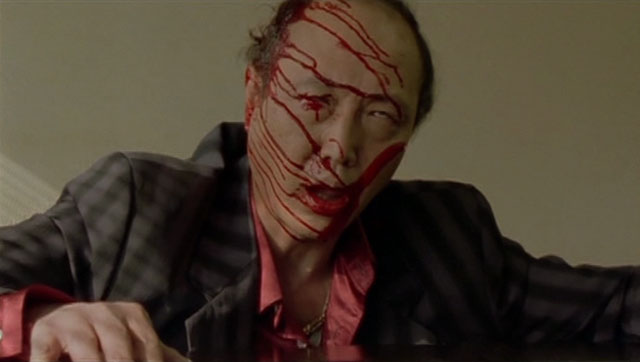
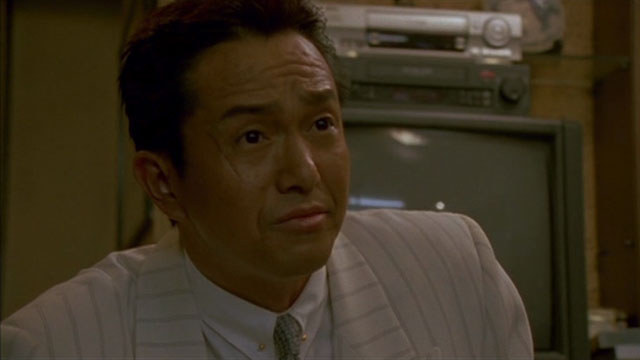
“We, the Futori family, are the oldest family on the island. In recent years, our transgressions have caused trouble on the island, therefore, I now promise the gods that the Futori family will never go out to sea, and I will keep Nekichi in shackles. We will topple the rock and restore the paddy fields of the gods. Once we have made good our promises, please let us associate with the islanders again, please let us go out to sea again, and please let us participate in the Dongama Festival.”

What island? A primitive place, owned by Japan but left largely untouched until now, when industry is trying to creep in. What rock? The massive one desposited on the fields behind the Futoris’ house by a tidal wave. What transgressions? Nekichi slept with his own daughter because her husband wouldn’t, impregnated her, and even worse as far as the islanders are concerned, he was caught fishing with dynamite.

Nekichi with his father:

I actually lost track of how everybody was related – I know, an unforgivable crime in a family/incest film such as this. But I think I figured it out again. Grandpa Futori has two children, the chained Nekichi (Rentaro Mikuni, lead actor in the first segment of Kwaidan) and island priestess Uma (Yasuko Matsui, who runs the inn of In the Realm of the Senses).

Uma and Kametaro:

Nekichi’s father might also be his grandfather, and Nek’s two kids are the straightforward Kametaro (Choichiro Kawarazaki of Kurosawa’s Rhapsody In August) and retarded Toriko (Hideko Okiyama of Kurosawa’s Dodes’ka-den)

Things look up for the family when Ryu from the local sugar factory (Yoshi Kato of Double Suicide) hires Kametaro as assistant to a visiting engineer. But the engineer falls to the same fate as previous engineers, getting caught up in island life and derailed by sabotage (perpetuated in part by Nekichi, who slips out of his chains regularly). He also gets himself into an affair with daughter Toriko, whose heart is eventually broken when the engineer is sent away and replaced by a team that finally gets the work done.

Toriko makes a dream appearance before Kametaro’s train:

Nekichi, meanwhile, is having an affair with his own sister. They murder Ryu and escape by boat during the festival. Kametaro has finally been allowed to join, which means he must also join the search party that rows out to sea, bludgeoning his father to death and leaving his aunt tied to the mast.

What plot description and screenshots can’t convey is how awesome is this movie, a real masterpiece. It just maybe feels a tiny bit long at three hours, but comes together so well at the end, and is lovely to watch. Peppered with closeups of wildlife, like a more grotesque version of the Thin Red Line cutaways (or more relevantly, a less rampantly indulgent version of A Tale of Africa)

G. Kenny:

Every shot in Imamura’s film (which was lensed by Masao Tochizawa) is a feast of often-golden light. The film is set on the sun-drenched fictional island of Kurage (actually Okinawa, of which the fictional construct is merely a thinly disguised version), and the light here functions as a character, as does the water and all the other natural elements that surround the characters. The film’s narrative is nearly three hours of quintessentially Imamurian insanity, wryness, wisdom and acute anthropological observation.

Our narrator/storyteller:

J. Sharp:

By all accounts, Imamura found himself similarly seduced during the production process, embracing island life with a verve that saw the original shooting schedule expand from six to eighteen months, and the budget snowball accordingly. The film’s resulting commercial flop saw Imamura retreat from fiction filmmaking into television documentary for almost ten years, while the studio that financed it, Nikkatsu, migrated away from such ambitious projects to the low-cost/high-impact world of sex film production with the launch of its Roman Porno line in 1971.

The thin line that exists between man and beast remained a salient point of Imamura’s worldview throughout his career, notably in The Insect Woman, his first collaboration with the surrealist scriptwriter Keiji Hasebe … but seldom has man’s precarious position in the natural order of things been so scintillatingly evoked as here.

Apparently the dirty, ugly unpleasantness of American 70’s cinema made it to Japan. This is basically Shaft as a samurai flick, more icky and less funny than Black Dynamite.

Why did I watch this? One summer at the beach I read an article by Jonathan Rosenbaum about Japanese filmmaker Yasuzo Masumura. I was impressed that so many essential films were made by someone I’d never heard of, so I sought them out when I got home – enjoyed his Afraid to Die and Blind Beast but I didn’t try very hard to find more, got distracted by other things, until I saw his name on this box set of filthy samurai cop films. Years later I am finally watching the first in the trilogy, which is not by Masumura but Kenji Misumi, director of some Zatoichi and Lone Wolf & Cub movies. So this is a bad movie watched in preparation for a bad sequel by a recommended director. Auteurism at work.

Hanzo is played by Zatoichi himself, Shintarô Katsu, also of The Loyal 47 Ronin. The 40-year-old actor’s speed and agility are unimpressive, but he can put on spiked metal knuckles and punch a dude’s eyes out. Hanzo’s main weapon is his cock (“You’re so virile,” exclaims a witness he is raping). Hanzo is so good that the girls give up information not when he threatens to rape them, but when he threatens to STOP raping them. And yes, it’s “them,” because the movie ran out of ideas so it used that one two or three times.

The uncorruptible Hanzo takes on his corrupt boss (Kô Nishimura), the escaped Killer Kanbei, and some sad little girl’s dad who is dying from stomach cancer. In the end, having wreaked some major vengeance upon the criminal justice system and raped every woman in sight (because females don’t deserve justice), he hangs the dad, then his theme song plays and it’s over.

I liked some of the stylish transitions and split-screen and backdrops anyway. IMDB isn’t being cooperative with character names, so I’m not sure exactly who fought whom or who got raped when, but I’m sure all lingering questions will be answered in the sequel.

Another entry for…

Initiated by Shadowplay

There’s classic Jimmy Stewart (The Philadelphia Story, Shop Around the Corner and those Capra flicks), mid-life Hitchcock/Preminger Jimmy Stewart, and the ripe-for-retirement late Jimmy Stewart of Airport ’77 and The Magic of Lassie. But this film stands alone in featuring a post-retirement Jimmy Stewart.

IMDB trivia page says:

James Stewart said that he and his wife were vacationing at a game preserve in Kenya when they came across the filmmakers shooting this picture. He said he was persuaded to make a short appearance, speaking a few lines, because he thought it would help to promote wildlife conservation. “Never did understand what it [the film] was all about”, he said. “I did it on a whim.”

Jimmy Stewart feeds a hawk

And he does only speak a few lines, but that makes him a pretty major character in a movie where nobody speaks more than a few lines. Early on, the filmmakers announce their intention to feature a narrative, introducing a man (Philip Sayer of a couple British miniseries, who managed to die eight years before Stewart) in search of help after his plane crashes in the desert, but then they let us watch a girl named Maya romp with wild animals for another thirty minutes before anything else happens. Worryingly, the slender story wasn’t improvised by some actors who stumbled into a wildlife shoot, as it seems to have been, but was rather written by Hana’s old collaborator, legendary avant-garde filmmaker Terayama Shuji (Grass Labyrinth, Emperor Tomato Ketchup). Also worryingly, the “special effect” used to show Sayer’s plane crashing into a tree seemed to have been achieved by actually crashing a plane into a tree. It’s hard to tell if the dialogue was improvised, or if it was written for children, or if everything got simplified because of language barriers: a Japanese crew in Kenya with American, British and Italian lead actors, plus “Kathy” as Maya, no idea where she’s from.

(to be read flatly with a vague smile, revealing no emotion)
“Grandfather, the zebras and the gazelles are having babies again.”
“Ah, that means you’ll have a lot more friends now.”
“Yes, I have so many animal friends now, and I’ve got you, grandfather.”

But enough about story and dialogue. The filmmakers don’t care about it, so why should we? If you remove your expectations of “a Jimmy Stewart movie” or even “a decent film that makes a lick of sense,” it has its own pleasures. Stewart and his granddaughter Maya live in a thatched house with no doors or windows (a rhino wanders inside at one point) and spend their days playing with the wildlife and caring for their adopted pets, including a monkey and a grey thing I don’t even know what to call (they named it Tiki), which makes a “sknt!” noise that cannot be real. These two pets are treated as major characters. We get a better sense of Tiki’s personality than Jimmy Stewart’s (notice I don’t use his character name – I’m not sure that he has one). And I could think of worse ways to spend two hours than watching the beautiful Maya prance about, intercut with wonderfully shot Kenyan nature footage.

Tiki and his monkey friend:

But if Maya’s playful solo scenes recall the early Pocahontas scenes in Malick’s The New World (unfortunately set to what sounded like electro-symphonic versions of Abba songs), the effect is lost when she opens her mouth. It’s very possibly the directors’ fault (you never know), but she and Sayer and his fiancee Eleonora Vallone sure come out looking like lousy actors. Stewart, however, gets showcase scenes for his acting skills – a couple of raging anger moments, and a climactic emotional story told to Sayer about the accidental death of his son, Maya’s father, in a mine explosion. He also really comes to life, with a warm glow in his eyes revealing the depths of his love for nature, during a short speech about dung beetles. Since Stewart isn’t in the movie long enough to get to know him, these scenes don’t mesh well with his other personas in the film (benevolent nature-loving grandfather/mean old curmudgeon), lending credence to Stewart’s claim that he never understood the plot.

An actor, acting:

Oh yeah, the plot. So, since Sayer has amnesia after his plane crash, there’s nowhere he needs to be, so decides to stay with the hot (but chaste in a children’s-movie way) Maya, gaining the family’s trust by braving a snake-cutaway to rescue some cute creature from a hole it had fallen into, and comforting Maya after Jimmy Stewart’s easily-predicted death (actually I thought it was just as likely he’d wander off set and return to his vacation as stay long enough to shoot the death scene). Then, over an hour into the movie it switches to unsubtitled Japanese and I’m lost for a while. Lions behead some gazelles, tens of wildebeest and zebras drown on-camera in a horrible flood (making me pray it was not a children’s movie), some guy is killing “koala birds” with explosives, and there is a montage of animals yawning. Then rich fancy-girl Erika, the fiancee of the crash victim, sets out in her own plane to find him. Sayer somehow gets caught in a brush fire and a native (the movie calls them “the nomads”) walks him out safely. Erika catches up with the young couple and shoots Sayer with a dart gun in frustration when he won’t join her, then pisses off, leaving him in peace with Maya.

Erika at left, with the worst jumpsuit/upholstery combination in human history:

The movie doesn’t have a wildly good reputation online. J. Sharp:

With this overly precious would-be epic the director seems to be so cowed by his subject, the raw beauty of the Kenyan savannah and its denizens, that the end result resembles little more than a protracted holiday slide-show display. … It seems strange that Hani seems so content to dwell on such superficial trimmings, not only given his impressive track record in the 60s, but also that he’d previously been in Kenya to film The Song of Bwana Toshi shortly after the country had achieved independence from Britain. Bwana Toshi had dealt with the cross-cultural encounters of a Japanese geological engineer with the local community in which he is sent to work, and at least addressed such issues as expatriate-local relationships and the misunderstandings that arise due to the cross-purposes of the parties involved. In Africa Story there’s barely a black face in sight.

This was last fiction film to date by Susumu Hani, a Japanese New Wave director of the 50’s and 60’s. Co-director Simon Trevor specializes in camerawork for films shot in Africa – he worked on Gorillas in the Mist, White Hunter Black Heart and Out of Africa.

Midnight Eye has the scoop:

Susumu Hani’s career began with documentaries about youth and shifted into pseudo-documentary dramas, climaxing with Nanami, one of the greatest masterpieces of Japanese film. Although his work proves he had a profound understanding of human psychology, Hani was becoming increasingly disillusioned with humanity, which may explain why he abandoned human subjects in favor of making nature documentaries for NHK. It’s best to keep that in mind while watching this film, because at this late stage in his career, Hani seems to be completely uninterested in human drama. Instead of focusing on developing the characters, Hani chooses to simply incorporate more nature footage than the story will allow.

The vertical lines were supposed to be slimming:

Watched as part of the Auteur Completism Project, in which I plan to watch the last remaining movies by some directors whose work I’d almost entirely seen. Lang was a big one. I previously claimed victory with The Return of Frank James because I couldn’t find Human Desire, then again with Human Desire because I couldn’t find Harakiri, and now I’ve found Harakiri along with two other long-missing silents. Joy!

My favorite shot: at right is the Bonze’s comic assistant

“You have lost your faith in Buddha in those foreign lands. Fear his wrath!” Buddha has wrath? A monk known as The Bonze (Georg John, who played the blind beggar who identifies the killer in M) has a crush on Lil Dagover (of Tartuffe, Destiny, Cabinet of Dr. Caligari), orders her dad the Daimyo to have her become a priestess so he could get closer to her. But the dad refuses, and is disgraced, made to commit harakiri. It’s all based on the story Madame Butterfly, but I don’t remember this part from the David Cronenberg version. The story had already been filmed a few years earlier in the USA with Mary Pickford in the lead.

Lil, looking not very Japanese, under a tree with Olaf:

It’s clear that all the “Japanese” people in this movie are really Germans plus whatever dark-skinned or foreign-looking people they could scrape up, wearing bald caps, samurai wigs and robes (if Japan had watched this movie they never would have allied with Germany in WWII), but anyway, a “European” comes over the wall of the forbidden forest and starts putting his hands all over Lil, so now she’s only got eyes for this guy, which further infuriates the monk, who imprisons her before sending her away to a teahouse to become a geisha. But the Euro Man keeps visiting her, agrees to “marry” her for 999 days, and she becomes pregnant just as he leaves the county, promising to return soon.

Lil shares her feelings for Olaf with their son:

Olaf shares his feelings for Lil with the camera:

After four years, she’s supposedly no longer married so the monk comes after her, and coincidentally Olaf the euro man (Niels Prien: was in a Paul Leni movie the same year and practically nothing else) returns to Japan on assignment, now married to another European and not caring a bit about this Japanese woman. Meanwhile a prince (Meinhart Maur, later of Tales of Hoffmann) is in town, sees the girl and is smitten with her but she claims loyalty to her son’s father and won’t give up until he returns. Her friend Hanake finds out Olaf is actually in town, and goes to plead with him (in front of his wife) to come see his “wife” and son. The prince sends the monk away, and Lil can’t take the pain any longer, takes her father’s sacred knife and does herself in just as Olaf arrives – now this German guy who was a total shit gets their baby, which I don’t see as a happy ending.

Very nice piano and violin music by Aljoscha Zimmermann. Much of the same cast as Lang’s The Spiders from the same year, which I barely remember, and the only other 1919 feature I’ve seen (same year as Broken Blossoms, The Oyster Princess, and Blind Husbands). The biggest star besides Lil turned out to be the “little boy”, actually a girl who would appear in Joyless Street, The Golem and a Joe May movie before retiring from movies at age 13. It’s said that Breathless invented the jump cut, but this movie is just full of them. I think a malicious editor in the sound era must have wanted to shorten the runtime and took out frames at random.

Level Five (1997)

La Jetee is often called Chris Marker’s only fictional film, but others have fictional frameworks or false narrators. This one is the prime example, casting actress Catherine Belkhodja (weirdly – thanks, IMDB – her daughter played the Diva in Fifth Element this same year) to play a fictional narrator before the cameras, not just in voiceover. She writes a book on a computer which is shared with her man, who is writing a video game based on the battle of Okinawa. They both research on an internet-like computer system called (what else?) OWL. Sometimes Chris speaks in his own voice, which seems unusual – is he supposed to be the never-seen game programmer?

Some philosophy about the nature of communication and computers – she feeds her antique Mac nouns as commands to see its response (“I don’t know how to sardine”) – and about the permanence of the past. No matter what variables you change in the Okinawa simulator, the results are the same. She says computers have become her memory, which obviously strikes a chord with me, sitting here typing about movies I’ve seen so I don’t forget them. Besides Catherine and her OWL, most of the movie is devoted to exploring the story of Okinawa, a Japanese island where a large portion of the rural locals committed suicide for fear they’d fall into the hands of barbarian Americans during a brutal WWII battle.

Okinawa memorial footage shot by Nagisa Oshima:

My favorite bit, about a man filmed falling to the ground engulfed in flames:

I know where Gustave is from. You told me his name was Gustave. I’d seen him a hundred times. Nobody had ever filmed a man burning alive so close, a lulu for war documentaries. The unknown soldier, in full kit, holding his own flame. He was carted around battlefields, like a war-artist on tour with a unique act. Gustave in the Philippines, Gustave in Okinawa. I even saw him in a Vietnam movie, still burning 20 years later. I viewed so much newsreel I knew Gustave at birth. Filmed in Borneo, by Australians. The interesting thing is that, at the end of the original shot, you can tell he doesn’t die. He gets up again. You feel he’ll get over it like the napalm girl in Saigon. That ending has always been cut in all documentaries. A born symbol doesn’t get out of it so easily! He testifies against war, you cannot weaken his testimony for the sake of a few frames. Truth? What is truth? The truth is, most didn’t get up.

Catherine dancing with an emu:


Immemory (1998)

I watched a nice transfer of Level Five on my laptop, and there are few movies that would seem more appropriate to view as a computer file rather than in cinemas or on television. But Immemory isn’t a movie at all – a CD-Rom with photos and collages, writings, articles and film clips, meant to be navigated instinctually, like a memory. There’s an index in case you want to cheat and view it exhaustively. I tried to read it like a book, going to each section in turn and reading forward through them all, taking side trips when I felt like it, but then returning where I left off. Really wonderful and fun, with more straight autobiography than you usually get from a Marker film – I enjoyed it more than Level Five.

Some choice pages:

It’s been a pretty outstanding SHOCKtober over here. I did well to avoid the usual direct-to-video garbage of the last few years and watch stuff I’d actually heard would be good. So I figured I was due for a disappointment when I popped in Kwaidan, another period Japanese piece where everybody moves too slowly – another Ugetsu, in other words. But though it’s definitely true that everyone moves too slowly (and the more rich and upper-class, the slower they move) it’s an awesome looking movie, and even the stories I liked less were a pleasure to watch. I don’t know much about Kobayashi, but easily figured out that he had a background in painting. Watched the full-length version from Masters of Cinema.

1. The Black Hair
Rentaro Mikuni (The Burmese Harp, Vengeance Is Mine, Teshigahara’s Rikyu) is a samurai who has fallen on hard times. He has a good wife, Michiyo Aratama (Sword of Doom, The Human Condition, Ozu’s The End of Summer) but he “could not understand the value of love,” tells his wife “for men, advancement is the most important” and walks out on her, moves away and marries the daughter (Misako Watanabe of Youth of the Beast) of a rich man. But he finds himself unhappy, misses his first wife, so one day he throws it all away and returns to her, finding his property decrepit and run down, but her still sewing quietly in a corner. Or is she? After he pledges he’ll stay with her forever, she’s revealed to be a ghost. He ages about fifty years in the span of a minute, in a pretty awesome scene, then falls to the ground.

2. The Woman of the Snow
This one has the most remarkable images, which is good since I already know the story, first from Tales from the Darkside: The Movie but it also has similarities to The Crane Wife tale. A woodcutter (Tatsuya Nakadai, star of The Human Condition and The Face of Another, played the old king in Ran) is caught in a storm with an older man and witnesses a sort of Jack Frost woman freezing the man to death. She lets him live if he promises to never tell what he’s seen. Soon after, he meets a girl (Keiko Kishi of Early Spring, Sydney Pollack’s The Yakuza), falls in love, gets married, has kids, and one day laughingly tells her about that day in the snow, at which point his wife turns back into the snow demon and leaves him, saying if their children ever have reason to complain about his parenting she will return and kill him. The sky is a series of colorfully painted backdrops, often with an eye in the middle, always watching the woodcutter.

3. Hoichi, The Earless
I assumed for a while that the subtitles had missed a letter in “Fearless,” but no. This was the longest and best story. Set in a monastery near the site of an ancient sea battle, with head priest Takashi Shimura (the older detective in Stray Dog and star of Ikiru) and blind errand boy Hoichi (Katsuo Nakamura of Demons, Sad Vacation). Ghosts of the defeated army appear at a shrine and send a warrior to fetch Hoichi to sing them the story of the sea battle. He secretly performs for them all week, until the priest finds out, and tells him he’s in great danger. The priests write scripture across Hoichi’s skin – but miss his ears. The warrior comes and can’t find the singer, “I will take these ears to my lord to prove his commands have been obeyed.” The ghosts leave, and from then on, people come from all over and pay to hear the famed Hoichi the Earless play his music.

4. In a Cup of Tea
Kan’emon Nakamura (Mizoguchi’s 47 Ronin and Miyamoto Musashi) is a very serious warrior, a guard I think. He sees another man’s smiling reflection in a cup of tea, but drinks it anyway. The ghost (Noboru Nakaya, husband of the Woman in the dunes) appears “in person” with his retainers, challenging the warrior, who finds he cannot fight them since they can disappear at will. But all this is a story being written by an author (Osamu Takizawa of Fires on the Plain) who goes missing until his reflection is seen inside a pot of water – the weirdest of the four stories, and a good one to end on. Kobayashi made 20-some other movies, all of which I must see immediately.

Welcome to a special SHOCKtober edition of The Last Ten Minutes, in which I find horror movies on Netflix streaming which I may have actually been tempted to watch (because I am stupid and will watch any trash some days), and remove that temptation by seeing how they end.

Howling VII: New Moon Rising (1995, Clive Turner)
A made-for-TV inspector is clumsily explaining the entire movie to priest John with copious flashback scenes. Ted (played by the director, who was also a producer on Lawnmower Man 2: Beyond Cyberspace) is a longhair biker rebel suspected of killing all the townsfolk, but the inspector is saying it wasn’t Ted. Later, a girl named Cheryl is even more clumsily explaining to Ted that she’s the werewolf. Does the whole movie consist of long explanations by terrible actors? Oh no, here’s a heinous morphing effect, then the townsfolk shoot the Cheryl-wolf to bits, and a county band plays us out, first apologizing to Ted that the whole town thought he was a werewolf. The music was the best part, all extended guitar solos, doing its own thing in a way reminiscent of Rollergator. This is the last Howling movie to date, though I’m sure they’ll remake the original any day now, since they’ve already done Pirahna.

Ghost Ship (2002, Steve Beck)
Cool music. First words I heard: “Murphy’s dead.” Shit, Murphy was Gabriel Byrne, and he’s the only reason I’m watching this – not for Julianna Margulies, beach-blonde Ron “Deep Impact” Eldard or a possessed-by-evil Desmond Harrington. Yay, blondie shoots the evil guy… but evil cannot be killed with a shotgun, as proven by a dodgy computer morph. Boat explodes, Julianna escapes, but a metal song indicates the evil is still alive. Director Steve Beck (13 Ghosts remake) went on to make… nothing. Good.

Day of the Dead Remake (2008, Steve Miner)
A room full of attractive young people led by Mena Suvari (Stuck) are in a bunker. Wow, the zombies can dodge bullets in this one. “He’s smarter than the others.” Oops, Nick Cannon got eaten. Makeup budget must have been low because whenever they show zombies, the camera goes all freakity flop. A zombie shot a zombie, and the kids rig a giant flamethrower that infernoes the whole place except for their little room. Whatever, looks bad all over. From the director of House and Lake Placid and the writer of Final Destination.

Shrooms (2007, Paddy Breathnach)
Lindsey Haun, I suppose, prowls a spooky house with an axe. Now they’re in a forest. I know from the netflix description that they all took killer shrooms so maybe nothing that is happening is really happening. Ah indeed, in the hospital Haun realizes that she was the killer all along. She took shrooms and killed all her friends! Haute twist.

Machine Girl (2008, Noboru Iguchi)
Hoo, some silly-ass special effects. Serious-looking schoolgirl Ami with machine-gun arm and her friend Miki with chainsaw foot kill yakuzas in the woods. Ami is badly bloodied by ninja lady with steel drill bra, then bisects the heads of the baddies. Naturally from the writer/director of RoboGeisha.

American Psycho 2 (2002, Morgan Freeman)
Netflix say: “Patrick Bateman is dead, but his evil legacy continues with Rachael Newman, the only victim who managed to escape Bateman’s grasp. Rachael will get rid of anyone who threatens her chances of becoming teaching assistant to the infamous Dr. Daniels.” Hmm, Mila Kunis is telling William Shatner (via answering machine) that she loves him. In flashback, she steals some girl’s identity and talks to herself all the time. I think this is supposed to be a comedy. I wonder if Bret Easton Ellis got paid for this. She kills herself in a car… or does she!!… followed by a news montage, then the infamous Daniels (dude from a couple vampire TV series) giving a lecture and she shows up. Looks stupid, but it might’ve been less stupid if it hadn’t pretended to be an American Psycho sequel. Freeman is sadly not the great sad-voiced actor but some nobody with the same name, and the writers of this movie fortunately never worked again.

The Signal (2007, Bruckner/Bush/Gentry)
Bad guy is beating up good guy. IMDB calls it “A horror film told in three parts, from three perspectives,” so I guess this is the last ten minutes of the third perspective. Everyone’s face is awfully bloody. Bad guy, with a voice like Patton Oswalt’s, is having an argument with his wife-in-a-coma, then both guys have identity crises and Patton punches through one of many TVs showing “the signal,” electrocuting himself to death. Then I think there’s a fake epilogue but I don’t get it. I thought this one would actually be cool (I dig the premise) but the ending looks somewhat worse than Ghost Ship.

Subspecies (1991, Ted Nicolaou)
Two girls (the Demi Moore one and the Catatonic Blonde) break free from prison but oops, Catatonic Blonde is a vampire. The evil vampire (Radu?) is a terrible ham, and what’s with his fake plastic fingers? Ooh, a shotgun-toting vampire hunter and a quick spot of stop-motion. Your standard swordfight ensues, along with a falling chandelier and some beheadings and everyone’s a vampire in the end. I think the bad guy has been in some Lars Von Trier movies, and I’m not sure who the vampire hunter was but he looked like a wannabe-Toulon. I also checked out the first couple minutes because I ain’t watching Subspecies without seeing Angus Scrimm in a Ludwig Von wig. Looks better than most of the Puppet Master movies, if that’s saying anything.

Subspecies 2: Your Sister is a Vampire (1993, Ted Nicolaou)
Michelle “daughter of Kirk” Shatner has come to fetch another girl from the castle. An old man sloooowly tries to stab a vampire, and his lack of haste is repaid by getting stabbed by a puppet. Evil vampire Radu is alive again and hammier than ever, until he’s stabbed repeatedly by the imprisoned girl amongst some sub-Evil Dead (sub-Subspecies, for that matter) puppet creatures. The original looked grudgingly watchable, but obviously sequels yield diminishing returns. Nicolaou, who helmed the ridiculous TerrorVision, would make two more Subspecies sequels then Puppet Master vs. Demonic Toys, all for the sinister Charles Band and his Full Moon Pictures.

The Astro-Zombies (1968, Ted V. Mikels)
Ted V. Mikels is maybe the only filmmaker I’ve ever met, but the only movie of his I’d seen was on Mystery Science Theater. Yay, John Carradine! He and crony William Bagdad (The Black Sheik in Head) are working on astro-zombie (read: dudes staggering around wearing rubber skull masks) brain transplants when Tura Satana and some actor from Agent for H.A.R.M. interrupt. The sound, lighting and editing are uproariously bad. Oh, I learned that bullets cannot stop a machete-wielding astro-zombie. Some people in suits tell us the moral of the story, and all was quiet for thirty-four years until Mikels and Satana made a sequel.

Thought I’d kick off SHOCKtober this year with Miike’s epic vampire TV- movie which I bought on DVD years ago but never actually watched. Bad move: either it was too stupid or I was not drunk enough to enjoy it properly. I think the problem is simply that it’s a giggling teenage sparkly-vampire flick and I am in my thirties.

Dig the shadow:

Opens with some guy who doesn’t matter getting his whole gang’s ass kicked by a teen girl in motorcycle gear – Riona, I think, who is friends with Mahn (Ayana Sakai of Battle Royale II and Devilman), I think. I didn’t take very good notes here, so I’ll omit the words “I think” (also “teen”) from now on, or else you’ll see them everywhere. Together they’re some kind of Teen Girl Squad who practice sweet fight moves, and maybe kill vampires. Not sure if vampires were a big deal before the scope of this movie, but presumably they fought something in Tennen Shojo Mahn, the previous chapter of this series. Both movies came out the same year as Audition and Dead or Alive and Silver and a couple others, so these didn’t exactly receive Miike’s full attention.

Mahn and Riona, I think:

Vampires have sparkly blood, of course, but they can walk in the daylight and go places they’re not invited and other stuff. Local hunk Yuya runs the city’s dreamiest fashion modeling agency (despite being nineteen) and is the public face of the vampire organization, while his buddy Kamio lurks moodily atop a skyscraper wishing for more power. Then there’s a winged “Saint Vampire” who controls them all from behind an Argentoesque red curtain.

Vamp boys:

Saint V:

Cheap cheap cheap looking movie. Reviews say it has amazing FX for television, but these reviewers have low expectations. The girls aren’t great actors either, but the fight scenes are surprisingly okay.

More intrigue: the girls’ friend Maki (who is big into donating blood – don’t ask) wants to be beautiful like top model Maria (played by porn star Shiori Fujitani), so gets bitten and joins the vamp club, immediately becoming a bitch to her former friends. Head vamp Yuya is a misogynist who is “taking revenge on all women”, though despite his big talk he kinda seems nice And Mahn meets a bullied young boy who happens to be Yuya’s little friend. She gives him a time-killing training montage set to some bland mid-tempo pop songs, teaching him not to be such a little wuss, while Yuya (who could’ve taught the kid himself) looks on disapprovingly. Everyone gets facile back-stories, including characters I won’t bother to mention. And this beardy preacher (Shingo Tsurumi of Freeze Me and Dead or Alive) shows up, embarrassing everyone whenever he’s on screen:

“Mahn, I wish I’d met you earlier… I might not have hated all women.”

Things Of Slight Interest: The word “vampire” isn’t spoken for the first hour. Kamio has a Dr. Claw-via-Minority Report virtual TV (below) that shows him what’s happening anywhere in the city. Only virgins can become vampires, so one girl’s dad tries (unsuccessfully and pathetically) to rape her in order to save her. And vampires are immune to garlic, crosses and sunlight but grow weak when they hear piano music. That one was never explained.

Turns out only the saints have eternal life. Girls become super beautiful and powerful when bitten, but only live 500 days after that, so Maria has an electric death scene on the beach. The girls decide to act, so their former friend won’t suffer the same fate. Then the grand vampire turns out to be the long-lost dad of one of the girls, or maybe of Taichi, I wasn’t paying attention. Some shit goes down and he dies easily, then Yuya stabs Kamio and himself and has a dull, protracted death scene

Maria on the beach:

Based on a comic, obviously, from the writer of Stop The Bitch Campaign, and adapted by the writer of Andromedia and (surprisingly) Visitor Q. So, not a killer Miike adaptation, but we do get a couple cool moments reminiscent of Big Bang Love:

IMDB says:
“A hit-man, with a fetish for sniffing boiling rice, fumbles his latest job, putting him into conflict with his treacherous wife, with a mysterious woman eager for death and with the phantom-like hit-man known only as Number One.”

I say: “She was his wife??”

Crazypants movie, seems to have been semi-remade in Suzuki’s own even-crazier Pistol Opera (they share a writer). This one has four credited writers, but Suzuki seems to have paid the script little mind, leading to his firing from the studio.

Starring my favorite chipmunk-cheeked badass Jo Shishido, who I just watched in the same year’s A Colt Is My Passport.

Joe, the third-ranked hitman, busts around with new partner Kasuga (Hiroshi Minami of a couple Miyamoto Musashi movies), gets a contract to protect a dude, but Kasuga seems unstable.

Kasuga loses it and charges the fourth-ranked hitman in a tunnel, killing both of them.

Joe kills the second-ranked hitman next – I’m not sure if he was supposed to, or if there was any plan, but he sets the guy on fire. Joe returns home to his wife and snorts rice fumes. It gives him energy (AKA makes him horny). But she tries to kill him and runs off.

Next, Joe is hired by a mysterious girl with a funny nose named Misako (Anne Mari of The Killing Bottle and Mini Skirt Lynchers).

But she is confusing, aims a gun at him, and maybe wants to kill herself.

Joe kills his own wife, the guy he was protecting ends up dead, he fails a job for Misako when a butterfly lands on his rifle scope. The movie begins to confuse Joe excessively.

Shadowy, mysterious Number One (Koji Nanbara of The Human Condition I) begins to threaten Joe, saying he’s kidnapped Misako.

Joe checks the film, says “this can’t be right”:

Joe is set up, hides under a car for cover, dragging it along as a ludicrous shield. But he can’t escape Number One, who leads him to a boxing ring, where Joe accidentally shoots Misako, and either Joe or Number One or maybe both are killed.

John Zorn loves it:

Born in 1923 during the short-lived and quirky Taisho period in Japan, Suzuki inherited a powerful appetite for Haikara (modern style) that was tempered by his experiences in World War II. As the member of a meteorological unit, he was twice shipwrecked in the Philippines and Taiwan, and bore witness to atrocities we can only imagine. His nihilistic philosophy is quite apparent in this work—“Making things is not what counts: the power that destroys them is”—as a kind of playful irreverence that echoes the French New Wave that influenced Suzuki and his contemporaries.