Plastic Bag (2009, Ramin Bahrani)

An American Beauty plastic bag, dancing with me for twenty minutes. Only this bag’s journey is very well filmed and the bag has the voice of Werner Herzog – two innovations that would have greatly helped the last plastic bag movie I saw, The Green Bag. A blatant environmentalism screed, but I really enjoyed it. I thought it’d have the same ending as Children of Men, but it had the same ending as AI: Artificial Intelligence instead.

The Dirk Diggler Story (1988, PT Anderson)

An actual fake doc, but not a polished one. I thought it was rigged to look amateurish until I read online that it was actually edited on two VCRs by young Anderson. Narrated by PT’s father Ernie Anderson, a big-time TV announcer. It’s nice that he was willing to participate in his 18-year-old son’s movie about pornography, homosexuality and drug addiction. The most fun part of the movie is hearing this straightlaced announcer pronounce titles like “White Sandy Bitches” and “Bone To Be Wild”.

Dirk is explicitly bisexual in this one, but otherwise it hits some familiar plot points from Boogie Nights: Dirk’s drug addiction, his ill-advised recording career, his buddy Reed. There’s less nudity in the short, and it ends with an on-set fatal overdose for Dirk. My favorite bit that didn’t make the feature was a group prayer for God to protect us against premature ejaculation.

Horner (Burt’s character) is played by The Colonel in Boogie Nights, the only actor who returned. Well, Michael “Diggler” Stein had a cameo as “stereo customer”. He turned writer/director after that – his last film starred Andy Dick and Coolio.

Las Hurdes/Land Without Bread (1933, Luis Buñuel)

A half-hour documentary that has been discussed to death – how much of it is real? Can it be considered surrealist? Etc. Taken at face value as a portrait of an extremely poor mountain community, it’s well made, interesting, and too vibrant (and even humorous) to blend in with your average educational short. I still can’t believe they had a donkey killed by bees, and shot a mountain goat then hurled its body off a cliff, all to make points about the difficulty of life in this place. At least they didn’t kill any people on camera, although the narrator may have exaggerated (or undersold, who knows?) their conditions. Was released in ’33, had a French voiceover added in ’35 then a newsreel-toned English voiceover in ’37 – I saw the French version. I assume the bombastic music was on all three versions.

Senses of Cinema calls it “a documentary that posits the impossibility of the documentary, placing the viewer in the uneasy situation of complicity with a cruel camera probing the miseries of the urdanos for our benefit.”

The Old Lady and the Pigeons (1998, Sylvain Chomet)

This 20-minute movie gives me inexpressible joy. It’s a good antidote to the world-weary realism of The Illusionist, back way past the anything-goes surrealism of Triplets of Belleville into a pure comic cartoon world. A starving policeman dresses as a pigeon, barges into a bird-feeding old woman’s house and demands a meal, then does the same all year until she tries to eat him for Christmas dinner. Full of delightful little details (and at least one sad bird death).

The Italian Machine (1976, David Cronenberg)

“Let’s figure it out, Gestapo-style.”
A series of betrayals leading to an obsessed mechanic gaining ownership over a unique motorcycle. Made for TV, so people call each other “meathead” and “turkey”.

Beardy Lionel (Gary McKeehan of The Brood) hears that a collector’s-item motorcycle is in the hands of a collector. This will not stand, so he grabs his buddies (Frank Moore, second-billed in Rabid, and Hardee Lineham who had a cameo in The Dead Zone) and heads over posing as reporters to figure out how to free the bike from the boring rich guy (played by Guy Maddin’s buddy Louis Negin). Lionel sucks at pretending, though, so they’d be screwed if not for Ricardo, a dull cokehead hanger-on at Negin’s house who helps them out. Cronie’s fascination with automotive machinery peaked early with this and Fast Company, then came back with a brief vengeance with Crash.

Our beardy hero first meets Louis Negin:

Bottle Rocket (1992, Wes Anderson)

Cute sketch, with the Wilson brothers and Bob from the Bottle Rocket feature, plus the gun demo scene shot exactly the same way (just in black and white). They’re budding criminals, robbing Luke’s house then a book/video store, taking one guy’s wallet. No Inez, Futureman, Kumar or James Caan.

Something Happened (1987, Roy Andersson)

An AIDS lesson with didactic narration, illustrated with Andersson’s expertly composed setups of depressed-looking white people. One particular pale balding guy is seen a few times. It ends up less depressing than World of Glory, at least. Commissioned as an educational short but cancelled for being too dark

Within The Woods (1978, Sam Raimi)

Ah, the ol’ Indian burial ground. “Don’t worry about it,” says Bruce Campbell, “You’re only cursed by the evil spirits if you violate the graves of the dead. We’re just gonna be eating hot dogs.” Then he immediately violates a grave of the dead. Nice test run for The Evil Dead, with many elements already in place, like the the famous monster’s-pov long running shot, girls being attacked by trees, evil lurking in the cellar, knifing your friend as he walks in the door because you thought he was a demon, and of course, “JOIN US”. Hard to make out the finer points of the film since this was the grossest, fuzziest, lowest-ass-quality bootleg video I’ve ever seen.

Clockwork (1978, Sam Raimi)

Woman at home is stalked by jittery creeper (Scott Spiegel, director of From Dusk Till Dawn 2). He sticks his hands through her crepe-paper bedroom door, stabs her to death, but she stabs him back, also to death. It’s not much in the way of a story, but Raimi already has a good grip on the editing and camera skills for making decent horror. How did 19-year-old Raimi get his lead actress to take her clothes off in his 8mm movie?

Sonata For Hitler (1979, Aleksandr Sokurov)

Music video of stock footage from pre-WWII Germany stuck inside a ragged-edged frame surrounded by numbers and sprocket holes. Halfway through, the music mostly fades away, replaced with foreboding sound effects.

Music for One Apartment and Six Drummers (2001, Simonsson & Nilsson)

Drummers break into an apartment, play catchy beats in the kitchen and bathroom, with a slow bedroom number in between, then a destructive romp through the living room. But just as they finish, the inhabitants return. Clever and fun, and just the thing that probably should not have been extended into a two-hour feature.

Masters Coppola and Scorsese, who dedicate much time and money to the worthy cause of film preservation, restored this 1960’s Polish film and brought it to the States, where I’m sure a sparkling, freshly-subtitled 35mm print enjoyed an acclaimed week at the Film Forum. Then these giants, pleased with their accomplishments, went off to watch Tales of Hoffmann at George Romero’s house, while some fly-by-night company bought the rights to a video release, made a middling transfer and issued an interlaced DVD.

Alphonse is so goofy and weak-looking, even next to the flamboyantly-feathered Uzeda. I assume from the actor’s Polish James Dean reputation that this was an unusual character for him.

Rebecca Uzeda: Beata Tyszkiewicz also played Edith Piaf’s mom in a 1983 Claude Lelouch movie

I’ve just finished reading the book by Jan Potocki. The movie wisely cuts out the last half of the book and skips to the final couple pages, missing the Wandering Jew and about a month’s worth of the gypsy chief’s stories within stories within stories. And since it is all stories within stories, composed mainly of meaningless sidetracks (Bunuel was a big fan, and I’d like to think he had this in mind while writing The Phantom of Liberty), I won’t go on forever with plot summary.

Alphonse being told his cousins are pregnant:

The first person Alphonse meets at the haunted inn:

The whole thing seemed to have a more comic, amused tone than the novel – noticable from the first framing story (the titular manuscript, being read together by enemies during wartime, in the midst of a battle). Zbigniew Cybulski (star of Ashes and Diamonds, killed by a train a couple years after this) is our hero Alphonse, constantly having his honor tested by ghosts and servants, heathens and temptresses. He teams up with cabalists Pedro and Rebecca Uzeda and mathematician Don Pedro Velasquez (Gustaw Holoubek, also of Wojciech Has films The Hour-Glass Sanatorium and A Boring Story), hooks up with his cousins Emina and Zibelda, meets Zoto and his hanged brothers, and spends not so much time with the gypsy chief (whose name I’ve forgotten at the moment).

Young Lopez Suarez and his outraged father:

Pasheko (Franciszek Pieczka) was my favorite actor:

Good looking movie, straightforwardly filmed without stylistic excess or ghostly effects. The rumbling electronic music sometimes does the movie a disservice. I’m sure the cinemascope-shot film looked a hundred times better in theaters than on my laptop – fingers crossed for another revival.

I’m guessing Alain Robbe-Grillet liked this shot:

A Zoto brother:

This story (stories) was remade as a miniseries a decade later in France – nobody seems to know much about that version (not in English, anyway). The only other Jan Potocki adaptation was by Raoul Ruiz in the 80’s. W. Has doesn’t immediately seem like a filmmaker I must seek out, but his Hour-Glass Sanatorium does sound good.

Finally, a great horror movie set in Barcelona (Carriers was directed by Barcelonans but set in the U.S., a missed opportunity). Although, it takes place entirely inside one small apartment building, so it could have been set anywhere – which was Hollywood’s point when they remade it in English as Quarantine.

The most fun thing about this movie is that the cinematographer (Pablo Rosso) is also a lead character, a news cameraman following young reporter Angela (Manuela Velasco of the upcoming Spiderland, which I’m hoping is a Slint bio-pic). I’m not up-to-date on my Spanish horror viewing, so haven’t seen any of these actors before. IMDB says the leads return for [Rec] 2, but I don’t see how that’s possible since everybody dies at the end. I don’t get why a sequel (plus two more in development) would be desirable either – having flashbacks of the hilariously stupid Blair Witch 2.

Fluff reporter Angela is following fire fighters for a night when they’re called to an apartment to check on a disturbance. Said disturbance is the old woman upstairs eating one of her neighbors. They soon find out they’re being sealed inside the building by the Spanish CDC, and that people the old woman bites seem to become flesh-eating zombies.

Panic ensues. There’s a nervous, power-crazed cop who likes to draw his gun, a cute widdle girl and her mother, a young doctor, and some more zombie-fodder residents. The fireman and the reporter/cameraman nearly escape but he gets bitten. The news crew lock themselves in the penthouse, where a crazy (you can tell because there are newspaper clippings all over the walls) but organized (if the clippings weren’t enough of a plot device, there’s a tape machine) mad scientist was conducting experiments on a zombie… who is… STILL IN THE APARTMENT OH MY GOD AND it kills them both and that’s the end.

Film director Mateo Blanco (Lluís Homar of Bad Education) reinvents himself as novelist Harry Caine after an accident, both out of trauma from losing his lover Lena (Penélope Cruz), and to stay in hiding from the men he suspects caused the accident. Millionaire Ernesto Martel (José Luis Gómez of Goya’s Ghosts), producing Mateo’s film which stars Ernesto’s young wife Lena is one of those men, and his closeted son (Rubén Ochandiano of Che, Biutiful), stalking Mateo and Lena with a videocamera, is the other. Those four plus the always excellent Blanca Portillo (pot-smoking friend in Volver) are the core of the movie, which stays twisty and exciting due to Almodovar’s withholding of major story elements (like the car crash) until the end. As with Volver, it didn’t seem to burst off the screen and declare its excellence, just came off as another solid Almodovar pic. But thinking of those two in hindsight they seem so good I want to watch them again right now. Maybe that’s why the Almodovar movies I’ve seen more than once (All About My Mother, Talk To Her, Women on the Verge) are my favorites… all his work needs to be examined a second time, to appreciate the filmmaking once the shocks of the plot twists have worn off.

Cruz:
image

T. Stempel:

Almodóvar is very aware that he is borrowing, and to save us from having to make a list of films and filmmakers he is referring to, we get a later scene of Diego going through Harry’s DVD collection, reading off titles and directors. One thing that struck me in watching the film is that it makes more sense as you watch it than any summary I have seen in the reviews of it. That is Almodóvar’s skill as a screenwriter.

Portillo:
image

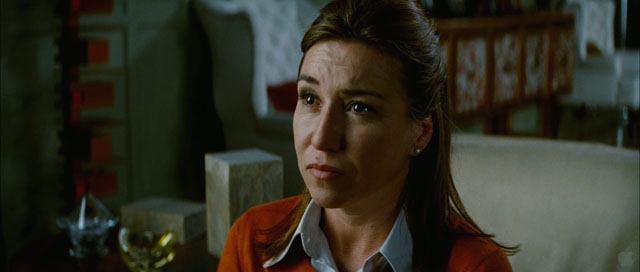
Ernesto’s son (in the present-day scenes calling himself Ray X) comes off as cartoonish (no disrespect to the actor; he’s given a cartoonish role to play). Mateo/Harry is very good as the star of the story, but as usual with Pedro’s films, my eyes are glued to the women: Cruz, Portillo, Lola Dueñas (The Sea Inside, Volver) as a lip-reader employed by Ernesto, and the unforgettable Rossy de Palma in a brief cameo.

Lola:
image

This has been compared to Primer, and the Hollywood remake machine is already rolling over it, so I thought it’d be a better time-travel movie to watch than Terminator 4 this weekend.

image

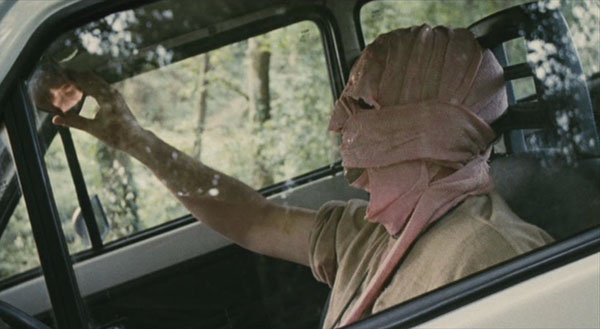
Hector is settling into his new house with his wife – one day sees a naked girl in the distance, goes to check it out and is attacked by a man with a bandaged head. This being a movie called TIMECRIMES I figure the bandaged man is Hector himself come from the past or future, and I’m right, but the movie doesn’t hide this for long, and there’s more to enjoy than just trying to guess the future/past. Doesn’t tell the story in real chronological order, but follows Hector’s own personal chronology as he is tricked by a scientist (played by the director) into entering a time machine and beaming into the past a few hours. Now Hector 2, he gets in an accident and bandages his face, goes around stalking himself and trying to figure how to get out of this. The bit I didn’t see coming is when he beams himself 30 seconds earlier than he did before, becoming the behind-the-scenes manipulator Hector 3 who ensures that the woman who falls to her death (causing Hector 2 to become Hector 3) is the poor previously-naked bicyclist who tried to help him, and not his beloved wife. Back in the normal flow of time, he sits with his wife as night falls.

image

Also checked out the shorts on the disc. Nacho is the king of the clever concept.

7:35 In The Morning (2003) is a musical – guy (Nacho himself) sings a song for a girl he sees every day at the diner and gets everybody there to participate. Thoroughly unexpected finale when she calls the cops and he turns out to be strapped with dynamite.
image

Crash (2005) is hilarious – guy (Nacho again, imagine that) out with his girl wants to ride the bumper cars just like old times, but he gets increasingly frustrated, angry, embarrassed and injured.
image

Finally it is SHOCKtober and I can watch Stuart Gordon movies again. This one is prep for Stuck, which should come out on video next week. It’s similar to Dagon in many ways: pretty good classic-lit-inspired story, foreign/period setting with cheap-but-good production values, spots of humor, sexual transgression… They’re fun movies to watch with some great characters, but our leads are bland, straightforward, naive dopes. It’s not like I’m rooting for Lance Henriksen, but I can’t bring myself to root for the baker and his wife either.

image

Set during the Spanish Inquisition in 1492 (when Columbus sailed the ocean blue), Lance stars as an evil monk who claims to be extremely religious but tosses the church aside when it interferes with his plan, a man who tortures people for confessions and insists what he’s doing is right. If the movie was released today, it’d be attacked for all the heavy-handed GW Bush comparisons. Lance is surrounded by his cronies: Stephen Lee (the toy-loving dude in Dolls), crazed torturer Mark Margolis (a Darren Aronofsky regular) and by-the-books Jeffrey Combs, and together they torture and kill a woman whose character name sounds like Contessa Alfred Molina (played by the director’s wife Carolyn) and one who claims to be an actual witch (played by the creeeepy hotel woman from In the Mouth of Madness).

Jeffrey Combs:
image

Thrust into this lunacy are a baker and his wife. The baker (also in Gordon’s Castle Freak) is a regular boring dude who can inexplicably take out three knights in full armor using only a spoon, and the wife (her only other role is in a rarely-seen Raul Julia movie) is honest and religious and doesn’t trust the Inquisition. She’s arrested and accused of witchery after she protests a public execution scene, but evil Lance falls for her and tries to get her by alternately threatening to torture her/her husband and offering to release her/her husband. He cuts her tongue out, she escapes by faking death (with help of the real witch – who swallows gunpowder so her body will explode and her bones impale the crowd during her burning at the stake, which I don’t think would really work), the couple escape and Lance dies (torture-free) in his own spike pit beneath the pendulum. Oh, and in the middle there’s a visit from a cardinal (Oliver Reed from The Brood, The Devils and Burnt Offerings!), but Lance locks him up inside a wall a la Poe’s “Cask of Amontillado.”

image

Lance is fun to watch as the monstrous monk. Lots of loving care is paid to torture equipment. Movie’s action scenes are weak, but overall I liked the thing. Happy Shocktober, everyone!

This is one of Buñuel’s anarchic sketch films (see also: Simon of the Desert, Phantom of Liberty) which he made in between his relatively more normal, subversive upper-class films (in this case between Belle de Jour and Tristana). I still think I appreciate his films more than I enjoy them, but the more of them I watch, the more I feel that his career is unassailable, that his last twenty years of filmmaking produced one long masterpiece. It turns out I had seen this before, though I barely remembered it. Must’ve rented the tape from Videodrome. Don’t think I finished it last time, because it got foggier around the halfway point.

image

Such a smart and well-researched movie, I don’t feel qualified to discuss it. I can discuss the cinematic aspects though. Good photography with no surprises, unusually long shots but not noticeably/showoffy long. Buñuel’s movies always feel the tiniest bit too slow for me, too perfectly calm and collected, the acting and sets and camerawork too high-quality for their content, which I suppose is the point.

The plot is a “picaresque”, two beggars wander into various scenarios during their long walk from Paris France to a holy pilgrimage spot in Santiago Spain – although it turns out they’re not on a pilgrimage themselves, they just heard there’s a huge crowd in Santiago where they can get rich on spare change. Different historical periods and bible stories blend into their present-day 1960’s voyage without anyone batting an eye. They meet Satan(?), the Whore of Babylon, and lots of people discussing the six central mysteries of Catholicism and their associated heresies. They do not meet Jesus, the Virgin Mary, the Marquis de Sade or the Pope, but they’re all in the movie via sidetracks from the main action (though one could argue that it’s all sidetracks). Plenty of surreal moments keep the movie lively even when the dialogue is all obscure religious debate.

image

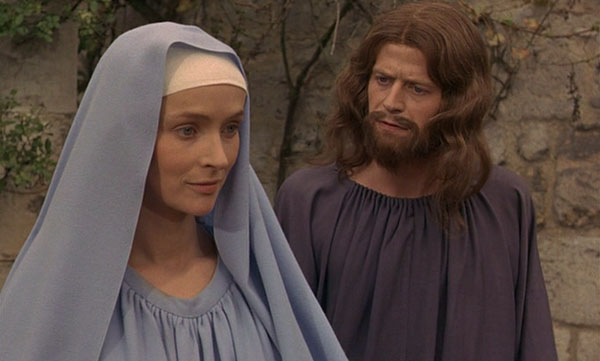
French cinematographer Christian Matras was about Buñuel’s age, had also shot most of Max Ophüls’ best films, also The Eagle Has Two Heads with Cocteau and Grand Illusion with Renoir. Co-writer Jean-Claude Carrière (also an occasional actor) worked on most of Bunuel’s 60’s-70’s stuff and over a hundred other movies, including recent ones like Chinese Box, Birth and Goya’s Ghosts. The guy who played Jesus starred in Rohmer’s sixth moral tale a couple years later. Virgin Mary Edith Scob was in Franju’s Judex in the 60’s, and lately in some Raoul Ruiz films and the newest by Olivier Assayas. Of the two tramps, the older would be in the next two of Buñuel’s French films, and the younger would star in Clouzot’s La Prisonnière and Godard’s Détective.

image

In the DVD interviews, Ian Christie tries to make us feel better for not knowing the historical references – he says nobody knew them. He got a press kit. The film was influenced by The Saragossa Manuscript, which sounds cool. “What heresy means for him is a kind of metaphor, I think, for human beings’ fascination with arguing about the immaterial, the invisible, trying to bolt it down and make it literal.” Screening when it did, it was alternately seen as cleverly reflecting or having nothing to do with the political and social upheaval in late 60’s France. Interview with the writer and documentary on the DVD are both pretty alright, nothing that needs repeating here.

Our two bums with the whore of babylon:
image

Michel Piccoli as the Marquis de Sade:
image

Alain Cuny as the mysterious walkin’ guy:
image

L’Age d’or reference:
image

À bientôt, j’espère [Be Seeing You] (1968, with Mario Marret)

“Almost 10,000 workers have lost a day’s pay, just like that. It is not a prowess, it’s solidarity and it is something formidable compared to TV games or trash papers. It’s far better, it’s wonderful. It’s normal, it’s the working class… that’s what we must be aware of. What is beautiful is not what is written in the tabloids. It’s what the working class does. It’s to lose 5000 francs to support our sacked mates, and to contribute today again to make up for their lost pay. If only this was advertised and spread. Isn’t that culture? I want to tell management we’ll win thanks to the solidarity they know nothing about. We’ll get you. We’re not mad at those who think wrongly they are the boss, but we’ll get those who own capital. It has to be, it’s natural, and we’ll be seeing you.”

Unfortunately this does not seem like an intricate film which will grow deeper in meaning with repeat viewings – just on-the-spot reporting, interviews with striking factory workers who calmly explain what’s wrong with factory conditions and the effects (both actual and hopeful) of their strike. The only good speech is the one quoted above, at the very end. Movie was a letdown considering the great strike movies I’ve seen lately, including Harlan County USA just last week… but this wasn’t aiming to be similar to that film, or to The Battle of Chile, just small-scale reporting of a single event, leading (hopefully, but not actually) to a revolution of working-class-created films.

image

image


2084 (1984)

Filmmakers are asked to commemorate the hundredth anniversary of the 1884 start of trade unionism in France. “They were rather at a loss, so they had this idea of simply jumping ahead a century… afraid of defining the state of the movement today.” Their software and studies predict three possible futures, color-coded.

The Grey Alternative: a never-ending crisis. “When it takes all your energy just to stay afloat, there’s not much imagination left for creating a future.” An alternative with the possibility of “a social or nuclear explosion”, “a fearful society huddled in its blankets of false security, staking its hopes on a precarious balance that is forever in jeopardy. Here the union is at best a powerful protective organization” to “safeguard your job, keep you as comfortable as possible… A union like that doesn’t bother with changing the world.” “Union ritual becomes… nothing but congresses, meetings, demos, slogans. What a drag.”

The Black Alternative: “it could be fascism, it could be stalinism… it’s not easy to forsee a world where the technical developments replace ideology… The appropriation of this technology: who is to benefit from it, who should control its development, was the overriding question of the late 20th century, its real challenge. Because we didn’t understand in time what was really at stake, it was left to a new type of leader to govern the future: the techno-totalitarians.” It forsees “violent workers revolts [in] the 80’s and 90’s and their repression.” This leads to a Wall-E utopia. “At home you get more images than your eyes can absorb and more information than your memory can stock… Anger too belongs to a bygone age. The state is a well-oiled feeding machine and the union nothing more than the engineer who keeps it working, the one who detects the little glitches, little breakdowns, and who can’t even imagine that the machine can serve some other purpose. In fact, of ‘union’, only the name remains. Trade unionism passed away with the dawn of the year 2000” because of infighting.

The Blue Alternative: a tentative hope. “before our eyes, technology is beginning to prove itself a fantastic tool for changing the world, and this transformation includes the struggle against hunger, against suffering, the struggle against ignorance and against prejudice. It is still a struggle, but in the context of the 21st century, not the 19th.”
image

“The 20th century hasn’t even existed. It was nothing but a long, painful transition from barbarism to civilization. In the 1980’s those who still felt angry about poverty, about the injustice of industrial societies were right. Those who felt there was hope for change were right too. The part unions played was to bridge the gap between this anger and this hope. They were the instrument of a new struggle, a place where imaginations could meet and create new solidarities, where people could… learn how to make good use of their differences, and how to win control of their days.”

The film proclaims that it has been “talking less about what has been done already than about what remains to be done. Nothing is programmed yet. The three alternatives are open to us.” “We’ve just got one century left.”

Definitely had to watch this a second time to make sense of it because of the rapid-fire low-key narration and the bizarre images (mostly of film students in a lab combing through 20th century film images), which I would focus on and lose the train of thought of the narration. They don’t exactly work together most of the time. It’s a great commentary though, and a strong little film.

image


Remembrance of Things to Come (2001, with Yannick Bellon)

Excellent movie by two 80-year-old artists celebrating the photography of Yannick’s mother Denise Bellon. Tells stories through Denise’s photographs of France and surrounding countries (including colonized north Africa) and of her friends the Surrealists, first in the pre-war 30’s, then the lead-up to WWII, and briefly post-war (incl. a surrealist reunion photo). Nothing afterwards, though Denise lived until 1999 – makes for a short, focused movie. Electro-sounds and female narration by the Sans Soleil crew of Michel Krasna and Alexandra Stewart.

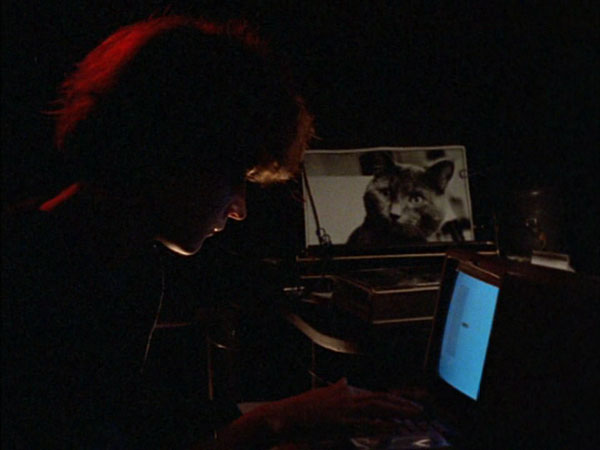
“Each of her photographs shows a past yet deciphers a future.” This is the kind of movie I’d been waiting for while sorting through Marker’s lesser-known 70’s stuff – poetic commentary weaving history and art around the images. Don’t know how the collaboration with Yannick Bellon worked, but this feels very much like a Marker movie, and a great one at that. There are cats, of course (see below), and the second mention I’ve seen him make of the 1952 Olympics.

From what Acquarello writes about this, you’d think he was talking about Sans Soleil: “It is in this analytical deconstruction between the integral art of composing an image and the cognitive assignment of significance behind the captured image that filmmakers Chris Marker and Yannick Bellon create a compelling exposition on the processing and (subconscious) self-actualization of human memory.”

Movie opens on Dali’s Rainy Taxi, which I saw in Spain.

image

image

The Bellon sisters:
image

Auguste Lumiere:
image

image

The Pont-Neuf, which I recognized from Lovers on the Bridge:
image

The commentary on this part, about scrap metal used to fuel the war effort, is one of Marker’s finest:
image


Puisqu’on vous dit que c’est possible [We Maintain It Is Possible] (1973)

“We can now point out that the government preferred to surrender to multinationals rather than grant anything to the workers. That’s what we can say for now.” [via megaphone]

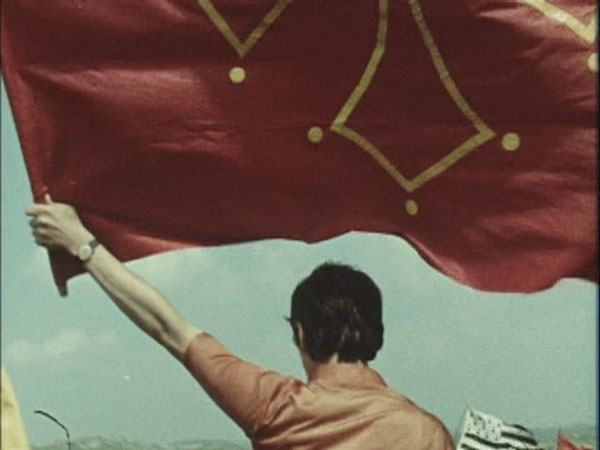
Movie about worker occupation of a factory in 1973, with an intro saying the movie was shot by “Scopecolor”, edited by Marker, and is the sole responsibility of those involved – the strike participants’ way of distancing themselves from the film, perhaps. A watch factory called Lip is to be shut down, then bought out, then restructured with massive layoffs, and the workers decide not to accept this, to take the factory and sell the watches themselves. Negotiations don’t go well (the workers have all sorts of demands, the owner simply says it’s not profitable so he’s shutting it down) then the police evacuate the building and demonstrations hit the streets.

Has much more interesting editing than À bientôt, j’espère but that’s not saying much. Still, for the most part, video interviews and a few photographs for a while, then footage from inside the factory, nothing exciting to watch. I mean, all praise to Mr. Medvedkin, and I agree that cinema can have many useful purposes, but personally I’ve seen an unusually high number of movies about worker strikes, so forgive me if I yawn when this one’s narrator goes on about how exciting are union meetings.

“The outrage lies in labor exploitation and the alienation that capitalism inflicts on workers.” says a speaker during a convincing speech – which is exactly the point here. Rich factory-owners aren’t going to freely hand their factories over to the workers, and the government isn’t going to allow one group to occupy another group’s buildings against the owner’s will, so the only way to win is the change the system, to reform capitalism. It happened, however briefly, in Chile, but the watchmakers at Lip failed to overthrow the French capitalist system.
image

image


Set Theory (1985)

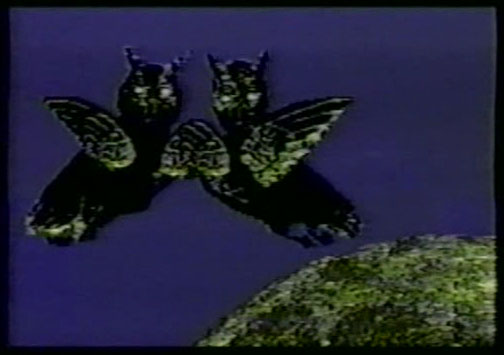
An ugly slideshow done entirely in HyperStudio, accompanied strangely enough by string music by Russian composer Alfred Schnittke instead of the electronic sounds Marker is fond of using. The story goes: Noah is on his ark wondering how to sort out all these animals, when two wise owls come by and teach him set theory. “Eureka,” cries Noah, who now understands all manners of mathematics through understanding set theory. Since it uses French intertitles instead of spoken narration, I transcribed the titles and ran ’em through google translator to make a subtitle track with helpful program Media Subtitler. The movie itself was only halfway worth the effort – it seems a very minor work (though more amusing than À bientôt, j’espère) – but it was fun to play around with. Some of the clip-art and dialogue is actually pretty cute – a tiger being confused with a house cat due to faulty classification and taken home is portrayed using an oversized tiger in a bathtub, with E. Munch’s “The Scream” in the foreground.

image

image

Watched this the same month as Trouble In Paradise, not having guessed how connected the two would be – the book/script of Stavisky even mentions that they stole shot ideas from Paradise. This one seems like a correction to the other, set during the same year with some of the same reference points (such as Trotsky) but here the upper-class gentleman thief is revealed to be a sham, and rather than escaping at the end to start over with his true love, the thief ends up dead, his widow in prison. The final shot is the chauffeur (of the period Rolls they drive everywhere) placing a bouquet of white flowers for her outside the prison.

Bright and lively music by Stephen Sondheim (who had already won three Tony awards in the 70’s) kept the doomed inevitability away until it was too late. Sondheim had already won three Tony awards in the 1970’s by the time Stavisky came out. It’s one of the very few times he’s written music (more than one song, anyway) for films – the other cases were Warren Beatty’s Reds (another movie featuring Trotsky!) and Dick Tracy.

image

Another story by Jorge Semprún, who wrote the exile-themed The War Is Over. One of Stavisky’s associates (Juan Montalvo, a slimy guy who hits on Arlette but can provide Serge with lots of money) was funding the attempted coup in Spain which led to the Spanish Civil War. In researching the film Semprun found that the same police inspector (named Gardet in the movie) assigned to watch over Leon Trotsky in France was also assigned to report on Stavisky, so Trotsky’s exile was written into the movie, as witnessed by a kid named Michel Grandville. The movie is bookended with Trotsky – first arriving in France, beginning his exile from Russia, and at the end after the Stavisky scandal, being moved further into exile, far from Paris, his political influence feared by the conservatives. Stavisky himself is a Russian Jew in exile – so there are a few connections to the previous film.

The paperback book says it “represents the final scenario” for the shooting of the film, and the intro by Richard Seaver addresses something I had wondered about after reading The War Is Over and believing that Semprun’s script was shot word-for-word with very little added by Resnais: “Once the subject is established, the writer does an initial draft, or treatment, after which writer and director discuss it scene by scene, often line by line, in excruciating detail, until the distinction between writer and director blurs or disappears.” So in fact the books by Semprun represent the collaborative vision of he and Resnais – my beloved auteur is no longer in peril.

The real Serge Alexandre Stavisky was involved in ever-larger finance fraud and was connected with people high up in French government, and when this was made public in January 1934 it led to riots, deaths (incl. the semi-suicide of Stavisky himself), trials for his friends and widow (all acquitted the following year) and political upheaval. Not knowing much about French politics, the Wikipedia articles are hard to follow, but it seems the ultra-conservatives tried to overthrow the leftists in power – eventually one leftist resigned, a conservative replaced him, and somehow socialists ended up in power.

Belmondo, a decade after Pierrot le fou and still looking the same:
image

Jean-Paul Belmondo as Stavisky/Alexandre is dazzling, a con-man with absolute confidence in himself. Arlette is his glamorous wife, and he’s surrounded by associates, some complicit in his underhanded dealings like assistant Borelli and Serge’s in-pocket doctor (Michael “Thomas” Lonsdale) who keeps declaring Stavisky unfit to stand trial for a six-year-old fraud offense… and some are just content to spend time with Stavisky, enjoying his company and not asking questions, like friend Baron Raoul (an outstanding Charles Boyer).

Arlette: Anny Duperey’s debut was seven years earlier in Godard’s Two or Three Things I Know About Her.
image

The book says “Barol Raoul’s looks, gestures, diction and bearing are those one would expect a baron to possess in those films where barons play a part.” That’s hilarious… I hope those are the character notes they gave to Charles Boyer.

This was French superstar Boyer’s second-to-last film. I saw him as the star of Fritz Lang’s not-so-good Liliom. He is the second actor I’ve seen lately (after Maurice Chevalier) claimed to be the inspiration for Pepe le Pew.
image

As Stavisky’s right-hand man, beloved character actor Francois Périer of Nights of Cabiria, Orpheus, Le Samourai, also narrated some Chris Marker films. From the book: “Albert Borelli’s face is impassive, but he has a sharp eye. He is a man of few words but not of few thoughts.”
image

No wonder I had trouble with inspectors Bonny and Boussard – it’s complicated. Boussard arrested Stavisky years ago, and a couple years afterwards Serge became Boussard’s “informant” – actually Serge pays Boussard to keep an eye on things inside the police department, and the informant thing is just a front so they can meet. Bonny has it out for Serge, hires the blackmailer who comes to the theater during auditions to extort money from Stavisky by threatening to expose his past, and later engineers the police raid during which Stavisky shoots himself. Plus I always have to look hard to tell which Inspector is which, since they look and dress the same.

Inspectors Boussard (left, Marcel Cuvelier, also played an inspector in The War Is Over) and Bonny (right, Claude Rich, star of Je t’aime, je t’aime):
image

Bad Boy Bonny:
image

Michel Grandville (Jacques Spiesser of The Man Who Sleeps and Black and White in Color) and Erna Wolfgang (Silvia Badescu), who auditions for a part at Stavisky’s theater (he reads with her, playing a ghost – see quote below):
image

Lonsdale, after “Serge Alexandre” tells him to get rid of Stavisky and his problems: “The person he once was has become someone else: a ghost he despises. But a ghost who worries him.” And later: “To understand Stavisky sometimes you have to forget files. You have to dream of him and to imagine his dreams.”

Dream doctor Michel Lonsdale:
image

Gérard Depardieu got his break as a star just two months earlier. Here he has one scene as an excited young inventor trying to get Stavisky to invest in his product:
image

And back to Erna Wolfgang. I just liked this shot.
image

One more look at Thomas:
image

I wasn’t in love with the movie after I watched it, seemed like a really well-done portrayal of a controversial man with great acting and an over-complicated plot, but reading the book afterwards cleared up all the characters and the structure of the whole thing, and thinking back on the story, acting and photography, I’m now liking this better than The War Is Over. Nobody here is a good guy – not even Bonny, who goes against police corruption but for personal & political reasons – but the movie doesn’t judge them, or go into the details of the scandal. It just gets inside their characters and shows where the scandal came from, how one guy’s belief that he could fake his way into the upper echelon ended up shaking the country.

image