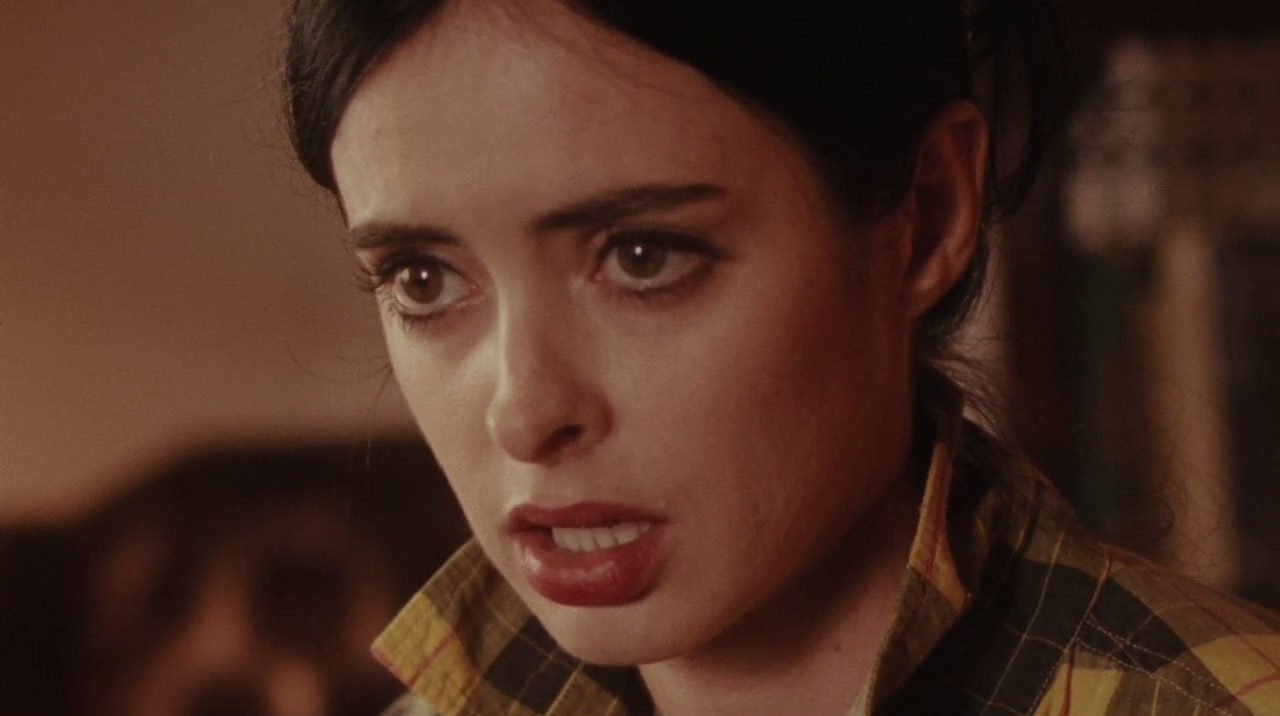
First movie watched since moving to Nebraska!

A movie with no baddies. Cursed ice-princess loses control of her snowy powers and hurts her little sister, then years later as hormonal ice-queen she dooms the whole town to endless winter and runs off. Little sister gathers hunky ice salesman and magic comic snowman (with the voice of Elder Cunningham) to set things right. There is singing.

Not what I was expecting after the increasing despair of Through a Glass Darkly and Winter Light – I mean there’s plenty of despair here, and more relationships falling apart irreconcilably and suicidal behavior and children being forever warped, but for the culmination of a “Silence of God trilogy” and a film that was originally entitled God’s Silence, there’s a curious lack of discussion of God.

After a train trip through a country at war, Anna (Gunnel Lindblom, suicidal Sydow’s wife in Winter Light) and sickly Ester (Gunnel Lindblom, Winter Light pastor’s no-longer love-interest) land at a hotel, sit in their room deteriorating while Anna’s son Johan makes the hotel his playground, spying on the porter (I loved him, a friendly old man who only speaks his fictional home country’s made-up language) and cavorting with a roomful of dwarves. The sisters hate each other – Anna tells some uncomprehending hookup that she wishes Ester were dead, finally takes Johan and abandons her sister to the hotel.

Quiet and mysterious movie full of ambiguity – hard to tell much about the relationships or history, why they are here, where is here (a place that Ester, a professional translator, knows none of the language), what Ester and the boy are thinking.

L. Braudy:

Anna and Ester form two sides of a whole person, a theme Bergman would go on to further explore in Persona. Anna is defined almost entirely through her physicality — washing, anointing herself with perfume and lotions, getting dressed and undressed, having sex, watching others have sex. Ester, the translator, with her typewriter, paper, and pens, is instead a creature of language — suffering from the lung disease that suffocates her, masturbating, smoking, drinking, and thinking of sex as a mechanical matter of “erections and secretions” that disgust her. Her body in ruin, only words seem to keep her alive.

Ingmar Bergman Makes a Movie (1963, Vilgot Sjöman)

Extremely good, five-part doc on the making of Winter Light, which I’m obviously watching one movie too late, but I didn’t realize it existed back in February. Sjöman, who hadn’t yet made it big with the I Am Curious films, interviews Bergman at every step of the filmmaking process. Amazing to me how open Bergman is about his script after just having completed it, his intentions for filming before beginning.

Bergman:

“This is what we suffer from so terribly in watching American films, where everyone walks around acting so desperately natural, talking in this damned monotonous way. It makes it so dead and dull. It’s important to keep the dramatic contour. It’s not about just keeping up a naturalistic level of chatter, but actually playing a part, conveying a certain impression. And as you get towards the end of a movie – and the director must keep a careful eye on this – it’s important to raise the energy level in the actors. After having watched the film for an hour and a half, the audience is so tired that they need more energy. They need to understand the big picture.

Sven Nykvist:

Segments of process (except for scriptwriting) are interspersed with interviews discussing why things are done the way they are. For one Winter Light scene fragment, we see all the angles shot, then the first edit, then the final. Bergman gives this doc strict attention, not playing it off as PR fluff but maybe a chance to seem less forbidding to audiences as his films were turning more serious. And of course, he’s more conscious of his public image and the reception of the doc than he appears.

Vilgot for Criterion:

Bergman avoided some things, though. He was afraid of letting me read the first sketches he put on paper. These were later published in Bergman’s book Images: My Life in Film. So here we find the embryo for the film: the minister alone in the church, trying to force God out of his silence. Bergman was also afraid of letting the TV crew into the studio while he was working with the actors, so what I got for the TV series is an arranged rehearsal, made on a separate day after the real shooting was finished. … When time was ripe for the last interview, he didn’t approve of the result. “No good,” he said. He was blaming himself for being too superficial. “We have to do it once more, Vilgot.” So we did.

Bergman’s Dreams (2013, Michael Koresky and Casey Moore)

A Criterion-produced DVD extra without a DVD, stuck onto their blog and youtube, about dreams and dreamlike atmosphere in Bergman’s cinema – curiously without directly mentioning his film called Dreams or his TV adaptation of Stringberg’s A Dream Play (a major influence, Bergman closes Fanny & Alexander with a reading from it).

The Venice Film Festival posted 70-ish short films online to commemorate their 70th anniversary. I watched them gradually over the past year. These are the ones I did not care for. Favorites are here and the rest here.

Apichatpong Weerasethakul

Visual: driving straight road in the rain through wipers
Audio: ocean with seagulls

Jean-Marie Straub

Single silent shot of pages relaying some quotes about death in a couple of French films.

Lluís Galter

Fuzzy slow-mo long shots of people near water.

Karim Aïnouz

Search party? Man in orange vest with flashlight helmet vanishes into mist.

Bernardo BertolucciRed Shoes

Electric Wheelchair drives over rough street.

Amos Gitai

Still photos of a man on beach crossfade while Jeanne Moreau speaks of a poem (or perhaps not literally a poem).

Lav Diaz

Handheld shot through an upper-floor window as an elderly person slowly walks down the street, then a poetic voiceover kicks in.

Todd Solondz

Ridiculous course catalog of a Chinese film history program 1000 years in the future, using an early-80’s-looking screen with early-90’s-sounding text-to-speech.

Marlen KhutsievIn Perpetuum Infinituum

Chekhov and Tolstoy are having a motion-picture portrait taken. Then: champagne, war footage, a brass band and a giant Viva Cinema intertitle.

Tobis LindholmThe Hit

Two camoflaged jeeps are driving. Bomb!

Claire Denis

Overheard conversation gives way to a noisy Tindersticks song. Is it that she can’t be bothered to find new music, or does she truly love Tindersticks that much? Camera seems to be inside a bag or under a scarf – I’m not convinced this short was even made on purpose.

Rama Burshtein

Man is told to open his mouth. Finally he does. A dance song plays. Hunh?

Semih KaplanogluDevran

Static shot of – what’s that, a tree? – with audio of thunderstorm and constant firefly flicker.

Franco Piavoli

Fire and yelling, then children and sunsets.

Amiel Courtin-Wilson

Rough-looking man plays a prolonged Amazing Grace on harmonica in close-up.

Tusi Tamasese

Stills of some leaves, then of two people doing… I don’t know what, since it’s over already.

Michele PlacidoYorick’s Speech

Old guy says the youth of today are the future of filmmaking while a banal pop song plays.

Julio Bressane

Silent 16mm clips, then clips from 1960’s period epics, something like that.

“A man on three scotches could program his way out of any problem in the world.”

I was sure I wouldn’t like this b/w 4:3 analogue-video about a 1980’s supernerd computer-chess competition set entirely in a drab hotel, but that’s because I didn’t realize the directions the movie would take. Very glad I gave Bujalski another shot, after disliking his Mutual Appreciation.

P. Coldiron for Cinema Scope:

Bujalski has always shown a tremendous talent for letting big ideas work themselves out in mundane scenarios; this film takes both of those to their furthest limits… Computer Chess’ main force of narrative thrust comes not from any event, but from the its subtly dynamic formal movement from something like mockumentary toward out-and-out abstraction.

There is a camera within the movie, a news documentary being made on the event (whose cameraman gets yelled at for shooting into the sun), but most of the footage isn’t from its perspective. Honestly by now I get the characters and actors all confused, so I can’t recall who participates in which threads, or who Wiley Wiggins played, but I remember Myles Paige as a confident independent with a new approach to programming, who gets trounced in the matches and ends up on the run for stealing drugs from two apocalyptic-minded interlopers. Patrick Riester from the Caltech team goes wandering, gets picked up (and ultimately terrified) by new age swingers at a sad post-hippie conference. One team works for a secretive well-funded organization, and M.I.T. is “the team that’s got a lady on it.”

“I do not think that Tesla is a good role model for your academic career. That is the path to madness.”

The movie becomes very playful, and the outcome of the chess match starts to matter (to us) less and less. It plays with its cameras, and with sound sync and color. Coldiron: “One character, short on cash, returns home in search of money and upon his arrival the film suddenly shifts to colour 16mm, eventually locking into a loop that traps him in a formal purgatory where he remains for the rest of the movie.”

“Everything is not everything.”

Bujalski: “I think it’s odd from the beginning; that oddness just flowers and flourishes more as it goes… I have no doubt that it will frustrate a lot of viewers, but I think it will frustrate them in a new and different way.

If Jarmusch set out to film the coolest vampire movie ever made, he may have succeeded. It helps that it’s about stuff like immortality and eternal love without speaking philosophically about those things, just making wisecracks around the edge of the topics. It does speak directly to human society’s tendency to destroy itself, though.

Tilda Swinton and Loki play the lead couple, with Mia “Stoker” Wasikowska as Tilda’s unwelcome sister, who kills Loki’s only human kinda-friend, Anton “Charlie Bartlett” Yelchin. There’s also old family friend John Hurt, and briefly, blood-supplying doctor Jeffrey Wright, plus a Lebanese singer and an indie rock band. For a couple who’ve lived so long, they don’t seem to have a very reliable blood supply, so when John Hurt dies drinking diseased blood, the others slump around looking hopeless before finding a young couple to pounce on.

A. Tracy picks the film apart in Cinema Scope and argues that it didn’t live up to his potential. I see his point and it’s fair criticism (not too sure about his attack on The Limits of Control though), but I found very much to enjoy in the movie. It helps that the music was on my wavelength, from the introductory slowed-down cover of Funnel of Love to the score by Jarmusch and Jozef van Wissem which I played daily for my first couple weeks at work.

Tracy:

As good old George A. Romero’s use of [zombies] for a leftist critique of rampaging capitalism and middle-class apathy has evolved, in this fast-zombie era, into a stealth right-wing vision of the revolt of the underclass hordes, the less overtly political vampire genre has more and more made vampirism a marker of cultural elitism . . . This, of course, is the central—and, conceptually if not in execution, very funny—joke of Only Lovers’ premise: vampires as the ultimate in world-weary hipsters, immortality granting them the ability to quite literally be there for and have seen everything before you did.

On one, very prominent, level, this is what Only Lovers boils down to: a lament by the culturally and cultishly cool about the injustices visited upon the great (themselves included, perhaps) at the hands of the philistine “zombies” who have snuffed out the brightest lights of their culture while poisoning the planet.

“There’s something terrible about reality.”

Another wonderful-looking Antonioni movie: characters full of ennui, atrocious dubbing and subtle electronic music by Vittorio Gelmetti.

Monica Vitti (a couple years after Avventura/Notte/Eclisse) starts out acting homeless and desperate, begging (actually buying) a sandwich off a striking worker and devouring it behind some trees. Turns out she’s comfortably married to factory owner Ugo, but she seems to have whatever Julianne Moore had in Safe mixed with run-of-the-mill bored-housewife craziness (husband says she hasn’t been quite right since a car accident).

Zeller (Richard Harris of Caprice, which probably isn’t how most folks remember him) is the new guy in town, meeting Ugo inside a rackety, color-coded steam-spewing factory to talk about replacing the strikers. Soon enough the three of them are joining a bald friend and two other women at a would-be-orgy at a beach house (actually a red shack over a polluted river). Monica thinks she’ll open a shop, is painting the place but still doesn’t know what she will sell, tries to confide her feelings in a somewhat ambiguous Harris. I’m not sure what it all meant, but Antonioni shoots the hell out of it, in hazy, polluted color.

From the film within the film: a story told to Vitti’s son:

Criterion says it’s a “look at the spiritual desolation of the technological age”, “a nearly apocalyptic image of its time”. M. Le Fanu:

Red Desert is the most ambitious of all of Antonioni’s attempts to ground the condition of our modern existence in a theory of alienation… on the one hand, Antonioni would say, the world being created by the advance of technology is undoubtedly beautiful: we see it in the fantastic structural shapes thrown up by science and industry… on the other hand – and here the pounding soundtrack of the film’s opening ten minutes makes its inescapable comment – this new world is very close to hell.

The Venice Film Festival posted 70-ish short films online to commemorate their 70th anniversary. I watched them gradually over the past year. These are the ones I especially liked. Least favorites are here and the rest here.

Shinya TsukamotoAbandoned Monster

A giant robot vs giant monster film that handily beats Pacific Rim, co-directed by a kid (his son?)

Athina Rachel Tsangari24 Frames Per Century

Two film projectors on an island aim picture over the ocean, running only a frame per few seconds, and as the reel runs out a woman appears to insert the new one and switch over.

Paul Schrader

Paul wears a harness of cameras pointing at himself, walks the city giving a monologue about cinema which is worth transcribing in full.

Paul Schrader on the High Line, May 29th, 2013. When I first came into the film business it was a time of crisis. Society was in upheaval. There was a drug revolution, sex revolution, gay rights, women’s rights, civil rights, anti-establishment, and the times required new heroes, new themes for movies, and we had about fifteen years of interesting film. Motion pictures are again in a time of crisis – only today it is a crisis of form, not a crisis of content. We don’t know quite what movies are. We don’t know how long they are. We don’t know how you see them, where you see them, how you pay for them. Feels more like 1913 than 2013. Everything is being made up on the fly. The idea of filmed entertainment is undergoing a systematic change. Every week brings another change. No one knows for sure what it’ll be like. It won’t be a projected image in a dark room in front of an audience – that’s 20th century. I also know that content is character, story, theme. Form is delivery systems. Content is the wine and form is the bottle. There is no content without form. There is no wine without the bottle. When the form is changing, content can’t stabilize. You can’t make a revolutionary film in the middle of a revolution. My concern is that this period of transition we’re going through may not in fact be a transition at all, but a new status of permanent technological change, which never stabilizes, will never resolve itself to the point where content can again reign supreme.

Yorgos Lanthimos

A proper drama with full credits. Two girls have a pistol duel.

Yonfan

Costume dance!

Salvatore Mereu

Young goat herder is watching movie on his phone that starred older goat herder many years ago – presumably something by Vittorio De Seta, since the short was dedicated to him.

Catherine Breillat

Hilariously self-deprecating – a café monologue about cinema’s ties to money and power is interrupted by some kids on their way to see a movie, but not the new Breillat because “I want something light, not to have to think.”

Walter Salles

Two photographs taken minutes before new popes were announced, while a woman tells a story of her absent mother who sent her a letter. “I keep you inside of me, like a film I watch and watch without ever tiring.”

Abbas Kiarostami

Laughing kid directs a remake of The Sprinkler Sprinkled.

Samuel Maoz

Hilarious digital representation of “the death of cinema”

Milcho Manchevski

Ironic piece about people engrossed in their portable devices – one girl watches a video about people on the street failing to notice some tragedy, ponders the video while walking right past another tragedy everyone is failing to notice.

Franco MarescoThe Last Lion

Hammy gangster type sings happy birthday to the festival in front of a giant cake and two silent twins, then devours the golden lion cake topper.

Aleksei Fedorchenko

Close-up split-screen faces of people dreaming movies (with sfx)

Ulrich SeidlHakuna Matata

Three guys say “Hakuna Matata” mantra-like, four times. Then three guys in a different setting, standing together in the same way, same action. Finally two of the original guys sweeping the floor. I have no idea what it means but I liked it.

Cast a Deadly Spell (1991, Martin Campbell)

“Los Angeles, 1948. Everybody used magic.”

Nice enough TV-movie with some good performances and a great premise: a noir detective story in a world where magic exists. Our hardboiled hero Lovecraft (Fred Ward, the year after starring in Henry & June) who doesn’t use magic due to an incident that killed his partner is hired by a rich guy (David Warner, an HP Lovecraft fan judging from his IMDB resume) to retrieve his Necronomicon. Ward runs into ex-flame Julianne Moore (this might count as her first starring movie role), tries to avoid thug Raymond O’Connor and his zombie, and finally protects Warner’s unicorn-hunting daughter from Warner’s own convoluted world-dooming scheme.

Clearly influenced by Who Framed Roger Rabbit with a lower budget, magic creatures and spells popping up in every scene (accompanied by overdone cartoon sound effects). Campbell went on to make some James Bond movies


Witch Hunt (1994, Paul Schrader)

“For some of hollywood’s biggest stars and studio moguls, it’s time to name names.”

When I heard Schrader had made a sequel starring Dennis Hopper, I couldn’t get a copy fast enough. Unfortunately it’s such a bad movie, it makes me wonder if I didn’t severely overrate the previous one by calling it “nice enough”. This one has fewer puppets, more early (too early) digital effects. And I love Hopper, but he doesn’t seem right for the role, speaking too slowly, looking out of his depth.

Shakespeare is summoned as script doctor:

Eric Bogosian (writer/star of Talk Radio) is a slimy anti-magic senator, starts a literal witch hunt by arresting and arranging to burn Hopper’s witch neighbor (now played by Sheryl Lee Ralph of To Sleep With Anger) for defying “the unnatural activities act”. I don’t know if this is a prequel or what – Hopper has different reasons to avoiding magic than Fred Ward did, and Raymond O’Connor’s zombie is back from the other movie. Penelope Ann Miller (Edna Purviance in Chaplin) is love interest fatale “Kim Hudson”, there’s a movie-star lookalike whorehouse a la L.A. Confidential run by a transvestite lipsync artist, more characters with obvious names (a cop called Bradbury), and Julian Sands with a heavy fake accent. And morphing – remember morphing?

Mouseover to see Hopper vomit a crow:
image

The first couple minute are nice though, with clips from 1950’s industrial films recognizable from MST3K and a reference clip of Reagan testifying before HUAC.

Another great one by Etaix. The first section, set in 1925, has no spoken dialogue (and for the first 20 minutes, not even an intertitle). Pierre is super-rich, super-bored, lounging in his mansion pining after a lost love. He finds her (and their clown son) at a traveling circus, which finally moves on without him.

A few years later, “the talkies were born” and the stock market crashed. With a wrecked, empty house and no servants left, he contemplates suicide but opts to run off in search of his family instead.

“Ten happy years passed, and Yoyo the little acrobat became the famous Yoyo the Clown.”

Mouseover to see what happened next:
image

Post-war, Yoyo (now played by Etaix) returns to renovate the family mansion.

An utter triumph, with all the sentiment, sight-gags and circus-love of Chaplin and Tati.