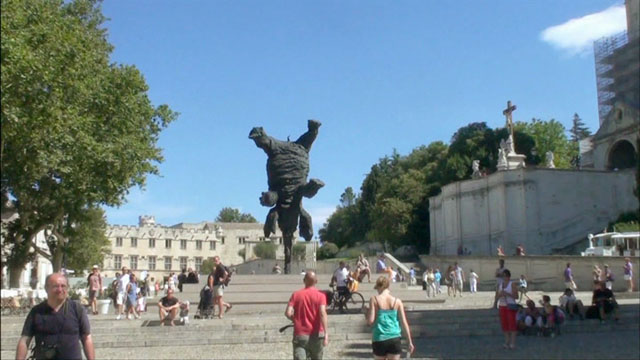
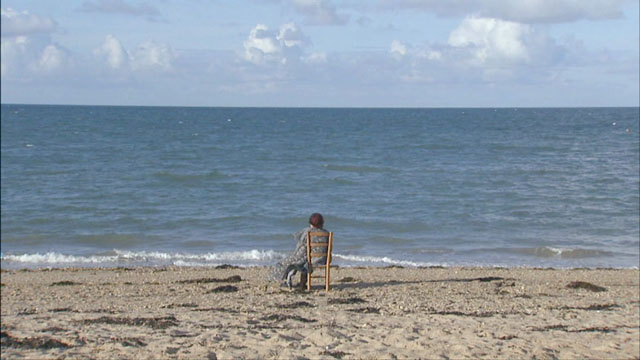
I found out about this due to the Greenaway short (also called Act of God, also about people’s experiences with lightning) included on the DVD, then was intrigued to discover that the feature is Baichwal’s follow-up to the great Manufactured Landscapes. Landscapes got to piggyback off its photographer subject’s artworks and visual ideas. This one is an interview documentary, so Baichwal and her cinematographer/husband were on their own to create meaningful enough images to justify the film, and I think they succeeded. And the storytelling definitely succeeded. I’ve never been afraid of lightning before, and now it’s all I think about.

A man in Ontario tells of a camping trip years ago, everyone stunned and scattered by a lightning strike, one kid had his insides burned right out. A man in France who won’t show himself on camera built a museum of lightning-struck objects. An ex-soldier in Vegas had his life changed by a strike through the telephone, opened a clinic for dying veterans. Three kids killed and others injured from a hilltop strike in Mexico. And, connecting these stories of powerful electricity hitting the human body, musician Fred Frith improvs while being hooked to brainwave machines, measuring the electrical impulses he uses when creating. He invents some wonderful storm-music at the end. Baichwal and husband filmed most of the lightning in the movie (and there’s a ton of it), set out to make a film about randomness and meaning, hence the Frith bookends.

Act of God (1980, Peter Greenaway)

Baichwal said she tried cross-cutting between segments but it didn’t work, so she lets each story stand on its own. Greenaway, of course, does not – he breaks up the questions and lightning-strike descriptions into categories (time of day/year, height of subject, etc), sorts them, and interrupts with bursts of Michael Nyman music. He’s also less natururalistic, arranging interview subjects into amusing compositions, including one person struck through the phone line who tells her story through a handset. Unless IMDB is messing with me, his DP later directed Surf Nazis Must Die. The short makes efficient use of its 25 minutes, but it wouldn’t have made much of an impact had I not watched the longer, calmly frightening feature beforehand.

The Loneliness of the Long-Distance Singer (1974, Chris Marker)

It’s not a short (an hour long), but I have little to say about it, so this is a short entry. The movie’s probably of more interest to fans of Yves Montand’s singing career than of Marker’s filmmaking or their shared politics. Marker focuses on Montand’s rehearsals for an upcoming concert benefitting Chilean refugees and he cuts to clips from the concert itself, and clips from Montand’s political films (Z, The Confession, The War Is Over).

Shot by the IMDB-credited Pierre Lhomme (Mr. Freedom, Army of Shadows) as well as Jacques Renard (Celine & Julie Go Boating) and Yann Le Masson. A nicely put-together little movie, but more like your standard fly-on-wall doc mixed with a celebrity personality piece than Marker’s usual style. Montand is passionate about the details, but it’s not my kind of music so I’m not sure what he’s going for. M. Legrand was involved somehow.

Some dude on the sidelines sports a Flo & Eddie shirt:

Lady Blue Shanghai (2010, David Lynch)

Plays like a total Inland Empire outtake (or Darkened Room 2). A confused Marion Cotillard calls security on an expensive handbag (the short was commissioned as a handbag advertisement) found in her room. She grabs it and half-remembers some alternate-existence romantic rooftop chase scene, featuring herself, an attractive man from Shanghai, and an expensive handbag.

My Wrongs 8245-8249 and 117 (2002, Chris Morris)

An unstable Paddy Considine is left in charge of the dog, but can’t manage it. Dog dies, Paddy ends up at the pond screaming at ducks. Nice Warp-sounding music from the director. I enjoyed it.

Mermaid (1964, Osamu Tezuka)

Katy likes when I show her movies I haven’t already watched, then criticizes this one for being depressing and My Wrongs for being unfunny. None of Tezuka’s shorts have been sad before (well, Male has a murder scene), so how was I to know? A re-run of Haanstra’s Glas was better-received. This one’s a 1984/freedom-of-thought parable about a boy who catches a fish and imagines its a mermaid, until the thought police imprison him and try to brainwash away his imagination so he’ll see the fish as a fish. Naturally it ends with the boy freeing his fish and either becoming a merman or drowning himself.

The Uneasy Three (1925, Leo McCarey)

A Hal Roach short starring Charley Chase as a wannabe thief who, with his girl and her brother, pretends to be a musical trio to gain entry to a high-society party and steal a valuable brooch. That’s such a generic-sounding description that now I can’t recall if I wrote it or I copy/pasted it from somewhere. Anyway, they successfully fake being musician/entertainers and frame the real musicians for the crime.

Bull Montana, harpist:

Winston Tong en studio (1984, Olivier Assayas)

A studio recording of a silly-sounding song. I missed the vocalist’s interview in French, but enjoyed Jah Wobble’s rant against commercialism. Also liked the filmmakers’ sound mix, keeping bits of the last take in the mix over the interview, dialing up and down the backing music while Tong is singing. Besides Assayas it’s got Nicolas Klotz (La Blessure, La Question Humaine) editing.

Hokusai: An Animated Sketchbook (1978, Tony White)

Tony, an assistant on Richard Williams’ A Christmas Carol brings acclaimed Japanese woodcut artist Hokusai’s drawings wonderfully to life for a five-minute short. Not having any previous Hokusai exposure myself, I can’t tell which drawings are his and which are interpreted by White. Teshigahara had also made a short doc on Hokusai, and a few years after this Kaneto Shindo would make a feature with the great English-language title Edo Porn.

Endangered Species (2006, Tony White)

I found Tony’s other short on YouTube – a eulogy for the lost art of hand-drawn animation, made in collaboration with Roy Disney. So ol’ Walt is championed at the expense of his competitors at Warner Bros. Also parodied: Roger Rabbit, Fritz the Cat, Beavis & Butthead, artistic diversity, and corporations that would cruelly try to control independent animators and diminish their freedom. Seems weird that a pro-Disney film would be against huge companies. Seems to have mixed feelings about Pixar, and tags Hayao Miyazaki as animation’s hope for the future.

I watched this and The Naked Spur building up to Emory’s 35mm screening of Mann’s T-Men, which I then missed. Oh well. These were excellent, so I’ll have to catch up with T-Men and the others eventually.

A perhaps less-wooden-than-usual Gary Cooper gets a train ticket, is asked his name and destination by two different people and gives them different answers. So we know something is up (turns out he’s a still-wanted ex-badman). But Gary has reformed, is now the inordinately earnest Gary we all know and love, so he’s not lying to talky card-shark Arthur O’Connell when he says he’s headed to Fort Worth with cash raised by an entire town to hire a schoolteacher. Arthur introduces him to saloon singer Julie London, says she’d make a fine teacher, but then the train is robbed, Gary’s money is stolen, and Gary, Julie and Arthur find themselves on foot.

Julie and Arthur in happier times:

Fortunately, this all took place a short walk away from Gary’s old hideout, where his half-crazy uncle Lee Cobb (baddie of Thieves’ Highway) still reigns over a crude bunch of dangerous dimwits, including Gary’s real asshole cousin Jack Lord. Gary is treated as a prisoner/possible-accomplice, Julie as a sex slave, and Arthur is finally just shot (so is Jack Lord).

Cooper, trapped by Lord (left) and Dano:

Gary talks his way into helping with a bank heist, but mute Royal Dano (the Kid’s henchman in Johnny Guitar, later Gramps in House II) comes along and gets himself killed – so now Gary’s got to pick off the rest of the gang as they come for him (that’d be John Dehner, who played Pat Garrett to Paul Newman’s Kid the same year, and Robert Wilke, the foreman in Days of Heaven) before facing off against his uncle Cobb, who I’m surprised was able to leave the house and ride into town.

Cooper vs. Cobb:

Gary’s got his money back, and rides off with Julie London. But besides the money and the schoolteacher plan, Gary was also not lying about having a wife and kids back home. So they can’t be together, but Julie says she’s happy with the unrequited thing, and they get their unique doomed-romance version of the ride-into-sunset.

J. Rosenbaum:

Man of the West is shot in CinemaScope, yet it’s initially hampered by the shallow dramatic space associated with television. This effect is made worse by the casting, which pairs the stagiest of stage actors (Cobb) with the most cinematic of movie actors (Cooper). But Mann is canny enough to turn these limitations to his advantage whenever he can, offering sly notations about Link’s physical discomfort on the train and using a long, tense scene inside the farmhouse to create claustrophobia before sending the characters outdoors for virtually the remainder of the picture. Once again, the hero is a dialectical contradiction, both regressing toward an unbearable past and making an anguished effort to break free from it — the struggle ultimately engendering hatred, violence, pain, and humiliation, and revealing boundless evil.

Royal Dano vs. the ghost town:

Another Brendan Gleeson action/comedy written/directed by a man named McDonagh – but this isn’t the guy who made In Bruges, it’s his brother. You see how that could be confusing.

There’s a serial killer on the loose, perhaps, and Gleeson is the local cop on the scene. Or it’s a drug crew faking the serial-killer thing to throw people off their scent. A young cop disappears and his wife is bugging Gleeson to find him. And FBI agent Don Cheadle (his character is from Atlanta, yay) shows up but finds his fancy training is no match for Gleeson’s down-homey knowledge and instincts. Also, Gleeson is a huge racist and thief, but that’s all played for laughs.

Our mismatched team takes on the druggies (incl. Liam Cunningham, priest in the super long-shot of Hunger, and Mark Strong, dude who lives in a trailer for most of Tinker Tailor) by themselves at the end. Gleeson blows up. Or he swims away with a half-billion in cash, depending who you believe. Anyway, it’s a diverting-enough picture, but my favorite bit was an excerpt from The Shout, which Gleeson sits at home watching between murders.

Valentine’s Day screening with Katy (who liked it more than I did, but has issues with Owen Wilson) ends my 8-year ban on Woody’s new films since his Melinda & Melinda was so awful. Owen is about to marry irredeemably bitchy Rachel McAdams (potentially of the next Terrence Malick movie), so they’re vacationing in Paris with her condescending/republican parents (Kurt Fuller: Karl Rove in That’s My Bush! and Mimi Kennedy: the anti-war diplomat trying to wrestle into the war meeting of In The Loop, also of the Mr. Boogedy movies).

Owen is an annoyingly self-effacing frustrated novelist (but not so self-effacing that he doesn’t push people he’s just met into reading his manuscript) and a lover of old-fashioned things. At the titular magic hour/location he finds himself in his ideal 1920’s, mingling with Zelda Fitzgerald (Alison Pill: Scott Pilgrim‘s girlfriend), Salvador Dali (Adrien Brody, wonderful), Gertrude Stein (Kathy Bates) and fifty others. Each time Owen manages to stammer out their name and indicate that it’s an honor to meet them, then the famous character gets a couple lines before we’re whisked away to another famous character. Owen also meets non-famous Marion Cotillard, who dreams of an even earlier time, and then that ol’ Paris magic whisks her and Owen back to a pub in the 1880’s or 90’s where she meets her own art heroes (Toulouse-Lautrec, Gauguin and Degas) – who dream of an even earlier golden age. This was my favorite bit, where the movie seems to mock Owen and its own nostalgic premise. Marion opts to stay in her ideal past, but Owen returns to his present, dumps his wife (she was sleeping with Michael Sheen anyway), and picks up tour guide Lea Seydoux (baddie who shoots Paula Patton’s boyfriend in Mission Impossible 4).

A “symphony of the Donbass” (region of eastern Ukraine known for coal mining) which aims to celebrate sound recording in film, but still has almost no noticeably-synched sound. I assumed this would be a part-talkie follow-up to Man with the Movie Camera, and it has moments of MwtMC-style montage, but mostly it’s dreary and impersonal (compared to Earth, which I just watched, anyway) propaganda for “shock workers,” which are workers who aim to overachieve their quotas in exchange for glory and prizes.

Before it gets bogged with with shock workers, the first half of the film, cutting between a woman listening to headphones and the reorganization of Russia (churches are torn down, replaced by angular Stalin statues) during the “five-year plan”, is exciting.

Grunes:

Amidst a cacophony of toot-tooting, static, chug-chugging and ding-a-linging, we are told this: “The country needs coal.” Vertov, in a highly fragmented fashion, aims at an integrative view of the interdependency of elements of Soviet productivity. Coal-mining provides energy; factories, combining machine- and human labor, provide steel and manufactured farm equipment; the latter, fueled by coal and operated by farmers, thresh a harvest of wheat. The railroad is shown as connective tissue, transporting mined coal to the factories and, from the factories, whatever is needed in rural areas. Railroad tracks are the new order’s bloodstream. Captions and narration assist in portraying workers at whatever point in this joint process as aggressive warriors and heroic figures.

A tidbit from J. Jacques: “Vertov himself placed massive emphasis upon Enthusiasm’s sound. Western screenings were notorious for Vertov’s insistence on raising the soundtrack to intolerable levels, having blocked the exits to prevent escape.”

from Senses:

After returning from glory abroad with his Man with a Movie Camera, Vertov undertook a suicidal double challenge – to make a political film that would both show (with image and montage) and song (with sound taken from nature and machine) the heroic, dramatic struggles of the state to industrialize at any cost – while pioneering the use of untested sound recording in the field. The finished film, Enthusiasm, was received with derision and incomprehension.

CJ Chamberlin, author of the above, has an outstandingly long, detailed and thoughtful article which would take as long to read as the movie did to watch, so I skimmed and grabbed a few parts.

Vertov was both a genius and a willing creature and subject of a totalitarian ideology. Whatever he was, Vertov never was that ambivalent about the price to be paid in blood and skulls for world socialism. And the Ukraine bore more than its fair share of the price: factory slave labour, brutal collectivisation and the terror famine. By any rational standard, his Donbass Symphony (the alternate title of Enthusiasm) should be an infamous film. If I were Ukrainian, I would burn the negative and sprinkle the ashes with holy water.

“Are you dying, Semion?”
“Yes, I’m dying, Petro.”
“Well, die then.”

From the very beginning – alternate shots of farmland, each time taking up more of the camera’s field of vision, the horizon getting higher until the earth covers the whole frame – which follows to this exchange by two old men, I was captured by the movie. But, reading the below description, I realize I wasn’t following its story closely enough. As usual with these revolutionary Russian silent films, knowledge of the history is important, and I come bearing none at all.

M. Sicinski:

This final scene takes place just as the funeral of Vasyl, the slain Bolshevik, evolves into a fervent demonstration extolling the Communism for which young Vasyl died. Even Vasyl’s father, who had up to this point been skeptical about Communism’s plan to collectivize the farmlands, joins the struggle. But the kulaks, the landowning peasant class from whom the farms are being expropriated, are going down swinging. Khoma Bilokon (Pyotr Masokha), the eldest son of the area’s dominant kulak family, has already committed murder, having shot Vasyl in the back. Khoma confesses, but Earth is not a crime procedural, and Dovzhenko’s final scene is both politically sharp and poetically evocative.
Using an odd form of cross-cutting that makes Khoma’s spatial relationship to the funeral extremely ambiguous, Dovzhenko moves us between the guilty individual and the burgeoning collective, the past and the future. Khoma shouts out to the mourners that he shot Vasyl, in the back, under cover of night. The crowd completely ignores him. Hysterical, Khoma exclaims that the land belongs to him, and he even goes so far as to plant his head in the dirt and run in circles. However, both within the diegetic world of the film and within Dovzhenko’s cinematic syntax, Khoma and the kulak class are marginal, almost nonexistent. Although this image is compromised by the truth that Dovzhenko cannot depict – that of Stalin’s mass extermination of the kulaks – its representation of what it feels like when history passes you by remains unequalled.

Introducing the kulaks with my favorite edit in the film:

So it didnt bother me while watching that I don’t know what a kulak is. I got that Vasyl (Vasili in the subtitles) is excited about technology, that he plows an entire field (which did not belong to him) with the town’s brand-new tractor and is killed for it. The black-bearded man from that early scene in which Semion was dying is apparently Vasyl’s father Opanas, goes asking the townspeople who killed his son and comes across a priest.

Uncle Opanas gets intense:

“There is no god. And there are no priests either.” (the priest lowers his head) “Just like Vasili died for the new life, I’m asking you to bury him according to the new ways, neither priests nor church servants beyond the grave.” It’s an intense thing to say before a priest, and in a movie that opens with discussion of the afterlife between the elders. Vasyl’s sister or wife or somebody goes naked and crazy as he’s buried near the sunflowers, and one of V’s comrades gives a comforting speech to Uncle Opanas and everybody, as the kulak Khoma dances in the graveyard trying in vain to attract attention to himself.

Great, tense western thriller with just a few (white) characters and an unusual philosophical ending. “He’s not dead if you take him back. He’ll never be dead for you.” Shot by William Mellor (Giant) in academy-ratio color. I noticed some cool secret-revealing camera moves – from a quick one during the opening titles to a slow traveling shot later on showing a guy hiding behind a rock. Overall great performances except that I wished Jesse Tate had been played by Rio Bravo‘s Walter Brennan – Millard’s voice wasn’t quite right.

Jimmy:

Jimmy Stewart (the year before Rear Window) comes at friendly ol’ prospector Jesse (Millard Mitchell of Thieves’ Highway and Winchester ’73), says he’s looking for lawman-slayer Robert Ryan. Jesse hasn’t seen Ryan since Clash By Night, so offers his assistance. In wanders Kiss Me Deadly star Ralph Meeker as a disgraced ex-soldier, and between them, the men take down Robert Ryan over the protest of his gal Janet Leigh (four years after Holiday Affair).

Everyone but Jimmy:

But Ryan pretty easily turns the men against each other by revealing that he’s got quite a bounty on his head, and Stewart is after him for the money, not as a lawman. This works better than Janet Leigh’s appeals that poor Ryan is innocent – and if we’d ever considered believing her, Ryan loses all sympathy when he wears down the men to the point that he’s allowed to escape, then he shoots ol’ Jesse. Meeker goes down next, but takes Ryan with him, and Stewart recovers the body. But apparently Janet Leigh can make a man fall in love with her pretty much instantly, so…

B. Lucas:

Howard drags Ben’s body to his horse in a final paroxysm of fury, but then turns to Lina and sees in her face the light of unconditional love and a new beginning, and at last relents. The tears and cracking voice of Stewart in close shot are a high moment of this great actor’s career, perfectly complemented by the softer yet no less vibrant playing of Leigh. . . As the camera moves up into the sky, then follows a dissolve to come back to the two characters moving through dead trees within an open expanse, one sees in these images that there is a spiritual rhythm within life, and that “choosing a way to live” can happen even in the roughest passage.

Another look at the face that turned Jimmy’s life around:

Bonus: lots of Indian-slaying and horse-injuring action when Meeker declares war on a passing tribe, and some Jimmy Stewart backstory, narrated to Leigh while he’s injured and raving. Jimmy uses his spur to help climb a cliff at the end (then throws it in Robert Ryan’s face), which I guess is where the weird title came from.

Dance doc based on the choreography of Pina Bausch, who died unexpectedly a week before filming was to begin. It ends up feeling like a memorial instead, the dance scenes interspersed with non-synched voiceover/closeup segments with each major dancer saying something about Pina.

Katy wanted more narrative and background, but the movie is purely interested in the dances, which are outstanding and look awesome in 3D. Highlights: “Cafe Muller,” in which Pina runs across a room full of chairs while a guy quickly clears her path, a couple climbing through chairs while a third guy precariously stacks them (Pina was into chairs), a solo sadness ballet at an empty factory, a rainy moon-rock scene with gondola-like floor slides, and dances in active locations (by a busy street, on a monorail).