Criticwire posted a great roundup of their favorite film criticism of the year. The only one I’d already read was Lili Loofbourow on Brave. I’m missing all the good articles on new films because they’re published when the movie opens then forgotten when I get around to seeing it a month later – need to start bookmarking interesting-looking articles and catching up on weekly sites. Then again, I have a job, and can’t be reading every article on the internet, so maybe the end-of-year roundup is where I’ll leave it.

Sheila O’Malley on Once Upon a Time in Anatolia:
She opens with a phrase I’ve never liked, calling Anatolia “the main character in the film,” but then she actually backs that up with great evidence, giving the film new dimensions.

Glenn Kenny on Cosmopolis: “the story of watching the end of the world from inside your clean room of a limo while you’re also causing that end. … [Cronenberg] examines irrationality with the unflinching precision of a diamond cutter, and the results are as hilarious as they are shocking.”

I liked The Master alright but dismissed its #1 placement on all the year-end lists because its story never seemed to end up anywhere, but now I’m reconsidering its value after reading this in the AV Club: “Phoenix’s performance calls to mind James Dean and the other Method actors who transformed the tone of movies in the ’50s. The era The Master covers, from roughly 1945 to 1952, was a tumultuous one in American culture. It was the age of film noir and psychological realism, but also a time when the suburban placidity for which the ’50s is remembered took root. All of that looms in Anderson’s movie, which deals with human impulses that run counter to the clean, composed America the corporate PR machine was selling.”

The next day I read Kent Jones’ The Master review in Film Comment, where he expands on this idea significantly.

With There Will Be Blood, he unveiled a genuine and immersive fascination with American history: every detail and choice resulted from a dogged pursuit of what it felt like to live in a lonely world of earth, stone, wood, and metal. Anderson drops us into times and places with their own rules and social structures, which we are invited to puzzle out, imparted through a careful deployment of settings, physical stances, and vocal timbres. In The Master, we are plummeted into the humming world of mid-century urban America, with its top-down organization of class, its smoothly managed department stores and amateur musicales in turn-of-the century mansions, its intimations of orgiastic abandon behind closed doors, its peculiar notions of the unconventional. It’s a moment at which the lowly sociopath and the genteel society matron are both in search of a liberator, who may or may not have arrived in the form of “theoretical philosopher” desperate to gain a foothold in an increasingly competitive landscape.

Matt Singer wrote an article about film franchises using The Simpsons’ Itchy & Scratchy & Poochie Show as a framework, hilarious.

David Cairns on The Hobbit:
“Maybe Jackson should have shot at 24 and projected at 48, thereby making the film half as long?”

from patheos.com on Holy Motors:
“It makes you wonder if the green-screen work for Avatar might be more compelling than the final animated production.”

Cairns again:
“I’m told that McKellen had to act his scene at the dinner table with a bunch of paper cut-out heads on sticks, with light bulbs that flashed on to signal when each character was speaking so he could look in the right direction. I would, on the whole, far rather see that version of the scene.”

Of course his Shadowplay blog and David Hudson’s Keyframe Daily are currently the only film sites I read daily, following links from within when needed. I’ve come up with a list of ten more to check weekly – we’ll see how long that lasts.

Things I didn’t read: what anyone thought of the new Batman movie or the Sight & Sound list, any conversations on whether movies/film/digital are dead or dying. But despite its “film is dead”-sounding title, I greatly enjoyed Dave Kehr’s book of movie reviews, When Movies Mattered, and I’m currently enjoying J. Hoberman’s slightly more optimistically-titled Film After Film.

I’d heard that A.W. had gone horror with this new mid-length film. Not really – it’s a slow-moving movie where a few hotel residents coexist with flesh-eating ghosts, or perhaps everyone in the movie is a ghost since the hotel feels abandoned, even when they are around. I found it overall less exciting/entrancing than his other movies.

Featuring Jen and Tong from Uncle Boonmee, with more talk of borders and immigrants, and discussion of last year’s major flooding in Thailand. I like the music, a long stretch of solo acoustic guitar. We see the musician at the beginning, and again near the middle (an intermission?). A.W. seems to want scenes to last after their meaningful dialogue has ended, because he’ll fade out conversations and let us listen to the guitar for a minute while the actors keep talking, unheard.

When the movie seems to have a story near the beginning, Tong (yes, same character name) is telling a girl called Phon that his dog seems to have been partly devoured by a pob (ghost). Phon and her mom Jen are revealed to be pobs. A guy named Masato sees his friend eaten by Jen, but he might have been dreaming this.

Later, Masato is a ghost himself, talking to Phon as if a lifetime has passed since the previous few scenes – then he’s wearing a machine on his head that allows his spirit to travel outside his body. It ends with an overlong shot of jet-skis on the river. I’m missing something major since this was nominated for a “best documentary” award.

AW with the guitarist, giving credence to the documentary theory:

E. Kohn:

According to the director, Mekong Hotel takes its inspiration from a story Weerasethakul originally wrote for a movie called Ecstasy Garden… [which] involved an alien vampire ghost who also happens to be the mother of a young woman unaware of her supernatural lineage… the mother’s appetite gets the best of her and she devours her kin in the midst of the younger woman’s romancing of a local teen boy. Mekong Hotel sort of follows this trajectory without exactly spelling it out; The movie contains scenes of rehearsals for Ecstasy Garden in the bedrooms and balcony of the titular hotel in northeastern Thailand.

Immediately reminiscent of early Spike Lee movies in style. Weirdo comedy from Cameroon. I didn’t follow all of the plot threads, but would have followed even less had we not read up on the movie ahead of time. The characters all helpfully introduce themselves to camera at the beginning, but there may be subtitle problems (“Call me GOOD FOR IS DEAD”). Somewhere in this jazzy intro, a young woman called Queen of the Hood apparently expresses a desire to experience life as a man, and so Mama Thecla transforms her into “Myguy” in a scene reminiscent of The Terminator (Myguy appears naked inside a fog-blanketed truck).

Myguy starts dating Saturday, the sheltered daughter of hard-ass local boss Mad Dog. I lost track of a couple other characters, but Mama Thecla had also transformed herself into Panka, a man who can cause other men’s penises to disappear with a handshake. She does this apparently for the hell of it, and it’s treated more as a hilarious prank than a source of terror in the community. After Saturday falls in love with Myguy, he meets Panka again and they transform back into their female selves. No word on where this leaves poor Saturday or the local men’s disappeared genitals. Audio commentary on the DVD would definitely be interesting, but alas, it’s in French.

Acquarello:

[Panka] becomes My Guy’s guide and protector to the social and sexual politics of the quarter: a self-made man who reinforces his stature by taking on a second wife, the subtle inculcation of Christianity into daily life, even as the people continue to practice traditional – often conflicting – customs, the marginalized role and maltreatment of women that sharply contrasts with their real roles as family nurturers and community builders (and, as in the case of Mad Dog’s exiled first wife, literally feeds society when she sets up a vending stand near a high traffic street). As in [Spike] Lee’s films, Bekolo uses archetypal characters, informal fourth wall address, jaunty camerawork, and integral incorporation of pop music to illustrate the paradox of social and gender inequity and anachronism of contemporary life in post-colonial Cameroon.

Katy liked that it referenced American culture (Denzel Washington, Michael Jackson’s African influences) and America’s view of Africa (starving children).

Or, Django Chained… and raped and tortured, branded, starved and left for the vultures, raped some more, and whipped and whipped and whipped.

A desperately unpleasant slavery movie with a slight framing story (present-day photo model shooting on a historic slavery site gets sent back in time by a meddling drummer named Sankofa to experience slavery). At least it has a happy ending, as the remaining slaves (after some are killed or sold) attack their masters with machetes. It’s all very well-shot for an indie movie, and the actors are playing their hearts out. But Gerima is trying to make an Important Statement Here, and so the story becomes a humorless exercise in tedium.

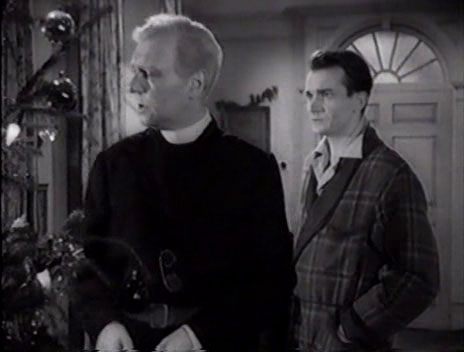
The Holly and the Ivy (1952, George More O’Ferrall)

A typical holiday family-crisis movie (see also: A Christmas Tale). Bulb-nosed Ralph Richardson (lead butler in The Fallen Idol) is a parson who doesn’t realize his whole family has come to resent him. They trade family secrets amongst themselves, then finally tell off the old man, causing him to proclaim that he’s wasted his life. Merry Christmas!

Ralph and Denholm:

Daughter Jenny (Celia Johnson, star of Brief Encounter) lives at home wishing she was free to marry her (apparently Christmas-hating) boyfriend David and move to South America. Daughter Margaret (Margaret Leighton of The Elusive Pimpernel and Under Capricorn) is a bitter drunk because her secret out-of-wedlock baby died earlier that year. She has towed along some relative named Richard (Hugh Williams of One of Our Aircraft is Missing) – never figured out what his deal was. Michael (a very young Denholm Elliott) is on leave from the military, meddling in his siblings’ affairs, and two aunts are around for comic relief and a teeny bit of wisdom: jolly Lydia and forbidding Bridget.

Celia and Margaret:

A Christmas Carol (1971, Richard Williams)

It’s just not Christmas until we watch some version of the Dickens story. This half-hour oscar-winner from renowned animator Williams (we just saw his work on Who Framed Roger Rabbit) is pretty excellent, with complex and impressive character animation. He recast Marley and Ebenezer from the movie Scrooge, which we watched two years ago, and added narrator Michael Redgrave. Marley is horrifying here, his jaw hanging open while he speaks, his coat-tails like tentacles behind him, and Christmas Past is a white flickering flame.

We also love Scrooge’s blue socks and yellow slippers:

Santa Claus Is Coming Tonight (1974, Pierre Hebert)

Opens with live-action footage of Santa descending by helicopter, the bulk of the movie is animated. A lonely old man full of Christmas spirit decorates his house for Santa’s arrival, while elsewhere an identical man working as a department-store Santa gets fired for stealing. Santa comes to the old man’s house and they party all night, then when Santa wakes up the old man is (I think) dead. Strange.

Sports Night season 1 (1998-99)

Good Aaron Sorkin show. Casey (Peter Krause of Six Feet Under) and darker-haired Dan (Josh Charles of Muppets From Space) are anchors of a sports show run by Felicity Huffman (of Transamerica and apparently Magnolia) and Robert Guillaume (Benson, Rafiki in The Lion King). Casey likes Felicity, who is engaged to Ted McGinley, and Dan likes Teri Polo (mom in The Hole), who is married. The only stable relationship is Felicity’s assistant Sabrina Lloyd (Harley’s The Girl From Monday) with new guy Joshua Malina (a Sorkin regular).

Asylum (1996)

Edgar Wright’s first series – and he has four others that I’ve never heard of between this and Spaced. Cowritten with the cast, overall uneven with a slim overarching story and characters that get tiresome if you watch the episodes too close together.

Simon Pegg is a pizza boy called to an asylum then imprisoned there. Jessica Stevenson plays the sadistic head nurse and a daytime-TV-addict inmate. Mighty Boosh star Julian Barratt is a talkative, pretentious artist (and the highlight of the show). Standup comic Adam Bloom is a Lenny Bruce obsessive, Paul Morocco a mute juggler, Norman Lovett (of Red Dwarf) the head doctor and Mick O’Connor (whose only other credit is The Falls) the receptionist. Each episode ends with a music video, which I kinda loved.

Big Train season 1 (1998)

Excellent sketch comedy show starring Simon Pegg (between Asylum and Spaced), Mark Heap (Brian in Spaced) and Kevin Eldon (a dim officer in Hot Fuzz), with Julia Davis (Nighty Night) and Amelia Bullmore (Jam and I’m Alan Partridge).

Weird to hear a Tortoise song scoring a fake TV ad in episode 3, and to see a parody of the intro to A Matter of Life and Death. Lots of animated (barely) footage of the staring-contest world finals.

Cowriters Arthur Mathews and Graham Linehan worked on The Fast Show, and with Christopher Morris on Jam and Brass Eye. Still need to watch Morris’s feature Four Lions

Arrested Development season 3 (2005-06)

So very good. I love how it ends with none of the characters having learned anything at all. Appearances by Justine Bateman, Judge Reinhold and a long section with Charlize Theron.

Scott Walker: 30 Century Man (2006)

Since I didn’t watch this with the release of The Drift like I was supposed to, I watched it with the release of his follow-up album. Wow. Some records I need to get: Night Flight, Climate of Hunter, the Ute Lemper album. Scott worked on Pola X so they show some behind-the-scenes bits of the warehouse performance and motorcycle crash.

The Pee-Wee Herman Show on Broadway (2011)

Apparently, Pee Wee is better remembered than revisited.

Also watched Maria Bamford‘s stand-up thing recorded at her house with no audience – weird and awesome. She’s got a new one with her parents as the audience, which sounds even better.

The Queen of Versailles (2012, Lauren Greenfield)

Katy watched on netflix in a couple installments – I think I was there for all of it, but not too sure. Belongs in the Movies I Only Sorta Watched category. Pretty fascinating, starting as a document of the loony mega-rich couple building the largest house in America, until the housing crisis delays their plans and threatens his timeshare business. Wonderful to see things from the 1% perspective, especially when they’re in what they consider to be desperate financial straits (though the wife has a five-shopping-cart trip to walmart and visits the warehouses where their extraneous crap is stored), repeatedly referring to themselves as normal people who got screwed by the banks.

Pictures at an Exhibition (2008)

Tour through a simple 3D computer gallery, stopping to view each of Marker’s mash-up portraits, some of which I’ve seen before in Immemory. Posted on Marker’s youtube page a few years ago. Gentle, repetitive piano music by Arvo Part. Probably named after the piano suite by Mussorgsky.

Silent Movie (1995)

Nine minutes of classical-Hollywood-evoking footage of a glamorously-lit, black-and-white Catherine Belkhodja, star of Level Five, first in motion smoking a cigarette in different poses, then as a series of stills. The stills of Catherine with eyes closed then open can’t help but evoke La Jetee. This was part of a video installation for the Wexner Center in Ohio, along with essays and photos and posters and more videos – “a highly personal response to the one-hundredth anniversary of the invention of cinema.”

I also rewatched We Maintain It Is Possible, and liked it better than last time, and the English version of Chats Perches.

“The owl is to the cat as the angel is to the man.”

Irrfan Khan is Pi, having a quiet day at home when an annoyingly Richard Dreyfuss-looking writer (Rafe Spall, one of the Andys in Hot Fuzz) shows up demanding to be told a story. So Pi starts at the beginning – he is named after a French swimming pool and lives with brother and parents (Tabu, who played Khan’s wife in The Namesake, is his mom) at a zoo, and is interested in religion.

One day the family packs up their zoo and heads off in a ship, which sinks in stormy waters, presumably killing Pi’s whole family. He finds himself on a lifeboat with an injured zebra, an orangutan, a rat, a hyena and a bengal tiger named Richard Parker, but the animals soon eat each other until it’s just Pi and the tiger. He fashions a raft so he can sleep without getting killed, but loses all his food and water due to a leaping whale. Formerly vegetarian, Pi learns to catch and eat fish. Boy and tiger stop on a “carnivorous island,” then get the hell out of there after loading up on edible roots. Finally, land and rescue, though Pi is sad that he never managed to connect with the tiger.

Rafe Spall thinks the whole thing is pretty far-fetched, so Pi gives another version of the story (told, not shown), where the lifeboat survivors were people, including Pi’s mother and a sadistic cook from the boat (Gerard Depardieu), then asks Rafe which story he prefers. The center of the film is just perfect – more colorful and awe-inspiring than a shipwreck story has any right to be.

G. Kenny:

But the frame story, in which an older Pi, a happily settled vegetarian living in Canada, tells his tale to a white male writer who in the credits is called “The Writer” is both a little cloying and forced and smacks a bit of, dare I say it, colonialist thought. I know that it’s a faithful adaptation from the book, and I know the book’s author is a white male writer, but I personally am just a wee bit tired of the convention in which a representative of The Other relates a tale of profundity to a white dude. Changing it up a little can’t hurt. Hell, a white woman would be less boring. I understand that second-guessing the artist is poor critical practice. But that fact remains that this convention, which was always pretty patronizing to begin with, has ossified into cliché, and the movie suffers for it.

It’s debutante season (Katy had to explain to me what that is) in Manhattan, so a group of friends home from college for the holidays get dressed up and hang out every night, mostly just the seven of them – but they pick up a “downwardly mobile” red-haired outsider named Tom early in the season and rope him into joining them for the whole two weeks of party games, dancing, jealousy and highly literate conversation.

Tom claims to be too much of a radical socialist to participate in such old-fashioned upper-class nonsense, but is easily enough convinced to buy a secondhand tuxedo and join in, especially when he finds out his ex-girlfriend Serena is a friend of the group. Molly Ringwald-looking Audrey crushes on Tom, while Charlie (a more intellectual Max Fischer) crushes on Audrey – as the others fade away over the second week, these three will remain from the core group.

Sally is the group’s host, who ends up with a gross record producer, Cynthia an easily-annoyed argument-baiter, Fred a tired guy who drinks too much then decides the group’s no fun anymore once he sobers up, and Nick the self-aggrandizing center of attention until he returns to school early. Nick’s at war with ladies’ man Rick who is currently dating Tom’s ex. Oh and there’s Jane, whom I already can’t remember.

After Tom hurts Audrey’s feelings pining after his ex, Audrey and Cynthia disappear to Rick’s house. Charlie and Tom are concerned enough for her welfare that they take a two-hour cab ride to rescue her. Audrey seems to be in no danger, but every girl likes to be rescued, so she goes with them, walking back to Manhattan talking vaguely about their futures. I kinda loved the movie, and especially the ending.

Beaten by Ghost for the screenplay oscar, Chameleon Street for best picture at sundance, and To Sleep With Anger (fair enough) for indy awards screenplay. Looks like half the cast appears in Last Days of Disco. Audrey (Carolyn Farina) was in The Age of Innocence as a relative (sister?) of Daniel Day-Lewis. Nick (Chris Eigeman) in a bunch of indie movies including Kicking and Screaming. Cynthia (Isabel Gillies) is billed just under David Lynch in the Nadja cast and Charlie (Taylor Nichols) appeared in Jurassic Park III.

L. Sante:

The dialogue is ostentatiously written; every character wields subordinate clauses and uses words like however and nevertheless. The combination of stilted speeches and deft behavioral acting sometimes seems peculiar, but it is also peculiarly apposite. Like Austen, Stillman wears his irony lightly and deploys it affectionately.

Urban haute bourgeoisie… is a term coined by Charlie, who is obsessed with the ongoing failure and imminent doom of his class. Stillman obviously thinks something of the sort himself—the movie’s title is subtle in its archly irrelevant grandeur, but you wonder if Twilight of the Gods didn’t cross his mind. (At one point, Tom’s bedside book is shown to be Oswald Spengler’s The Decline of the West.)

Speaking of the low-budget resourcefulness of the movie’s production, Sante says “a picture about the rites of passage of the urban haute bourgeoisie might be expected to appear as impeccably composed as The Earrings of Madame de…“. Having just watched that film, I thought of it in a different respect. At the beginning of both movies, as we’re being introduced to the characters I groan inwardly: not another movie that expects me to care about the minor problems of privileged rich people. At the end of Madame de… the minor problems have become major and I still don’t care (actually I came to respect General Charles Boyer somewhat), but Metropolitan made me love its overeducated rich-kid protagonists.