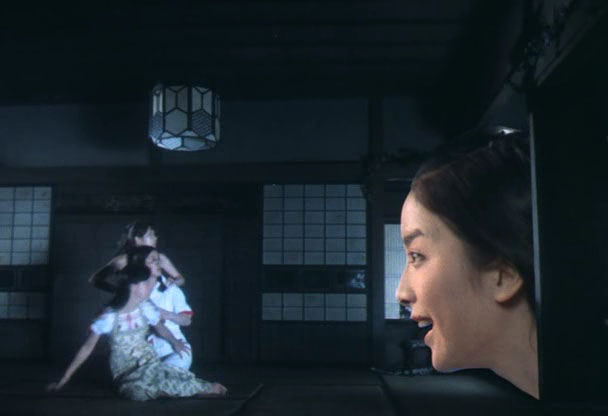
A vacationing Marianne and Nicolas visit the estate of long-idle painter Frenhofer and his wife Liz, where an unguarded look by Marianne gets Fren’s artistic urges raging once more. Nicolas tells Fren that Marianne will pose for a painting without asking M.’s permission first, but she comes anyway, with an angrily determined look on her face, to spite Nic. First few scenes when she goes naked in the studio are just astounding. Frenhofer goes about his work, setting up a drawing table, sketching some lines (Rivette, in his usual fashion, shows us the entire artistic process, omitting nothing for the sake of runtime), while M. has this incredible internal struggle visible on her face. It probably helps a lot that the film was shot in order, so the character and the actress become increasingly comfortable with her nudity as the audience does too.

image

Fren’s relationship with his wife Liz proves to be complicated. She was once his model, and the very painting he’s attempting to achieve with Marianne was once begun and abandoned with Liz. In her conversations with Fren and Marianne and Porbus the art dealer (with whom she once had an affair) and in her movements and her uneasy looks we get a wonderfully conflicted character. She’s never showy or artificial – the only one here who fits that description is Marianne’s boyfriend Nicolas, who grows increasingly absent. He comes back towards the end when his sister arrives to artificially force a closure to Nic and Marianne’s long limbo-vacation. Marianne, either dedicated to the painting or still stubbornly trying to prove her mettle, refuses. When she sees herself in the finished painting, sees what she’d been trying to hide while apparently so exposed, Frenhofer watches her expression, and what he sees convinces him to hide the painting forever behind a brick wall and stay up all night creating a substitute, a less powerful work which pleases Porbus and sickens Nicolas. I wonder if Frenhofer’s falling in love with Liz prevented him from ever finishing the painting a decade earlier, for fear of scaring her, or if his falling in love prevented him from being able to see that part of her which would enable him to finish it. Either way, a very satisfactory ending, the masterwork completed but Frenhofer, a greater man than Nicolas, hides it for the well-being of the two women.

Simply filmed, mostly in long takes in authentic locations. I mean, the shots aren’t Tarr-long, or even Rivette-long, just longer than most films – though there are authentically long insert-shots of sketches and drawings created from scratch before our eyes. I watched with headphones and found the sound of Fren’s pen scratching across his notepad to be almost unbearable. Rivette’s usual favorite sound effect of footsteps on a wooden floor can be muted when convenient, as when Liz comes into her husband’s studio and watches unnoticed.

Frenhofer = Michel Piccoli – Simon Cinema himself, of lots of films by Ruiz, Oliveira, Godard, Bunuel, Hitchcock, Varda, Demy, Resnais, Malle, Clouzot, and Mario Bava.
image

I just saw Emmanuelle Béart as Marie, and she’s been in two different movies called L’Enfer.
image

Jane Birkin was in Love on the Ground, Same Old Song, Kung-Fu Master, Keep Up Your Right and Blow-up.
image

Art dealer Porbus (right), Gilles Arbona was in similarly-titled La Belle Captive.
image

Nic’s sister Julienne, Marianne Denicourt (left with David Bursztein as Nic), later starred in Haut bas fragile and played Victor Hugo’s wife (?) in a French TV biopic of Balzac.
image

“And the hand of painter Bernard Dufour.”
image

Towards the end, when Frenhofer is through sketching and has started to paint, we see the first slash of red across a canvas. There’s more red during the next painting session, and when we glimpse the bottom of the “true” completed painting from under a sheet it’s mostly red). The false ringer painting is almost all light blue.

image

J. Heilman:

The film begins unassumingly in a hotel courtyard where we see a young man stealthily sketching some seemingly oblivious English-speaking tourists. As Rivette’s camera continues to pan, however, we find that our casual artist is actually the subject of another’s art. A woman on the hotel’s balcony furtively snaps a photo of him, but is noticed by sketcher, who becomes visibly irate. As soon as he confronts her, though, it becomes immediately apparent to us that most of this incident was a ruse. The two artists are lovers, and their coyness was entirely put on. Spurned by the excitement of their charade, they retire to the bedroom. The stunt even continues a bit farther than planned when one of the tourists watching this amorous French drama unfold says to another in mock culture shock, “Well, what do you expect?” This seemingly frivolous episode resonates throughout the rest of the film, since it manages to say much about the relationship between an artist and subject, the secretive, similar natures of art and love, and the need to sometimes create an environment where ever-fleeting inspiration might strike. It’s these themes that come to the fore during rest of the long journey that La Belle Noiseuse takes.

image

K. Uhlich in Slant, less reverential than most, says it “vacillates between genuine insight and didactic mystique-of-the-artist bullshit.”

Won the grand jury prize at Cannes, but didn’t have quite enough of that barton fink feeling to take the golden palm. Did not take the nation’s award shops by storm – lost the Cesar to some Gérard Depardieu flick, and wasn’t nominated for an Oscar or much else. But it did put Rivette’s name back into public circulation.

I watched two-hour edit Divertimento a couple months later.
“The hand of painter Bernard Dufour” barely appears in it!

Music by Igor Stravinsky, and the name Divertimento was stolen from the short version of one of his works. An in-joke for Stravinsky fans. That fits in with the Balzac references and the fact that the entire project was based on a joke, a flip fake answer Rivette would give when asked about his next project.

Jacques Rivette:
image

Wonderful 16mm screening at Emory, but not well-received by the students and regulars who came to be entertained. Silly students and regulars, it is not a university’s job to entertain you!

Scorpio Rising – 1964, Kenneth Anger
Couldn’t remember if I’d seen this before, but of course I have… opening credits bedazzled onto a motorcycle jacket were immediately familiar. Despite the nazi imagery and comparisons between bikers headed for a gay orgy and Jesus and his disciples, I heard no complaints. I think people enjoyed the juxtapositions (well-prepared presenter Andy warned us about ’em in advance) and grooved on the hot 60’s rock radio score (kept hearing “oh I love this song” from behind me).

Lemon – 1969, Hollis Frampton
Lovely film, second time I’ve seen it. Should be shown every year. Only comment overheard: “I don’t know about the second movie. Just a lemon.” Mostly people were quiet about this one. I choose to believe that they were awed into silence, contemplating its light play and imagining possible deeper meanings, and not quietly wondering what they needed to pick up at the grocery store. A movie can feel much longer or shorter than it is. Lemon is supposed to be seven or eight minutes long, but I say it feels like four, five tops.

Zorns Lemma – 1970, Hollis Frampton
(no apostrophe, in tribute to James Joyce’s Finnegans Wake)
Okay, this one feels its length… its exact length, measured second by second.
1) Black screen, voice reads us some children’s poetry, each line beginning with a successive letter of the Roman alphabet (so I=J and U=V) to make 24.
2) The meat of the piece, 24 seconds, one letter per section. First section we see each letter once. Then a word beginning with each letter. Then again (different shots, different words). Again. Again, but X has been replaced by a shaking, roaring fire. Again, with the fire. Again. Again. Again, but Z has been replaced by the ocean, flat horizon, a wave rolling out to sea. Again with the fire and the ocean. Again. 24 letters at 24 frames per second (though it’s 25 seconds if you consider that each alphabet section is followed by a second of black, a shout-out to our PAL-locked buds in Europe who see everything on video a little faster than we do). And on until, some 40 minutes later, each letter has been replaced (C was the last to go). No audio except the groaning and laughter of my fellow filmgoers.
3) Sound and Vision together! A visual cooling-down after part two, two people and their dog walk across a snowy field from bottom of the screen to top as six alternating female voices on the soundtrack read us some philosophical writings about light – at precisely one word per second.
4) The audience members (those who hadn’t walked out) were horrified!

D. Sallitt liked it:

The bizarre experience of taking a test during a movie was completely distracting, so that I absorbed the materiality and the narrativity of the alphabet images only indirectly, during brief rest periods. Somehow this strengthened my investment in the images: I don’t think I would have found the “letter H” guy’s walk around the corner very interesting in itself, but that corner took on mythic spatial qualities for me.

Hahaha, I know what he means about the corner. Of the little movies that replace each letter, seen in one-second increments, some stay pretty much the same (the fire, the tide) and some progress as time passes (someone peels and eats a tangerine, this guy walks towards a corner). Everyone breathes a little sigh of relief when, finally after a half hour, the man disappears around the corner in a one-second bit toward the end. Next bit is just the corner. Next one the man comes back around the corner! Must be considered one of the biggest twist endings in non-narrative avant-garde cinema.

excerpts from S. MacDonald:

Even a partial understanding of Frampton’s films requires a rudimentary sense of the history of mathematics, science, and technology and of the literary and fine arts. … Nowhere is Frampton’s assumption that his viewers can be expected to be informed, or to inform themselves, more obvious than in Zorns Lemma, the challenging film that established Frampton as a major contributor to alternative cinema. Zorns Lemma combines several areas of intellectual and esthetic interest Frampton had explored in his early photographic work and in his early films. His fascination with mathematics, and in particular with set theory … is the source of the title Zorns Lemma. Mathematician Max Zorn’s “lemma,” the eleventh axiom of set theory, proposes that, given a set of sets, there is a further set composed of a representative item from each set. Zorns Lemma doesn’t exactly demonstrate Zorn’s lemma, but Frampton’s allusion to the “existential axiom” is appropriate, given his use of a set of sets to structure the film. Frampton’s longtime interest in languages and literature is equally evident in Zorns Lemma. …

The tripartite structure of Zorns Lemma can be understood in various ways, at least two of them roughly suggestive of early film history. The progression from darkness, to individual onesecond units of imagery, to long, continuous shots. … If the second section of Zorns Lemma is Muybridgian – not only in its general use of the serial, but because the one-second bits of the replacement images “analyze” continuous activities or motions in a manner analogous to Muybridge’s motion studies – the final section is Lumieresque.

As set after set of alphabetized words and their environments is experienced, it is difficult not to develop a sense of Frampton’s experience making the film. The film’s collection of hundreds of environmental words suggests that the film was a labor of love, and an index of the filmmaker’s extended travels around lower Manhattan, looking for, finding, and recording the words.

For most viewers the experience of “learning” the correspondences is fatiguing – especially since the process of watching sixty shots a minute for more than forty-seven minutes is grueling by itself – but the laborious process has been willingly (if somewhat grudgingly) accepted. The experience of learning the correspondences is the central analogy of the second section. It replicates the experience of learning that set of terms and rules necessary for the exploration of any intellectual field.

In a philosophic sense, Grosseteste’s treatise [spoken during the third segment] is an attempt to understand the entirety of the perceivable world as an emblem of the spiritual. And, on the literal level, what Grosseteste describes in the eleventh century is demonstrated by the twentieth-century film image: For a filmmaker, after all, light is the “first bodily form,” which, literally, draws out “matter along with itself into a mass as great as the fabric of the world.”

Edit, one week later:
I unexpectedly got to see this again, in the theater in Nashville when Phantom Love was postponed. The festival guy described it as an “experimental documentary”, and that got most of the packed theater to walk out right there. A few more left immediately after the subtitled berry-mashing chant that opens the picture, and more shuffled out gradually until around the 1920’s there was only me and the two other people who stayed till the end. Movie makes me extremely happy, glad I saw it again. Was on video, though, so not real different from my home viewing, only larger.

——–
Apr 14:
I was nervous about this one, and wouldn’t have rushed to watch it if not for the Hidden in Plain Sight connection. On one hand, it made top-ten lists last year and was featured on the front cover of Cinema Scope, a magazine that hardly ever steers me wrong. On the other hand, it’s an hour-long narration-less tour of gravesites, which sounds less than exciting.

Cinema Scope was right. A moving, beautiful film which I now want to show to everybody I know. Peaceful and contemplative, with shots of trees and fields to break up the reading of gravestones and historial markers. The graves include people I know of (Frederick Douglass, Malcolm X, Emma Goldman, Paul Robeson), people I SHOULD know but don’t know very well (Mother Jones, Sacco & Vanzetti), people whose social relevance is explained by the text on the markers (the founder of the first all-female labor union) and people and events I was inspired to look up on wikipedia (Philip Berrigan: a pioneering Vietnam War protester, Lucretia Mott: women’s rights advocate in the 1800’s, The Ludlow Massacre, when the Colorado National Guard murdered the children of striking mine workers in 1914).

image

Felt good to watch, moving and energizing, not morbid despite the cemetery locales and mentions of massacres and executions. Shows these past people & events, triumphs and defeats, from today’s perspective, mostly a natural perspective with no living humans in the shot, but sometimes an Exxon will be seen across the street from a cemetery, cars will be whizzing by a historical sign, a marker will be located in the parking lot of a PetCo (!). Closes with some recent protest footage with lively editing. The struggle continues.

CScope: “In addition to forging a radical remapping of the American terrain, Gianvito’s film provides its audience with the rare opportunity to pay our respects by proxy.”

image

JG: After September 11, 2001, “I found myself re-reading stretches of Howard Zinn’s A People’s History of the United States, re-encountering some measure of what is admirable in this country’s past, the words and deeds of so many, known and unknown, who contributed to the historical struggle for a more just and egalitarian society. In time the idea took root to pay homage to this significant history, as well as to this book which continues to mean so much to so many of us, and by so doing, the hope was to draw sustenance from the sacrifices and efforts of those who came before us. Profit Motive and the Whispering Wind was intended to be a small poem to this progessive past.”

Only thing I’d seen before by Lelouch was his fairly conventional and lightly enjoyable entry in Chacun son cinema, which it turns out was good preparation for this fairly conventional and lightly enjoyable film.

A meta-thriller without too many thrills of its own. I would’ve been shocked if the eminently likeable Dominique Pinon turned out to be a psycho killer and slaughtered down-on-her-luck chainsmoking hairdresser Huguette, as the movie kept implying he would. I also would’ve been shocked if the top-billed Pinon whose character is a ghostwriter and a former magician had NOT been faking his own death at the end, and had actually been killed by famous author Judith Ralitzer (Fanny Ardant of some unseen Resnais and Truffaut films from the 80’s). Judith’s suicide at the end was surprising though, and seemed tonally out-of-place. There’s no evidence that Judith was a potentially-murderous monster (it’s only implied), but we’re not supposed to be upset when she is driven to suicide… I was, a little.

Pinon is on his way to a yachting trip with Judith but stops along the way to stalk Huguette who is dramatically dumped in front of him at a gas station. He waits all night to give her a ride – not because he is the escaped magician serial killer whom the radio keeps mentioning, but because he’s researching roles for “Judith’s” next novel. Takes H. to her rural home and pretends to be her boyfriend for the benefit of her family, then continues to the yacht two days late, proclaims that he’s done ghostwriting for Judith and that this will be his own “first” novel, writes the book onboard, “falls” overboard, hides out for a year, then returns Fury-style during police questioning, gets Judith to kill herself, then gives Huguette a big kiss. Why did he disappear? The book would sell tons more copies as a Judith novel than as a Dominique Pinon novel, and I guess by returning he gets all the royalties, though the movie conveniently ends before explaining that part. Also, in a cute side-plot, Dominique’s sister’s husband (never seen) leaves her and she falls in love with the police detective to whom she reports the crime.

The fun of the movie is its fooling around with thriller conventions, with Dominique alternately set up as the killer, the ghostwriter, and the sister’s missing husband. Pretty good looking film, but nothing amazing. Seems like the kind of slick, enjoyable, not-too-foreign movie that could run at the Landmark for a couple weeks.

Apr 2008:
——————-
Watched again with a very small, mildly unhappy audience. Oh how will I meet some fellow Rivette fanatics in my town if not at a public Celine & Julie screening? Love love love the last twenty minutes or so when they attack the fiction house, but the parts in the middle where they interfere in each other’s lives (Celine driving away Julie’s lover, Julie wrecking Celine’s job) are great fun also. Still don’t know what to make of Julie meeting her grandmother at the house next door to the fiction house.

Catching up with the cast: “Julie” had not-huge parts in Renoir and Fellini films, was recently in Ruiz’s Time Regained with La Belle noiseuse star Emmanuelle Béart. Marie-France Pisier played the dark-haired flower-fearing woman in the fiction house, also appeared in Time Regained, as well as Phantom of Liberty, Trans-Europ Express and got her start starring in Truffaut’s short Antoine & Collette.

Remembering the cat in the final shot, I paid attention to all the cats in the movie this time. Not much to say about that, though.

Feb 2007:
——————-
Incredible movie. Been thinking about it a lot. Lived up to expectations after I’d been wanting to see it for 6-7 years. Delightful to watch for all three of its hours, playful in every sense.

Dark-haired Celine meets red-head Julie, and they goof around for a long time, then…

James Crawford in Reverse Shot:

From the outset, Céline’s been on the run from a mysterious mansion with a gruesome secret. And so, just as the title predicts—in French, ‘aller en bateau,’ literally translated as ‘to go boating’ has a colloquial meaning of approximately ‘to get taken for a ride’ or ‘get caught up in a story’—Céline and Julie get wrapped up in discovering said secret.

The two take turns entering this house and comparing their experiences, trying to change the outcome and learn the secrets within. They mess with each other’s personal lives (jobs and friends), experiment with spells and legends and memory, and seem to never stop enjoying themselves. A big ol’ metaphor for movie watching, filmmaking, audience participation, getting caught up in the action. Out 1 is at the theater and Celine & Julie is at the movies.

Released the same year as another movie to blow my mind on video lately, Edvard Munch.

Will have to see this again and again.

Celine & Julie:
image

Feuillade-ing through town:
image

Bulle Ogier (Out 1’s Pauline/Emilie)
image

Director Barbet Schroeder as the guy in the fiction house:
image

The girl from the house, rescued:
image

Going boating:
image

aka Short Story, but I much prefer the above title. I even prefer the title to the movie itself, though the movie is pretty cool too. A two-minute loop of a four-minute scene, the first and second halves playing at the same time, with neat overlapping of color and audio. The scene was hard-subtitled (dialogue in Farsi), so even the subtitles overlap. Then the scene repeats, presumably about 10 times, though my downloaded copy broke after about six. I thought that was sufficient. The set looks like the Presents set, with that staginess and simple color washes.

image

Snow:

Writing about my films has sometimes discussed the ‘narrative’ aspect or ‘reading’ of some of my ‘pictorial’ nature, which is much more important. Reflecting on this, I realized that I have never wanted to make a purely narrative film, never had and therefore perhaps I should. Perhaps I should finally make a film that really tells a story. Thus ‘SSHTOORRTY’. … The film of the … scene was cut exactly in half and the two halves of sound and picture as super-imposed. This makes a simultaneity of actions that occurred ‘linearly’. Before and After become a Transparent Now. Arrival and Departure are united. It’s truly ‘filmic’, one transparent film over another.

image

Hooray, it’s the two year anniversary of my movie journal. I have now covered 807 films in 531 journal posts. Contemplation time!

———–
Some Things Change:

– I discovered keyword tagging! All the posts now have clickable keywords, and if you click on the title of a post, it will use these keywords to calculate which posts/movies are the most similar. Therefore I now know that The Fury is similar to The Savages and Sukiyaki Western Django is similar to Zazie dans le metro. I never could’ve drawn those connections on my own.

– I have three sometime-readers (up from last year’s one). That’s three more than I ever intended to have, but I’m still gonna leave the sucker online and searchable instead of taking it private, because I like the idea that if someone’s googling something obscure like Red Garters or Gran Casino or that episode of a cop show that Joe Dante directed, there’ll be something written online about it, even if it’s something snarky and uninformative and poorly written.

– People whose articles I quote can also find me on google and make me feel bad for having attacked their writing style, so I’m going with the first-initial last-name approach in my credits these days to avoid further embarrassment. I’m not obscuring the names of directors however, so I’m sure the filmmakers of yesterday’s experimental shorts entry will find and rebuke me soon enough.

———–
…And Some Stay The Same:

– I’m still way behind on all my viewing goals, but that’s because my viewing goals are still unachievable. I guess they’re technically achievable if I were to stop watching new releases and anything arbitrary, methodically viewing only films on my current must-see list. But that’d take all the fun out of everything, wouldn’t it?

– My writing hasn’t gotten any better, any more rigorous, any funnier. I haven’t improved at analyzing films or even analyzing my own reactions to films. As a “movie memory”, I am doing a fine job, blandly marking my reactions to every single movie I watch (except for Mystery Science Theater movies, which do not count). Since I never really intended to be a Famous Film Critic or a brilliant writer, I guess that’ll do fine.

– Still haven’t learned any French. Didn’t I mean to begin learning French two years ago?

– I am currently working through my thoughts on the “Finding Forrester effect”, especially after having just wasted my time on some Atlanta Film Festival screenings. Can’t eliminate risk entirely and only watch critically-proven films, but there must’ve been some way I could’ve known to avoid Fugitive Pieces.

———–
My most enjoyable posts from the past year:

There’s little record in the posts themselves of my week-long mailing-list argument over Charlie Wilson’s War vs. Twilight’s Last Gleaming, but it made a deep impression on me. I enjoyed watching The Story of Marie and Julien, writing about it, then reading some articles and having my whole perspective on the film change. My illustrated interpretation of Glory to the Filmmaker! was fun to assemble. Three
different
shorts programs were a blast to do, but time-consuming to get all the screenshots. Histoire(s) du cinema was a baffling adventure. Recently I had fun writing about Southland Tales than watching it. Also pleased with posts about Werckmeister Harmonies, Dog’s Dialogue and, since they are so exciting to watch and learn more about, the latest string of movies by Marker and Resnais.

An utterly boring and mediocre movie made by a Canadian TV director. Based on a novel, and I can tell. Seems like an adaptation, not as something conceived as a film. As a film it has no spark, life, reason to exist. Every scene is meticulously edited, ends exactly when you think it will end. All the actors seem capable (except maybe for the girl who played our hero’s first wife). Our hero looks a touch like Gabriel Byrne. Plot doesn’t matter, doesn’t matter, doesn’t matter. Memory and mementos, moving on with our lives after tragedy. Tragedy comes in the form of nazis. I hate nazis as much as the next guy but that doesn’t mean the movie gets off the hook for being so dull. I just wish I had watched Black Book for the third time instead.

World premiere of this doc, which will double-feature with Profit Motive and the Whispering Wind at Tribeca in a couple weeks, so I watched Profit Motive on video then ran out to see this one in the theater. Unfortunately, Hidden In Plain Sight was also on video, and looked considerably worse projected in the theater than Profit Motive looked on DVD on my laptop. Shot in 16mm and video (you can sometimes see interlacing, especially at the end), then the whole thing thrown into an ugly low-grade digital video mash. If this bothered the director (in attendance), he didn’t mention it, nor did he mention how the music seemed to skip every couple of seconds, so I have to assume these things were intentional. It’s a movie about looking and seeing. Street, somewhat pretentiously (and comparing himself to Godard and Vertov along the way) wants to teach us new ways to look at city scapes. Leaving the theater I was very happy that my city was full of natural light and color, non-interlaced, without any of the dull ambient music (seemingly ripped from last night’s “experimental” shorts) that plagued Hidden.

Street visits Dakar, Santiago, Marseilles and Hanoi, stands on street corners and films stuff. Just whatever. Then there’ll be some black and an intertitle with a quote or an organizational header, then more street corners. Sometimes sync sound, sometimes sound from elsewhere or ambient music or silence. I was content to be bored for the hour, but Street lost some goodwill when he talked some crap about how he enjoyed seeing San Francisco disfigured by the 1989 earthquake… then lost more when he tried to make a point about tourists seeing a wide view of the city, and locals seeing more narrowly, observing finer details. It’s actually a fine point, but he is a tourist, and his street-corner tourist-gaze is far from a local’s view of the city. Shooting stuff that tourists aren’t expected to shoot (walls, locals walking around, more walls) does not make one a local and I resent his attempt to educate the audience and show us “unique perspectives” via banal images. Gianvito’s Profit Motive (or Marker’s Sans Soleil, or Vertov’s Man with the Movie Camera, or Akerman’s From the Other Side) this ain’t.