Camille is home during WWI waiting for her man, and when he sends a letter telling her to stop writing, she cuts her hair short and sneaks out of town, hoping to blend in with soldiers while tracking him down. She joins an increasingly suspicious troop company – turns out they’re deserters heading to the Belgian border, and they have a habit of pulling out makeshift instruments and singing a continuing song about a blind girl. The men get sick and fall in holes and hide in caves, she helps by killing a lookout guard, she admits her name is Camille but they continue thinking she’s a boy, somehow.

I was right to think this would pair well with A Very Long Engagement. She is Sylvie Testud (in Vengeance, stars in La Captive) and her man, who appears at the end, is Guillaume Depardieu (the same year he was very good in Don’t Touch the Axe). A European Barn Owl can be seen – and heard – towards the end, which gains the movie an automatic half star, but it doesn’t need to kiss up to me with owls, I was already charmed. On letterboxd it looks like nobody loved this, so now I guess I’ve gotta see his other features, which nobody also loved.

This was the end of a successful Cannes Fortnight, in which I watched a bunch of movies I’d never seen by directors who had new work premiering at Cannes: Serge Bozon, the Dardennes, Claire Denis, Hlynur Pálmason, Cristian Mungiu, George Miller, Sergei Loznitsa, Jerzy Skolimowski, and David Cronenberg.

From Sammo Hung to Jeffrey Lau this week. After Eagle Shooting Heroes, Lau made a two-part Journey to the West with Stephen Chow called Chinese Odyssey, and a few years later, this movie has… no relation to that one – probably just a U.S. distrib capitalizing on name recognition. Heroes was produced by Wong Kar-wai, featured cast from Ashes of Time which was being shot at the same time, and jokey references to the Wong film, which ended up releasing later than the would-be parody because Wong spends years in the editing room. These two buddies have not learned their lesson, repeating the same trick here with 2046, which wouldn’t come out for two more years. Besides the Wong refs (also a Days of Being Wild joke, and people being precise numbers of meters apart) it’s got really good music, overall a snappy action-comedy.

Princess Faye Wong escapes the palace, in part by smashing through the gate with her head, pursued by Emperor Chang Chen. Meanwhile, Tony Leung is the most hated man in his small town, obstructing business to his beloved sister’s restaurant (she is Zhao Wei of Three and Red Cliff) while trying to find her a man. Each sibling couple falls for their counterpart, and it looks like things will work out until the Dowager Empress Rebecca Pan (Maggie’s landlady in ITMFL) denies the marriage to Tony, and Princess Faye goes mad. As usual in Chinese movies, everyone mistakes the two lovely women for men, but this goes even further, becomes a genuinely transsexual movie when Tony and the Princess swap roles at the end.

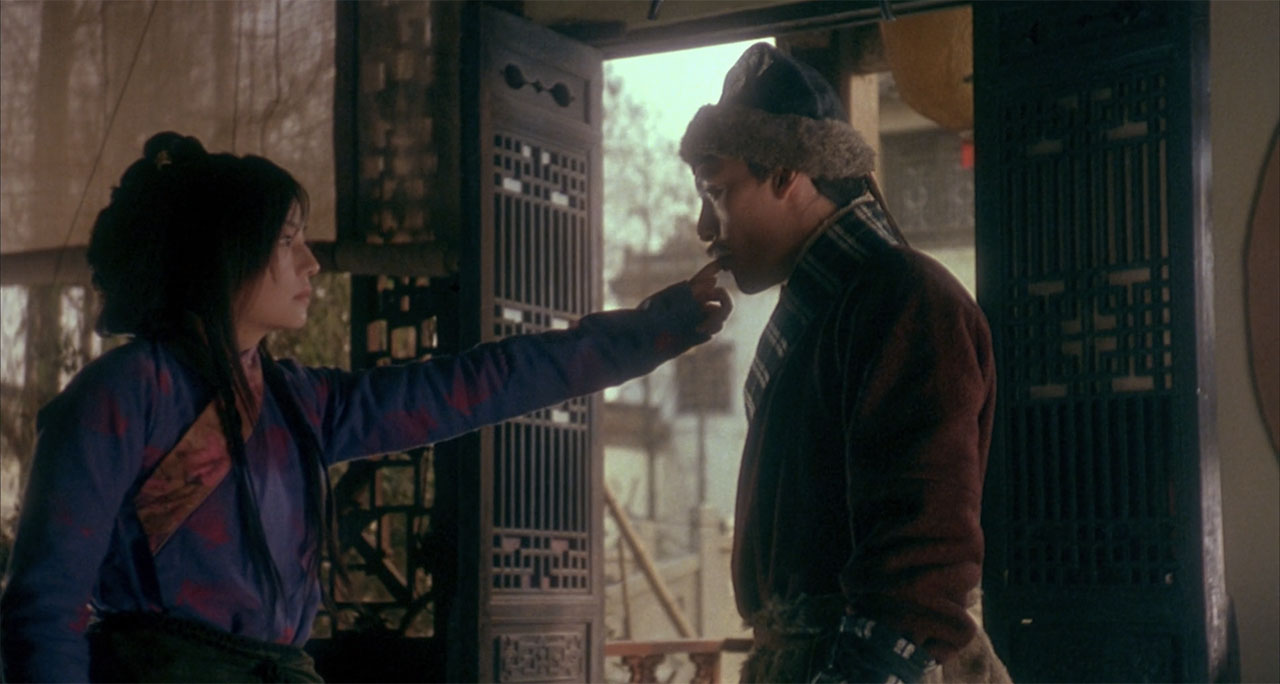
Chang and Zhao being weird:

Tony and Faye in trouble:

Hou is weirdly good at capturing technology in transition. Lead character Yoko has a cellphone in this, but there are pay phones around, and you could still call a bar and ask to speak with a customer. There’s also a minidisc recorder, which is very exciting to me. The story, not so much though – Hou thought it would be interesting and Ozu-like to follow a Japanese girl around. His follow-up Three Times was slowly sensuous, while this is just uneventful.

a womb of trains:

She visits her parents, tells mom she’s pregnant over a late night snack. She won’t marry the baby daddy, who lives in Thailand and works at an umbrella factory, bringing her umbrellas when they visit. She researches a dream she had about a goblin stealing a child, and interviews locals to locate a cafe which a Taiwanese author used to frequent. Her book store friend records train sounds on minidisc, and people murmur to each other about art and memories and technology.

Rosenbaum called it “a provocative and haunting look at Tokyo and the overall drift of the world that’s slow to reveal its secrets and beauties,” and I was disappointed not to agree. Yoko’s parents are stars – Kimiko Yo of Yumeji and Hiruko the Goblin, and Nenji Kobayashi of Twilight Samurai and a bunch of Obayashis – and the minidisc guy is Ichi the Killer star Tadanobu Asano.

I watched Dragon Inn (1967) at home Friday night. On Saturday I was the only person who bought a ticket to Goodbye, Dragon Inn which is entirely set in a nearly-empty movie theater that is playing Dragon Inn… then I was the only person at West Side Story (2021), which is of course a remake of the 1961 movie. So, both of the newer movies are resurrecting the 60’s in their own way, both feature people watching their younger selves (actors from Dragon Inn are in the Goodbye audience, and 2021 Rita Moreno has a big scene with Anita, Rita Moreno’s 1961 role)… and both feature coin-operated fortune-telling machines.

Goodbye was my first Tsai film, watched originally on a blurry DVD, which inspired my first pre-blog web writeup. This week I’ve seen it twice – or, one a a half times, the second being a Metrograph stream in the background while I read Nick Pinkerton’s book on the film (and on so many related topics). Reading while the movie plays feels like a good idea, not only with the other Fireflies/Decadent books, but with books in general, which I should maybe always be reading with a Tsai film playing behind them. This movie seemed so slow and empty twenty years ago, and now it seems very full – and I wrote “so many cuts” in my notes, so my definition of “slow” is obviously very different now.

Apichatpong is a big fan, and I thought of his actress Jen when the crippled ticket taker was making her way around the theater. The first words aren’t spoken until halfway through, and they’re about ghosts. Later, our Japanese cruiser encounters a seed-chewing woman who may be a ghost, and he runs straight out of the movie. On the same day I watched this movie where a guy is confronted by a loud eater, a Florida cop was acquitted for killing a guy who threw popcorn during a movie argument.

“No one comes to the movies anymore.” Surprised at how small Lee Kang-sheng’s projectionist role is here, and how much of the movie takes place not in the screening room but the surrounding hallways. Despite being set in the back alleys of a haunted crumbling building, it’s at least as gorgeous as the King Hu film, probably more so.

A description of the opening scenes would sound like a scare headline about the callous drug-afflicted youth: Morvern’s boyfriend is dead in a doorway, she grabs cash from his pocket and goes out to meet a friend Lanna for a bar date. Morvern books a resort trip to Spain with the funeral money her man left on a bank card, puts her own name on the man’s finished novel and gets a publishing deal, ditches Lanna who admits having an affair with the man. Good character and movie, full of unexpected developments and images.

Samantha Morton is my age – I’ve seen her in Synecdoche and Cosmopolis, Mister Lonely and Minority Report, and it’s been a long while since Sweet and Lowdown and Jesus’ Son. So all of Ramsay’s movies are about death trauma? I first heard of her when Criterion released Ratcatcher twenty years ago, deciding I must watch it, but now I’ve seen all of her features except Ratcatcher – typical of my roundabout way of doing things.

Trauma drama in which a high schooler dies in a diving accident. I’d always been curious about this one for winning the Palme d’Or over Mulholland Drive, The Piano Teacher, Va Savoir, et al. Quality movie, mostly about the performances and the coping. Dad is a psychiatrist, catches abuse from his patients then abruptly quits the business. Eventually the family latches onto a girl who knew their son briefly, tries to befriend her and help her out, go on a spontaneous road trip together. It’s unusual to hear an Eno/Roedelius/Moebius song in a movie. Mia Madre feels like a superior remake, but this was good.

A movie about slackers and fuckups, shot with usually-in-focus handheld with little dodges and zooms. The soundtrack is the most professional part – an Of Montreal song follows a Spoon song. The legacy is that this was a key mumblecore movie along with Mutual Appreciation – movies about difficult nobodies which are discussed more for their very low budgets than for any craft.

I didn’t hate the story, but started to hate codirector Mark as he finally loses his shit over the difficulties involved in buying and retrieving a puffy chair for his dad over the internet. Tagging along is his brother Rhett Wilkins, whose open and impulsive character nicely balances Mark’s. And Katie Aselton (recently of She Dies Tomorrow and Synchronic) as “the girl.” I dunno about mumblecore, but if She Dies Tomorrow was the end result then I’m happy to pay respects to its roots.

The movie ends up where all movies must: driving into Atlanta

Tying this up before part four comes out. Neo’s in limbo, aptly represented as a train station, having passed out using his matrix-powers in the real world. Morpheus and Trinity and the Oracle’s protector Seraph (Collin Chou with WKW glasses) visit Lambert for some interminable dialogue, cutting a deal to rescue him. But the dummies should’ve known not to trust a character named Bane, who gets reverse-matrixed, possessed by Agent Smith, and blinds Neo with a power cable (he can still see).

Movie is about 60% boring, and keeps trying to make us care about new characters, particularly the enthusiastic young Clayton Watson, a Neo fan who steps up during the climactic battle. But the Wachowskis are also good at creating touching human moments on the flimsiest of background and evidence. Carrie-Anne dies in a crash, and Neo gets the central AI to agree to reset the world if Neo can defeat the now thousands of Agent Smiths, which he does by simply absorbing them then exploding.

In 2003 we watched this, wanting it to rule, but it kinda sucked. In 2021, I am a serious auteurist cinephile who understands the unique artistry of the Wachowskis, rewatching with a corrected mindset, wanting it to rule, but it kinda sucks. The action certainly moves like a twice-as-big upgrade to the original, but the digital effects and music picks say otherwise.

Keanu dreams an extreme-bullet-time moto-leather-splosion intro, then he’s back with Larry, who always uses three words when one would suffice. Jada Pinkett Smith is a bigwig in a red coat. Humans live in caves, led by Harry Lennix, and worship Neo and Morpheus. Neo has hot sex with Trinity, then has to battle Oracle’s agent Serif before he’s allowed to visit her – those two are said to be programs, not human. At this point, Neo battles a playground full of Agent Smiths, who have been duplicating themselves.

There are too many new characters, and it’s very talky, but somehow Lambert Wilson and his wife Monica Bellucci are important – she opens a secret door behind a bookcase and shoots a guard with a silver bullet, then the albino twins turn into medusa-haired ghosts. The crazy car chase with the twins is just as crazy as I remember it, and Neo isn’t even there. This is all a quest to save the Keymaster, who all but admits he’s an NPC. Keymaster leads Neo to The Architect, who is of course a genteel bearded white man (c’mon Wachowskis). GW Bush appears when he says the phrase “varying grotesqueries.” “It was all another system of control” is very Adam Curtis. There’s talk of performing a full system reset, saving a few people after Zion is destroyed, but we’re distracted by the death and resurrection of Trinity. Chad Stahelski and Leigh Whannel both in the credits.

My WFH setup:

What I do at work: