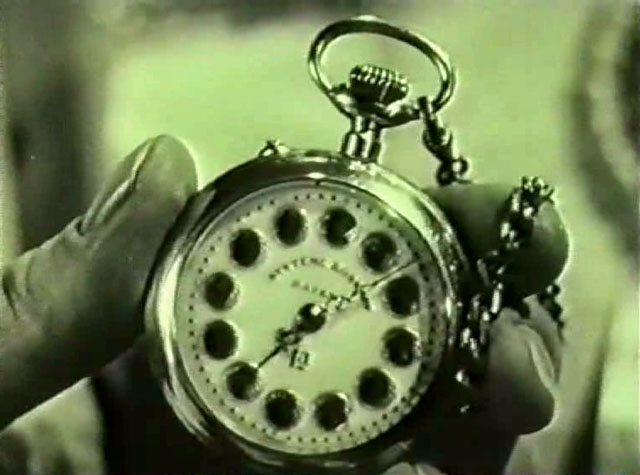
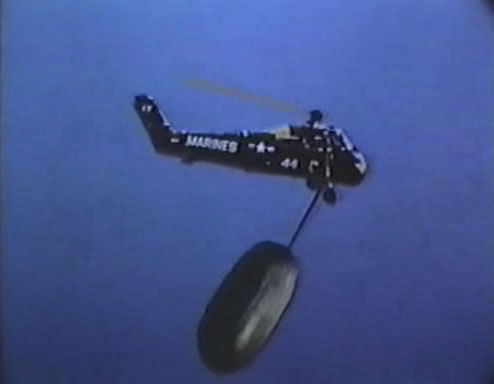
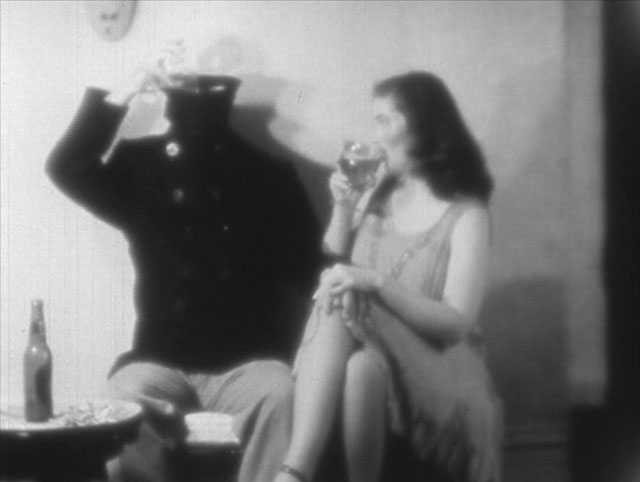
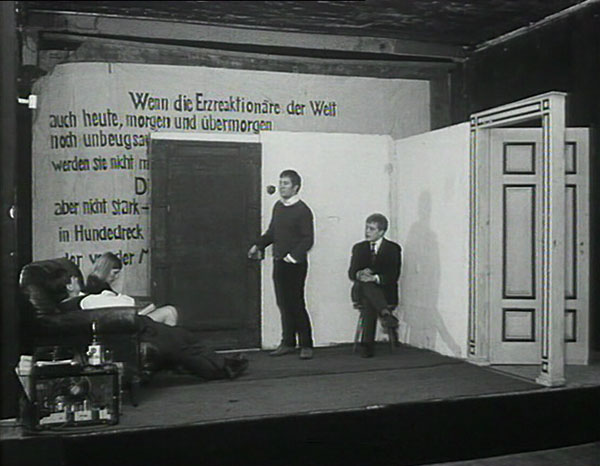
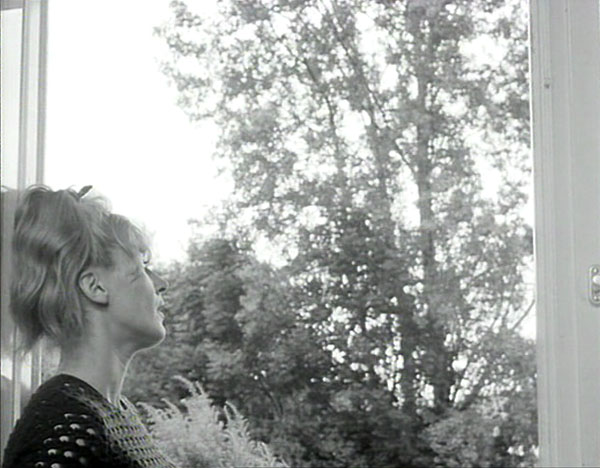
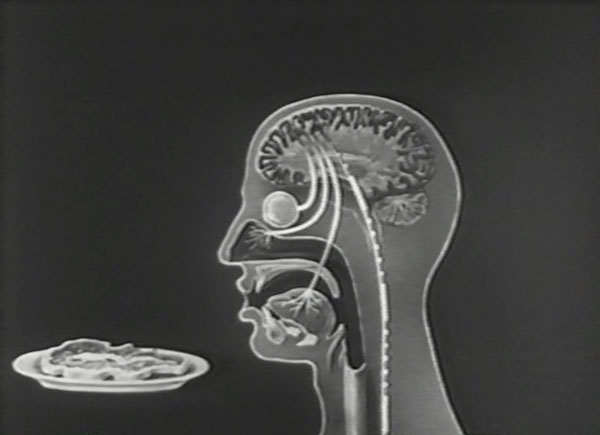
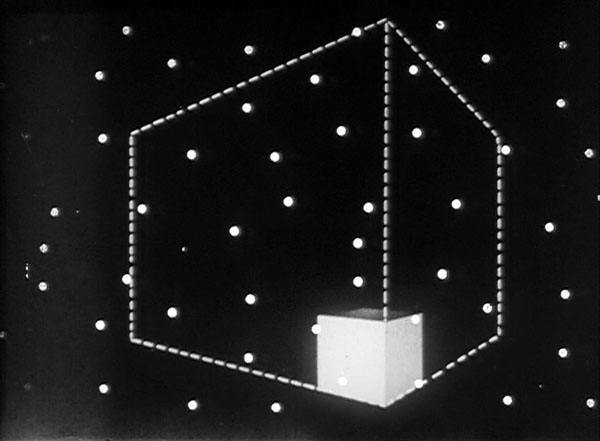
“This film deals with the world of fantasy. It is a fairy-tale for grown-ups. It explores the realm behind the magic mirror wich served Lewis Carroll 100 years ago to stimulate your imagination. … This film has been produced by artists. We have made use of the traditional freedom of the artist to follow our inspiration.”

The producers felt compelled to append that little preface, probably to distinguish their movie from contemporary films like Desk Set, Bridge on the River Kwai and I Was a Teenage Werewolf. But this was also the year of artistic masterworks The Cranes Are Flying, Letter From Siberia and The Seventh Seal, none of which felt the need to open their piece with a pretentious prelude pointing out its poetry.

Cocteau, I think:

With the participation of Louis and Bebe Barron (Forbidden Planet), Max Ernst, Alexander Calder, dada artist Marcel Duchamp and Man Ray, some of whom had previously worked on more justifiably renowned films like Entre’act, L’Age d’Or and Richter’s own Dreams That Money Can Buy.

Short, playful episodes, all somehow chess-related. For instance, in one scene a man is paralyzed and confounded by a chess board, mocked by a coat rack in the room shaped just like the king piece, while white mice run around his black shoes. A naked woman arrives and suddenly he is able to take his turn, while a horrible horn plays and the mice, captured by a folding chess board, transform into pigeons. This all sounds like it should make for a fine bit of visual poetry, except that the pacing makes it tedious, and most of the movie features intolerable flute, trumpet, accordion and violin music.

Richter was around 70 when he made this. Seems more like something he did with/for his buddies rather than general audiences. Titles and occasionally narration in English. I liked some stop-motion, a Svankmajeresque dance of rattles, mobiles and masks made from repurposed found objects. Liked the 1950’s fashions. Otherwise it’s a pleasant waste of time, maybe not the Great Lost Cocteau Film I was hoping for. I wouldn’t mind watching again if it ever surfaces with less appalling picture quality than my copy.

Allmovie:

The idea is to present chess conundrums cinematically the way Lewis Carroll did in literature, particularly in Through the Looking Glass. Filmmaker Hans Richter, who’d previously collaborated on Cocteau’s Blood of a Poet, designed his films like paintings; as a result 8 X 8 is visually dazzling, especially segment #2 (“A New Twist”) — even when the viewer is at a loss to understand what is going on.

Grunes:

The first episode is a period piece depicting royal intrigue in the woods. It includes a lady’s tripped-up, trapped bare foot: one of numerous erotic images. In another, Calder constructs a mobile and uses his breath to blow it into life. Here, also, is randomness—of the found objects, various movements resulting from disparate shapes and weights, etc. A woman’s kiss elsewhere turns a royal doll into a human beloved, but, unwilling to cede any power, the woman submits the man’s head and neck to a succession of hats (including a large one with a chessboard design) and ties, preferring to wear the crown herself, and converts the man into a puppet on a string. In perhaps the most wonderful episode, an adventure in “the fortunes of love,” Max Ernst pursues another chess piece, wife Dorothea Tanning, throughout Lower Manhattan—initially, in unexpected black and white. … A clock turns counterclockwise, erasing its numerical indicators. The film’s irresolution suggests that life is a chess game in endless play.

Monsieur Fantomas (1937, Ernst Moerman)
This was the prize short of the month… good show, Moerman. Takes the dream-logic, intense crimes and crazy escapes of Feuillade and goes all-out surrealist with them. The master criminal lives in a room with no walls on the beach (much of the movie takes place on the beach), seeks out his true love Elvire. Chief Juve is roused from the bathtub, consults with some seashells and heads buried in the sand. A hundred delightful things happen then it closes with the title card “end of the 280,000th chapter.” Made in Belgium, and I’m very sorry that Moerman didn’t shoot any more films. There really needed to be more surrealist cinema.

The cops close in on Fantomas… but is it really him, or just a cello?

Dinner For One (1963)
Shot in Germany, and shown traditionally every year on television since, a beloved little sketch in which a butler sets the table for an old woman’s absent guests, drinking toasts in each of their places and getting roaring drunk as he continues to perform his duties.

May Warden and Freddie Frinton:

The Spine (2009, Chris Landreth)
Group marital counseling + codependency, slowly coheres into a story. I didn’t like it nearly as much as his short Ryan.


Three by Sally Potter
These shorts predate Thriller by almost a decade, early film experiments not having much in common with her features – well, perhaps slightly with The Gold Diggers, which I started watching but haven’t finished.

Hors d’oeuvres (1972)
Silent avant-garde film, a flickering light shines on still photographs, then slow, unstable film footage of one person at a time in a bare room. Dance movements, slowed down then paused, superimpositions, the light pulsating. Lasted about twice as long as my willingness to appreciate it.

Play (1970)
Also silent, two cameras high up at different angles capture the same scenes of children playing on the sidewalk, at first presented side-by-side simulatenously, then re-edited, slowed down and chopped up.

Jerk (1969)
Faces, sped up and extremely rapidly edited. This was my favorite. I wonder if Potter considered the film’s motion to be “jerky” or if she thought this guy was a jerk.

Father (1977, Shuji Terayama)
a one-take silent sex scene that turns into a pleasant slideshow, featuring video superimpositions of a hand and the back of a head. No audio on my copy.

La Chambre (1972, Chantal Akerman)
Four slow pans around a cramped apartment, fully silent. First the director flutters her eyes at us from bed, then she is wriggling around, then playing absently with an apple, then – change of camera direction! – eating the apple, as the camera finally realizes she’s the only thing of interest in the room and starts rocking back and forth, homing in on her bed.

Birds Anonymous (1957, Friz Freleng)
“Birds is strictly for the birds.”
Just an average tweety and sylvester short, some kind of parody of werewolf movies and alcoholics anonymous, as far as I can tell. Wonder why this was on my laptop. And what is alum?

Playback (1970, Pere Portabella)
Two cameras, and you can see each in the other’s shot as they circle a composer who is arranging his unconventional choir piece, chattering constantly in unsubtitled Catalan. It’s all kind of exciting. I don’t know anything about Portabella, but I like his shooting style so far.

From the filmmaker’s official site:

Playback is presented as a short rehearsal in a double sense. It is a satellite of the constellation of works that Portabella dedicates to the analysis of the “materiality” of aesthetic and cultural languages (Vampir-Cuadecuc and Miró l’Altre among others can also be understood in this manner). At the same time, he analyzes the rehearsals that Carles Santos carries out for the playback recording of a film on the work of Antoni Gaudi. The choir of the Gran Teatro del Liceu of Barcelona reads fragments from Wagner’s Tannhauser, Lohengrin and the Valkyries. The film was shot in the theater “Lluïsos de Gràcia”.

Two Portraits (1981, Peter Thompson)
The director narrates a series of one-sentence statements about his father, as we see consecutive film frames cross dissolving. “His oldest son died at age 31. The decision to have children was left to his wife, as were all decisions except those concerning money.”

Second portrait is of his mother, filmed sleeping outdoors, while on the audio she reads pages from her diary. The first half was far more illuminating and sympathetic. I’m not sure what to do with the second part, but as with all of Thompson’s films that I’ve seen, I’d be glad to watch it again.

First portrait:

From Chicago Magazine: “When Peter Thompson was 35, his father committed suicide. That tragedy 29 years ago sent the Columbia College professor searching for Super 8 film of his father. He found only 12 seconds’ worth, but stretched them out to 17 minutes and added narration. When he expanded it to include his mother, the resulting film, Two Portraits, moved audiences to tears.”

Second portrait:

After “A Bill Morrison film” it says “A Michael Gordon symphony”, assigning auteur credit separately over the soundtrack, a rare thing. I didn’t love the symphony, though – an undertone even more monotonous than Philip Glass with bombs-falling string-sliding atop it. I enjoyed the bit where percussion chattering along with the background rhythm sounded like an old TV news theme song. But next time I’ll just listen to a Pinback album instead.

Visuals are exciting, though – Fragments of narrative films (and science films and home movies and other weirdness) gone Brakhage (or less generously, gone Begotten) through decay, slowed down so we can appreciate the distinct frame-by-frame damage.

I don’t understand what property of film decay causes the picture to go negative, bright whites turning black while the rest of the picture looks unaffected, but I’ve never much understood the chemical side of film anyway. Elsewhere, scenes are obscured by dark blots, sunken under oily water and giant amoebas, or just torn to shreds.

Forget the Great American Scream Machine – this is the most terrifying carnival ride. Each car emerges from a burbling time/space warp on left side of the frame, to circle around and go back inside. At the end of the ride, whoever’s left inside the reality-warp is doomed to spend the rest of their days in a hellish alternate dimension.

Second best part here, a boxer fighting an amorphous column of decay

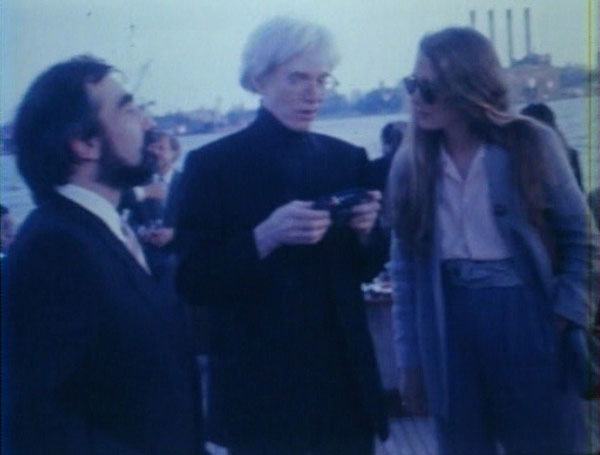
After an opening monologue about not understanding life or people, and not really wanting to understand them, hours and hours of home movies! Mekas in voiceover assures us they are edited in “random” order, but chapter 8 starts with a shot of a campbells soup can, then we glimpse Warhol on a ferry a minute later, so it’s not as random as he’d like us to think. Not randomly selected, either… each is a scene from the previous 30-or-so years chosen for its “glimpses of beauty.” So even though it seems weird to release home movies, with details a hundred times more meaningful to Mekas and his family than to a distant viewer like myself, it’s edited for wide appeal so really very nice.

image

I don’t mean to represent the entire five-hour film with a screenshot of Andy Warhol, it’s just that I was watching on the TV then I moved into the kitchen for ten minutes and brought the movie with me (miracles of technology) and happened to grab this frame.

There’s also sped-up film, rapid editing and some superimpositions – not just untouched boring ol’ film footage. His voiceover isn’t concise, but he has plenty of time. “I’m not so sure what I’m doing, really.”

I like that he keeps calling us his friends.
Or maybe he thought only his friends would ever watch this.

Alternate title: Children and Cats (Sped Up)

The sound quality could use a boost. I recognized Allen Ginsberg, and titles introduce Hollis Frampton, P. Adams Sitney, Nam June Paik, Ken Jacobs and Richard Serra.

I’m guessing it was New Yorkers (more specifically, regulars at the Anthology Film Archives) who voted this a decade-best film. Seems like it’d have added significance for a New Yorker.

Recommended listening: “Springtime in New York” by Jonathan Richman

“That moment everything came back to me, in fragments.”
Some repeated title cards (like “This is a political film”) and the chapter headers give it a sense of structure.

Random dude on IMDB:
“This is the work of a man at peace with his own happiness. We should all be so lucky.”

Mekas explains himself:

My film diaries 1970-1979: my marriage, children are born, you see them growing up. Footage of daily life, fragments of happiness and beauty, trips to France, Italy, Spain, Austria. Seasons of the year as they pass through New York. Friends, home life, nature, unending search for moments of beauty and celebration of life friendships, feelings, brief moments of happiness. Nothing extraordinary, nothing special, things that we all experience as we go through our lives.

NY Times:

At almost five hours, the movie is brief only when compared with Mr. Mekas’s 78 years of life. The film is a first — the home movie as epic. With its intentionally rough-hewn cuts, it is a journal, with hand-typed titles interspersed throughout that skitter past like lightning flashes and are meant to evoke moments. It’s a fleeting storm of a film, with pockets of rhythms that suggest the ebb and flow of a naturally unfolding event — though for some, its length may call for coffee and blankets.

The Bridegroom, The Comedienne, and the Pimp (1968, Straub/Huillet)
Four minutes in, it’s just been a long car ride in the rain with opera music playing (there was no sound at all for the first two minutes) and I am very suspicious.

Five minutes in, cut to a stage set, with German words on the wall and a clattering wood floor. Rivette (or Michael Snow) would be pleased. A fast-paced stagey farce follows. Blackout, next scene but the camera hasn’t moved, hasn’t even cut for all I know. Actors include Fassbinder regular Irm Hermann, composer Peer Raben, and future superstar Hanna Schygulla (who I’ve recently seen in The Edge of Heaven, Werckmeister Harmonies and 101 Nights of Simon Cinema).

Bang, cut, new location, and back out on the street. An action scene. Jimmy Powell is marrying Lilith Ungerer (star of a couple Fassbinder films). They go home, the pimp (Fassbinder himself, early in his career) is there, she shoots him and gives a speech as the music returns. All affectless acting.
image

So, what was that all about? Well the title refers to the cinematic drama in the third section, that much is clear. And the actress and the pimp were in the stage play in the middle. IMDB fellow says “The film has its roots in a theatre production of a play by the Austrian playwright Ferdinand Bruckner which Straub had been asked to direct by a German theatre company. He considered the play too verbose and cut its length from several hours down to just ten minutes, and it is the production of this play which forms the centrepiece of the film.” As for the beginning, the same guy says it’s a “Munich street frequented by prostitutes.” F. Croce calls it a “mysterious, structuralist gag” and notes that “filmic subversion can prompt political revolution, and transcendence.” No revolution or transcendence here – I just thought it was a weird little movie made by an overacademic sweater-wearing type. Was only Straub’s fourth work – let’s check out his tenth, which is half as long.
image

Every Revolution is a Throw of the Dice (1977, Straub/Huillet)
It’s in French this time. Actors sit in a half-circle near the memorial site for the Commune members and recite a poem. I’m mistrustful of the English subtitle translation of the poem, and there’s not much in the movie besides the poem (the recitants are as expressionless as in the previous film, maybe even more so), so there’s not much of value for me here. Actors include Huillet herself, Michel Delahaye (the ethnologist in Out 1) and Marilù Parolini (writer of Duelle, Noroit, Love on the Ground), shot by William Lubtchansky and dedicated (in part) to Jacques Rivette.
image

Mongoloid (1977, Bruce Conner)
Music video for a Devo song using (I’m assuming) all found footage (science films, TV ads and the like).
image

Mea Culpa (1981, Bruce Conner)
Dots, cubes, light fields and… whatever this is. Conner goes abstract! The music sounds like 1981’s version of the future. Aha, it’s Byrne and Eno, so it WAS the future. I didn’t know that Conner died last year, did I?
image

(nostalgia) (1971, Hollis Frampton)
of a photo of a man blowing smoke rings:
“Looking at the photography recently it reminded me, unaccountably, of a photograph of another artist squirting water out of his mouth, which is undoubtedly art. Blowing smoke rings seems more of a craft. Ordinarily, only opera singers make art with their mouths.”
image

So far I really like Hollis Frampton. His Lemon and Zorns Lemma were brilliant, and now (nostalgia) is too. Anyway this is the one where Frampton films a photograph being slowly destroyed on an electric burner while Michael Snow reads narration describing the next photograph that we’ll see. It’s important to know that Snow is the uncredited narrator for a humorous bit in the middle. The movie also has a funny twist ending that I wasn’t expecting. This would be part one of Frampton’s seven-part Hapax Legomena series. I have the strange urge to remake it using photographs of my own, but I lack an electric burner and a film/video camera.

Gloria (1979, Hollis Frampton)
Remembrance of a grandmother, Frampton-style, meaning annoyingly hard to watch and strictly organized. Clip from an ancient silent film, then sixteen facts about gramma (“3. That she kept pigs in the house, but never more than one at a time. Each such pig wore a green baize tinker’s cap.”) then a too-long bagpipe song over an ugly pea-green screen, and the rest of the silent film. Or as a smartypants would put it, he “juxtaposes nineteenth-century concerns with contemporary forms through the interfacing of a work of early cinema with a videographic display of textual material.” I prefer my version.
image

Prelude #1 (1996, Stan Brakhage)
I don’t think that I enjoy watching low-res faded videos of Brakhage movies. I’ll wait for the next DVD set to come out (or the next Film Love screening). As a side note, I cannot believe that Raitre plays stuff like this. Just imagine: art on television. Picture a single TV station anywhere devoted to showing art. Can you? Can you?!? I feel like screaming!!
image

NYC (1976, Jeff Scher)
Shots of the city sped-up, rapidly edited, reverse printed and hand colored, two minutes long with a jazzy tune underneath. Super, and short enough to watch twice (so I watched it twice).
image

Milk of Amnesia (1992, Jeff Scher)
I’m thinking it’s short scenes from film and television, rotoscoped, with every frame drawn in different colors, with some frames drawn on non-white paper (a postcard, some newspaper). Warren Sonbert is thanked in the credits. I would also like to thank Warren Sonbert.
image

Yours (1997, Jeff Scher)
An obscure musical short from the 30’s or 40’s overlaid with rapidly-changing patterns and images from advertisements. Descriptions and screenshots can do these no justice.
image

Frame (2002, n:ja)
Black and white linear geometry illustrating a Radian song. I can’t tell if it’s torn up by interlacing effects or it’s supposed to look that way. Give me Autechre’s Gantz Graf over this any day. Between this and Mongoloid and the Jeff Scher shorts, I’m not sure where to draw the line between short-film and music-video. Not that it’s a dreadfully important question, but I’m in enough trouble tracking all the films I have/haven’t seen without adding every music video by every band I like onto the list. Although maybe videos should be given more credit… I’m sure Chris Cunningham’s video for Squarepusher’s Come On My Selector would beat 90% of the movies I watched that year.
image

Zweigroschenzauber (1929, Hans Richter)
The intertitle says “Twopence Magic: a commercian in picture rhymes.” Movie shows us a thing, then crossfades to a similar-looking thing. Much better than I’ve made it sound.
image

Dada (1936, Mary Ellen Bute & Ted Nemeth)
Shapes in motion, quick.
image

Synchromy No. 4: Escape (1938, Mary Ellen Bute & Ted Nemeth)
A Bach music video, with black bars perversely imprisoning the viewer away from the orange and blue color geometric spectacle beyond.
image

War, etc. (1983, Leo Schatzl)
Crude drawings of planes, horizontal scratches give the appearance of speed, sound fx from old arcade games. Mix it up with some TV interference. Part of an installation which surely annoyed many (unless the sound was turned down).
image

OXO Wonder Vision (1996, Leo Schatzl)
Looks/sounds like the window of a plane flying through a cloud. Then the plane slowly sinks into a giant coffee pot. It must be endless fun to be an avant-garde video installation artist.
image

The Endless Sandwich (1969, Peter Weibel)
Pretty much this shot, a guy watching a guy watching a guy, until the TVs start staticking from the inside out, until our own TV statics, closing with a quote by the filmmaker.
image

Imaginare Wasserplastik (1971, Peter Weibel)
Meta-video-art using “television as a time-space switch,” only a minute long. Not great, but so far I like this guy better than Leo Schatzl.
image

Fluxfilm 1 (1964, Nam June Paik)
“pranksters”, “playful artists”, “ephemeral humor”: the Fluxus movement sounds like fun. But then the first film I watch is a pure white screen and silent soundtrack. What’s worse, someone has punk’d my DVD player so the clock is moving at half-speed.

Fluxfilm 2 (1966, Dick Higgins)
Still silent, closeup of a man’s mouth chewing. Okay, I’m done for now.

Some selections from the Treasures IV avant-garde set – just the ones from the 1950’s, so they’re all post-Desistfilm but pre-Mothlight.

Eyewash (1959, Robert Breer)
Flickers and movements, accurately titled. Saw this at the Anthology way back when. Think I prefer A Man And His Dog Out For Air over this. Includes a whole alternate version with (most of?) the same scenes in a different order.
image

Aleph (1956-66, Wallace Berman)
Berman isn’t a well-known filmmaker – this is his only film and it went unreleased (and even untitled) until now. A cool, unexpected addition to the set, instead of just focusing on known directors. Faces and jittery camerawork, bent and damaged and overlayed with filters and text, its jittery relentlessness (and John Zorn’s squealing sax) got me down after the first five of its eight minutes.
image

Odds & Ends (1959, Jane Conger Belson Shimane)
Stop-motion cut-outs and found footage and so on while a guy talks about jazz and poetry, this is supposedly an avant-garde spoof. If not for the jokey commentary, how can one tell serious experimental work from parody?
image

Bridges-Go-Round (1958, Shirley Clarke)
Have I seen this before, or only read about it? Looks familiar. A dance film with bridges, overlapping images like sci-fi architecture. Two scores – I prefer the Bebe Barron one.
image

Little Stabs at Happiness (1959-63, Ken Jacobs)
Just a dude with a grungy camera filming his friends and neighbors goofing around with props in a room and on a rooftop. Now that it’s less novel to own a camera, and the idea of releasing a film that isn’t a big studio production is nothing new, this seems to have lost its reason to exist. Then again, in Jonathan Rosenbaum’s Cinema Scope article he puts this in the “relatively familiar standbys” category, meaning cinephiles have been watching Jack Smith put balloons in his mouth for decades now, so maybe there’s something I’m missing. Some happy old records play over the start and end, but in the middle Jacobs narrates from ’63, telling us that none of these people shot in ’59 still talk to him, casting a mild bummer tone over the whole project.
image

Betty Boop in Snow White (1933, Dave Fleischer)
Just some animated shorts from the 30’s – but this one would fit in nicely with the avant-garde set because it is bonkers crazy and also one of the most excellent things ever. It’s vaguely SnowWhitey but the story comes second to wacky invention and Cab Calloway’s St. James Infirmary clown-ghost music video.
image

The Old Mill (1937, Wilfred Jackson)
This is Historically Significant, as the first film to use a multiplane camera. Won the oscar (same year as Torture Money) beating out something called Educated Fish and a dialogue-free animation of The Little Match Girl (sound familiar, Disney?). Animal life inside a battered windmill during an especially stormy night. Katy: “Aren’t owls supposed to be awake at night?”
image

Ferdinand The Bull (1938, Dick Rickard))
Won an oscar against three other Disney shorts (including Brave Little Tailor, one of the only mickey cartoons I still remember) and a Fleischer short about two donkeys. Ferdinand is a pansy bull who wants to sit and sniff flowers all day. All the other bulls desperately want to be picked for a bullfight (seriously?) but our pacifist Ferdinand gets picked over them. He screws around and doesn’t fight and instead of killing him they send him back to the meadow to sniff flowers again. I don’t know what’s the moral here.
image

I took advantage of the huge weekend snowfall in Atlanta by huddling on the couch with a pile of DVDs of short films which I’ve long delayed watching, followed by two obscure features, totaling eight newly-seen titles on Jonathan Rosenbaum’s hallowed list of 1,000 favorite movies. At this rate of eight per day, I’ll be through the list in no time, so anyone else can feel free to send me their own thousand-faves list and I’ll get to it shortly.


First off, two by Jane Campion. I wasn’t too kind to Sweetie or The Piano, was hoping I’d enjoy the early shorts more. A Girl’s Own Story (1984) is a vaguely Terence Davies-reminiscent period piece about two sisters and a friend one winter in the 60’s – having fun, going to school, singing Beatles songs and dealing with family trauma. The parents only speak to each other through their children, and dad brings his girlfriend to Pam’s birthday dinner… meanwhile friend Gloria leaves school because she is pregnant by her brother. Passionless Moments (1983) is a series of humorous sketches (each with its own title: “Clear Up Sleepy Jeans”, “No Woodpeckers In Australia”) with an ethnographic narrator telling us somebody’s mostly-insignificant stray thoughts (misheard lyrics to “Daydream Believer”, identifying a strange sound outdoors).

A Girl’s Own Story:
image

These were two of the most enjoyable shorts I watched all day, so hooray for Jane Campion. Both were worked on by Alex Proyas, director of Dark City, whose new Nic Cage movie opens this month, and Passionless was made in collaboration with Gerard Lee, who wrote/directed a comedy in 1995 involving marital strife because of a sold piano, hmmmm.

Passionless Moments:
image


Franz Kafka’s It’s a Wonderful Life (1993, Peter Capaldi)
I’d always admired the title of this and assumed it to be blending of Kafka’s and Capra’s sensibilities, but no such luck… it’s more of a Franz Kafka In Love, as the writer struggles to complete the first line to The Metamorphosis. Might’ve been nicer if I’d watched it earlier then, since by now every known artist’s inspiration has been illustrated by the movies, either as a serious drama or a light fantasy. Richard Grant (same year as The Age of Innocence) is Kafka, and his work-interrupting neighbors include Ken Stott (who’d soon play the lead detective in Shallow Grave) as a knife seller with a missing pet cockroach, and Phyllis Logan (a Michael Radford regular) as a novelty salesman. Our director is better known as an actor (Local Hero, Lair of the White Worm). My favorite detail: being friendly to a neighbor Kafka says “call me F.”

image

image


There’s time in any shorts program for some Norman McLaren. I checked out a section on the DVDs of work he did with Grant Munro, one of the few men strong and patient enough to animate himself with stop-motion. A piece I’ve seen before called Two Bagatelles (1953) has Grant zooming around to music (Katy came in from the other room to express disapproval at the music), a fun exploration of their live-stop-motion ideas. An unreleased set of sketches and experiments called either On The Farm or Pixillation adds slow-mo, film-reversal and mattes into the mix. Canon (1964) features a blippy electronic version of “Frere Jacques” and has four Grant Munroes at once, moving across a stage and interacting. And A Christmas Cracker (1962), for which McLaren/Munro did great dis/appearing stop-motion jester titles and transitions, is a compilation of short holiday cartoons.

On The Farm/Pixillation:
image

A Christmas Cracker:
image

One of the non-McLaren segments of A Christmas Cracker, in which an inventor travels to space to retrieve a real star to top his Christmas tree:
image


Wong Kar-Wai’s Hua yang de nian hua (2000) is a montage of rotting nitrate footage from newly-discovered vintage Hong Kong films. Two minutes long, fast-paced and wordless, set to a song used in In The Mood For Love.
image

Two by Santiago Alvarez. Now! (1965) is a montage of upsetting footage, still and moving images, as Lena Horne belts out the title song, and Hasta La Victoria Siempre (1967) is twenty looong minutes of music and stock footage focusing on Che Guevara and other revolutions and revolutionaries. A chore to sit through – I’m gonna stop watching Alvarez movies for a while now.

Now!
image

Hasta la victoria siempre
image

Two early shorts by D.W. Griffith… although he made about 200 films in the two years between them (those were the days!) so maybe only the first one can be called “early.”

A Corner In Wheat (1909)
Wealthy trader corners the market in wheat, meaning less money for the farmer and higher prices at the market. As unrest grows and the cops are called to protect a bakery, the now even richer trader and some classy women tour the grain elevator to symbolically survey their fortune. He slips and is buried in grain, an ending stolen by Vampyr a couple decades later.
image

Tom Gunning via Erik Ulman says: “the editing has special appropriateness in this film, as it represents the ‘new topography’ of modern capitalist economics, and its ‘lack of face-to-face encounters with the forces which determine our lives.'” Based on a book by the novelist who wrote McTeague (Greed). Actor who played the farmer appeared 45 years later in Ford’s The Sun Shines Bright.
image

Musketeers of Pig Alley (1912)
A musician, just back in town after some weeks away working, gets all his money stolen by the titular gang. A rival crime gang fights the musketeers, and during the fracas our man gets his money back. When the rival gangleader is about to be arrested, the musician and his girl vouch for him, lying that he’d been with them the whole time, as thanks for his help. The enemy of my enemy is my friend, and all that.
image

Wikipedia claims this “probably the first ever film about organized crime” and an influence on Gangs of New York – as if Scorsese’s first exposure to crime was in DW Griffith films. Lillian Gish, star of many Griffith movies, plays the girl.
image

Report (1967, Bruce Conner)
Recording of radio broadcasts from when JFK was shot. Sometimes the visuals are robotically repeated loops of newsreels, sometimes film countdown leader, sometimes all white and black flash flickers, which do not translate well to medium-grade internet video. The second half is excellent, still the radio announcers but with shock associative visual editing from all manner of sources: a bullfight, advertisements, war movies and so on.
image

Tunneling the English Channel (1907, Georges Méliès) has long bothered me because it’s the earliest film on Jonathan Rosenbaum’s 100 favorite films list but hasn’t been available anywhere on video. Fortunately the new Flicker Alley set remedied that, and I could finally see it, in fine condition with wonderful hand-coloring. It’s a cute story and a technically superior film, with the color and the combination of animation, live action and Melies’ usual fun effects. Story goes that the leaders of France and England agree to build a tunnel under the channel, and all goes well until the train crashes. As the tunnel fills with water undoing months of work and drowning the prime minister, they wake up – it was all a dream and they decide not to build the tunnel after all.
image

LMNO (1978, Robert Breer)
A hammer, a faucet, a headless naked woman. Rapid-fire comic-book situations. Mainly-irritating soundtrack of running people, running water, and running tape static. Next time I’ll feel free to see how it works with a couple Kinks songs instead. Not my favorite Breer, but I’ve actually seen his films projected in a theater before, so this one obviously suffers from being a bootleg download watched on a laptop.
image

Chris Stults, Film/Video Assistant Curator at the Wexner Center in Columbus, says (out of context): “The thing that has always drawn me the most to avant-garde cinema is that it is intended for an individual viewer, not a mass audience. The individual has to complete the work. To go back to the idea of seeing cinema anew, the viewer often has to figure out how to watch the particular film or video and then from that process of learning how to watch, meaning and interpretation can follow.”

Flight of the Conchords: A Texan Odyssey
Short doc of the duo band at SXSW. Funny! Seen below massaging the feet of Peaches.
image

Wallace and Gromit in A Matter of Loaf and Death (2008, Nick Park)
This was as fast-paced as the action scenes in the Wallace & Gromit full-length, and packed full of jokes and puns. Our heroes are bakers now, and a former bread company model, now grown fat on breads and pastries, is out for revenge on the bakery world. She gets cozy with Wallace, plotting to murder him with a giant cartoon bomb (among other things) while Gromit and the woman’s terrified pet poodle try to ruin her plans. Lovely movie, probably inspired by the name of cowriter Bob Baker and/or voice actor Peter Sallis’s appearance in the movie Who Is Killing The Great Chefs of Europe. Must check out Nick Park’s series Shaun The Sheep.
image

Living in a Reversed World
Educational doc. Sadistic Austrian professor, trying to prove a point about perception, gets students to wear special mirror/prism glasses which reverse left/right or up/down and see if they can adjust. They can. He also puts goggles on a chicken, which I don’t think is a good idea.
image

The Contraption (1977, James Dearden)
Closeups of construction. What’s he building in there? What the hell… is he building in there? Turns out to be a giant mousetrap for our suicidal handyman. Dearden later made Matt Dillon thriller A Kiss Before Dying. Contraption-builder Richard O’Brien had lately been in Rocky Horror, would play Mr. Hand in Dark City. Tied for best short at the Berlin fest… this is pretty neat, but I wouldn’t have thought it an award-winner.
image

Cameras Take Five (2003, Stephen Woloshen)
Abstract hand-drawn animation set to Dave Brubeck’s Take Five. Liked it, not super busy, didn’t think people were doing stuff like this anymore.
image

Herb Alpert and the Tijuana Brass Double Feature (1966, Hubleys)
John & Faith animate two short musical numbers to Spanish Flea and Tijuana Taxi. Not slick like the Doonesbury short, homemade-looking. Cute pieces though (predictably about a flea and a taxi). Beat out a Pink Panther short and an anti-smoking PSA for the oscar. Rough year for animation, I guess. Lost at Cannes to a documentary on Holland (not by Bert Haanstra).
image

The Tortoise and the Hare (1935, Wilfred Jackson)
Hare is kinda an asshole – supposedly his character was stolen by Warners as a prototype for Bugs Bunny. This plays like the other Silly Symphonies, not as good as the Three Little Pigs though.
image

A Perfect Place (2008, Derrick Scocchera)
Sharp b-w cinematography and two very dryly comic actors (Mark Boone Jr. of Memento & Thin Red Line and Bill Moseley of all the Rob Zombie films) make for a good movie. In the first second, MBJ “kills” an acquaintance who was cheating at cards, then they spend the next 25 min trying to dispose of the body. Not the usual over-the-top situations either, movie keeps it cool. I guessed early on that the cheat wasn’t really dead but that didn’t make it less enjoyable. Dig the theme song by Mike Patton.
image

MANT! (1993, Joe Dante)
Tracigally not a full feature. All the scenes shot for the film-in-a-film of Dante’s awesome Matinee were assembled into this short included with the laserdisc.
image

Three excellent shorts by Norman McLaren. Fiddle-de-dee (1947, painted to an upbeat fiddle tune), Boogie-Doodle (1948, drawn with pen to a piano boogie) and Serenal (1959, etched and hand-colored to a Trinidadian string quartet number)

Fiddle-de-dee:
image

Boogie-Doodle:
image

Serenal:
image