A typically crap Crowe movie with big obvious pop music cues (in Crowe’s hammy hands, I understand why they’re called cues) and a big fat score by Jonsi. Adapted from the real zoo-buyer’s memoir by Crowe and Aline “Morning Glory/27 Dresses” McKenna.

Adventure-craving newsman Matt Damon is sad because his wife Gwyneth Paltrow died from plague, so he buys a zoo from realtor JB Smoove, warms up somewhat to head zookeeper Scarlet Johansson (taking time out from her new career of having cameos in other people’s superhero movies), and tries to assure his brother (Tommy Sandman Church) and moody kids that it’ll be a great adventure. Spoiler alert: it is! I might’ve spotted a big La Jetee reference in the family-photos montage, but I looked away for a while, so maybe not.

Starts out with a chattery narrator, dropping wordplay over straightforwardly tourist-doc images of the city. After some minutes of this it shows various episodes with very slight stories, which almost feel like they were scripted after the fact when writing the voiceover, if not for a few scenes that prove otherwise. T. Gallagher’s book says the movie was shot just how it looks like it was shot – piecemeal, one sequence at a time, as R.R. focused on raising funds, having an affair and breaking up with Ingrid Bergman.

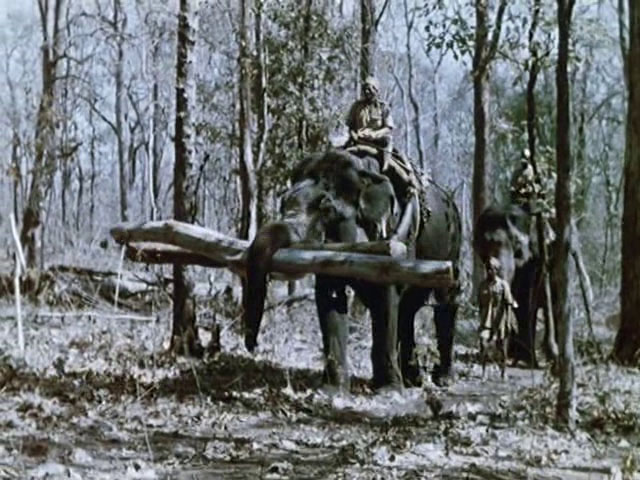
I had subtitle problems on my copy, but managed to make it through since there’s little dialogue. Overall not one of my favorite movies, except I was blown away by the first sequence after the tourist-doc intro: loggers on elephants. The director of the Vienna film festival agrees: “The real reason for including the film in the Viennale is my love for the elephants.” After the logging (the elephants knock down threes then lift them on their tusks) the men scrub their elephants clean.

Quick time out for a puppet show, then a boy elephanter is climbing trees to catch glimpses of the girl he likes. Marriage negotiations follow. Cows, a deer, a warthog, and an old man versus a tiger.

Final story: a pet monkey’s owner dies in the desert. Awesome/sad scene as the monkey stays with the owner as long as he can, with vultures approaching and the man not responding. Then the monkey heads to the city, chain leash still trailing behind, and tries unsuccessfully to make new friends. A weird place to end the movie.

Rossellini had already shown a knack for filming children (perhaps why Truffaut loved him so), and now he proves a master at animal drama – which is good, since he’s almost forgotten to include any human drama in the movie. A four-hour India miniseries came out the same year – not sure if it’s an expanded version of this same material or something completely different.

Haven’t seen this in a long time. Love the Vertigo and La Jetee references, and the Vertigo-via-La Jetee references. Katy was pleasantly surprised that Brad Pitt used to have energy. With such a perfect script, I’m surprised the writers haven’t done anything except a Kurt Russell actioner since.

Where Are They Now: Madeline Stowe hasn’t been in movies since 2003, is starring in a new show Katy watches. Chris Plummer (Brad’s dad the famous biologist) came back to play Dr. Parnassus. His plague-unleashing assistant David Morse was in Drive Angry 3D last year. Jon Seda (Bruce’s ever-present fellow prisoner from the future who hands him a civil war pistol in the airport) is in Treme. And Bruce Willis has an upcoming movie called Looper, in which he travels from the future and his past-self sees him (almost) die.

Gilliam:

I loved the idea of trying to make people consider the thought that to save the world five billion people might die. . . . But now you know that the world demands that things change. The word “culling” comes to mind. There’s going to be a culling of human beings soon. I don’t know what it will be. David’s thing was that a plague will do it. War? Famine? These things, the old favourites, are always there. Basically, I think there are too many people. And it’s not just that there are too many people; there are too many people who all want all these things that we have. That’s the problem. It’s Malthusian: there’s population and resources and, when they hit imbalance, look out boys and girls!

This was unexpectedly awesome. Between this, Regen and A Valparaiso, it’s time to consider adding Ivens to my list of favorite people. Sort of a Beaches of Joris, but less confessional to camera, shot more like an allegorical feature film starring himself. Always playful and never loaded with dialogue, with the occasional film reference, fable flashback or appearance by a prankster tiger-monkey.

Joris sets out to film the wind, goes to China. He trades a print of one of his films (“my first love story in 1930”) for a wind-creating mask. He sets up an array of microphones in the desert. He gets carried over mountains and enters political negotiations to film at a cultural landmark (the Terracotta Army), then gives up and recreates the landmark using models bought from street vendors.

At one point when he walks up to a massive Buddha statue which watches with a thousand eyes, closeups cutting from an eye to the camera lens, I thought strongly of Antonioni’s short Michelangelo Eye to Eye, also made by a director in his 90’s. But while Antonioni has always seemed associated with monuments, this was just a leisurely sidetrack for Ivens before returning to the matter of the wind, sixty years after he filmed the rain in Regen.

Senses of Cinema:

This is an unusually personal account of his lyrical rather than his political obsessions, largely directed by Marceline Loridan-Ivens, his wife and collaborator since the Vietnam films. … Joris Ivens died in 1989, only days after joining protesters against the Tiananmen Square massacre in Paris.

Mango Grove:

Ivens originally planned to use two crews; Ivens’s crew would film the wind, while Loridan’s crew would film Ivens’s crew filming the wind. Complications arose. Ivens was sick and, in a particularly serious incident, required on-the-scene surgery. … Thus the two crews became one. The Wind became Loridan’s film.

Speaking of Loridan, this also sounds good (from ivens.nl):

With La Petite Prairie aux Bouleaux, Marceline Loridan-Ivens made her feature film debut, at the age of 74. … She had agreed with Joris Ivens after A Tale of The Wind, their last project together in which documentary and fiction are mixed together, that she would make the tale of the fire. For a long time she dared not return to Birkenau, but finally she succeeded where Steven Spielberg and Roberto Benigni failed, she got permission to film on the premises of Birkenau. … It is a film about the pain and illusive character of the memory.

Rosenbaum:

The film is clearly addressed to the West and not to China … and the overall message is to listen to all that China has to say. … Both poetic essay and meditative fiction, A Tale of the Wind has certain affinities with movies as different as Jean Cocteau’s The Testament of Orpheus, Chris Marker’s Sans soleil, and Souleymane Cissé’s Brightness, but it is too proud to owe its vision to any source beyond Ivens’s own far-reaching experience and research. Part of the film’s inspired thesis appears to be that cinema and history, fantasy and documentary, have a lot to teach each other.

Another entry for…

Initiated by Shadowplay

There’s classic Jimmy Stewart (The Philadelphia Story, Shop Around the Corner and those Capra flicks), mid-life Hitchcock/Preminger Jimmy Stewart, and the ripe-for-retirement late Jimmy Stewart of Airport ’77 and The Magic of Lassie. But this film stands alone in featuring a post-retirement Jimmy Stewart.

IMDB trivia page says:

James Stewart said that he and his wife were vacationing at a game preserve in Kenya when they came across the filmmakers shooting this picture. He said he was persuaded to make a short appearance, speaking a few lines, because he thought it would help to promote wildlife conservation. “Never did understand what it [the film] was all about”, he said. “I did it on a whim.”

Jimmy Stewart feeds a hawk

And he does only speak a few lines, but that makes him a pretty major character in a movie where nobody speaks more than a few lines. Early on, the filmmakers announce their intention to feature a narrative, introducing a man (Philip Sayer of a couple British miniseries, who managed to die eight years before Stewart) in search of help after his plane crashes in the desert, but then they let us watch a girl named Maya romp with wild animals for another thirty minutes before anything else happens. Worryingly, the slender story wasn’t improvised by some actors who stumbled into a wildlife shoot, as it seems to have been, but was rather written by Hana’s old collaborator, legendary avant-garde filmmaker Terayama Shuji (Grass Labyrinth, Emperor Tomato Ketchup). Also worryingly, the “special effect” used to show Sayer’s plane crashing into a tree seemed to have been achieved by actually crashing a plane into a tree. It’s hard to tell if the dialogue was improvised, or if it was written for children, or if everything got simplified because of language barriers: a Japanese crew in Kenya with American, British and Italian lead actors, plus “Kathy” as Maya, no idea where she’s from.

(to be read flatly with a vague smile, revealing no emotion)
“Grandfather, the zebras and the gazelles are having babies again.”
“Ah, that means you’ll have a lot more friends now.”
“Yes, I have so many animal friends now, and I’ve got you, grandfather.”

But enough about story and dialogue. The filmmakers don’t care about it, so why should we? If you remove your expectations of “a Jimmy Stewart movie” or even “a decent film that makes a lick of sense,” it has its own pleasures. Stewart and his granddaughter Maya live in a thatched house with no doors or windows (a rhino wanders inside at one point) and spend their days playing with the wildlife and caring for their adopted pets, including a monkey and a grey thing I don’t even know what to call (they named it Tiki), which makes a “sknt!” noise that cannot be real. These two pets are treated as major characters. We get a better sense of Tiki’s personality than Jimmy Stewart’s (notice I don’t use his character name – I’m not sure that he has one). And I could think of worse ways to spend two hours than watching the beautiful Maya prance about, intercut with wonderfully shot Kenyan nature footage.

Tiki and his monkey friend:

But if Maya’s playful solo scenes recall the early Pocahontas scenes in Malick’s The New World (unfortunately set to what sounded like electro-symphonic versions of Abba songs), the effect is lost when she opens her mouth. It’s very possibly the directors’ fault (you never know), but she and Sayer and his fiancee Eleonora Vallone sure come out looking like lousy actors. Stewart, however, gets showcase scenes for his acting skills – a couple of raging anger moments, and a climactic emotional story told to Sayer about the accidental death of his son, Maya’s father, in a mine explosion. He also really comes to life, with a warm glow in his eyes revealing the depths of his love for nature, during a short speech about dung beetles. Since Stewart isn’t in the movie long enough to get to know him, these scenes don’t mesh well with his other personas in the film (benevolent nature-loving grandfather/mean old curmudgeon), lending credence to Stewart’s claim that he never understood the plot.

An actor, acting:

Oh yeah, the plot. So, since Sayer has amnesia after his plane crash, there’s nowhere he needs to be, so decides to stay with the hot (but chaste in a children’s-movie way) Maya, gaining the family’s trust by braving a snake-cutaway to rescue some cute creature from a hole it had fallen into, and comforting Maya after Jimmy Stewart’s easily-predicted death (actually I thought it was just as likely he’d wander off set and return to his vacation as stay long enough to shoot the death scene). Then, over an hour into the movie it switches to unsubtitled Japanese and I’m lost for a while. Lions behead some gazelles, tens of wildebeest and zebras drown on-camera in a horrible flood (making me pray it was not a children’s movie), some guy is killing “koala birds” with explosives, and there is a montage of animals yawning. Then rich fancy-girl Erika, the fiancee of the crash victim, sets out in her own plane to find him. Sayer somehow gets caught in a brush fire and a native (the movie calls them “the nomads”) walks him out safely. Erika catches up with the young couple and shoots Sayer with a dart gun in frustration when he won’t join her, then pisses off, leaving him in peace with Maya.

Erika at left, with the worst jumpsuit/upholstery combination in human history:

The movie doesn’t have a wildly good reputation online. J. Sharp:

With this overly precious would-be epic the director seems to be so cowed by his subject, the raw beauty of the Kenyan savannah and its denizens, that the end result resembles little more than a protracted holiday slide-show display. … It seems strange that Hani seems so content to dwell on such superficial trimmings, not only given his impressive track record in the 60s, but also that he’d previously been in Kenya to film The Song of Bwana Toshi shortly after the country had achieved independence from Britain. Bwana Toshi had dealt with the cross-cultural encounters of a Japanese geological engineer with the local community in which he is sent to work, and at least addressed such issues as expatriate-local relationships and the misunderstandings that arise due to the cross-purposes of the parties involved. In Africa Story there’s barely a black face in sight.

This was last fiction film to date by Susumu Hani, a Japanese New Wave director of the 50’s and 60’s. Co-director Simon Trevor specializes in camerawork for films shot in Africa – he worked on Gorillas in the Mist, White Hunter Black Heart and Out of Africa.

Midnight Eye has the scoop:

Susumu Hani’s career began with documentaries about youth and shifted into pseudo-documentary dramas, climaxing with Nanami, one of the greatest masterpieces of Japanese film. Although his work proves he had a profound understanding of human psychology, Hani was becoming increasingly disillusioned with humanity, which may explain why he abandoned human subjects in favor of making nature documentaries for NHK. It’s best to keep that in mind while watching this film, because at this late stage in his career, Hani seems to be completely uninterested in human drama. Instead of focusing on developing the characters, Hani chooses to simply incorporate more nature footage than the story will allow.

The vertical lines were supposed to be slimming:

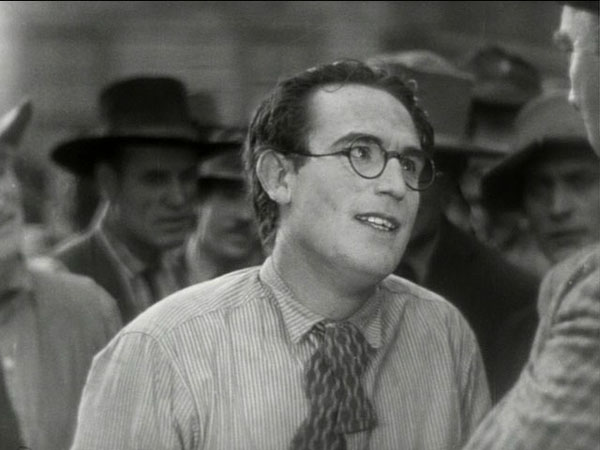
An amusing 80-min comedy, no masterpiece to be sure, but very likeable and occasionally funny. Harold Lloyd is the weak kid in a family of two burly brothers and sheriff dad. Medicine Show comes to town while dad is out and Harold was pretending to be sheriff, so he signs their permit, then can’t tell ’em to get out of town because he has fallen for the cute girl in the act. But note: she’s doing the show against her will along with two slimy characters who run off with the town’s treasury – and the sheriff is blamed! Can Harold Lloyd redeem himself by finding the abandoned ship where the criminals are hiding out and return to town triumphantly with the loot and the surviving thief before his dad is lynched? Yes.

Some real nice staging, more elaborately planned shots than the Keaton (see below; the Keaton was also seven years later, which might make a difference, but I think Keaton camera setups were pretty plain, just make sure the action is in the viewfinder), incl. a cool bit where he climbs a tree, higher and higher and the camera follows on a high crane. Movie also had a trained monkey, slingshots, a burning trailer, and laundry drying on a kite string, so you really can’t complain.

Could you bring yourself to hit this man? Could you?!?
image

Two of Harold’s family members had small parts in Citizen Kane, a medicine show guy was in Sunrise later the same year, and actor Ralph Yearsley who played Harold’s rival died aged 32 a year later. Lloyd was working at a pace of one movie per year, and this came after For Heaven’s Sake and before one of my favorites, Speedy, which would be his last silent film. Speedy also had Ted Wilde as credited director (though IMDB says Lloyd pretty much directed his own films), and Ted died the following year at age 36. IMDB also claims some uncredited direction on this movie by Lewis Milestone, who would soon make All Quiet on the Western Front. The General, Metropolis and October all came out in ’27, pushing the cinematic art ever forward, but so did The Jazz Singer, spelling doom for Keaton and Lloyd (but not for Lang or Eisenstein).

Also watched Neighbors, a 1920 Buster Keaton short which outshone the feature. Buster likes the girl next door, but her family won’t have him. Hilarity ensues. All you really needed for a great Keaton film was a basic premise and thirty brilliant gags – fully-developed plot/characters not required. Terrifically funny movie.

Buster gets into the neighbor’s third-floor window with help from the Flying Escalantes:
image

Blackface is funny; half-blackface is funnier:
image