World of Tomorrow (2015, Don Hertzfeldt)

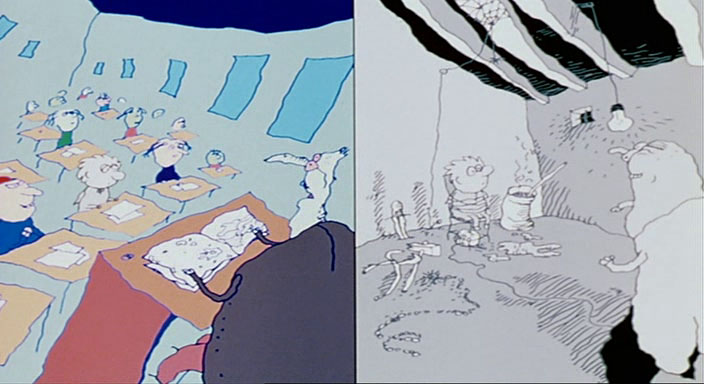
Emily Prime is contacted by her third-generation clone, discussing memory, robots, love and life in the outernet of the future.

Only 16 minutes long but I watched it seven times.

Choose You (2013, Spike Jonze & Chris Milk)

Written by Lena Dunham and directed by Spike Jonze – and yet it’s terrible? I think that’s because it’s a corporate-sponsored short made for a music video awards show. Anyway, subtitled and censored, club dude’s ex-gf is now dating DJ Michael Shannon, some girl he doesn’t even know freaks out about this, then Jason Schwartzmann hosts a choose-your-own-adventure ending and double suicide is chosen.

The Discontented Canary (1934, Rudolf Ising)

A sad caged canary gets his chance to escape, but nature beats the hell out of him, so he returns home, learning to appreciate his captivity. At least he wasn’t hit by lightning like the feral cat. Moral: life is just horrible.

The Alphabet (1968, David Lynch)

Now in high-def!

Les jeux des anges (1965, Walerian Borowczyk)

Heads roll.
Pipe organ becomes firing squad.
Angel wings.
Infinite scrolling.

Mouseover for decay:
image

The Sinking of the Lusitania (1918, Winsor McCay)

Didn’t realize this was a WWI propaganda film. “Germany, once a great and powerful nation, had done a dastardly deed in a dastardly way.”

Intro explaining how difficult the movie was to create, and plenty of title cards, so the nine minute short has maybe four minutes of animation. But the animation is real good stuff, all water and smoke.

We Give Pink Stamps (1965, Friz Freleng)

Absurd fun in a department store as the Pink Panther torments the night janitor.

Closed Mondays (1974, Will Vinton & Bob Gardiner)

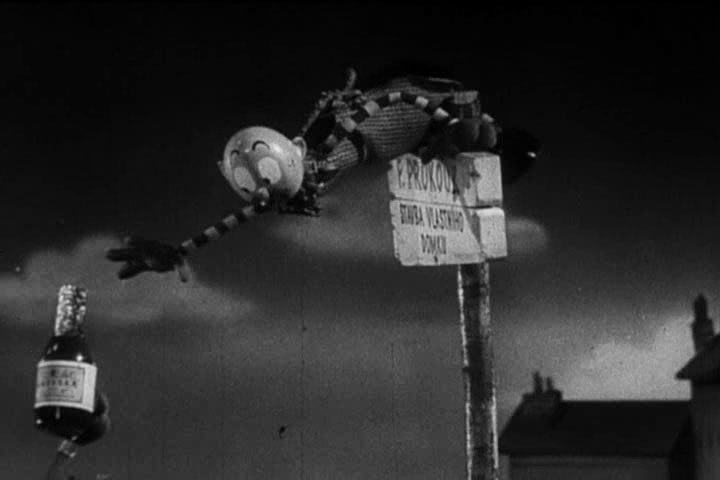
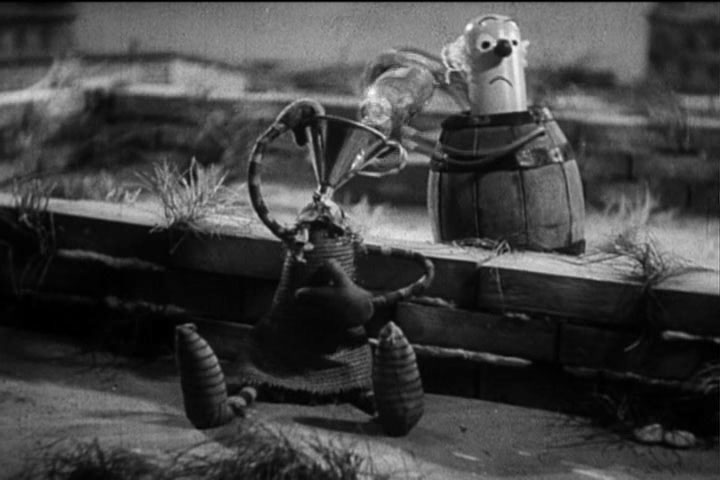
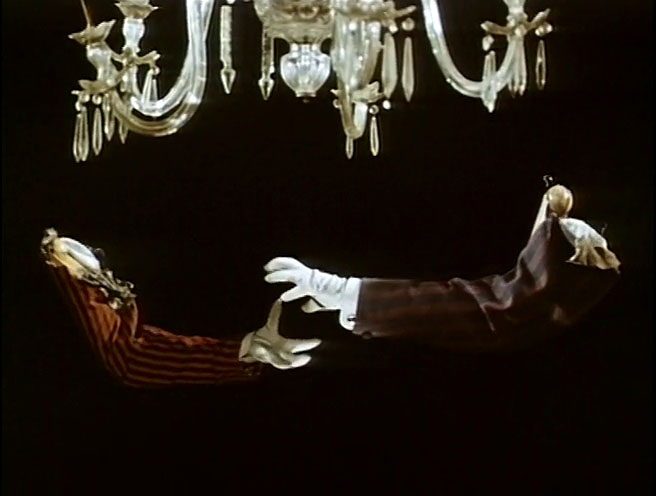
Great claymation. Wino wanders into an art gallery, hallucinates (?) all the paintings and sculptures coming to life.

Night Mail (1936 Wright & Watt)

I’ve heard this is one of the greatest short documentaries. True, it’s admirably put together, showing all the moving parts in a great, manned machine that moves the mail across England and Scotland really damn fast. And it makes you marvel at the heights of human endeavor. And it ends with a post office rap song. So yeah I was gonna say it’s just a doc about a mail train, but I guess I see their point.

Monster (2005 Jennifer Kent)

Beginnings of The Babadook (there’s a pop-up book and everything). Monster-doll grows into full monster and attacks son, mom screams at it, tells it to go to its room.

Fears (2015, Nata Metlukh)

Terrific 2-minute animated short linked by Primal.
A man literally embraces his fears.

Restaurant Dogs (1994, Eli Roth)

Student film in which an evil brigade of fast-food restaurant mascots is bloodily defeated by a young dude who’s given a mission from the Burger King himself to save his daughter the Dairy Queen. Something like that, anyway. I thought the guy only wanted to buy a milkshake, and suspected he was drunk, so I’m surprised he signed up for the murderous mission so quickly.

Given all the trademarked properties being mixed with nazi images via Terry Gilliam-style cut-out animation, I thought I’d better watch this as soon as I heard about it, rather than wait until our corporate overlords remove it from the internet like they did the Soderbergh cut of 2001: A Space Odyssey which I’d been meaning to watch. Besides Reservoir Dogs, there’s some Deer Hunter and Apocalypse Now in the grimace/hamburglar flashback scene.

Ritual (1979, Joseph Bernard)

Under three minutes, viewed online as a trailer for the new Bernard blu-ray, which I obviously need. Drawings, figures, people and scenes and stuttering colors cut together into changing rhythms and overlays. My favorite bit has an overlay of two scenes, one of which is cutting, an effect I don’t see often.

Half-hour movies of Chaplin causing havoc a hundred years ago. Guess I’d assumed they’d be better with more planned-out gags, like my favorite Keaton shorts, since Chaplin had creative control at Mutual. Fun stuff though, and the HD restorations look great.

The Floorwalker (1916)

Charlie wanders into an awful department store, with abusive employees, a thieving manager and shoplifting customers. He swaps place with lookalike Lloyd Bacon (later director of Footlight Parade and 42nd Street), and fights both manager Eric Campbell and a confounding escalator.

The Fireman (1916)

Charlie is a very bad fireman who should not rightly be in the business of saving lives. Chief Campbell is supposedly corrupt, letting Bacon’s house burn down for insurance money in exchange for Campbell getting to wed Bacon’s daughter Edna Purviance. But there are two fires and Edna is caught in one of them and I lose track of what happens but Charlie scales the building, saves Edna and they run off.

The Vagabond (1916)

Good one – Charlie (more Tramp-like than in the previous two) plays violin for spare change, gets chased out of a bar and comes across a gypsy camp where poor Edna is being cruelly mistreated, so he rescues her with speed and violence. But the plot goes on – Charlie helps her clean up and she’s discovered by painter Lloyd Bacon, whose portrait of her wins a prize, attracting the attention of Edna’s real mom, who races to rescue her presumably-kidnapped daughter. Charlie refuses payment for his part in all this, is left sad and alone as usual.

A. Vanneman:

For the first time he “saves” someone, Edna, kidnapped by Gypsies as a child and kept as a virtual slave ever since. In real life Chaplin wanted to save his mother Hannah Chaplin, first from poverty and then from madness, which he was never able to do.

One A.M. (1916)

Wrote this up back in the public-domain DVD days.

The Count (1916)

Chaplin and Campbell are tailors who crash Miss Moneybags’ society costume party hoping to hook up with a rich countess, or at least get some free booze. It doesn’t go well. By the end there’s cake and punch bowls flying into faces, flip kicks and ass beatings (also an unaccountable scene about stinky cheese). Charlie gets the hell out of there, running for his life.

The Pawnshop (1916)

Pretty bad, mostly padding with fight scenes and ladder gags. Chaplin and John Rand work for pawnshop owner Henry Bergman (later Chaplin’s assistant director). He knocks around with Purviance, destroys stuff, threatens the customers and incidentally foils a robbery.

Behind The Screen (1916)

Charlie works for Campbell in movie sets construction. There’s some business with a lever-operated trap door, striking workers and Edna pretending to be a boy to find work, then this all devolves into a pie fight. Ends with Campbell being blown to bits! Poor Eric didn’t have a mustache to twirl in this one, though all the other actors with big fake beards couldn’t stop playing with them.

The Rink (1916)

From working at a restaurant to roller skating and back again (Charlie was both a skater and waiter in Modern Times as well). There’s an attempt to add extra plot and characters (Eric Campbell and his wife are both cheaters) but mostly it’s Charlie hurting people and causing gleeful chaos.

Easy Street (1917)

Elevated by the local mission (actually by missionary Edna), Charlie decides to get his life together and become a cop. He’s assigned to the worst street in town, run by ultraviolent wife-beater Eric Campbell. Charlie defeats Campbell (twice), an angry mob and a needle junkie. Some good moves in this one.

The Cure (1917)

Back to the rich drunk character from One A.M. (“Alcoholic Gentleman” in the credits). This time, Rich Drunk heads for a spa, with hot springs (which he pollutes with booze), a frightening masseur and a confounding revolving door. Eric Campbell is a short-tempered lout with a bad foot (“Gentleman With Gout”).

The Immigrant (1917)

Seen this before. Charlie and Edna immigrate to the U.S., he helps her out a few times, they somehow get jobs and evade Eric Campbell as a sadistic waiter, then Charlie marries Edna by force.

I’ve noticed Albert Austin before (a cook in The Rink), especially liked his reactions here:

Used this same shot last time, but it’s a favorite:

The Adventurer (1917)

Watched before. Charlie is an escaped convict evading police across a beach and mountain, then an endless succession of watery rescues featuring Edna, her mother and her loser fiancee Campbell, and finally Charlie and Campbell have an ass-kicking contest at a society party.

Watched a couple new Marker-related shorts,
and rewatched some older ones in shiny new copies.


Sunday in Peking (1956) in lovely high definition


Letter from Siberia (1957)

Forgot how amazing this one is.
Songs and animation and opera, owl-led advertisements and imaginary newsreels.

“Since you can never tell how a bear will react to a camera, we were offered the protection of an armed policeman. But since we’re much more frightened of policemen than we are of bears, we politely declined.”

The Irkutsk Dam, “sitting on its own reflection like a station in outer space”:


Le Chant du Styrene (1958, Alain Resnais)

Mostly shots of the factory, with few humans.
Forgot about the rhyming voiceover.


Broadway By Light (1958, William Klein)

From Marker’s intro: “Each evening, in the centre of New York, an artificial day rises. Its purpose is to announce spectacles, sell products, and the producers of these adverts would be amazed to know that the most fascinating spectacle, the most precious product made by them, is the very street transformed by their signs.” Klein shoots the lights of Broadway, scored by cartoon-jazz music that matches the editing and light movement. Wonderful, would like to put this and some Joris Ivens and Bert Haanstra shorts on an infinite loop in my office. Klein’s first film (I only knew his Mr. Freedom before), edited by Alain Resnais.


A Valparaiso (1963, Joris Ivens) from the 2008 restoration


Junkopia (1981)

Uses the sort of electronically-processed sound he’d be featuring in his next full-length film, Sans Soleil.


Eclipse (1999)

On a day when everyone is looking at a solar eclipse through special glasses, Marker watches the watchers instead. First half has live sound at a hippo sculpture park, then he switches to slow motion and electronic music and goes elsewhere (the zoo? there are owls).


Description of a Memory (2007, Dan Geva)

I didn’t rewatch my terrible-quality copy of Marker’s Description of a Struggle, but instead tried this doc, the second feature-length film I’ve seen this year made in response to a Chris Marker-related film. Geva shows the Marker film and stills to locals, asks about the people who appeared in the original. Reminds me of Marker’s friend Agnes Varda, her periodic returns to previous films through documentaries and shorts and DVD extras. Geva is investigating images and memories a la Marker and Varda, turning out a worthy follow-up to the original feature.

Of the happy kid riding a cart down a hilly street: “British policeman bashed his head with an iron rod. Gone a bit mad since.

“Noah Rosenfeld, who fulfilled his dream to become a chess champion.”


More Marker:
Far From Vietnam is out in HD. The Confession is also out, and includes the Arthur London short. Mémoires pour Simone still lacks subtitles, as do most of the 1969-1970 shorts. Oh, and it looks like new copies of Description of a Struggle and Blue Helmet just came out – will save those for another day.

Chess Nuts (1932)

Where I last left off with Betty Boop cartoons: a less-than-thrilling circus romp with Koko the Clown from 1932, but previous to that was the insane and wonderful Bimbo’s Initiation. All three characters are back in this one. I think Bimbo is a dog, but he’s pretty uninteresting, like Mickey Mouse minus the voice and ears. Anyway this opens with a live-action chess game then turns into the animated world of the chess pieces. Queen Boop is kidnapped by a wicked king and Bimbo comes to the rescue. No lipsync on dialogue, Popeye-style, except during songs. These are the ideal cartoon shorts – fun and extremely inventive, never content to have a character walk from here to there without trying something new (“what if he’s high-stepping but his shoes glide forth independently of his feet?”)

The Betty Boop Limited (1932)

The crew travels by train to their next short-film adventure. Betty sings a song. Train hits a cow, which transforms into bottles of milk, in a scene I played over and over.

Betty Boop, M.D. (1932)

Betty and gang sell snake oil to townspeople, who experience psychosomatic symptoms.

Betty Boop’s Bamboo Isle (1932)

Okay I was surprised that Boop is blacked up until I realized it’s a damn cartoon and that she’s no more “white” than anything else, so I relaxed for a second then “white” Bimbo blacks up to escape capture by the earringed and bone-haired island natives, so I suppose that’s license to be offended but there’s too much else going on… like Betty doing a topless hula dance (apparently rotoscoped from the live-action dance that opens the short). Sure she’s got a lei covering her boops, but still. Took a wikipedia sidetrack and discovered that animator Shamus Culhane married Chico Marx’s daughter, so there’s your Boop/Marx connection.

Betty Boop’s Birthday Party (1933)

Watched one with Katy, who enjoyed it more than she expected to. Betty hangs out at home with all her sentient objects, like the Beauty and the Beast castle gone haywire, when her friends (Bimbo, Koko, a hundred others) show up to throw her a surprise birthday party ending in a huge food fight. Of course it ends with Betty hugging George Washington.

All these Boops were by Dave Fleischer, and I also managed to watch one other short…

Good Mothers (1942, Carl Theodor Dreyer)

Work-for-hire shorts made for government organizations by great filmmakers don’t tend to be essential. This one was pretty surprising, though – an ad for the Mother’s Aid group, which convinces young mothers not to have abortions (“Erna has listened to reason and has decided to give birth to her child”). They also convince Erna not to give up her kid for adoption by forcing a waiting period before she decides, during which she bonds with the kid. But Erna can’t afford a child… no worries, Mother’s Aid teaches her how to make her own clothes, and make baby toys out of paper. There’s no further mention of the job Erna was afraid of losing by having the baby, or where she finds time to work, raise the kid and make all these paper toys. Finally they teach Erna songs to sing her kid. I didn’t realize this was a primary problem for mothers, not knowing what songs to sing, but Mother’s Aid wants particular songs: “Poor little negro boy / he is black from tip to toe.”

Dreyer made this just before Day of Wrath, and given his own upbringing (unmarried mother, orphanages, adoption) and conservative leanings, I’m sure it’s of interest to biographers at least. More importantly, it was Dreyer’s re-entry into Danish cinema, proof that he could produce an appealing film inexpensively, after his reputation of excess in the silent era, and after the success of this short he worked on ten more government shorts over the next decade.

Baby power!

It’s stupid to chuckle at foreign words, but I can’t help it when the end title card for a short about pregnant unmarried women reads:

Premiered accompanying a feature by Christen Jul, the cowriter of Dreyer’s previous film Vampyr.

Oh no, I got behind on the blog and didn’t write about these.
I tend to forget shorts pretty fast, so I’m using web sources to recall which of these was which.

Me and My Moulton (Torill Kove)
Narrated memoir of three girls growing up in a normal town with not-normal parents – they are art and design obsessed, and when the kids ask for bicycles they finally get a weird one the proud parents have mail-ordered. Kove won best picture in 2006 for The Danish Poet.

Feast (Patrick Osborne)
We saw this before, playing with Big Hero 6, and I forgot to mention it then. Dog’s-eye-view of food, food, doomed human relationship, more food. Osborne worked on Bolt, Tangled and Wreck-It Ralph.

The Bigger Picture (Daisy Jacobs)
One of my favorite things: wall drawings and real objects interacting, 2D and 3D blending, like the drawn animations on paper-mache backgrounds in Rocks In My Pockets, or in a different sense, the dimension-based drama of Rabbit and Deer. But while I love the idea, it’s still a drab little story about fighting siblings and a dying parent.

A Single Life (Blaauw/Oprins/Roggeveen)
My favorite – also the shortest. Woman puts a 45 on the player, and finds that if she skips to different parts of the record, she travels to different times in her own life. IMDB claims the story was conceived on a drunken college night.

The Dam Keeper (Kondo & Tsutsumi)
Lonely pig runs the windmill that keeps the darkness at bay, but nobody in town loves or respects him so one day he lets the darkness in. Both directors worked on Pixar movies. This was cool, dark and imaginative, so naturally there’s talk of sequels and franchises and live-action remakes.

Sweet Cocoon (Bernard/Bruget/Duret/Marco/Puiraveau)
A student film, I think. A caterpillar is fat!

Duet (Glen Keane)
Keane has been in animation forever, was a lead character animator on many Disney features, and this is his first solo film. A boy is sporty, and a girl is graceful, and they like each other, all in one continual, fluid animation. Katy thought it reinforced oppressive gender roles, but that was before she saw the new Cinderella.

Footprints (Bill Plympton)
Moebius-strip footprint-following detective story.

Bus Story (Tali)
Another memoir, this time of a young woman who dreams of being a bus driver, so rents a shitty bus from its grumpy owner. Tali made La Pirouette, which I saw in 2002 and liked, though I can’t remember at all.

Incoherence (1994, Bong Joon-ho)

Bong’s half-hour student short has been on my laptop for ages, and since I’d just watched Coherence, I couldn’t resist pairing these. I’m guessing it’s closer in tone to his unseen Barking Dogs Never Bite than his more sinister features of the 2000’s. Three comic chapters, each featuring a man in a position of power doing something immoral (professor reading porn in his office, business exec stealing milk from stranger’s front step, lawyer getting drunk and belligerent) with an epilogue of the three appearing on a panel show to discuss morality and self-control. The drunk prosecutor would go on to play a detective in Memories of Murder.

Light Is Calling (2004, Bill Morrison)

Like a Decasia outtakes short. Scenes from The Bells (1926, James Young), destroyed and decayed, set to serious violin music. The director of Begotten probably cries himself to sleep watching this.

Three Video Haikus (1994, Chris Marker)

Firstly, some manipulated digital video of a river under a bridge.

Catherine Belkhodja from Level Five smokes a cigarette, each exhale punctuated with superimposition of an owl in flight. I think the smoking is the same footage from Marker’s Silent Movie. These first two were set to piano music.

The third has opening and closing titles, static shot of railroad tracks, and electronic sfx, and I think was supposed to be humorous?

Tomatoes Another Day (1930, James Sibley Watson)

I didn’t know indie goof-off sound shorts existed in 1930. Where’d they get the equipment? Oddball talkie featuring a wife, her husband and her lover playing out a predestined scene while flatly speaking their every thought (“You are my husband”). The second half is full of punny wordplay like the title line, which the Portuguese subtitles on Youtube faithfully translate as “outro dia de tomates”.

This is Watson of Watson & Webber, following up their Fall of the House of Usher. A. Grossman, who brought the movie to my attention with a Bright Lights article, calls it a “satire of the redundancy of talkie cinema, in which image and sound are inflexibly congruent” … “a revelation that the silent trance, when granted sound, becomes embarrassingly demystified.”

On Departure (2012, Eoin Duffy)

The Missing Scarf finally showed up online, so after failing to impress Katy with that, I watched Duffy’s other popular success. Depressed alien goes on a business trip… then, as tends to happen at the end of his movies, the world ends. Actually I read an interview with Duffy, and this is about something else entirely, but I’m gonna gonna stick with my interpretation.

Sausage (2013, Robert Grieves)

Local craft food sellers work together to defeat mustache-twirling corporate foodlike-product manufacturer. Populace is easily distracted by whatever shiny new thing tries to catch their attentions. Movie shows the public swayed by price and spectacle (true) and turning up their noses at gross combinations of things like hotdog-in-a-donut (sadly not true).

Three Little Bops (1957, Friz Freleng)

I’d planned to follow up Shocktober with Animation November but cancelled… still watched a few Looney Tunes, though. Wolf vs. Three Pigs story retold in the jazz age. At the end, the wolf dies, goes to hell, returns as a ghost sitting in with the pigs on trumpet. Could they not get a vocalist who could sing on the beat… or is that jazz? Great line: “The Dew Drop Inn did drop down.”

Duck Soup to Nuts (1944, Friz Freleng)

Porky goes duck hunting. Daffy does his thing, gets away.

Ali Baba Bunny (1957, Chuck Jones)

Bugs and Daffy are buddies on vacation together until Bugs digs ’em into an Arabian treasure cavern and DD gets greedy. Showdown with the Sultan’s enforcer follows. DD gets shrunk by a genie. Stereotypes abound, but this is all better than it sounds.

Transylvania 6-5000 (1963, Chuck Jones)

The one with the two-headed bird-witch. Bugs stays at a vampire’s castle, learns some useful magic words. Remade in the 80’s with Jeff Goldblum and Geena Davis,

Vampire vs. umpire:

Porky in Wackyland (1938, Robert Clampett)

Katy’s first time in Wackyland – she seemed annoyed at just how wacky this was, decried the “darkest africa” bit, asked if that’s what dodos really looked like, and claims scientists are trying to clone new ones.

Boop-Oop-a-Doop (1932, Dave Fleischer)

Less nuts than my favorite Boops can be. A couple terrific visual gags, some good cartoon weirdness (sinister circus ringmaster has a mighty morphing mustache, empty seats applaud on their own) and one song (“don’t take my boop-oop-a-doop away”) but Betty’s act only amounts to whipping lions, and her standard damsel-in-distress scene (saved by Koko the Clown) is uninspiring.

Arcana (2011, Henry Hills)

A half hour of zen based on a “treatment” by John Zorn (a numbered list of things) and featuring his music. I always love Hills’s editing (less extreme here than I’ve seen before), so this is enjoyable and relaxing, with seemingly no rhyme or reason to the order of events. I fell asleep to this a couple times in Georgia but only now watched it all the way through. Katy also praised the movie when I used it once as a kitchen screensaver.

Premonition Following an Evil Deed (1995, David Lynch)

David Lynch’s mysterious contribution to the Lumiere and Co. anthology, now in high-def. I think police discover a dead body and inform the family, and in between there’s a weird alien lab with a brilliant burning-paper scene transition.

Festi (2014, Arcade Fire)

Someone is possessed by the ghost of Jim Morrison, who wants to murder Will Butler and Richard Parry, presumably for releasing solo albums. He chases them with a knife saying “these guys won a fucking grammy?” Richard dies running into an electric fence. Terry Gilliam cameos. This is a celeb goofoff with pretty bad camerawork.

Haha, creepy National twins:

Alone (2014, Jeremiah Kipp)

This is a nice eye-cleanser after the sub-amateur cinematography of the Arcade Fire piece.
Adam Ginsberg reads a Poe poem with gorgeous cutaways.

The Minions (2014, Jeremiah Kipp)

“You walked down the witches’ path, didn’t you?”

William helps pick up incredibly drunk girl on the sidewalk and get her home. But drunk girl acts very attracted to poor William, and reminds him of voiceover witch who is presenting him with moral dilemma. I don’t think this is out yet, so will say no more, besides that Kipp seems prolific, puts out consistently high-quality work, and is the only person who emails me to preview his movies and I’ll say yes.

Berenice (2014, Jeremiah Kipp)

I’ve just watched the Rohmer version – this one is set in modern day, so dialogue has been rewritten, and has a 100% more horrifying ending (she wakes up entombed, blood-spattered, her teeth having been removed by her bonkers fiancee). Hmmm both of the last two shorts ended up featuring regular guys who end up being creeps helping to carry passed-out women. Found this on IMDB under the anthology Creepers.

L’etrange Portrait de le Dame en Jaune (2004 Cattet & Forzani)

After Amer and Strange Color I’m out of Cattet & Forzani features, so catching up on the shorts. Of course it’s about a woman’s murder by a black-gloved stranger, but this time no fancy editing since it’s a single take shot through a mirror, which breaks at the end, so at least there’s a semblance of the directors’ favorite split-screen effect

Santos Palace (2006 Cattet & Forzani)

Watched in unsubtitled French and Spanish. Almost-affair-and/or-murder between barista and customer is interrupted. As usual, delectable editing and audio.

Chambre Jaune (2002 Cattet & Forzani)

Most of this is in such extreme slow-motion that it looks like Dog’s Dialogue-style stills. Music box song… black gloved hand holds a razor… somewhat storyless sex/murder/fetish flick. They love keyholes and the creaking sound of leather.

Catharsis (2001 Cattet & Forzani)

Their most explicitly gruesome movie. A La Jetee low-frame-rate loop-film. A man arrives naked in a room, is killed and chopped to bits by gloved stabber played by the same man, who then arrives naked in the room, etc.

La Fin de Notre Amour (2004 Cattet & Forzani)

Guess I saved the most disturbed one for last. Entirely told in still images, man seems like a more artistic Frank from Hellraiser, very into razors and masochism, then leather-clad woman shows up and they destroy each other in creative new ways.

I ran out of screen shots – may have used the wrong one for the wrong movie…

Our first time at Film Streams in Omaha, which is playing great stuff (Celine & Julie, Je t’aime, je t’aime, Boyhood, the Nick Cave movie) and is located right next to the Saddle Creek shop and the club where The New Pornographers are playing. This was a groovy screening of finely restored Hubley shorts, which looked just brilliant. Katy enjoyed half of them, dozed during the others.

Covered in a post last year:
The Hat, Eggs, The Adventures of *, Moonbird and Urbanissimo

Of Men and Demons (1969)

Man starts to build himself a nice place to live and hunt and work and play, and demons of fire, water and lightning mess it all up. So he teams up with a woman, builds a stronger base with whole manufacturing plants, and the demons find ways to turn his work against him. It ends (either hopefully or ominously, depending on your outlook) with computer technology being the new invention. Some animation by Omaha-born Art Babbitt, creator of Goofy. This lost the oscar to It’s Tough to Be a Bird by John’s former Disney coworker Ward Kimball.

The Tender Game (1958)

Lovely little love story, flower girl meets a gardener. Wordless and slightly abstract, set to an Ella Fitzgerald song, more like a painted music video than anything else here. Some wild techniques – I love the scratchy static as surface motion on the lake.

Windy Day (1968)

Young Emily and younger Georgia are attempting to put on a play with a knight and princess, but Georgia keeps breaking character, asking questions, and changing their characters into kangaroos. Lost the oscar to Winnie the Pooh and the Blustery Day.

Last time I was in love with both The Hat and Moonbird – funny how those are the two I complained about this time, saying The Hat was too rambling and Windy Day outdoes Moonbird in every way.

This seemed like a good time to check out the Hubley DVD that came with an issue of The Believer.

A Date With Dizzy (1958)

Real crackly soundtrack on this one. Ridiculous plot, not brilliantly acted, in which Dizzy Gillespie and his band are being asked to score a TV ad for a fake product (“instant rope ladder”). We see a pencil test for that, plus three completed-looking ads for real products, and hear some good mini-songs by the band, with the dialogue scenes the filler between.

Cockaboody (1973)

Like an indoor, bedtime version of Windy Day. This was made years later but the girls seem about the same age, so I’m guessing the sound recordings for both movies were made the same year. Best part is when Georgia is upset, which the animation shows by having a grey storm start in her belly and form into wild animals jumping through her mouth as she screams. Katy tells me this all sounded obnoxious from the other room.

The Hole (1962)

The original improvised-dialogue Dizzy Gillespie short, predating The Hat, this time with Dizzy and George Mathews as construction workers talking about the big issues, fate and accidents, with a nuclear twist ending. Unlike The Hat and Moonbird, this one seemed better than I remembered it. Maybe it’s about how long I wait between viewings. Animators are Gary Mooney (from Lady and the Tramp and Sleeping Beauty to Four Rooms and Jurassic Park) and Bill Littlejohn (from the Parrotville series in the 1930’s to all the Charlie Brown specials, The Phantom Tollbooth and Watership Down.
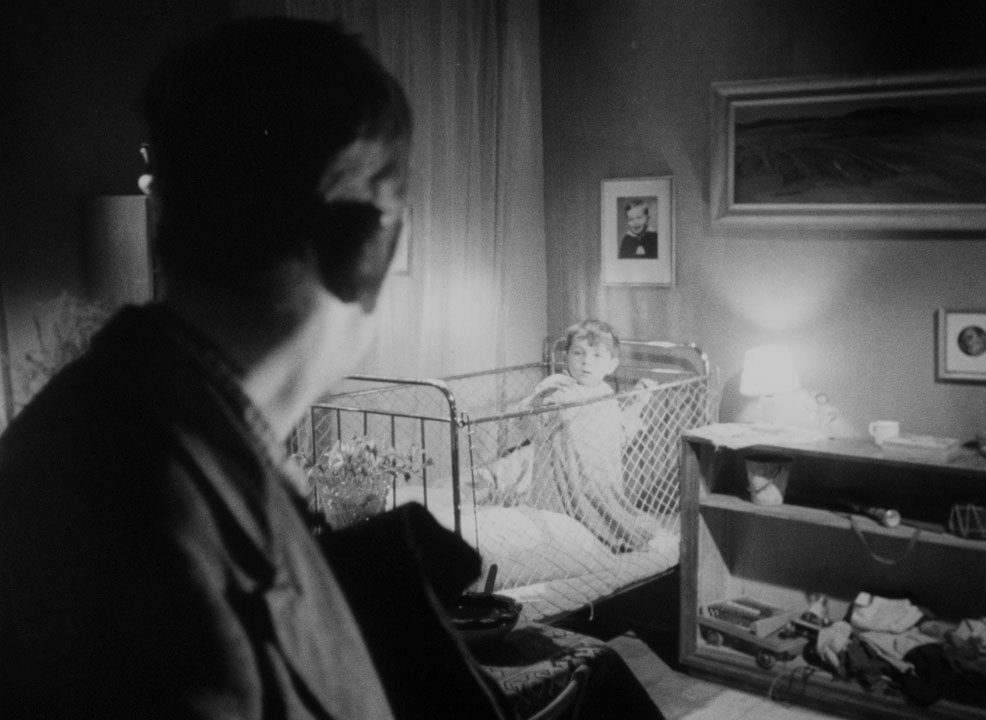
The disc includes five more advertisements that weren’t in Date With Dizzy. Best is the very short Sanforized piece, but also notable is the three-minute short about what pretentious know-it-alls PBS watchers can be. What ever happened to “flavor maker” dog food sauce?

Plus home movies and photographs and behind-the-scenes footage for Cockaboody. Real cool DVD, can’t believe it came free with a magazine.

Berenice (1954, Eric Rohmer)

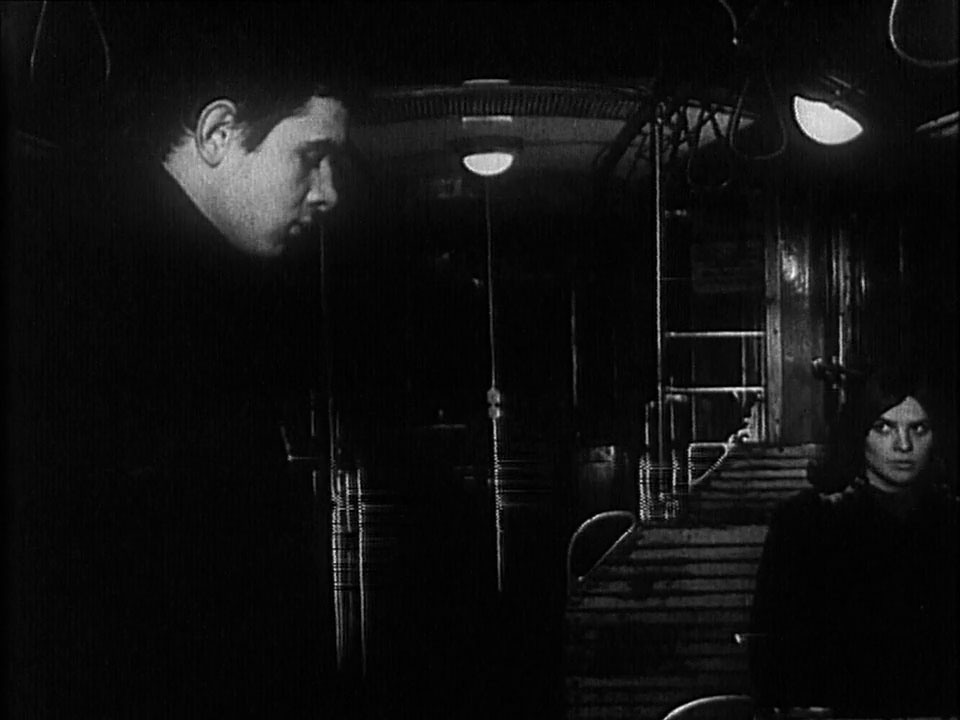
An Edgar Allen Poe story about a talky, sickly shut-in who stares at everyday objects all day is an odd choice for your first film. The guy (Rohmer himself!) lives with an epileptic cousin, becomes monomaniacally obsessed with her teeth, and eventually they get engaged since neither can deal with the outside world. But she dies one night, and he takes this very melodramatically, then awakens from a fugue days later having dug up the grave and stolen the teeth. It’s all narration and sound effects, shot by Jacques Rivette, still a couple years before his debut short.
Khan Khanne (2014, Jean-Luc Godard)

“This is not a film anymore, although it is my best.” What Godard sent to this year’s Cannes instead of appearing in person. Godard is his usual latter-day self, acting the scatterbrained professor, possibly quoting Hannah Arendt and/or referencing Chris Marker, cutting in excerpts from Alphaville and King Lear, using camera shots and sound editing that make it seem like he doesn’t know what he’s doing, ultimately making little sense to me, but with a weirdo bravado.

Adieu a TNS (1998, Jean-Luc Godard)

Swaying, smoking, Godard recites a singsongy poem over gentle accordion in three parts, the framing tighter each time. I’ve read that this was “a bitter and mournful farewell to the National Theater of Strasbourg.”

The Accordion (2010, Jafar Panahi)

Two brothers play music for spare change, not realizing they’re outside a mosque. A guy threatens to report them to the police, takes their accordion and runs. But it turns out he’s just a poor bastard hoping to earn money with the instrument, so the kids join him instead of killing him with a rock, which had been the other option.

The Nest (2014, David Cronenberg)

Single-take nine-minute shot from first-person perspective of surgeon (Cronenberg) interviewing patient (Evelyne Brochu, Tom’s ally/coworker in Tom at the Farm) who claims she has a wasps nest inside her left breast. Doubles as a commissioned short for some exhibition and a trailer for his first novel, Consumed, out this fall.

Gradiva (2014, Leos Carax)

Another gallery commission featuring a naked girl. This time the girl has gone to buy cigarettes, returns and has a short conversation with Rodin’s The Thinker.

The Legend of Hallowdega (2010, Terry Gilliam)

Unfunny fake investigation into haunted goings-on at the Talladega racetrack from a Daily Show writer. Just terrible. I won’t give away the twist comedic ending because I’m too embarrassed. Ends with a nice Wolf Parade song, at least.

On demande une brute (1934, Charles Barrois)

Early Jacques Tati, who wrote and starred as a hapless actor who accidentally signs up to be a wrestler. Despite all the time spent on audition scenes and the wrestling match, the only good bit is when he tries to keep his shrew wife from absentmindedly eating a pet fish at the dinner table.

Gravesend (2007, Steve McQueen)

Beautiful shots that seem to go on longer than they should, check, yep it’s the guy who made Hunger. One of those art installation pieces that is very cool to read about and less fun to watch. I wanted to like it, and almost did…

From the official description:

Gravesend uses a documentary approach to focus on the mining of coltan, employed in the manufacture of cell phones, laptops and other high-tech apparatus. The film cuts between two sites: a technological, highly automated industrial plant in the West where the precious metal is processed for the final production of microelectronic parts, and the central Congo, where miners use simple shovels or their bare hands to extract, wash and collect the ore on leaves. .. coltan, traded at an extremely high price, represents one of the key financial factors in the armed conflict of the militia in the Democratic Republic of the Congo, where decades of civil war have cost several million human lives.

Away From It All (1979, John Cleese & Clare Taylor)

Fake travelogue disguised to look and sound like a real one (unless you recognize John Cleese’s voice), very gradually straying from the company line, slipping in notes of humor and aggression. Stock footage takes us from Rome to Venice to Ireland to Bulgaria to Vienna to New York, back to Venice to Acapulco, to a rapid montage of vacation spots as the narrator begins ranting about existential terror. Accompanied Life of Brian in British theaters.