This must be the best book I’ve read on the work of a director. It’s organized just how I’d like, with articles covering all aspects of Tashlin’s work (with little overlap), interviews with Tashlin and with others about Tashlin, excerpts from his cartoons, plenty of photographs, critical write-ups of each film he directed and detailed chronology and filmography of all his work. I read the library copy straight through. Gotta adjust myself to not being able to put it on my shelf of film books since it’s so far out of print… can’t own everything, ya know.

Some edited excerpts:

Jonathan Rosenbaum:

It seems to me that “Tashlinesque” can mean one or more of five different strains in the contemporary cinema which I will list below, with appropriate examples…

A. Graphic expression in shapes, colors, costumes, settings and facial expressions derived from both animated and still cartoons and comic books: The 500 Fingers of Dr. T., I Want To Go Home, Dick Tracy

B. Sexual hysteria – usually (if not invariably) grounded in the combination of male adolescent lust and 1950s’ notions of feminine voluptuousness: Seven Year Itch, The Nutty Professor, Lord Love a Duck, The Man With Two Brains

C. Vulgar modernism: a “popular, ironic, somewhat dehumanized mode reflexively concerned with the specific properties of its medium or the conditions of its making” (Hoberman): Duck Amuck, Hellzapoppin’, Sullivan’s Travels, The Patsy, Real Life, The Purple Rose of Cairo

D. Intertextual film references: Shoot The Piano Player, Zazie dans le metro, Celine & Julie Go Boating, Who Framed Roger Rabbit

E. Contemporary social satire: products, gadgets, fads, trends: Christmas In July, A King in New York, Mon oncle, Tampopo


J. Hoberman

Tashlin’s films ultimately have less to do with the production of cultural forms than with their packaging and consumption. His America is a nation of robotic image junkies whose minds have been colonized by the media. Jerry Lewis’s landlady in Rock-a-Bye Baby does exactly what TV commercials tell her to do, even to the point of dying her hair vermilion; the movie fans in Hollywood or Bust and Rock Hunter are little more than popcorn and fan-mag consuming zombies. The protagonist of The Girl Can’t Help It is made to hallucinate singer Julie London every time he hears one of her records on a jukebox.


Bernard Eisenschitz

Although Truffaut and his colleagues at Cahiers knew little English and even less about contemporary trends in American theater and jazz… they were not caught unawares by The Girl Can’t Help It and Hollywood or Bust. Rivette, Rohmer and Truffaut rated them “masterpieces” in the same month as The Wrong Man and Chikamatsu monogatari. A phantasy view of America to be sure, but no less valid than the recent sociological approach, in which films have little place. Tashlin not only identified and denounced the contradiction of American cinema, but also embodied it, since the ambivalence of his films makes it impossible to say which side he is taking, or to be sure that he is not exploiting the very thing that he is denouncing. The Cahiers group did not only see Tashlin as radically destructive, they also appreciated the sheer beauty of what he showed.

Playing to the French title of Hollywood or Bust, Charles Bitsch wrote, “A true movie nut, Tashlin is the first to have made films for other true movie nuts.”


Tashlin in 1964

Cartoons are a very stimulating medium. For animators, the joke reigns supreme. But it’s also a world of enslavement. The world of an animator, no matter how fertile his ideas may be, is in the end, a confined frame, a tiny glass cel where his creations come to life. It’s as though the whole universe were reduced to a series of postcards. You spend your whole life splicing, flipping through cel sheets, drawing frame by frame. After a few years the whole thing becomes so debilitating that you lose all contact with the real world.

same interview, after he’d quit working at Disney in 1941…

I sought refuge at Leon Schlesinger’s where I worked on the Merrie Melodies and Looney Tunes cartoons, then went to Screen Gems at Columbia where John Hubley and I developed the “Fox and Crow” series. I became a gagman for Harpo Marx in A Night In Casablanca. The mirror sequence, which I invented specially for him, was a series of variations on an old gag … Then I worked for Eddie Bracken, and later for Bob Hope.


Tashlin in 1962

I really hate television. It’s no experience. You sit at home, you don’t get dressed and go out. It’s free – the audience doesn’t participate – they sit there and turn the dial and be critical. I detest it.


1994 interview with Bill Krohn and Joe Dante:

BK: So much live-action filmmaking today is influenced by cartoons which he was the first to do, but so little of it has any social pertinence.
JD: That’s because he was influenced by better cartoons. The people who are doing cartoons today are basing them on The Flintstones. That was the nadir; cartoons were disappearing as cartoons and becoming radio shows. Doing live-action cartoons – movies like L’il Abner, Popeye – it’s a very tough thing to do. But the Flintstones themselves were so uncartoonlike that it’ll be a little easier to translate them into live action. Whereas to do Bugs Bunny, or to do characters that really are fanciful, you just can’t do that in live action.


Mike Barrier interviews Tashlin in 1971

MB: I understand you worked on the very first development of Lady and the Tramp too.
FT: That’s right, Sam [Cobean] and I did that whole story; I’d forgotten about that.
MB: Were you working from the story that Ward Greene wrote?
FT: I don’t recall the book. Joe Grant had modeled the dog, Lady, and Sam and I did a story. I never saw the film… I think we had rats coming after the baby at the end… did they have that? Then that’s what we did.

MB: You’ve mentioned that when you made your cartoons, you were looking forward to feature work. Now that you’ve been making features for many years, have there been occasions when you’ve looked back to your cartoon work and tried to get a cartoon flavor in some of your films?
FT: Oh I guess quite often, because all the reviewers – Truffaut and Godard and all these people when they were reviewers on Cahiers du Cinema, they always treated my films, my Jerry Lewis films and all, as a cartoon. I did a picture with Tom Ewell and Jayne Mansfield [The Girl Can’t Help It] and as far as they were concerned, that was a Tom and Jerry cartoon, and the fact that his name was Tom and hers was Jerri – which I never thought of – they said, “She is the cat and he is the mouse.”


From the chronology:

1952 – Tashlin spends nearly six months working with Robert Welch on the script for “Sapphire Sal,” later re-titled Red Garters. Tashlin is originally set to direct, but when he checks off the Paramount lot in late August the production is put on hold awaiting the loan-out of Jane Russell from RKO. (Red Garters, not produced until 1954, ultimately stars Rosemary Clooney, with screenplay credit going to Michael Fessier.)

Been enjoying this show. After reading a heated online fight between auteurists over whether a single episode of the show can be judged as “a film by” the episode’s director apart from the rest of the series, I gave the idea two seconds’ worth of thought before ruling it total bunk.

But out of curiosity, the episodes were directed by: Clark Johnson (former Cronenberg effects artist, dir. SWAT with Sam L. Jackson), Clement Virgo (movie Rude which played Cannes & starred Clark Johnson), our old friend Peter Medak (The Washingtonians, The Ruling Class), Ed Bianchi (Deadwood), Joe Chappelle (Hellraiser 4, Halloween 6 and Hackers 2), Gloria Muzio (20+ different TV shows), Milcho Manchevski (Criterion-anointed classic Before The Rain), Brad Anderson (The Machinist, Session 9, Sounds Like), Steve Shill (Knight Rider relaunch pilot, upcoming Beyonce movie) and Timothy Van Patten (star of Master Ninja).

I’d love to say that everyone mumbled in the Van Patten episode, screamed in the Medak episode, and lost 50 pounds to appear in the Anderson episode, but it don’t work like that. The true heroes: Written and produced by ex-Baltimore-PD Ed Burns (also Generation Kill and The Corner) and David Simon (those two plus Homicide: Life on the Street).

Too many actors to go through… I mean, they were all in movies I’ve seen in roles I don’t remember, so I’ll catch them next time. Noticed a few of ’em came up in the same movie though, one called Perfume (not the Tom Tykwer) written and produced by David Holzman himself. Also notably, McNulty was third-billed in 300. Of the dead, club owner Orlando has since appeared in a TV movie starring Alan Rickman and Mos Def, and young Wallace moved on to All My Children and is co-starring in an Atlanta-shot movie with Keith David and Ernie Hudson this year.

Since Fantoma is not ever going to release this on DVD (with Christa Lang commentary) like they promised to do, the dirty rats, I found a copy elsewhere and finally watched it. And it’s good! Criterion started our national reappraisal of the great Sam Fuller mid-career with The Naked Kiss and Shock Corridor, then moved on to the early films with that Eclipse set, now this week they’re hitting his late period with White Dog, so I’m participating with this pre-Big Red One episode from his forgotten days in the ghetto of television.

This is an episode of a German cop show from 1970 which is still running. I can’t imagine why an American director was allowed to write and direct a German TV episode in English… we’d certainly never invite Werner Herzog to shoot an all-German episode of Law & Order. The producer must’ve been a Naked Kiss fan. Anyway, it’s over 90 minutes long and there’s no indication of regular characters or a running plot or a teaser for next week’s episode, so I’m not sure what format this cop show takes… this played like a standalone film in TV picture-ratio.

I enjoyed the movie quite a lot. It’s technically excellent at times, but when time or budget didn’t allow for excellence they played it loose and fun. Acting isn’t so strong – Christa (Sam’s wife) overdoes it at times, and lead man Sandy (Glenn Corbett of The Crimson Kimono) is generically TV-crappy. I wouldn’t call the incidental music by “The” Can amazing, but has its moments. Fuller (or whoever) gets points for hiring the ultra-hip Can in the first place. The double-agent spy story is pretty cool, but the way it’s pulled off visually is beyond cool. Check it:

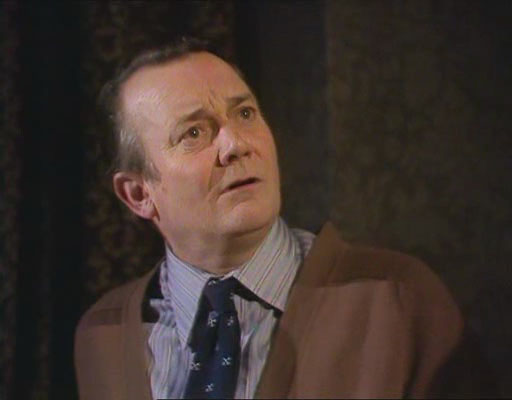
How our hero is introduced – he’s the dude in the middle, and that’s his murdered partner on the table:
image

How Christa is introduced, walking past a giant poster of Frank… this movie is very clued-in musically:
image

Some Citizen Kane hole-in-the-floor cinematography:
image

Fuller is having fun with this movie. They watch Rio Bravo, there are characters named Novak and Bogdanovich, and Fuller cameos offscreen as The Senator with a framed picture of Nixon on the wall and a novel by one Samuel Fuller prominently placed on the desk.
image

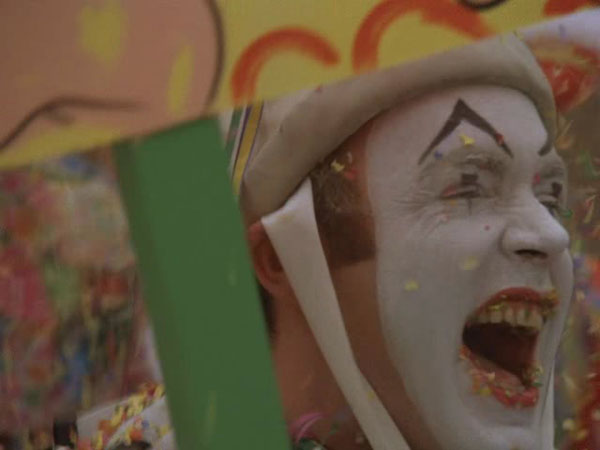
And then there’s this guy, with the fantastic name of Charlie Umlaut. I’m not sure what his deal is – I think he might’ve killed our cop’s partner, then at the end he shows up in a parade in clownface, screaming his own name until he’s caught and killed. Whatever it meant, it certainly livened up the picture.
image

Very nice cinematography of German cities (Bonn, Cologne) by Jerzy Lipman, who shot early Wajda films and Knife in the Water.
image

Oh right, the plot. Christa works for fey evil rich guy Mensur. She drugs famous people, poses with them in lewd positions, then blackmails them with the photos. Sandy, our cop, shows up far-fetchedly claiming to be in the same business and happening to pick Christa to perform the same job she does for Mensur. Eventually she’s in on his plot and supposedly helping him, but it all gets twisted up, and in the end he’s challenged to a hilariously unconvincing fencing duel in Mensur’s office, which Mensur inexplicably loses.

Mensur, top, is Anton Diffring (of Tusk and Fahrenheit 451).
image

Christa:
image

Christa:
image

Christa!
image

Ronny Yu’s entry is my first dip into Fear Itself, aka Masters of Horror season 3. As before, I’m counting them as movies even though they’re obviously not. Don’t know if I’ll be watching more of these until either the promised uncut DVDs come out, or it becomes apparent that they never will. Yu, who brought the Freddy, Jason AND Chucky series to new heights (but whose Jet Li retirement film was so bad, Jet Li had to cancel his retirement) brings no style at all to this slightly gruesome but otherwise standard twilight-zoney story.

A guy from Tigerland and the new Star Trek is a bad criminal who murders families, and a guy from some show called Eureka is the perfect church-going dad, then as they both lay dying in a hospital, they switch bodies and our good dad is in prison being tried for the death penalty while the bad guy is trying to deal with work and family.

image

Written by a guy who did some Carnivàle episodes. Not really a horror story, just an identity-swap thing with a twist ending: dad escapes from prison, there’s a fight, they switch back into their real bodies, but the criminal has murdered dad’s family as dad, so now dad will go back to prison, haha. John Landis’s season-two Family beats this by a mile. This ep was an okay time-waster, not worth watching again on the DVDs… can’t imagine what would’ve been cut out.

I.
Movie opens exactly how I would’ve opened a Tom Petty movie, with a concert performance of “You Wreck Me”. And this is a four-hour movie, a four-HOUR movie, so I thought we’d have some breathing room and could afford the four minutes to hear the whole song uncut, set the stage for your epic Tom Petty documentary by letting us hear a whole Tom Petty song, just so we know what exactly we’re celebrating here. But P.Bog goes the obvious talking-heads documentary route instead, cutting into the song so people like Eddie Vedder, Stevie Nicks, Dave Grohl and Johnny Depp can tell us that they love Tom Petty and his music so much. Damn, almost had something there. I guess P.Bog doesn’t want people tuning in and thinking it’s gonna be a straight-up concert, but still, I hope in the next four hours he finds time to play one song, just one song all the way through without voiceover. Can you celebrate a musician without actually playing any of his songs?

We may not get to hear a song uninterrupted, but we can enjoy watching Johnny Depp talk without any bothersome on-screen text saying “Johnny Depp”. But I didn’t recognize half the people who spoke, so if he doesn’t eventually start with the text, I’ll just never know.

But look at me complain. It’s an enjoyable show so far, talking ’bout Petty’s early obsession with rock music and his meeting Mike Campbell and Benmont Tench and early days in Mudcrutch. All songs I’ve heard before from the box set with nice home-movie footage to go with it.

II.
Tom drives to L.A. to find a record deal, gets a few of those, Mudcrutch breaks up because the studio wants Tom more than the rest of the band, and the Heartbreakers are quickly formed to replace it. Their record producer wrongly assumes that they mean the name Heartbreakers ironically. Tom is shot in arty black-and-white.

III.
First two Heartbreakers albums are out. There was all of one sentence about the second album being more difficult than the first before they cut to people raving about it. Some good live footage, some talk about drug use. And finally, one entire TV performance of a song with no cuts or voiceovers. Hoorah! A “required monthly test” on my tape cut out one talky segment. The band was initially popular in Britain before they caught on in the U.S.. Someone’s trying to convince us that Tom Petty was part of the Talking Heads/Sex Pistols rebel new-wave/punk movement, since the Heartbreakers’ roots-rock was out of fashion on the radio, replaced by bloated dinosaur rock and disco. I guess it’s a workable theory but I want to hear David Byrne’s opinion first.

IV.
Third album was a big deal. Jimmy Iovine shows up and tells us that third albums are always big deals. Petty found out he was being dicked around by his record company and he sued them… big unprecendented event, led to settlement giving Tom more control and royalties from his music and the eventual release of “Damn The Torpedoes,” feat Refugee, Even The Losers and Don’t Do Me Like That. Movie plays nearly the whole album over the story.

V.
Some pressure for the fourth album, “Hard Promises”, another great one, feat. Insider and A Woman In Love. Very nice segment on The Waiting that starts with Petty singing it acoustic, cuts into music video / studio version, then after an interview piece closes out the song with Eddie Vedder on vocals during a live performance. We lost a bass player (no hard feelings), gained a new one (Howie Epstein), won another fight with the record company (over album pricing), dealt with Stevie Nicks, and played the great Stop Dragging My Heart Around. First time diving into Tom’s angry youth, his abusive father (plenty of hard feelings) and sweet mother who died during the recording of this album after long illness. Iovine presents his theory: missing mother + abusive father = rock star. Towards the end of 1982 I drove back to work blasting Insider with the windows open. Man, it’s only 1982… how long can P.Bog keep this up? Did he ever watch the whole thing at once?

VI.
Next album “Long After Dark” (the one with “You Got Lucky”) isn’t as good as it might’ve been. Producer Jimmy Iovine is blamed for his involvement. Next album “Southern Accents” (feat. Eurythmics-penned “Don’t Come Around Here No More”) isn’t as good as it might’ve been. Producer Jimmy Iovine is blamed for his lack of involvement. We get a full pretty-recent concert performance of the song “Southern Accents”, and a brief description of the drug-fueled two year period around the Accents album leading to Tom’s smashing his left hand into a wall. P.Bog uses an innovative cutting style during this segment, and intimate camera work reminiscent of his film “Texasville”. Haaaa I’m just kidding, it’s the same ol’ interview stuff. I turned it off after a black screen announcing the end of part one. I hope part two is on my videotape!

VII.
The album: “Let Me Up (I’ve Had Enough)” feat. Bob-Dylan-co-penned “Jammin’ Me”. Here in part two, Petty’s rock cred and history firmly established, we take an immediate P.Bog-style veer towards talking about all Tom’s Famous Friends. Tom and his group back up Dylan (who hadn’t played with a band since The Band), hang out with ex-Beatles and Jeff Lynne and Otis Redding and finally form the Traveling Wilburys, marking the point when Tom went from rebel-rocker to a guy whose records my mom would buy. I haven’t seen The Last Waltz but mentions of The Band got me wondering if this is P.Bog’s answer to that movie, a big rock statement blending his two main talents of reminiscing about the old days and namechecking famous friends. Oh but I shouldn’t be mean to P.Bog, don’t really know much about him.

VIII.
Wilburys record comes out and is a huge hit, then Roy Orbison dies so that doesn’t go any further. Tom alienates the band by making a solo-ish record in “Full Moon Fever,” but it’s the biggest hit of his career and the Heartbreakers play the songs live and they don’t seem so bitter anymore.

IX.
Tom continues to alienate the band, this time with the help of Jeff Lynne, “Into The Great Wide Open” producer who likes to record the band members one at a time instead of all together like they are used to doing. New drummer joins during “Wildflower” sessions and is asked to stay permanently when old drummer finally quits. They hang out with Roger McGuinn, Johnny Depp, Dave Grohl, Faye Dunaway. “Greatest Hits” sells ten million copies after Tom is finished grumbling about it. The band gets a little happier. I’m starting to be thankful that the movie is so long. It’s been nine lunch hours so far I’ve gotten to hang out and listen to Tom Petty stories, and I always feel like playing some Petty albums when I get back to work.

X.
I didn’t think I’d end up criticizing a four-hour doc for its omissions, but when it acts like it’s telling the whole story, those omissions seem serious enough to mention. Firstly, they didn’t mention the Petty/Heartbreakers soundtrack to She’s The One. I can see not wanting to spend a lot of time on it, but they could at least mention it in passing… it’s a great album. More importantly, Tom’s cameo as the mayor of Bridge City in the post-apocalyptic epic The Postman went unmentioned. “I heard of you, man… YOU’RE famous.” On the bright side, the band is back together. On the less bright side, nobody seems totally happy with “Echo”, least of all Tom, who was going through a divorce at the time of recording. Back up with a new wife and a hall of fame induction for “The Last DJ”, currently the Heartbreakers’ most recent album and a very good one. And then back down again as bassist Howie Epstein dies from drugs and is replaced in the band by original bassist Ron Blair. Oh, and the band backed up Johnny Cash on “American Recordings”, something else to be proud of.

XI.
Oh augh, the summary chapter. Would that the VCR chewed up my tape sometime between last time and this one. Tom is proud of “Highway Companion” but has nothing new to say about it. There’s some more concert and video footage, but mostly this is where we throw all the clips of people saying nice things about each other to leave us feeling good about ourselves and Tom and rock ‘n roll. Might work better if you’ve been spacing on the movie for four hours and gone through a couple six packs, but as a standalone episode it’s tedious. So I’ll keep my last words to a minimum: good flick, good tunes.

Experimental shorts program at the Nashville Film Festival. Below in italics I’ve quoted their online program notes for each film and added my thoughts in regular text. Unfortunately my memory is very bad and I was neither taking notes nor concentrating on remembering details during the screening, just getting lost in the films, so my thoughts might be wrong or meaningless. I will say it was a cool program, a little saggy in the middle/end but mostly high-quality work, very enjoyable. Most of these were on video, but not the first few I don’t think.

Olivo Barbieri’s Sevilla (06) (Italy 2006,13 min.) is a tale about the perception of Europe in Africa…from the vantage point of an airplane.

Deceptive to call it a “tale” since it’s non-narrative. Also I thought it was from a helicopter – there are helicopter noises on the soundtrack (along with harsh electronic sounds coinciding with some edits, mostly near the beginning and end). I struggled throughout this one to tell if it was out-of-focus, if my eyes had gone funny, or if it’s just supposed to look that way. Didn’t know what city I was ever in, assumed Sevilla, Spain. Whether caused by the focus effect or not, it looked very much like models, a giant, detailed model city, until I’d see traffic moving. Think I liked it, anyway a nice way to start the program. I still remember the percussive music, but I bet I won’t the next time I read this. How to describe music?

Combining live action, stop-frame animation and a kinetic sculpture, Harrachov (Matt Hulse, Joost van Veen, Netherlands 2006, 10 min.) explores the effect of an arcane force that, like a black hole or an immensely powerful electromagnet, exerts a far-reaching and irresistible power upon certain objects and materials, willfully seducing, centralizing and internalizing them.

Junk moves across uninhabited ground towards a sinister shed, pulled by unseen strings, magnets, animated by stop-motion or simply tossed and rolled. Very cool movie, black and white, really brought to life by the great sound effects. We never see the final assembled creation, unless it was obscured in darkness or I blinked and missed it, but it’s shown on the website:

image

In The Drift (Kelly Sears, USA 2008,9 min.), a mysterious disappearance on a space journey gone awry launches the counter-cultural revolution at the end of the 1960s.

Not quite slow-zooms on still 1960’s photos, because slight motion is added to the “photos”. This one had a story and a voiceover, unusual for the program, and the woman next to me whispered “was that experimental?” From the director’s website statement: “The Drift uses frame-by-frame techniques to weave an absurd fable about our country’s unflinching frontierism and the desire to push too far, too fast. Images dug out of thrift store bookshelves and flea market bins are animated to create an alternate take on what really happened behind the face of ground control, the space program, and the American psyche.” A cool little movie about a contagious space-disease, certainly better than The Astronaut’s Wife. The drift theory would probably answer some of Werner Herzog’s questions about the inhabitants of Antarctica.

Sera Sera (John Murphy, USA 2007, 3 min.) sets atomic-bomb-testing footage to a reggae-ized version to hypnotic effect.

Director was in attendance but I had to haul ass to Phantom Love (which it turns out was cancelled, so I could’ve stayed, sorry Mr. Murphy, and sorry also for not being able to remember your film clearly but I do recall that it was short and felt like a good music video and that’s not an insult because I like a good music video). Come to think of it, the music was a trippy “que sera sera” remix. Wait, it’s coming back to me, 60’s footage treated with Tscherkasskian film-off-the-rails effects.

With water imagery as the foundation, Number One (Leighton Pierce, USA 2006,11 min.) engages the experience of elasticity between varying states of mind.

A flowing, sometimes symmetrical composition with a sliver of image in the center, and mirrored or continuous images on the left and right. And sometimes it’s something else entirely. Put me in a happy mood. Can be bought in digital form from the iTunes store.

Dig (Robert Todd, USA 2007, 3 min.) is a constricted frame in agitation, with the sweet music of jackhammers raging throughout – with intermission.

Haha, Mr. Todd, the “sweet music of jackhammers,” I get it. A desperately irritating movie about the annoyance of road construction. Actually, it’s pretty cool visually, rapid-rapid-fire shots of painted road markings spinning and sliding – would watch it again with the sound turned off. This is when people started walking out, about 3-4 per film from now until the end.
image

Kip Masker (Maria Petschnig, Austria 2007, 3 min.) disguises body parts in altered pieces of clothing to create semi-abstract compositions that defamiliarize the human form.

J. Schaffer says: “Soft, strained breathing accompanies the picture, intermixed with the occasional crackling of latex. From the start, I am faced with the task of disentangling the compositions magnified on screen: a hole purposely cut into a white bra with a shoulder muscle swelling over the seams? A white supporter for a packer (a silicone penis), worn the other way around?” And so on. I actually got and appreciated the intention of this film, a rarity for me. People next to me didn’t like it one bit.

The Green Bag/Documentary Happens (Tim Sharp, Austria 2007, 7 min.) is a single take, real-time documentary shot from the terrace of the Circle Hotel restaurant in Gondor, Ethiopia. While it allows a brief look at the density and multiplicity of everyday interactions taking place around the camera, the film also stimulates questions related to defining the essence of what documentary film is as a cultural artifact.

I was mesmerized by a green plastic bag blowing in the wind… dancing with me. Just kidding, I was actually bored to tears by this dull documentary by Wes Bentley, errr Tim Sharp. It stimulated questions like “when will it end?” and “how many more people will walk out?” Movie had a stunt ending: the appearance of a different-colored plastic bag. A different bag! Reminded me very much of Hidden In Plain Sight. Apparently there’s a new trend in filming stuff nobody cares about and calling it an experimental documentary. Paging Andy Warhol…

With super high-speed cinematography, reminiscent of adored science education films from our childhood, gun fetishization is taken to a surrealist extreme in Kogel Vogel (Frederico Campanale, Netherlands 2006, 6 min.).

Gun shoots bullet through glass in super-slo-mo – whoosh! Liked it, but not much there besides art-i-fying those mentioned education films.

In Ariana Gerstein’s 96 (USA 2007, 7 min.), the space between being 90 and 6 is always shifting in this moving picture portrait.

Something about photographs and a little girl? I don’t remember! I think the sensual overload of the next film acted as a memory-blanker.

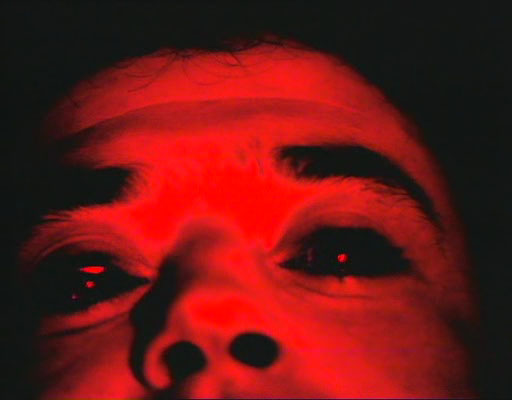
Daddy I’m Scared (Tijmen Hauer, Netherlands 2006, 4 min.) is an iconoclastic video piece consisting of thirteen different children’s cartoons layered on top of one another, transforming their innocent qualities to an aggressive and mesmerizing inferno of image and sound.

Almost interesting, but the clips don’t seem to be meaningfully combined, just thrown atop each other to form a red-tinted fiery Disney nightmare. I recognized Aladdin by sound and Hunchback by visual. It was short at least.

In Light Is Waiting (Michael Robinson, USA 2007, 11 min.), a very special episode of television’s Full House devours itself from the inside out, excavating a hypnotic nightmare of a culture lost at sea.

The one I’d been looking forward to (and the reason I didn’t wander away unhappily during the green plastic bag doc) didn’t quite live up to expectations. Funnier as described to me than to actually watch. Excerpt of a Full House ep (which Katy remembers) where they drop a TV from a great height turns into SCREAMING BLINKING PAIN turns into a mirrored, folding-in-upon-itself color-tinted noisy nightmare, an extreme slow-mo excerpt from a different episode on some fantasy island (which Katy also remembers). Good move equating Full House with shrieking hell, but not actually much fun to watch. I want some Peter Tscherkassky, please.
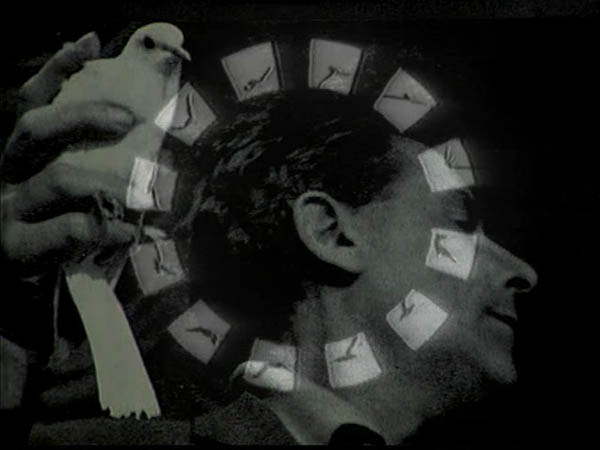
This will be one to watch again when I know more French, or just when I’ve lived longer.


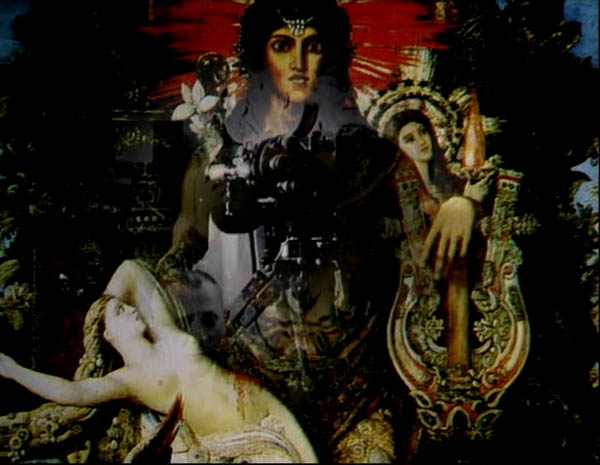
Chapter 1(a), “Toutes les histoires” (“All the (Hi)stories”)

Dedicated to Mary Meerson (Langlois’s companion who helped run the Cinematheque) and Monica Tegelaar (producer of Raoul Ruiz’s On Top of the Whale).

image

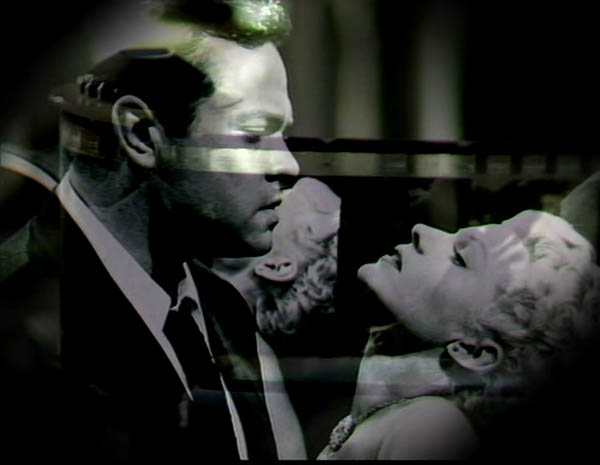
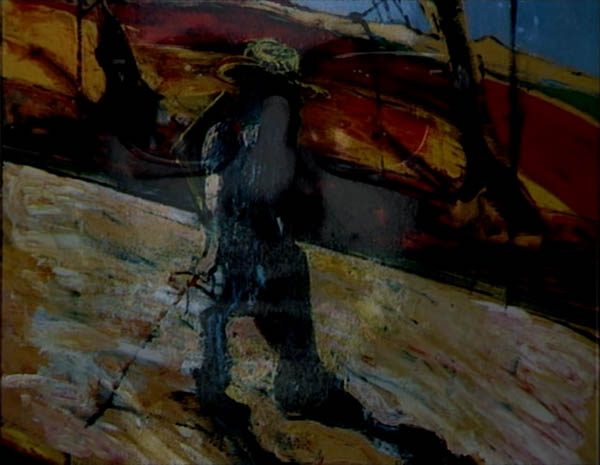
IMDB says parts one and two came out in the late 80’s, and the rest followed in the late 90’s. This one seemed more like a 50-minute trailer than an episode. Montage of archive footage, still and moving, edited and faded and superimposed and blended together. The footage includes scenes from films of course (rules of the game, great dictator, day of wrath, germany year zero) but lots of stills (producers, directors, Thalberg, Hughes) and paintings. Lots of focus on World War II, and ending with that Germany Year Zero segment, the whole thing came off as vaguely depressing. Maybe that’s why it took ten years to get the rest of the episodes made?

Three images overlapped: (1) Rita Hayworth dancing, (2) a drawing of Howard Hughes in his final days, (3) the witch-burning scene in Day of Wrath.


Chapter 1(b), “Une Histoire seule” (“A Single (Hi)story”)

Dedicated to John Cassavetes and Glauber Rocha (Brazilian director of Black God, White Devil).

image

Surprising number of references to Godard’s own films. Tons and tons of stuff I am not getting because I don’t know much French (I pick up half the film titles and some of the short sayings printed onscreen) or art history, and haven’t seen most of the films. Should’ve known better than to think part two would be more straightforward or make more sense. Even if I don’t know what it’s saying, I still get interesting juxtapositions of images and nice shots from great films seen and unseen, which is enough to keep me watching. Sounded like I heard some Leonard Cohen and Neil Diamond.


Chapter 2(a), “Seule le cinema” (“Only Cinema”)

Dedicated to Armand J. Cauliez (a writer, published a book on Jacques Tati) and Santiago Alvarez (Cuban filmmaker).

image

Fast-forward a decade. Same ol’ thing here, but two big changes:

(1) Not just montage of pre-existing footage edited with Godard in his study anymore. An actual actor, Julie Delpy, reading poetry. Also an interview with Godard by another guy (couldn’t be Serge Daney – he died in ’92), 90% untranslated.

(2) Me getting a little tired and pondering making my own historie(s) of cinema instead


Chapter 2(b), “Fatale beauté” (“Deadly Beauty”)

Dedicated to Michele Firk (film writer turned militant radical, killed herself in Guatemala to escape arrest) and Nicole Ladmiral (actress in Bresson’s Diary of a Country Priest).

image

Sabine Azema (above) recits some poetry, much of it untranslated. Godard types at his typewriter some more. I listened in the headphones and a background noise (JLG’s pet bird?) frightened me. Something about photography being invented in black and white as the colors of mourning to note the death of reality. And something about women, and murder, and Band of Outsiders and Rancho Notorious and Gone With The Wind. Good to see that Godard appreciates Tom Waits.


Chapter 3(a), “La Monnaie de l’absolu” (“The Coin of the Absolute”)

Dedicated to Gianni Amico (Italian filmmaker, assistant director on Bertolucci’s Before the Revolution and Godard’s Le Vent d’est & James Agee (film writer, champion of Chaplin’s Monseiur Verdoux, writer of Night of the Hunter and The African Queen)

image

or part 3A, the war and futility episode. WWII talk leads into an appreciation of Italian Neorealism and the most clearly presented introduction to a certain aspect of cinema and history thus far in the series. Says that Italian cinema in the 40’s and 50’s changed film like Manet (the godfather of modern art) changed painting. Closes with a nice montage of Italian film (minus too much onscreen block text and crazed fade transitions) set to a Richard Cocciante song. This episode has a clear point and meaning and narrative arc and supporting arguments… I don’t understand. Maybe the others have too, and I’ve been missing it. Juliette Binoche appears with Alain Cuny (of Les Amants and La Dolce Vita), who died in 1994, four years before this episode aired. Julie Delpy looked mighty young in her segment too – maybe all this footage was shot in the 80’s and not finished editing until ten years later.


Chapter 3(b), “Une Vague Nouvelle” (“A New Wave”)

Dedicated to Frederic C. Froeschel (head of a cine-club in Paris, 1950) and Naum Kleiman (Russian film critic, director of the Moscow Film Museum).

image

“Becker, Rossellini, Melville, Franju, Jacques Demy, Truffaut. You knew them.”
“Yes, they were my friends.”

A personal episode, sometimes celebratory but more usually melancholy. Godard himself is the guest speaker this time, but he’s actually into it, not just distractedly reciting behind his typewriter. These things never quite seem to begin, the opening titles still playing when the episode is half over. Some 400 Blows, some Henri Langlois, more goings-on about the death of cinema. What, is video the new art form?


Chapter 4(a), “Le Côntrole de l’univers” (“The Control of the Universe”)

Dedicated to Michel Delahaye (actor in Out 1, Alphaville, plenty more) and Jean Domarchi (1950’s, 60’s Cahiers critic, had a bit part in Breathless).

image

Another really good one. Probably not coincidentally, all the voiceover on this one is translated, so I was able to understand it. Lots of voiceover – it’s getting to be more of an essay lately and less of a purely visual slideshow. Still plenty of that dull video text, white-on-black block lettering. The thing always drags a little when JLG decides to move those words around the screen for thirty seconds before returning to the film clips. When there were clips, it seems half of them were by Hitchcock, “our century’s greatest creator of forms.”


Chapter 4(b), “Les Signes parmi nous” (“The Signs Among Us”)

Dedicated to Anne-Marie Miéville (one of Godard’s collaborators since 1976) and to Godard himself.

image

I hope nobody stumbles across this entry hoping to learn about the film, because I really doubt I understood most of it. More more more war images in this section (have I mentioned that the film is obsessed with WWII?) and more ponderings on love, death, art, history, man, the state, and Charlie Chaplin. And it seems to me that Godard is terribly depressed. Anyway, here’s a good bit of the voiceover from the last eight minutes:

I need a day to tell the history of a second…
I need an eternity to tell the history of a day.

We can do everything except the history of what we are doing. It is my privilege to film and live in France as an artist. Nothing like a country that every day walks further down the path of its own inexorable decline.

I am the fugitive enemy of our times. The totalitarianism of the present as applied mechanically every day more oppressive on a planetary scale. This faceless tyranny that effaces all faces for the systematic organization of the unified time of the moment. This global, abstract tyranny which I try to oppose from my fleeting point of view. Because I try, because I try in my compositions to show an ear that listens to time. And try to make it heard and to surge into the future.

The only thing that survives from one epoch is the art from it created. No activity can become an art until its proper epoch has ended. Then, this art will disappear. Thus, the art of the 19th century – cinema – made the 20th century exist, which barely existed.

Cinema feared nothing of others or of itself. It wasn’t sheltered from time. It was the shelter of time. Yes, image is happiness. But beside it dwells nothingness. The power of the image is expressed only by invoking nothingness. It is perhaps worth adding: The image, able to negate nothingness, is also the gaze of nothingness on us. The image is light. Nothingness, immensely heavy. The image gleams. Nothingness is that thickness where all is veiled. The most fleeting moments possess an illustrious past. If a man passed through paradise in his dreams and received a flower as proof of passage, and on waking, found this flower in his hand… What is there to say? I was that man.

Thought I’d watch the Cannes 1988 press conference, but after the first three minutes (“video artist” Godard passionately attacking television) it all turns French.

From a belatedly-discovered interview between JLG and J. Rosenbaum:

JR: Yes, but it also isn’t legally acknowledged that films and videos can be criticism.
JLG: It’s the only thing video can be — and should be.

With that strong distinction between film and video, it occurs to me that JLG considers Histoire(s) as being about cinema but not being a work of cinema itself. I watch Breathless on my TV and say I’ve seen one Godard movie, then I watch Histoire(s) on my TV and say I’ve seen two Godard movies. JLG should like to smack me for such a thought.

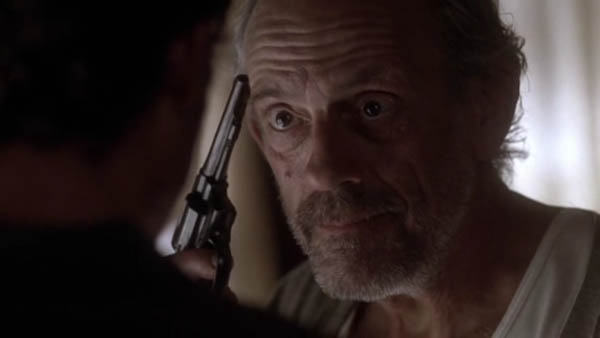
Another Clive Barker story that was either badly adapted or bad to begin with. And another story about writers’ creations coming to life. This is all writers think about.

At first it seemed like it was headed exactly in the direction of “dreams in the witch-house” but it took a far more boring turn. The episode seems like the creation of a repressed network-TV writer… it exists just so dude can yell “shit” and “fuck” and we can show a naked girl on TV.

image

Star actor Christopher Lloyd has little to do. Barker vet actor Tony Todd (candyman!) plays the beast. Whole thing is just terrible. Oh, our main guy turns into book pages and blows away at the end… he was a fictional creation, just part of the story all along!!!

Season 2 overall kinda sucked. Maybe my expectations were just high because s1 was half good, but it seemed like this one’s hit-to-miss was much lower.

I am not making this screen shot up:
image

A supervisor for a call center (bizarrely located in the USA) finds that his ears have turned against him, greatly amplifying certain sounds, making him annoyed and finally insane:

image

I could talk for a while about the last four episodes in a row I’ve seen from MoH, how two featured parents who tragically lost a kid, one had a kid who kills his father, and another had a father who tries to kill his kid. Or I could go on about Brad Anderson, who is exhibiting auteurist tendencies with this and Session 9 and The Machinist having people with body issues who hear voices. Or I could ask how our guy trashes his house with a baseball bat without awakening his wife upstairs. But I’m busy, so I’ll just say that the music over the closing credits was “Don’t Have To Be So Sad” by Yo La Tengo.

image