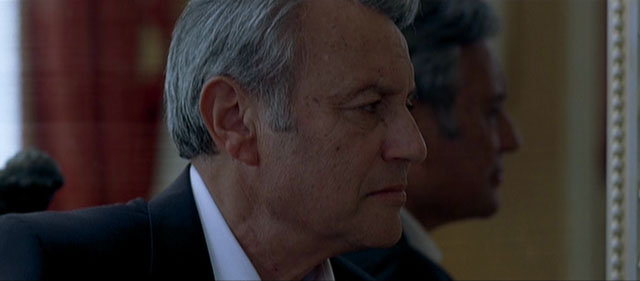
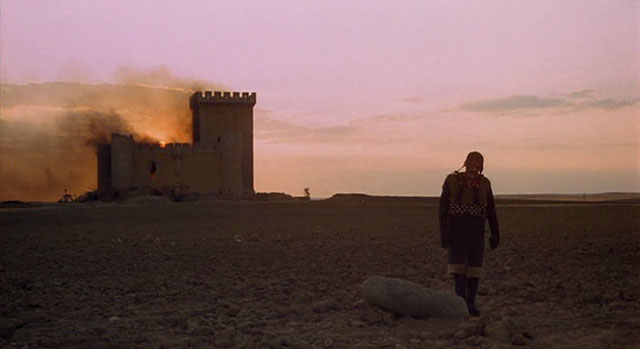
There’s a reason why this is the first Kurosawa movie on this site (and therefore the first I’ve watched in almost four years). After excitedly renting The Hidden Fortress, which I didn’t like, and Ikiru, which I did, I decided Akira was overrated and instead focused my attentions on Kiyoshi Kurosawa (no relation). Lately I’ve been greatly enjoying celebrated studio auteurs like John Ford, who make slow-paced movies without any spider-people, doppelgangers, magic trees, computer-virus apocalypses or killer jellyfish at all, so maybe it’s time to revisit A.K.

IMDB plot:

Murukami, a young homicide detective, has his pocket picked on a bus and loses his pistol. Frantic and ashamed, he dashes about trying to recover the weapon without success until taken under the wing of an older and wiser detective, Sato. Together they track the culprit.

A.K. follows his protagonist around the city, meeting shady characters in seedy parts of town, taking the camera out of the studio and bringing it along, influenced by the incompatible styles of film noir and neorealism. It’s a similar approach to The Naked City, and in a similar timeframe. I’d say Naked City was more successfully scenic, showed better city views, but Kurosawa did more with his less-than-stellar scenery. His mastery of camerawork, if not of pacing, shows up here.

At least the title character, the “stray dog”, is clearer than in The Thin Man – it’s Yusa, a small-time thief turned murderer with the help of detective Murakami’s pilfered pistol. The point is made again and again that Y. & M. came from similar backgrounds and befell similar fates until M. turned cop and Y. turned robber, leading to a climax of the two men fighting in the mud, dirty and interchangeable (not really, since Y. is wearing an unmistakable white suit by then). The other parallel is between M. as idealistic young cop with the weight of the world on his shoulders and elder cop Sato, with his burned-out black-and-white view of humanity. None of this is anything new by 2010 standards, but it may have seem fresh in ’49, and Kurosawa presents the ideas as if they’ve just occurred to him. By the end I couldn’t keep up my “ho-hum, Kurosawa” stance, was hooked by the style and story of the final third, featuring cross-cutting between Murakami’s bizarre interrogation of Yusa’s girl Harumi (with her mother in the room trying to help the cop) and Sato tracking down the killer in a hotel, as the oppressive heat of the last few days broke into a rainstorm.

Thanks to Emory for showing this on 35mm, though it features the kind of harsh, blaring music that always sounds better softened by my TV or laptop speakers than it does cranked loudly in a theater. Only the 7th listed film with superstar Toshiro Mifune (Murakami). Elder cop Takashi Shimura, with his giant Edward G. Robinson lips, was in 200+ films from Mizoguchi’s 1936 Osaka Elegy to Kurosawa’s 1980 Kagemusha, with some Zatoichi and Godzilla films thrown in, plus Kwaidan, Life of Oharu, and the lead role in Ikiru. Stolen-gun-toting Yusa is Isao Kimura in his first film – he’d appear in a bunch of Kurosawa films, the Miyamoto Musashi trilogy, Naruse’s Summer Clouds and Fukusaku’s Black Lizard. Harumi, Keiko Awaji, was in When a Woman Ascends the Stairs, and her mother Eiko Miyoshi would play scores of mothers in Japanese films, finally a grandmother in Ozu’s Good Morning. Movie was remade in cinemascope in the 70’s with the stars of Tokyo Drifter and Red Angel. I tried to draw comparisons with the missing-police-gun stories in Magnolia and The Wire but could not manage to do so.

C. Fujiwara:

Through the constant unfurling of interposed surfaces (multiple superimposed images, the strips of mesh and garlands down which the camera cranes at the Wellesian Blue Bird club), Kurosawa evokes a world in perpetual motion.

The sequence in Stray Dog in which Murakami goes undercover in the streets of Tokyo to look for the gun lasts slightly over nine minutes—much longer than necessary to advance the plot and convey that his search goes on for some time. The feeling of excessive length comes from the lack, or the randomness, of variation: the viewer’s main impression is the ever-dawning awareness that the sequence has nothing new to give. Kurosawa’s intention is to heighten our identification with Murakami as he slogs through the lower depths. By immersing us in the world’s chaos so thoroughly, the director makes us rely all the more on Murakami’s obsession as a potential source of meaning and order, while at the same time showing how inadequate it is to pose the problem of this chaos in the specific terms of a missing gun.

T. Rafferty:

Murakami poses as a down-and-out veteran, which turns out to be an uncomfortably thin disguise: he is a veteran of the recent war, and as he wanders through the ravaged city, in an elaborate montage sequence, we sense that he’s experiencing a life he might have led—that these mean streets are, for him, a collective image of the road not taken. That sequence, which incorporates a fair amount of documentary footage shot by Kurosawa’s assistant Ishiro Honda (later famous as the director of Godzilla and Rodan), is much longer than it needs to be, but it’s the key passage in Stray Dog because it sets in motion the film’s real story: Murakami’s growing identification with the man who now possesses his gun.

Anthology film, with segments listed in decreasing order of greatness.

IRAN
A schoolteacher, an Afghan refugee in Iran with no equipment or facilities, tries to convey the 9/11 attacks to children whose world doesn’t extend far beyond the local well. By Samira Makhmalbaf (At Five in the Afternoon)
image

BURKINA FASO
“Bin Laden, come back, please. We all need you here.” Idrissa Ouedraogo, director of Tilai, turns in an unlikely comedy. A kid has to drop out of school to support his mother, thinks he spots Osama Bin Laden, so he and his friends set out to capture him for the reward money. Osama gets away, the kids pleading for him to return so they can get paid. Kind of hilarious and awesome.
image

INDIA
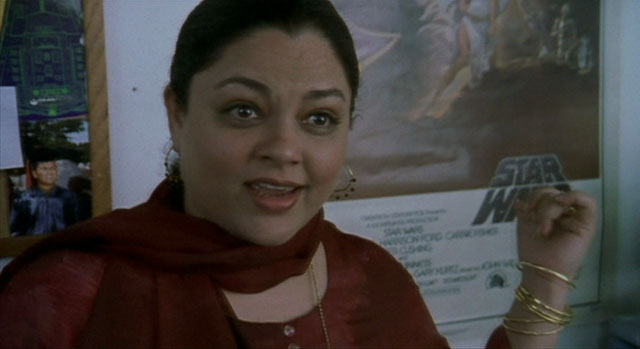
Mira Nair, following up Monsoon Wedding (and working with the same writer), recounts a based-on-true story of a woman whose son goes missing on Sept 11, is accused by the authorities of being a terrorist before he’s discovered to have been trying to help. The mother (Tanvi Azmi, I think) is excellent in this. When first questioned by the FBI, she points to her son’s posters, saying he’s American, he loves Star Wars, but she doesn’t say it defensively, just as a mother delightedly telling someone about her son. The final shot in this segment is my favorite of the whole anthology.
image

UNITED KINGDOM
Ken Loach, between Sweet Sixteen and Tickets, takes a completely anti-sympathetic approach, choosing to discuss the American-backed Sept. 11, 1973 coup that killed Salvador Allende, including footage from The Battle of Chile. There was probably a time I would’ve considered this tacky, but now I’m thinking “good for you, Ken Loach.”
image

USA
Sean Penn, recently off The Pledge (and I Am Sam, shhh), shoots an Ernest Borgnine one-man show in a grubby apartment in the shadow of the towers. Ernest putters around, laying out clothes for his absent wife, talking constantly, in his own crazy world, tending to a pot of dead flowers. Tower 1 goes down and sunlight flows through Ernie’s window for the first time in decades, bringing the flowers magically to life but waking him up to the reality that his wife is gone. Weird, sad one… I liked it better than Katy did.
image

JAPAN
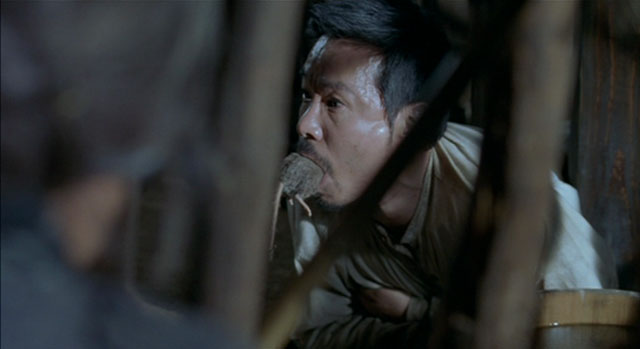
The final film of Shohei Imamura (The Eel, Vengeance Is Mine), with writer Daisuke Tengan (Audition, The Most Terrible Time In My Life), and if Shohei were alive he’d have some explaining to do. A man returns from the holy war (WWII) a spaced-out wreck, thinking he’s a snake (Katy did not appreciate the scene in which he swallowed a rat). Closes with the line “There is no such thing as a holy war.” Very odd way to end the anthology… still not sure what I think of it, though Mr. Grunes has named it one of his ten faves of the decade.
image

FRANCE
Claude Lelouch (Roman de gare) directs an offbeat story of a French tour guide for the deaf in NYC. His girlfriend is writing him a note saying she’ll leave him unless there’s a miracle, then he comes home covered in dust. I liked it better the second time through.
image

BOSNIA-HERZEGOVINA
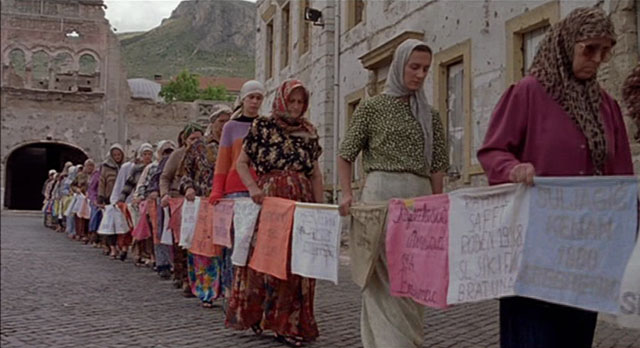
In 2002 director Danis Tanovic was high off his oscar-win for No Man’s Land. Since then, he’s adapted a Kieslowski script (Hell) and made one with Colin Farrell and Christopher Lee that played in Toronto. Women are going out for their weekly protest of something (local war/genocide) when 9/11 hits. They don’t know what to do, go protest anyway. Lightweight.
image

ISRAEL
None of my Amos Gitai experiences have been happy ones. Starts with a guy disarming or examining a bomb after another explosion has already killed a few people, then the news team covering the event is told they’re not on the air because of coverage of 9/11. Gitai could be saying local problems feel humble compared to the scope of the 9/11 attacks, or maybe that America is hogging the spotlight away from his country’s problems, or possibly that it’s all Palestine’s fault.
image

EGYPT
Youssef Chahine seems like a humorless Elia Suleiman, not that I know more about either of them than their Chacun son cinema segments. Here, Chahine pulls the same trick as in that anthology, a piece where I think he’s full of himself, then I think maybe he’s joking and it’s modesty in disguise, but no, he is just full of himself. Someone said “Youssef, write a September 11th movie” and he scribbled down every thought that came to mind then filmed them in that order.
image

MEXICO
Alejandro González Iñárritu, between the great Amores Perros and the not-great 21 Grams, shot ten minutes of black punctuated occasionally by shots of people falling from the towers and closing with this quote.
image

This must be my fourth time watching, and I still can’t remember who’s the killer (it’s the dead scientist’s lawyer!). Don’t think this counts as screwball comedy despite the fast-paced, often racy, comedic dialogue – it’s a detective comedy with screwball tendencies. Came out the same year as Twentieth Century and The Gay Divorcee – I think I like this one best of the three.

The titular thin man wasn’t meant to refer to detective William Powell (retired since marrying rich socialite Myrna Loy), but the missing, turns-out-to-be-murdered old scientist Wynant (Edward Ellis, sheriff in Fury). Nobody mentions this in the dialogue, hence all the Looney Tunes caricatures of Powell as a paper-thin man, and the carrying of the Thin Man title across the sequels.

Movie is a light joy to watch, so I won’t weigh it down by fussing over plot for three pages – there’s certainly enough of it. Powell (recently in Double Harness, not yet in My Man Godfrey) and Loy (post-Love Me Tonight, pre-Great Ziegfeld) don’t appear for a while but make up for lost time. Wynant’s death and the lawyer’s guilt aren’t revealed until the last minute at a grand suspects’ dinner party with cops as waiters (Katy thought the lawyer-as-killer was unjustified). Two older blonde women seem interchangeable until one is killed (the dead man’s girlfriend, Natalie Moorhead, no relation to Agnes). Dead man’s daughter (Maureen O’Sullivan of Devil Doll, The Big Clock, Song o’My Heart) and ex-wife Mimi (Minna Gombell, the law-breaking aunt in Wild Boys of the Road) and some other fools (including Cesar Romero, The Joker in TV’s Batman, and Porter Hall, a newsman in both Ace in the Hole and His Girl Friday) run around lying to each other for ninety minutes. All those actors, and the only one I recognize from other films is the dog, Asta, a main character in The Awful Truth and Bringing Up Baby.

Van Dyke directed three of the five sequels before dying of cancer. Prior to this, he made MGM’s first sound picture, White Shadows in the South Seas, which somehow involved Robert Flaherty.

Movie opens on a border patrolwoman (Florence Loiret Caille, the eaten maid in Trouble Every Day, also in Time of the Wolf), then moves to her husband (Grégoire Colin, upstairs neighbor in 35 Shots of Rum), then quickly to the husband’s father Louis (Michel Subor of Topaz, Anatomy of a Marriage, Le petit soldat) with whom it remains, more or less, for the duration.

image

Along the way we meet a pharmacist (attractively-freckled Bambou, best known for her relationship with Serge Gainsbourg) who sleeps with Louis, Louis’s dog-owning neighbor (Béatrice Dalle, cannibal Coré in Trouble Every Day, also in Clean and Inside), a sinister blonde woman (Katya Golubeva of Twentynine Palms, Pola X, I Can’t Sleep) who stalks him obsessively, and Louis’s ex in Tahiti who will not help him find his estranged son Tikki. Oh, “and Alex Descas,” proudly proclaims the opening credits, but he only appears in one scene, in close-up, as a priest.

image

Nobody I’ve talked to seems sure of exactly what happens in this movie. Much of that can be explained by the director’s comment that some of the characters don’t actually exist except in Louis’s imagination – I’m guessing that accounts for his blonde stalker, but I’m not sure who else. Louis abandons his dogs at his wintery shack in northern France, goes to Switzerland to withdraw piles of cash, negotiates the purchase of a ship in Korea, then heads to Tahiti to look for his son (not caring half as much about his other son in France). Along the way, probably in flashback, he gets a heart transplant in Russia, the memory of which seems related to the mysterious stalker. Oh, and back in France he kills somebody with the knife he always carries.

image

Guy from Tindersticks did the music without his band – it’s quiet and upsetting and wonderful. Played at Venice with 3-Iron, The World, Kings & Queen and The Sea Inside, but lost to Vera Drake. Between this movie and Trouble Every Day, I’m thinking the director of Martyrs could be a Claire Denis fan.

image

Story interpretations vary, although apparently it helps immensely to read the essay by Jean-Luc Nancy on which the script was based. In the DVD interview, Denis describes the physical feeling the book gave her, talks about the film being a vehicle for Michel Subor as much as an adaptation of the book. “My producer also was absolutely the most perfect producer for that film, but he was also suffering from a very severe depression, and he killed himself before we finished.” – this is the same producer who worked on The Man From London.

image

Carson:

The Intruder is loaded with Marxist Dialectics, the kind of suggestive cutting collisions that were pioneered by Sergei Eisenstein. A man describes a scene in the woods to his wife as a way of setting an erotic tone between the two of them, followed by a cut to the man’s father sitting amidst tall pine trees relaxing with his dogs. A priest speaks about the variety of immoral beings in the world, followed by a cut to the film’s blank protagonist, Louis Trebor. … In order to gather any semblance of narrative momentum, one has to look towards the way that the film is essentially divided into three parts, each comprised of a different locale, though not entirely limited to it, and connected by the theme of travel and intended self-renewal. … his lonely woodland cabin on the French-Swiss border, Pusan [South Korea], and Tahiti. … The film’s tempo steadily decreases … By the finale in Tahiti, The Intruder feels like a completely different work than what its opening anticipated. The shots lengthen, the soundtrack becomes quieter, comedic scenes appear, and Denis begins interspersing the action with footage from an unfinished 60’s film called Le Reflux, also set in Tahiti and starring Michel Subor.

image

Claire Denis in Senses of Cinema:

My films are not highly intellectual, and L’Intrus is like a boat lost in the ocean drifting, you know? I think that’s the way I picture it … Even if it’s the dream of a voyage, I think it was very important for me that the film offer the two sides of the globe, the north hemisphere and south hemisphere, as the two sides of the heart.

He’s not aware of the people still around who love him. He has no respect for that. The only woman he’s gentle to, the woman with the dogs played by Béatrice Dalle, it’s because she doesn’t care for him that he’s attracted by her beauty. I would imagine that if she would let him enter her house and open her heart to him, he would disrespect her immediately. So I think Trebor is not a very lovable man. Politically, I would say he represents everything I dislike in my country, this sort of selfish-solitude mentality … So I’m happy that he is condemned at the end: He is defeated, and I think it’s only fair. But it’s interesting to me that this main character is someone I do not respect. I understand I can suffer from his anxiety, but I don’t like him. When I wrote the script, I called him A Man With No Heart, a heartless man.

[Subor] had read the script and I gave him those new [Johnny Cash] songs to listen to because I wanted him to be inspired. I told him, “Probably I will never use this as music for the film”, but I wanted him to feel that death is coming closer, to hear that voice, that man in Cash’s last two records whose life has been rich and full of love and emotion. And there is a trembling, as if the moment is coming.

For further study I rewatched Claire Denis’s episode of Ten Minutes Older in which L’Intrus author Jean-Luc Nancy talks endlessly in a train car about French homogeneity and foreigners as intruders, but didn’t find it any more interesting than last time.

On one hand I’m proud of myself for burning through half a season in three weeks. That’s an unusually productive period of TV watching for me. On the other hand if you take the entire 12-episode season into account, I finished season 2 in August and season 1 a year ago, so bragging is not in order.

The usual stable of directors is joined by TV’s Leslie Libman, oscar-nominated filmmaker Agnieszka Holland, Alex Zakrzewski (lead cinematographer on Homicide: Life on the Street) and first-timer Christine Moore (who’d later work on CSI episodes). That’s twenty directors! The hardcore auteurists must go mad trying to figure this out.

Dead Men and Women:
Omar’s gang member Tosha: Edwina Findley, who went soap opera before landing in a new movie co-written by George Lucas. Main man Stringer Bell: the great Idris Elba, soon to appear in The Losers and Kenneth Branagh’s Thor. And Johnny, Bubbles’ junkie friend, in the least-surprising development in the entire series so far, dies of a drug overdose: Leo Fitzpatrick, who I didn’t recognize as Telly, lead character in Kids. Since The Wire he’s been in Hal Hartley’s Fay Grim.

This shouldn’t have worked… a typically overstuffed Gilliam fantasy, riddled with CGI, with a lead actor who died in the middle of filming. But if there’s anything Gilliam seems to be great at, it’s dealing creatively with catastrophe, so this came out miles better than the relatively smooth Brothers Grimm (oops, nevermind, research indicates that Grimm was ruined by fights with studios).

No surprise that the cowriter of Baron Munchausen and Brazil is along for the ride, since this is crammed with dreams and costumes, little stories and bizarre images. Parnassus (Christopher Plummer, having a good year with this, Up and The Last Station) is immortal thanks to a deal with devil Tom Waits (his own sinister self plus a little mustache), who will claim Doctor P’s daughter Lily Cole (Rage) when she turns sixteen in a few days. Dr. P and his gang of circus misfits (including a shockingly good Verne Troyer and young Andrew Garfield, star of Boy A and the Red Riding trilogy) kidnap citizens within a magic dream-mirror, and try to make them pursue their ideal selves instead of succumbing to the devil’s lazy temptations. A bet is made, and they race to save enough souls to win back P’s daughter.

Enter Tony (Heath Ledger) as a charismatic con-artist who attracts Tom’s interest as he begins helping the carnies win the bet, modernizing their look and sucking people into the show. He’s a mysterious dude, which makes his shapeshifting into three other immensely likeable actors inside the dreamworld work, both narratively and visually. I didn’t even notice for a while when Johnny Depp replaced him. Way to save the movie there, Terry and gang. The movie tells us and tells us that Tony is a bad guy, a liar who steals from children, but it still came as a shock when he’s killed at the end. Charisma counts for a lot.

With all the negative-nellying I’ve heard about Parnassus, I’m glad to see it’s got a high IMDB rating and a couple oscar nominations. I was especially suspicious of the computer graphics, but they are bright and cartoonish, fake without trying to seem real, and work great in context, shaming Tim Burton’s Willy Wonka flick and Terry’s own Brothers Grimm. I’d already like to see it again… maybe rent the DVD and listen to Gilliam’s commentary when it comes out.

I like to go into movies not knowing anything about them, but my only prior Claire Denis movies were the dreamily sexy Friday Night and the violent vampire flick Trouble Every Day. So there’s a scene early on in 35 Shots of Rum where a young guy (Grégoire Colin of Beau travail, Sex Is Comedy, Sandrine’s brother in Secret Defense) stops in an apartment building, overhearing the sounds from a room down the hall, and I thought “oh shit, he’s going to murder the people in that room,” then, “or maybe he’s in love with them!” With no frame of reference, it threw me for a few minutes. Turns out the latter was closer to the truth… it’s a (mostly) nonviolent love poem of a film.

Later I read some descriptions of the movie and found them misleading. IMDB: “The relationship between a father and daughter is complicated by the arrival of a handsome young man” – I got the impression that he’d been their neighbor for years, so what arrival? Landmark: “father and daughter realize they must confront a painful aspect of their past in order to embrace what lies ahead” – implies suspense where there is none. Presumably it refers to them visiting her mother’s grave towards the end of the film, but no dark secrets are painfully revealed there. The same description calls the film “gloriously delicate and sublime,” which is right on. It feels like that spectacular final scene of Summer Hours playing on repeat.

Lionel (Alex Descas, scientist in Trouble Every Day and airport rendezvous in Limits of Control) and daughter Josephine (Mati Diop, Djibril Diop Mambéty’s niece) live together, take care of each other, and hang out with neighbor Gabrielle (who likes Lionel) and Noe (who likes Josephine). They each attend to their own careers of train operator, student, cab driver and [something involving lots of travel to Africa], respectively. Third-world debt and Frantz Fanon are mentioned, the anthropology students at Josephine’s school go on strike, and a boy in her class likes her, but the main struggles are Lionel’s former coworker, unable to adjust to retirement, who eventually kills himself, and Noe threatening to move away. Correct me if I’m wrong – I’m not too good with story points told entirely through costume design – but Josephine and Noe decide to get married at the end, after father and daughter confront a painful aspect of their past.

I’ll join everyone else in mentioning the soft, lovely cinematography of Agnès Godard and the perfectly suited music of Tindersticks.

D. Kasman

Let us get the Ozu out of the way: 35 Rhums starts with Late Spring’s playbook, where a widowed father (Alex Descas) is living with deep affection with his marriageable daughter (Mati Diop) at a point in both their lives where each should move on. And there are many trains, and a great deal of rice. … If Denis’ push towards minimalism in her run of films from 1999 until 35 Rhums made anything stunningly obvious, it was just how expressive and perceptive films could be while paying nominal attention to explicit plotting and narrative clarity. 35 Rhums is a bit different, as its story holds on more than usual to traditional lines of character and action, but Denis’ sensibility transforms it from an obvious revision of the Late Spring paradigm to something else entirely.

J. Weissberg:

Claire Denis’s latest may appear whisper-thin on the surface, yet it’s marvelously profound, illuminating the love between a father and daughter but also highlighting the difficulty of relinquishing what most people spend a lifetime putting into place.

Denis:

I’ve been dreaming for many years of making an homage to Ozu, and this particular film was possible for me to use as an homage to Ozu, because actually it’s the story of my grandfather and my mother. She was raised by her father. And once I took her to see a retrospective of Ozu, and she really had a sort of shock to see that film [Late Spring]. That was like maybe ten, fifteen years ago, and I told her, “Maybe, once, I will try to make a film like that for you.”

Trivia from interviews… the “family” was supposed to be on their way to a Prince concert, and “Little Red Corvette” was to be playing in the cab, but this was deleted due to time and money constraints.

Won the golden lion in Venice against Throne of Blood, White Nights and Bitter Victory. Apu’s family gets settled in the big city by the river. Dad seems to be making a good living as a priest, but he gets sick and dies soon after. Mom moves Apu to a small town (doesn’t seem as rural as their home in Pather Panchali) and works for a rich family, sends Apu to school. Years later, new actor College-Age Apu wants to leave home and further his education. He tries to balance career and family, but favors the former and his mother dies of heartbroken loneliness. Apu’s own story is pretty hopeful (he’s still a good kid who loves his momma) but his family is as depressing and sudden-death-prone as ever. I’m guessing Apu himself will become desperately poor then die of a sudden illness in part three, but we’ll see.

Watched for Shadowplay’s Film Club, where you can find an excellent summary and valuable comments by regular readers, plus less-valuable comments by myself.

image

A step down from Disney’s recent Robin Hood in Roger Miller music contributions and in novelty voice characterizations, but two steps up in every other respect. I think David didn’t want to set expectations too high for this one, so I was prepared for a middling semi-romance with clunky action bits, but the action was clunky on purpose (Robin’s not a young lad anymore), the romance is fully there, and I felt the whole thing came together beautifully.

image

Sets its tone in the first scene: aging, disillusionment, violence (King Richard has turned murderous tyrant), with a hint of the supernatural (a blind man throws an arrow from far too great a distance straight into Richard’s neck). Prince John (now King, and played by Ian Holm in his only scene) and the Sheriff (played by Robert Shaw and his scary eyes, one of his last films) are still in charge. Marian (Audrey Hepburn’s return from retirement) has become a nun. Friar Tuck (TV star Ronnie Barker), Will Scarlett (Denholm Elliott of Brimstone and Treacle) and Little John (Nicol Williamson, later Merlin in Excalibur) happily follow Robin’s renewed, somewhat obligatory-seeming, fight against the sheriff and eager new deputy Ranulf (Kenneth Haigh in cool leafy armor).

image

Sean Connery (right between James Bond and Time Bandits) and Richard “Dumbledore” Harris as King Richard are both excellent in scary, unpredictable ways. Whenever I thought the movie might drag, whether the final battle-of-champions evoked The Postman/Gladiator-type cheesefests or the plot seemed headed towards a Prince of Thieves action spectacle, it’d either take a left turn or just cruise through on charm, throwing out hints of humor when necessary. Whole movie is a treat, really, with one of the most moving endings I’ve seen in a while.

image

I like how the end credits disclaimed that “some of the characters and incidents portrayed and some of the names used herein are fictitious”… not really any kind of disclaimer at all.

image