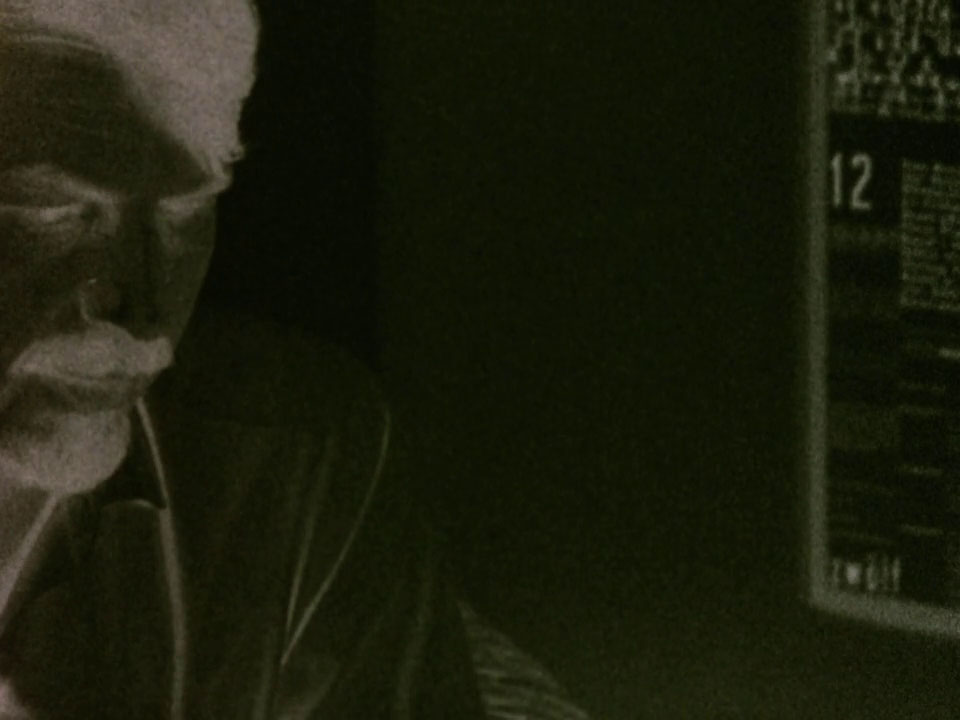
Patrick McGoohan is #6, resigns from some spy organization and is immediately kidnapped, waking up in a prison/town. They want to know why he resigned, and he wants only to escape. Opening credit sequence is three minutes long, and each ep starts with him waking up, dazed, looking out the window towards the title of this week’s episode, giving the impression not of continuity between episodes but that each episode is an alternate reality, or that Pat is caught in a time-loop.
Ep 1 – #2 (Guy Doleman of The Ipcress File) invites him over, has a dwarf attendant (Angelo Muscat, a rare series regular). A girl (suicidal Virginia Maskell of Our Virgin Island) pretends to conspire with him after their mutual friend dies. Escape Method: stolen helicopter, which is remote-controlled back to the island. And there’s already a new #2 (George Baker, an agent in Hopscotch) at end of episode.

Ep 2 – The new #8 (Nadia Gray of Maniac) tells him she’s figured out they’re in Lithuania, and she has friends on the outside. Escape Method: they sail off in a hand-carved boat created as abstract-art project with purchased tapestry as sail, packed by fake #8’s friend into shipping cartons and sent to fake London, revealed by time zone discrepancy. Today’s #2 is Leo McKern of Help! and Finlay Currie plays a chess-playing general.

Ep 3 – Scientist #14 (Sheila Allen of The Alphabet Murders) hooks him up to a mind-reading machine (showing that his mind tends to linger on the show open), gives him experimental drug causing him to dream meetings with three different spies to see his reactions: fabulous party host Katherine Kath (appropriately of The Man Who Wouldn’t Talk), mustachioed defector Peter Bowles (The Legend of Hell House) and former compatriot Annette Carell. Pat takes control of his own dreams to fuck with the new #2 (Colin Gordon of The Pink Panther) in grand fashion. Pat does tell them one definite thing, “I wasn’t selling out. That wasn’t the reason I resigned.” That piece of information won’t keep #2 from getting replaced in the next episode.


Ep 4 – Fake election is held and Pat is voted the new #2 in order to boost his confidence before breaking his spirit and beating the hell out of him. A Canterbury Tale star Eric Portman is the old/fake #2, and Rachel Herbert is Pat’s non-English-speaking personal driver who turns out to be the real #2.

Ep 5 – #6 is made to think that he’s #12, and his doppelganger is now “the real” #6. It’s never explained where they found an identical twin of Pat, but the effects are very well done. Odd to hear mister “I am not a number” emphatically declaring himself to be #6. Jane Merrow (Hands of the Ripper) is his psychic friend, and #2 is Anton Rodgers (a cop in Dirty Rotten Scoundrels).

Ep 6 – The young new #12 (John Castle of Blow-Up) is possibly an actual counter-conspirator inside the organization? Maybe not, I wasn’t paying close attention. The organization controls a professor (Peter Howell of Scum) through his artist wife (Betty McDowall of Time Lock and Dead Lucky), getting him to design a supercomputer (“the general”) to brainwash the already-brainwashed citizens in the guise of speed-learning. #6 blows up the computer, conspirator and professor before an amazed #2 (Colin Gordon again, from ep 3) by asking the machine “why?”


Ep 7 – The town is deserted. Pat builds a sailboat and compass, keeps a log, sails to England. He meets Mrs. Butterworth (Georgina Cookson of The Woman Who Wouldn’t Die), the woman living in his old apartment, borrows his old car from her, and goes to headquarters, tells The Colonel (Donald Sinden of Mogambo) and his man Thorpe (Patrick Cargill of A Countess From Hong Kong) about the village. They figure where on the map he could have sailed from and Pat searches in a jet until he finds it – and the pilot ejects him back into the village, where everyone reappears (including Mrs. Butterworth).
Unhappy birthday:

Ep 8 – Pat finds a radio on a washed-up dead man, tries to drive his observer (Norma West of And The Ship Sails On) crazy. New #2 (Mary Morris of Thief of Bagdad) focuses on convincing him that the outside world is dead to him, and he to them, as she has the dead man sent back into the ocean with Pat’s ID in his wallet. Crazy scene where after a trial on carnival day, the costumed villagers chase Pat through town hall.


Ep 9 – Nice double-cross variation. Pat teaches fellow prisoners how to detect who’s a secret sentinel, recruits an inventor to create a distress signal to summon nearby ships, but because of his confidence and authority, the prisoners decide Pat is a sentinel and turn on him. New #2 is Peter Wyngarde (The Innocents, Flash Gordon) even though Mary Morris claimed she was playing the long game and seemed triumphant at the end of the last ep.

Ep 10 – Pretty straightforward. Pat runs around doing fake spy stuff, having hushed conversations with bewildered villagers, sending coded messages to nobody in particular, to drive #2 (Patrick Cargill from episode 7) mad. As a bonus, Pat has a trampoline duel with #2’s main man #14.

Ep 11 – Trampoline fights are the new padding scenes. This is feeling like the flabby center of the series, with Pat’s goal changing from escaping the village to fucking with various #2s. Outgoing #2 (Andre Van Gyseghem of Demy’s Pied Piper) is going to be assassinated by Incoming #2 (Derren Nesbitt of the 1972 Burke & Hare), or was it vice-versa? – and Pat cares about this supposedly because he fears retaliation against the villagers since a brainwashed watchmaker (Martin Miller of Peeping Tom) rigged the bomb. Pat teams with the watchmaker’s daughter (Annette Andre of A Funny Thing Happened on the Way to the Forum), turns the bomb against the bomber, ending in stalemate.

Ep 12 – Pat has lost his sunny disposition, is being short-tempered with everyone, so he is declared persona non grata by the town and given the silent treatment. The new #2 (John Sharp of The Fiendish Plot of Dr. Fu Manchu) is into mind control, has a Clockwork Orange-like “aversion therapy” room, but orders instead a mood-improving lobotomy for our hero. Of course they can’t burn his brain with all those valuable memories inside, so they fake it with drugs, leaving Pat meek and defenseless against the striped bullies – for about 20 seconds before he pulls himself together and turns the drugs against his handler #86, then at his “confession” in the town square, Pat gets the townsfolk to rebel, and another #2 goes down.

Ep 13 – Excitingly weird one, in which Pat kinda escapes but decides to use his semi-freedom to rescue/endanger a scientist. Chubby-faced Colonel (Nigel Stock, Watson to Peter Cushing’s Holmes) comes to village, sent by “the highest authority,” and they electrically swap his psyche with Pat’s, then send Pat’s consciousness in Colonel’s body back to Pat’s house, where he dances with his fiancee (daughter of his spy boss – did we know Pat had a fiancee?), confuses his superiors (technically his ex-superiors, since he’s still angrily quitting his job in the opening credits), then leads the Village baddies straight to the mind-control scientist who invented the brain-swap device, though if the device worked so well I wonder why they need him. I also wonder why they keep fucking with Pat’s brain, since in the early episodes they were claiming they didn’t want to injure it. Anyway, back in the lab, scientist pulls the ol’ switcheroo, escapes via helicopter in the Colonel’s body (the Village has brain-swap technology, but not a simple radio to recall a helicopter that has barely lifted off), Colonel dies in the scientist’s body, and Pat’s his smarmy self again.

Ep 14 – Pat wakes up in a Western movie, thinks nothing of it. So it’s his stubbornness and moral character transplanted into a drifter who becomes town marshall. Nice Western sets but I think this was underlit because it’s not sunny enough in England. Pat is in prison when the brother of some girl (Valerie French of Jubal) is hanged, then he fails to save her from a loony, obsessed redshirt (Alexis Kanner, who later directed a film starring Patrick McGoohan). Final shootout, then Pat wakes up and realizes it was all a multiplayer dream-RPG. In two weird postscripts, the sets are are real and filled with cardboard cutouts of the other players, and redshirt remains obsessed with the girl leading to both of their deaths in the “real world”. New #2 David Bauer had a small part in a Sean Connery Bond film.

Alexis Kanner #1:

Ep 15 – So right after the episode that gives Pat a backstory and a fiancee, we get two in a row that turn him into an interchangeable spy. This is a really weird one, but fun, as Pat’s in London on the trail of a mad bomber, a resourceful woman who calls herself Death (soap star Justine Lord) and leads Pat into trap after trap, each of which he escapes, up to the lighthouse from where her Napoleon-wannabe dad is planning some kind of attack. The whole thing turns out to have been a story he’s freewheeling for some Village kids. Not entirely sure what #2’s theory was: that Pat would tell the kids his own life story, ending with his reason for retirement?


Ep 16 – An intense #2 (Leo McKern from the second episode) returns to the village, reviews clips from previous episodes to see what he has missed, then resorts to his ultimate solution to get Pat to confess: regress him to childhood via a magic lamp then lock them both in a room with the butler (Angelo Muscat, who may have appeared in every episode) for a week of intensive role playing/interrogation. Leo’s theory is that only one of them can survive this. There’s some 1984 number-play, Pat refusing to say the number six for a while, and Leo slips the retirement question into every scenario, but finally Pat makes him crazy, turns the tables, and Leo falls dead. It’s one of the more boring, shouty and unsatisfying episodes, with Pat being bonkers for most of it, but it’s all setup for an even weirder finale, as Pat is given his desire to see #1 at the end.

Ep 17 – Of course we don’t see #1 – this show makes nothing easy. Instead, Leo #2 is shaved and resurrected and put on trial as a nonconformist, along with Pat and a young mod who never stops singing “dem bones.” Nothing ends a thrilling spy series like a good, slow courtroom drama, amirite? It’s hard to explain what happens, and apparently fans have been trying for years, but Pat seems to escape and/or become #1, and “All You Need Is Love” is played over a machine gun battle and the village is given a specific location in the opening credits and the guy singing “dem bones” is the same actor who died three episodes ago. David Lynch could hardly have done better.
Angelo Muscat made it through the final episode!

Alexis Kanner #2:


Episode directors include McGoohan himself, Don Chaffey (Jason and the Argonauts, One Million Years B.C.), Pat Jackson (Don’t Talk to Strange Men), Peter Graham Scott (Into the Labyrinth, Night Creatures), Robert Asher (Maid for Murder) and David Tomblin (Return of the Ewok). Wonder if the remake is worth checking out? After all, prisoner torture, personal freedom and intrusive searches for information are still making headlines.