“My life, though ordinary enough, seems to haunt me in uncommon ways.”

And so, fictional amateur filmmaker Holzman sets out to film his life because, after all, film is truth. By studying the film, he will discover the truth about himself. But the film of his life begins to replace his life… and forty years before Synecdoche, New York. I think the movie’s claim to fame is that it’s a fake-documentary two decades before This Is Spinal Tap – but it’s a full decade after Peter Watkins got started, and two of his masterpieces were out already.

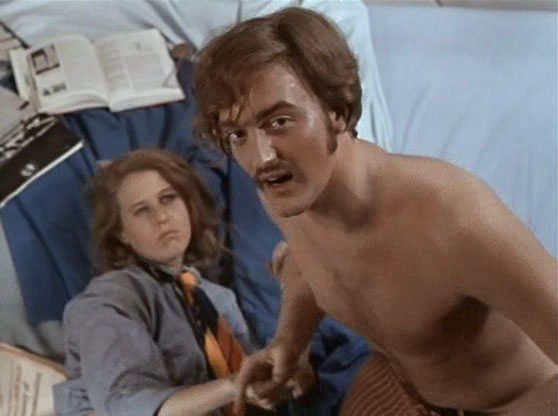
Holzman in his apartment:
image

Not a lot of scenes, many are one shot. McBride says there was lots of rehearsal beforehand, since there wasn’t much extra film to burn. D.H. wastes no time making his girlfriend leave by filming her naked in her sleep (below), then wanders the city, filming people on park benches, following a woman out the subway, becoming more of a camera-voyeur a la Peeping Tom / Rear Window, alternated with long nowhere-conversations with himself and a camera/mirror. There’s actually not much to Holzman or anything else in this… it’s a good enough movie, but I wouldn’t call it a favorite. Probably has less of an impact now that everybody’s got a camera and every fifth person under 30 has put a fictionalized documentary of himself up on youtube.

image

David Holzman gets as excited as Brendon Small over his fisheye lens:
image

Also watched My Girlfriend’s Wedding, which I liked better. J. Rosenbaum: “In many respects, the best ‘critique’ of David Holzman’s Diary that I know is McBride’s 1969 63-minute follow-up to it.” He’s right on – the is great to watch after the other one, with life-imitating-art actual similarities, and some obviously planned ones (Bartleby The Scribner is mentioned in both movies).

My Girlfriend, cameraman, Jim McBride:
image

Grainy and foggy as hell, nice and filmy-looking, gets off to a slow start with girlfriend (her name is bleeped out) giving us a select history of her life by pulling out everything in her purse and explaining it. She’s a Brit trying to stay in the States legally by marrying one of Abbie Hoffman’s Yippies whom she doesn’t even know, and McBride interviews her about this, watches the wedding, and talks to her new husband afterwards. The doc is simplicity itself, but the subject is well worth watching.

image

McBride went on to direct the Richard Gere remake of Breathless (co-written with the actor who played Holzman – who also worked on Bottle Rocket and Texas Chainsaw Massacre 2) and Great Balls of Fire. Guy who shot both movies directed Woodstock and an Albert Finney werewolf movie called Wolfen.

Don’t know why I assumed this was not a good movie. I’d seen screen captures from the DVD (some of the same ones I’ve got below) and somehow I still thought it was possible to make a bad movie using those images. It is not. This was astounding.

image

In a daring but successful shout-out to Feuillade, the story (set in 1910 or 20) is ridiculous. Plot threads do not weave together as in a tapestry of grand design. Each scene seems to have been thought up after the last one was finished filming. This is not a weakness, but adds to the movie’s dreamlike effect.

Master criminal Judex’s evil plans aren’t very broad-ranging in this story. He’s stalking rich guy Favraux acting as his servant, sends a letter demanding Favraux surrender half his fortune or he will die the next night. Next night at the costume ball (seen above), Favraux does die.

But he’s not dead! Imprisoned by Judex!

image

Daughter Jacqueline is left alone in the house!

image

She is easy prey for Marie, the swinding ex-governess of the house who returns to steal Favraux’s valuable papers and kidnaps Jac. when she interferes.

image

But Jac. is rescued by Judex’s dogs!

image

There’s a private eye named Cocantin (seen below reading Fantomas), originally hired by Favraux, and somehow still involved.

image

Can he stop Marie?!? Who can??

image

Judex!

image

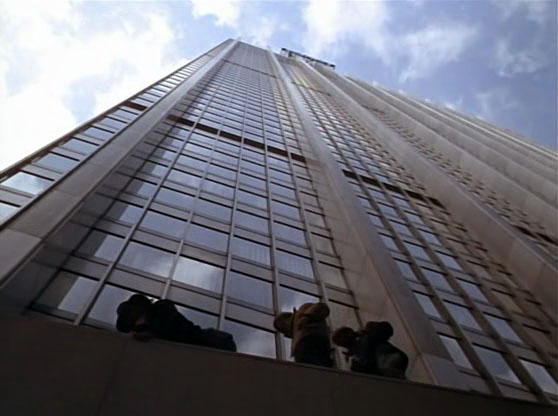
Ha, not really. Marie has captured Jac again, has her tied up atop a building along with Marie’s accomplice, a man who found his long-lost father earlier after Favraux tried to have the father killed, but that’s another story. Highlight of the movie here, Cocantin is wondering how to get atop that building when a circus caravan rolls past. Why, it’s the circus of his old friend Daisy, an acrobat who easily climbs the building!

image

Rooftop fight! Marie grabs the gutter! Will she fall??

image

Yes!

image

I think the only actor I knew was Edith Scob as Jacqueline – just saw her as Mary in The Milky Way. Sylva Koscina (Daisy) was in some MST3K-approved Hercules films. Francine Bergé (Marie) was later in Mr. Klein, Rivette’s The Nun and Roger Vadim’s La Ronde remake. Channing Pollock (Judex) was a magician with only a few other film roles. René Génin (Pierre Kerjean) had appeared in Renoir and Carné films in the 30’s. This movie was co-written by Feuillade’s grandson, heh.

G. Gardner with Senses of Cinema:

Franju sought in particular to recapture Feuillade’s sense of documentary and his playfulness. He reproduced with as much exactitude as possible the costumes and settings which Feuillade filmed in scrupulous detail. Feuillade’s street-scapes are now an invaluable documentary record, but Franju also paid particular attention to reproducing the elaborate interior designs and furnishings of the day, resulting in settings of quite extraordinary detail and clutter. Franju also sought, despite the playfulness, to avoid any camp satire of these elements by over-emphasis or any special attention being paid to them.

In the title role, Franju pulled off his most brilliant coup by casting the master prestidigator of his day, near godlike in his handsomeness, Channing Pollock. Pollock’s skills as a magician were employed to produce a dazzling array of apparent magical occurrences involving, most particularly, disappearing doves, a plot device that Feuillade uses to enable the regular rescue of the heroine and others by Judex. Franju’s Judex is a far livelier, less sombre, more inventive and more mysterious character than that of Feuillade.

This is one of Buñuel’s anarchic sketch films (see also: Simon of the Desert, Phantom of Liberty) which he made in between his relatively more normal, subversive upper-class films (in this case between Belle de Jour and Tristana). I still think I appreciate his films more than I enjoy them, but the more of them I watch, the more I feel that his career is unassailable, that his last twenty years of filmmaking produced one long masterpiece. It turns out I had seen this before, though I barely remembered it. Must’ve rented the tape from Videodrome. Don’t think I finished it last time, because it got foggier around the halfway point.

image

Such a smart and well-researched movie, I don’t feel qualified to discuss it. I can discuss the cinematic aspects though. Good photography with no surprises, unusually long shots but not noticeably/showoffy long. Buñuel’s movies always feel the tiniest bit too slow for me, too perfectly calm and collected, the acting and sets and camerawork too high-quality for their content, which I suppose is the point.

The plot is a “picaresque”, two beggars wander into various scenarios during their long walk from Paris France to a holy pilgrimage spot in Santiago Spain – although it turns out they’re not on a pilgrimage themselves, they just heard there’s a huge crowd in Santiago where they can get rich on spare change. Different historical periods and bible stories blend into their present-day 1960’s voyage without anyone batting an eye. They meet Satan(?), the Whore of Babylon, and lots of people discussing the six central mysteries of Catholicism and their associated heresies. They do not meet Jesus, the Virgin Mary, the Marquis de Sade or the Pope, but they’re all in the movie via sidetracks from the main action (though one could argue that it’s all sidetracks). Plenty of surreal moments keep the movie lively even when the dialogue is all obscure religious debate.

image

French cinematographer Christian Matras was about Buñuel’s age, had also shot most of Max Ophüls’ best films, also The Eagle Has Two Heads with Cocteau and Grand Illusion with Renoir. Co-writer Jean-Claude Carrière (also an occasional actor) worked on most of Bunuel’s 60’s-70’s stuff and over a hundred other movies, including recent ones like Chinese Box, Birth and Goya’s Ghosts. The guy who played Jesus starred in Rohmer’s sixth moral tale a couple years later. Virgin Mary Edith Scob was in Franju’s Judex in the 60’s, and lately in some Raoul Ruiz films and the newest by Olivier Assayas. Of the two tramps, the older would be in the next two of Buñuel’s French films, and the younger would star in Clouzot’s La Prisonnière and Godard’s Détective.

image

In the DVD interviews, Ian Christie tries to make us feel better for not knowing the historical references – he says nobody knew them. He got a press kit. The film was influenced by The Saragossa Manuscript, which sounds cool. “What heresy means for him is a kind of metaphor, I think, for human beings’ fascination with arguing about the immaterial, the invisible, trying to bolt it down and make it literal.” Screening when it did, it was alternately seen as cleverly reflecting or having nothing to do with the political and social upheaval in late 60’s France. Interview with the writer and documentary on the DVD are both pretty alright, nothing that needs repeating here.

Our two bums with the whore of babylon:
image

Michel Piccoli as the Marquis de Sade:
image

Alain Cuny as the mysterious walkin’ guy:
image

L’Age d’or reference:
image

A very good movie, though it didn’t strike me as completely excellent – fascinating to see Watkins’ style applied to a fully fictional narrative. This movie’s complete obscurity and unavailability until two weeks ago on DVD really supports the director’s constant claims of marginalization. How can you continue your career when all your past work has been suppressed? It’s a glimpse at where PW’s career could have gone. Also interesting how all the reviews he quotes on the website attack the film’s shooting and editing style, calling it failed art, when I thought it was far more artfully put together than most movies of its time (although it’s not like I’ve seen BAFTA-winning A Man For All Seasons for comparison).

Paul Jones (former singer of top-ten UK band Manfred Mann) plays the top teen idol in Britain, Steve Shorter (sort of all four Beatles in one), who appeals to the youth with pain and rebellion, then is used by the government to promote peace and conformity. Sidetracks along the way for a love interest (who was supposed to be painting Steve’s portrait but that was dropped pretty quickly), TV commercials to push surplus apples, a Mr. Freedom reminiscent (not least of all for its effective cheapness, walls covered in tin-foil) “Steve-mart” superstore, and concert footage including the very nazi-rally-like concert finale (15 years before Pink Floyd’s The Wall). Sure Steve is a tool of the establishment, but he plays it too consciously, usually with an uncomfortable expression on his face (even in public).

Polish cinematographer Peter Suschitzky has had an awesome career, starting with The War Game, going through this and Gladiators, to Jacques Demy, to Ken Russell and Rocky Horror, to Empire Strikes Back and Krull, now shooting all David Cronenberg’s films since Dead Ringers (with time out for Mars Attacks). All great-looking films.

Watkins:

American novelist Norman Bognor and I adapted the script, which we retitled ‘Privilege’, to emphasize the significance of Steven Shorter as an allegory for the manner in which national states, working via religion, the mass media, sports, Popular Culture, etc., divert a potential political challenge by young people.

1970: the first ticker-tape parade in Britain’s history:
image

Arty love interest Jean Shrimpton:
image

Steve goes all Mike D. on this advertising billboard:
image

Behind the scenes on the apple commercial:
image

Set for the big rally:
image

Steve drives the message home:
image

Unlike the cop-out Boogie Nights reissue, this DVD includes the short bio-doc which was the inspiration for the film: Lonely Boy, about teen idol pop singer Paul Anka and his unreasonable screaming female fans. Lonely Boy was released in ’62, the same year he was second-billed (alphabetically, ha!) in The Longest Day with John Wayne, Robert Ryan and Sean Connery. Three years earlier Paul was in the MST3K classic Girls Town. The doc is good, made by two Oscar-nominated Canadians named Wolf and Roman, b/w in “verite” style, but there are voiceovers and lots of editing, so I’m not sure the label is appropriate. Anka is a cutie but his songs aren’t all that. He’s says to the camera that “it’s all about sex”, his manager admits to a nosejob, this was in ’62! Fun to watch them together, since Privilege steals a couple scenes wholesale from the doc.

Lonely Boy:
image

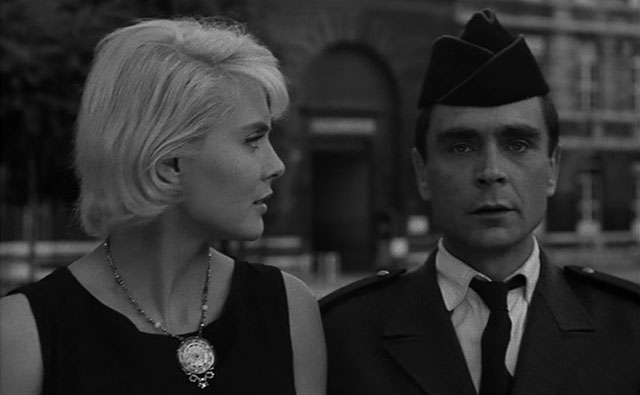
Resnais’s fourth feature, coming out the same year as Rivette’s The Nun. Watched this once before and have practically no memory of it, so this time I read the screenplay then watched again. By doing so, and by watching it alongside the other Resnais films I’ve seen this year, I’m sure I’ll remember and appreciate it more than I did before, but it also makes me wonder about the nature of Resnais’s art, because he has filmed Spanish writer Jorge Semprún’s screenplay word for word and shot for shot. Semprún describes flashback cuts and actors’ facial expressions, and there it is on the screen. The film isn’t as poetic and dreamy as Resnais’ other films of this period, but it definitely fits in with them, has a similar feel, plays like the work of the same artist. The book felt more tense, and the movie felt more melancholy, like a somewhat lighter Army of Shadows.

Story takes place across just a couple of days (not counting flashes-backs-and-forward) in Paris suburbs, two weeks before a planned protest and strike in Spain. Diego aka Carlos aka Domingo aka The Passenger (Yves Montand, halfway between his starring roles in Let’s Make Love and Tout va bien) returns from Spain to warn his underground anti-Franco activist organization (led by chief Jean Dasté) about the recent police crackdown in Madrid which led to the arrest of some operatives including one good friend. Diego wants to warn his other friend Juan away from returning to Spain, but Juan is already on his way to Barcelona. Diego was himself detained at the border, his false passport inspected by Customs official Michel Piccoli, which leads to complications later. Diego lives (on the rare occasions when he is back in France) with lover Ingrid Thulin (a Bergman regular who is wonderful in this movie) but he also half-heartedly messes around with a young Geneviève Bujold, daughter of the man whose passport he borrowed and herself a revolutionary, but with a younger group that practices impatient and violent means of returning Spain to her mythical (never existent) past Marxist glory. Diego and his group (incl. pro smuggler Jean Bouise, who later played Warok in Out 1) resent that Spain has become a symbol of the radical left but without any definite progress, that they’ve lost more and more comrades promoting these strikes and protests which are never as widespread or effective as intended. They continue their struggle, workmanlike but without much hope… a tone more fitting (in France) for the mid 70’s than the mid 60’s. Interesting that this came out right when Resnais’s contemporaries were about to turn to politics, then he followed it up with the much less political Je t’aime, je t’aime.

Writer Semprún later adapted screenplays for Costa-Gavras and wrote Stavisky for Resnais. He must be the only non-English speaker to receive TWO oscar nominations for writing. Shot by his regular guy Sacha Vierny with music by Giovanni Fusco, an Antonioni regular who died of a heart attack in May ’68.

The movie is called “stylistically orthodox” and “one of his most accessible films.” It’s not reportage-style realism, just straight drama, which never feels heightened by technique even though there are some signature smooth tracking shots and the love scene with Bujold is downright expressionist. I found the look and the camerawork to be more Muriel than Je t’aime, but of course the editing is completely unlike either of those.

Time Out: “Perhaps it is the film’s directness and obviously dated aspects (middle-age male angst faced with effervescent feminine adoration having become such a staple ‘art movie’ subject) that have made it seem a minor item in an often challenging director’s career.”

Harvard: “A series of premonitions told in flash-forward near the film’s conclusion make powerful statements about memory and aspiration, commitment and faith.”

A. Agarwal: “The film ends in inevitability. Thulin, the mistress whose devotion sometimes makes Montand uncomfortable yet at peace with himself, learns Montand is going to be sucked into a trap, and she starts out to let him know and save him from crossing into Spain. The film ends here, yet there’s a shadow of death over it. Either Thulin will not be able to save Montand, or she will be able to save him and Montand will quit this life and spend the remaining part of it trying to make peace with himself and his country.”

Michel Piccoli
image

Jean Daste
image

Warok
image

Genevieve Bujold
image

Thulin & Montand
image

image

“Why sometimes do images begin to tremble?”

From the film:

1967 saw the arrival of a rather peculiar breed of adolescents. They all looked alike. They would immediately recognize each other. They seemed to posses a silent but absolute knowledge of certain issues but to be totally ignorant about others. Their hands were unbelievable skillful at pasting up posters, handing paving stones, spraying on walls short and cryptic messages which stuck in the memory, all the while calling for more hands to pass on the message they’d received but had not completely deciphered. Those fragile hands have left us the mark of their fragility. Once they even wrote it on a banner. “The workers will take the flag of struggle from the fragile hands of the students.” But that was the following year.

image

Watched the 3-hour 2008 edit with English narration. There are so many versions of this out there… maybe next time I can watch the 2008 or 1977 French with subtitles.

I thought I’d have more to say about it… three hours’ worth of Chris Marker’s most celebrated film, but I don’t really. Marker is mainly credited as an editor here, arranging others’ footage to show a bigger picture. There’s no wall-to-wall narration, just pops up occasionally. And I’m starting to notice a real sadness beneath many of Marker’s films… the same feeling in Chats Perches is present here. Glad I prepped a little by watching Sixth Side of the Pentagon and Battle of Chile, but I still had to check on wikipedia to see what exactly happened in Bolivia (Che Guevara killed Oct. 1967) and Prague (Jan-Aug 1968, attempted reform of Czech socialism led to 30 years of Soviet military occupation). The movie isn’t here to teach basic history of revolution – assumes you know something already, and since I quit reading The People’s History of the United States before it reached the 1900’s, I do not. Still, was able to follow the movie, thought lots of the footage was excellent, enjoyed watching and learned a little. Some segments have little gems of Marker wit in their editing or narration, but much of it is making connections between different scenes of revolution, both real and wishful, and thinking about what has been achieved, what might have been achieved. Really have to watch again sometime.

image

Either this was an early use of the electronic soundtracks that Marker would use in Sans Soleil and beyond, or the sound on my copy of the movie was pretty badly distorted. Or, more likely, both. The sound got worse during part two – there were some sections when I couldn’t make out any of the (English) dialogue.

image

Video and audio footage by: Pierre Lhomme (Mother and the Whore, Le Joli Mai, Army of Shadows), Etienne Becker (The Spiral, Le Joli Mai, Malle’s Calcutta), Michele Ray (Latcho Drom), Francois Reichenbach and his crew, Harald & Harrick Maury (The Owl’s Legacy, Day For Night, In the Year of the Pig), Théo Robichet (Band of Outsiders), Pierre Dupouey (Silence… on tourne), Raymond Adam (Jodorowsky’s Tusk), Paul Bourron of the Dziga Vertov Group, Willy Kurant (Far From Vietnam, Masculin-Feminin, Pootie Tang), Peter Kassovitz (Jakob the Liar), Paul Seban (Welles’s The Trial), Michel Fano (Rivette’s The Nun), Fernand Moskovitz (Last Tango in Paris), Yann Le Masson (Je t’aime moi non plus), Mario Marret & Carlos de los Llanos (À bientôt, j’espère), Jimmy Glasberg (Sans Soleil, Shoah), Robert Dianoux (Africa, I Will Fleece You), Jean Boffety (Thieves Like Us, Je t’aime je t’aime, Adieu Philippine), Robert Destanque (Joris Ivens’s The Threatening Sky), Hiroko Govaers (Terayama’s Fruits of Passion), Michel Cenet (Celine and Julie Go Boating), and an excerpt from Volker Schlöndorff’s The Lost Honor of Katharina Blum. That is quite a list of collaborators, though you never hear anyone talking about them.

image

English voices: Jim Broadbent (Brazil), Cyril Cusack (Fahrenheit 451), Robert Kramer (dir. Ice, Against Oblivion), Alfred Lynch (The Hill), and numerous British 1970’s TV actors.

“You can never tell what you might be filming.”

Quotes and other reactions:

Icarus Films calls it an “epic film-essay on the worldwide political wars of the 60’s and 70’s: Vietnam, Bolivia, May ’68, Prague, Chile, and the fate of the New Left.”

image

J. Hoberman: “Marker begins by evoking Battleship Potemkin, and although hardly agitprop, A Grin Without a Cat is in that tradition—a montage film with a mass hero. Unlike Eisenstein, however, Marker isn’t out to invent historical truth so much as to look for it. (The untranslatable French title, Le Fond de l’air est rouge, is a play on words suggesting that revolution was in the air but not on the ground.)”

Paul Arthur: “In its rhythms and editing structures, Grin tries to embody the very shape and textures of historical transformation, rendering the abstraction of change as an amalgam of rapid, plurivocal, uneven, and, at times, contradictory forces aligned in provisional symmetries encompassing past, present and future perspectives.”

image

Y. Meranda: “The editing de-emphasizes the narrative structure and instead stresses the poetical interrelationships of the sequences by putting almost all of them out-of-context. … Paralleling the visual editing, the sound editing is more based on poetical considerations than on intellectual ones. … Because there is very little attention paid to the intellectual arguments and because the style goes beyond making statements about a political ideology, A Grin Without a Cat becomes much more than a left wing documentary about the left: It achieves to be a poem about revolting against the system (and not just the political system), the conformity and the order. It suggests that it is an eternal struggle that is supposed to fail (as was in the case of the New Left) most of the times. This universality, achieved by Marker’s distinctive style, is what makes the film great.”

image

Excerpts from the Lupton book:

“Marker explicitly pitched the film against what he saw as the historical amnesia surrounding the period promoted by its treatment on television, where ‘one event is swept away by another, living ideals are replaced by cold facts, and it all finally descends into collective oblivion.'”

Movie is partially composed of outtakes from other projects. “Introducing the published script, Marker wrote that he had become curious about all the material that had been left out of militant films in order to obtain an idealogically ‘correct’ image, and now wondered if these abandoned fragments might not yield up the essential matter of history better than the completed films.”

“As a groundbreaking work of visual historiography, Le Fond attempts nothing less than to give cinematic form to the chaotic and contradictory movement of world history during the tumultuous decade that it covers.”

“The reappearance of cats, even in this thoroughly politicized context, is a signal that Chris Marker was beginning to re-emerge from the anonymity of unsigned militant productions and to reintroduce into his work the familiar tokens of his own distinct presence.”
image

Chris Marker:

Scenes of the third World War 1967-1977

Some think the third World War will be set off by a nuclear missile. For me, that’s the way it will end. In the meantime, the figures of an intricate game are developing, a game whose de-coding will give historians of the future – if they are still around – a very hard time.

A weird game. Its rules change as the match evolves. To start with, the super powers’ rivalry transforms itself not only into a Holy Alliance of the Rich against the Poor, but also into a selective co-elimination of Revolutionary Vanguards, wherever bombs would endanger sources of raw materials. As well as into the manipulation of these vanguards to pursue goals that are not their own.

During the last ten years, some groups of forces (often more instinctive than organized) have been trying to play the game themselves – even if they knocked over the pieces. Wherever they tried, they failed. Nevertheless, it’s been their being that has the most profoundly transformed politics in our time. This film intends to show some of the steps of this transformation.

More images:

image

image

The Chairman:
image

Funeral in Prague:
image

Last footage ever shot of Salvador Allende:
image

Allende’s daughter, who would commit suicide in 1977:
image

Fidel in Russia:
image

Enormous cats (no owls):
image

Nixon looks on:
image

“I just got enganged.”
“Are you pregnant?”
“Not yet, but we’re getting married anyway”

Awesomely insane comedy following a girl (Zazie, who apparently had a cameo the following year in A Woman is a Woman) through Paris for a weekend vacation in the care of her uncle Gabriel (Philippe Noiret of Agnes Varda’s debut feature and La Grande bouffe).

image

Zazie quickly escapes her uncle. She teams up with an icky-seeming man who I’m not sure is trying to kidnap her or not, and the uncle (who is incidentally a cross-dressing dancer) teams with his cab-driver friend Charles. There are car accidents and cops and the uncle is kidnapped by tourists… all plot description attempts are useless. I also wasn’t paying total attention because it was on TV and I couldn’t pause when making dinner. Should be fun to watch again sometime.

Came out a year after The 400 Blows, half a year after Breathless, and there’s already a “new wave” joke in it.

Wasn’t letterboxed. I got screenshots from elsewhere.

image

Time out review:

Malle’s third feature plunges us straight back into the world of New Wave jiggery-pokery, with jump-cuts, lavish in-jokes, and a whirlwind narrative (taken from Raymond Queneau’s delightful novel) centred around a precocious brat (Demongeot) lewd enough to give a few tips to the Jodie Foster of Taxi Driver. It has survived the years much better than other indulgent frolics, mainly because Malle really does seem motivated by gleeful malice and anarchy – he’s not just toying with a fashionable mood. This spirit captured even underground guru Jonas Mekas, who commented on the original US release, ‘The fact that the film is a failure means nothing. Didn’t God create a failure too?’

image

Jonathan Rosenbaum:

Arguably Louis Malle’s best work. Based on Raymond Queneau’s farcical novel about a little girl (Catherine Demongeot) left in Paris for a weekend with her decadent uncle (Philippe Noiret), this wild spree goes overboard reproducing Mack Sennett-style slapstick, parodying various films of the 1950s, and playing with editing and color effects (Henri Decae’s cinematography is especially impressive), though gradually it becomes a rather disturbing nightmare about fascism. Forget the preposterous claim by a few critics that the movie’s editing influenced Alain Resnais, but there’s no doubt that Malle affected Richard Lester–and was clearly influenced himself by William Klein, whom he credited on the film as a visual consultant. A rather sharp, albeit soulless, film, packed with ideas and glitter and certainly worth a look.

image

This is now the most recent Godard film I’ve seen up until Notre Musique 40 years later. Wow. Came out the same year as Masculin Feminin AND Alphaville. Same year as Simon Of The Desert. Right after Umbrellas of Cherbourg, The Soft Skin and The Naked Kiss… and before Blow-Up, Balthazar, The War Is Over, The Nun and Tokyo Drifter.

Unfortunately, I didn’t write about this right after seeing it. Now it’s almost a month later, and I remember nothing but a mash of genres, a funny musical scene, some low-key crime and body disposal, a parrot, a funny Samuel Fuller cameo, and a bunch of too-cool people on an adventure. I think in the end, Pierrot shoots the girl and blows himself up. I liked the movie better than Jimmy and Katy did.

I missed Jean-Pierre Léaud in the cinema scene. Anna Karina (of The Nun and a buncha other 60’s Godard films) and Jean-Paul Belmondo (of Breathless, A Woman is a Woman, Magnet of Doom, Le Voleur and Stavisky) star.

Janus Films’ description: “After abandoning his wife at a Parisian party, bored Ferdinand (Jean-Paul Belmondo) flees his bourgeois existence with his babysitter and ex-lover, Marianne (Anna Karina). Taking it on the lam to the south of France, the couple becomes an existential Bonnie and Clyde, battling gunrunners, gas station attendants, and American tourists as they come face to face with their own roles as characters in a pop-cultural landscape. A profound turning point in Godard’s cinema, Pierrot le fou recalls the gangster cool of Breathless and Band of Outsiders while also pointing towards the increasingly essayistic, apocalyptic visions of Two or Three Things I Know About Her and Weekend.”

“I saw Pierrot le fou by chance … I decided to make movies the same night.” – Chantal Akerman

Man has accident. Needs new face.

image

Fortunately he’s friends with a brilliant tissue-replacement surgeon who wants to test his theories that facially-scarred people can reintegrate into society if their faces could appear normal again.

image

They find someone with a good face to copy (note: it’s the miner from Pitfall)

image

The doctor works hard in his all-glass laboratory.

image

The procedure is a success!

image

But the doctor’s psychological theories were wrong – the burnt man uses his new face to create a sociopath alternate personality, kind of like Hollow Man but not at all like Darkman.

image

Meanwhile, a young woman with a similarly deformed face has an unhealthy relationship with her brother.

image

Completely beautiful movie, obviously.

image

If Pitfall was a weird movie, this one just dives off a steep cliff of weirdness.

image

And it doesn’t end well. For anyone.

image