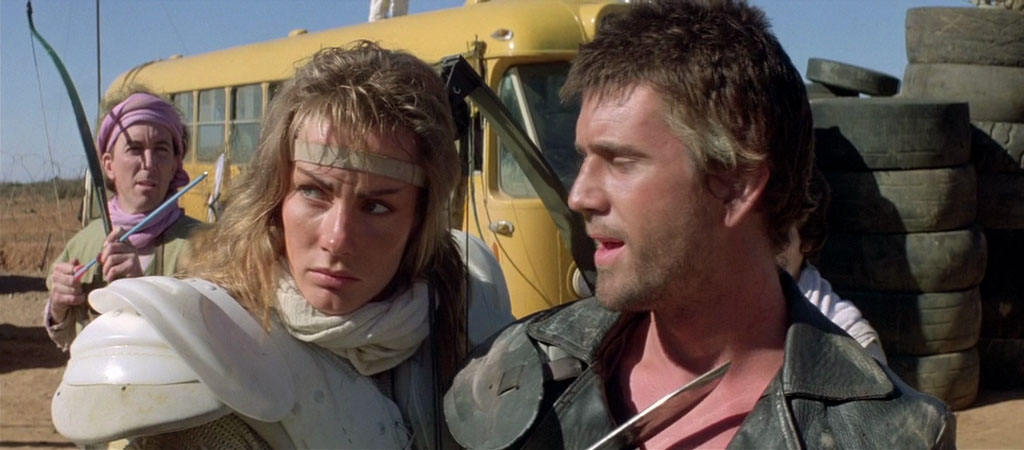
Opens by telling us that yes, the first movie took place after the Oil Wars, and now we’re in the post-apocalyptic future wasteland, and I appreciate them clearing that up. I’m still not convinced that Max is all that mad, not even in the fourth movie. Gibson seemed madder in Lethal Weapon. That said, the climactic road race is pretty damned mad.

Max w/ flamethrower:

These details aside, this movie is electrifying, with an expert mix of intensity and absurdity. Setting the pattern for parts 3 and 4, Max is out in the desert minding his own business and looking for fuel when he stumbles into a situation where people are being oppressed by an evil authority. Max doesn’t set out to save them because he’s a noble hero – it’s in his own self-interest. Max doesn’t even make friends with the gyrocopter pilot who leads him to the oil town (Bruce Spence, later a Dark City alien), keeps him chained up until needed.

Gyrocaptain and snake friend:

Max has a cool dog, who comes to a predictably bad end:

Villains: hockey-masked sharpshooter Lord Humungus and his rage-filled biker enforcer Wez (Vernon Wells, villain of Commando and Innerspace), who is excellent. Also really good is the eight-year-old boomerang moppet – but not good enough to justify the proliferation of kids in part three.

Wez – there are no bad shots of this guy:

Some advanced Babe-foreshadowing via pigs, like when Dekker put a message from the Monster Squad in Night of the Creeps. I didn’t realize when watching this that Thunderdome would be absolutely full of pigs.

Virginia Hey, later a blue-skinned alien in Farscape:

Toadie reminds me of Dennis Hopper in Waterworld:

We’re dumped into the middle of a complex situation in a mechanized future city, where teenage kids are piloting giant robots to fend off invading aliens, or “angels,” then as the show settles into a groove of one angel per episode (each requiring either skill, strategy, or brute force/rage to defeat) it gradually fills in the details – some of them, anyway. Plenty of questions remain: why teenagers? Where do the alien-angels come from, and how are they connected to the apparently partly-biological robots (or “evas”)? Who’s the shadowy organization that runs the shadowy organization that runs the eva program and where did they get their plans and prophecies from? Why do the main characters have a pet penguin? And why is every single character in this show extremely neurotic?

I get that we’re in Japan, so of course there are teenagers piloting giant robots and of course there’s an out-of-place, comic-relief pet penguin. These traditions endure from Voltron to Macross/Robotech to Gundam to American movies like Robot Jox and Pacific Rim. I just played a 2015 Japanese video game in which cool dudes and underdressed sexy ladies pilot giant robots to kill marauding aliens, accompanied by a comic-relief talking potato, so it’s still going strong.

Our heroes:

Things get dark quickly:

The show is obsessed with numbering things (the third child, unit 04, seventh construction phase of tokyo-3, twelfth angel, second branch, code 707), feeling at times like the script was written in Excel. Set in the futuristic time of 2015-2016.

Seele or Nerv or something:

Our tormented lead character is Shinji. He lives with Misato, a hard-drinkin’ penguin-owner who runs mission control along with ex-rival Ritsuko and ex-flame Kaji, or actually I’m not sure what any of their jobs are because I watched the show slowly and missed or forgot some details. Also living with them is super-cocky pilot Asuka, whose whole world falls apart if she can’t be the best at everything. And living on her own is the quiet, often-injured Rei. Everyone has major, major parental and/or love-life issues, the worst of which is that Shinji’s dad Ikari runs the shadowy Eva organization Nerv but has never once spoken to his son with affection, and has a weird offscreen relationship with Rei, who he might be cloning.

Rei-clones:

Ikari-hand:

Then in the final episodes, instead of polishing off the story it dives into the tortured minds of the lead characters for an experimental-film psychoanalysis session. “This is the me that exists in your mind.” Shinji meets the perfect friend who turns out to be the final angel and must be killed by Shinji’s own hands. Asuka’s and Shinji’s moms die repeatedly in flashback. Ikari talks to an eyeball in his disfigured hand. Rei keeps being resurrected. Even the penguin is sent to live with someone else. Finally, Shinji reaches self-acceptance. “It’s okay for me to be here.” I found parts of the final episodes whiny and repetitive, but over the next few days warmed up to the idea of the whole series having been a prolonged Shinji therapy session.


The End of Evangelion (1997)

Then, the movie remakes those last two episodes the way the fans preferred: with mad apocalypse instead of therapy. There are still sexual and parental hangups, petty grievances, inter-agency power struggles, and everyone’s still super lonely and unhappy, but now there’s more sci-fi storyline to go with it. Nine new winged evas are unleashed along with military forces upon our Tokyo base, decimating it. Asuka goes on the biggest homicidal rampage of all time, taking down all the new evas, then Shinji has the biggest crippling self-doubt paralysis of all time, then every other character in the entire series is killed, then Rei becomes a planet-sized god, rapturing and absorbing the souls of all humanity. Unfortunately, the underground control panel nerds stay alive until the very end so they can keep spouting nonsense:

“Ikari has installed a Type 666 firewall on the MAGI’s external feed circuits.”

“Psychograph signal down!”

and my favorite,

“Pilot response approaching infinite zero!”

Said to be one of the best anime series ever… after this and Paranoia Agent I wonder what I should try next. Apparently Death & Rebirth is a skippable movie, condensed from the series and End of Evangelion movie, and there’s a trilogy of remake movies from 2007-2012 from the original creative team, which might be good, but I’ll hold off watching those since Wikipedia says there’s a part four coming. Writer/director Hideaki Anno apparently created the series (particularly the finale) in response to his own battle with depression. He started out as an animator on Nausicaa, also made Cutie Honey (which I enjoyed), some other kid/teen animated shows, and I guess he’s making the next Godzilla movie. Codirector Kazuya Tsurumaki directed the weirdo series FLCL.

Rebellious young Judy (Marta Alicia of Body Chemistry 4: Full Exposure) is rebelling against Infinisynth, the mind-control company that provides her family with virtual-reality escapism via a data port in the back of their necks. She’s chastised by the Systems Operator for invading her mom’s dreams and soon expelled into the wastelands outside their cushy VR-fueled apartment building, where she’s discovered and protected by post-apocalyptic survivalist Bruce Campbell and threatened by a cult of underground mutants led by Angus Scrimm.

Angus displays his ID card:

Bruce displays a possum:

So it’s Ash vs. The Tall Man in a post-apocalyptic virtual-reality sci-fi/horror… in HD. But it’s poorly made, dingy looking and dull, all those promising ideas and cast members wasted on a movie that doesn’t quite work. At least it continues to get weirder, Angus having his mutants comb through the ruins of civilization for useful junk, occasionally sacrificing a mutant via his person-juicing-machine. He reveals that he’s Judy’s father and reveals his plan to repopulate the earth with her in the same scene. Bruce proves an ineffective protector, is fed to pirahnas. Then Angus says it was all a test, that he’s the SysOp of the VR universe and he wants his daughter to take over. Then that was all a dream – then that was all a dream. The Matrix and Existenz would use similar ideas with improved cinematography.

Judy’s mutant army:

Sleep pods from Je t’aime, je t’aime:

SysOp Guy Fieri:

Produced by the short-lived Fangoria Films, who at least attracted good casts, with Oliver Reed and Karen Black in their other early-90’s movies. From the director of Scanner Cop II and Hollywood Boulevard II (no way), written by John Brancato and Michael Ferris (Terminator 3 and 4, The Net). At least something good came out of this movie – Bruce Campbell married the costume designer. Also, it appears to have invented the roomba.

More consistently great than part one, with higher high points (Robert Morgan!). I’m tempted to make a playlist of ABCs highlights and edit myself a super-anthology but I’ll wait until part three comes out next year.


Amateur
Imagined scenario of cool, efficient sniper in the air vents taking out his target, then reality of tight insect-infested ducts full of nails. Great ending. Director EL Katz also made Cheap Thrills.


Badger
Directed by and starring Julian “Howard Moon” Barratt. Asshole nature-doc spokesman (Barratt) is abusive to his crew, gets eaten by badgers.


Capital Punishment
Local gang of vigilantes take a dude suspected of killing a girl out to the woods and clumsily behead him. Meanwhile the girl turns out to have run away, is fine. Director Julian Gilbey made A Lonely Place To Die, which is probably better than Wingard’s A Horrible Way To Die.


Deloused
I probably would’ve skipped ABCs of Death 2 had I not heard that Robert Morgan was involved. This was… inexplicable… and amazing, and ultimately makes the entire anthology worthwhile. Involves insects and beheadings and knife-arms.

Equilibrium
Funny and well put-together, with single long takes simulating time passing. Couple of idiots stranded on a beach are unexpectedly joined by a pretty girl. Jealousy ensues, then they return to bliss by killing the girl. Alejandro Brugués made the Cuban Juan of the Dead.

Falling
Israel/Palestine, woman whose parachute is stuck in a tree convinces a rifle-toting kid to cut her down, he accidentally shoots himself in the head. Nicely shot, anyway. Directors Keshales and Papushado made Israeli horrors Rabies and Big Bad Wolves (a Tarantino fave).


Grandad
Grandad is tired of his disrespectful grandson living with him. Jim Hosking is working on something called The Greasy Strangler next. Grandad Nicholas Amer has been around, worked with Peter Greenaway, Jacques Demy and Terence Davies.


Head Games
During a makeout session, a couple’s facial features go to war with each other in classic Plympton style. One of two Bill Plympton anthology segments from this year – we missed The Prophet.


Invincible
Old woman will not die, siblings want her inheritance and try everything to kill her. Stylishly shot (as are most of these, so it’s maybe not worth writing that anymore). Erik Matti (Philippines) got awards for crime flick On The Job last year.


Jesus
I think it’s supposed to be payback on a couple of dudes who torture and murder homosexuals, but when the kidnapped gay guy displays his demonic powers I’m not sure what’s going on anymore. Dennison Ramalho wrote latter-day Coffin Joe sequel Embodiment of Evil and actor Francisco Barreiro is showing up everywhere this month.


Knell
Initial scene where girl witnesses supernatural globe over the building across the street followed by people in every apartment turning violent was like Rear Window meets The Screwfly Solution, then it continues in the direction of total doom. Directors Buozyte and Samper are apparently Lithuanian, also made a surreal sci-fi thing called Vanishing Waves.


Legacy
Guy to be sacrificed is being set free and is arguing with this decision, and I lose the plot after that, but there are groovy, cheap Metalocalypse-looking gore effects. Lancelot Oduwa Imasuen is Nigerian, has made a million movies so far since 2003.


Masticate
Drugged-out flesh-eating fat man goes on rampage before he’s killed by cop, all in slow-motion and set to a jangly pop song. Robert Boocheck made a short that apparently played in an anthology called Seven Hells.


Nexus
Cleverly timed and editing, goes for tension instead of twist ending since we figure out early on that the distracted cabbie is gonna hit the guy dressed as Frankenstein. Larry Fessenden made Habit and Wendigo and The Last Winter, all of which have been on my to-watch list forever and just came out on blu-ray.


Ohlocracy (mob rule)
After the cure for zombiesm is found, human zombie-killers are sentenced to death by a kangaroo court. Hajime Ohata made the non-Kafka movie called Metamorphosis.


P-P-P-P Scary!
Poppy, Kirby and Bart look like escaped convicts, have big noses, meet a face-morphing guy who does a jig, blows out their candles and murders them inexplicably. Todd Rohal made The Catechism Cataclysm, and I might’ve guessed this was him.


Questionnaire
While a guy correctly answers questions on an intelligence test, we see flash-forwards to the “career opportunities” the interviewer has in mind for him (brain transplant with gorilla). I watched Rodney Ascher’s The Nightmare just last week.


Roulette
German game of Russian Roulette ends with the sixth-chamber guy shooting his beloved instead of himself, as some unknown evil approaches. Marvin Kren made Rammbock and Blood Glacier.


Split
Like a remake of Suspense but with more baby murdering. Hammer-wielding intruder destroys family of cheating husband(s) during a phone call.
Juan Martinez Moreno made horror-comedy Game of Werewolves.


Torture Porn
Girl in porn audition turns out to be Cthulhu, I guess. Jen and Sylvia Soska are identical twins who made American Mary and Dead Hooker in a Trunk.


Utopia
Self-driving incineration machines deal with non-beautiful people. Vincenzo Natali made Cube and Splice.


Vacation
Dude is on phone with girlfriend when dude’s friend reveals they’ve been doing drugs and prostitutes while on vacation. The friend is disrespectful, and one prostitute stabs him many times with a screwdriver. Jerome Sable made last year’s Meat Loaf-starring Stage Fright.


Wish
Kids go inside their off-brand Masters of the Universe playset, discover it’s horrible in there. Steven Kostanski made Manborg, which looks similarly wonderful.


Xylophone
Kid won’t stop playing her damned toy xylophone while babysitter Beatrice Dalle (of Inside, the first actor I’ve recognized since Julian Barratt in letter B) is trying to listen to opera records. Julien Maury and Alexandre Bustillo made Inside, of course. Credits say Beatrice is the grandmother not the babysitter, which makes sense since babysitters should leave antique record players alone.


Youth
Miyuki hates her mom and stepdad, imagines them dying in tremendous ways. Soichi Umezawa is a longtime makeup artist who worked on Bright Future and Dr. Akagi.


Zygote
Dad abandons pregnant mom with a 13-year supply of a root that delays labor. Horribleness ensues. Chris Nash has made a bunch of shorts.

Matt Singer: “Fury Road is an incredible achievement, one that strains so hard at the leash of the possible that it eventually breaks free and barrels headlong into the realm of insane genius. … They’ll keep making car chase movies after Fury Road, but there’s really no need.”

I loved the movie, but was maybe not as bowled-over by its lunatic intensity because was prepped by reviews. What I wasn’t prepared for was the plot twist when the movie’s first-two-thirds nonstop car chase finally stops, and with nothing but salt wasteland in front of them, Max proposes The Worst Idea Of All Time, to drive straight back through the armies that they’d just escaped and attack the citadel.

Tasha Robinson:

These are some preposterously tough people, and yet they’re perpetually at the end of their rope, and yet they perpetually keep going. That’s a very fine emotional place to keep a film pitched to for two straight hours, but the action is so well choreographed, so solid and visceral, that it works fine.

Charlize Theron stars as Furiosa, her team of escaped wives including Zoe Kravitz (Angel in X-Men 4). Max is Tom Hardy (Locke), constantly being threatened and/or helped by “albino maniac” Nicholas Hoult (Beast in X-Men 4). The main gas-masked villain played someone called Toecutter in the original Mad Max, which I should really watch sometime.

The movie was so beloved that even Cinema Scope gives it their breathless Tony Scott treatment, explaining Miller’s filmmaking techniques to keep his action scenes visceral and legible at once. “Advances in data processing and motion capture are rendered moot by Fury Road‘s proof that a basis in reality still adds a sense of weight to the proceedings impossible to recreate artificially.”

EDIT JUNE 2017:

Watched again at home,
in beautiful black and chrome.

“We are not to blame.”
“Then who killed the world?”

EDIT OCT 2020:

Showed to dad… he liked it.

This is a completely looney Japanese horror oddball movie released in the Eclipse Shochiku set. It’s cheap, weird and highly entertaining, also atomic-bomb-obsessed and weirdly Vietnam War-referencing, with stock footage edited in at key moments.

The most doomed flight of all time encounters a UFO, receives a bomb threat and hosts a gun-toting hijacker at the same time. Large-faced hijacker Hirofumi has little effect as the plane flies through red skies filled with crazed engine-clogging birds then crashes, killing the pilot and leaving first officer Sugisaka in charge. On the ground, the hijacker runs off and gets possessed by aliens in his forehead (recalling Jeffrey Combs in From Beyond), while the bomb-threat fella hides his bomb and claims he was only kidding.

Potential bomber allowed to roam free:

The gov’t rep gets homicidal:

So the survivors are hiding in the plane from alien vampires who appear to kiss people to death (Yuko Kusunoki of Dodeskaden and Kurahara’s Thirst for Love is next to be captured/possessed) except for psychiatrist Kazuo Kato (Kurosawa’s Ran) who wants to go outside and study the aliens, while government representative Mano (Eizo Kitamura of the Yakuza Papers parts 2 and 3, and Modern Porno Tale: Inherited Sex Mania) proves to be a bigger asshole than the aliens or hijacker, getting people killed in order to save his own skin. Bomber dies blowing a hole in the side of the plane, and American Mrs. Neal (Kathy Horan of Genocide and The Green Slime) comes after the vampire with a rifle and loses. When our hero Sugisaka (with his woman on his arm) finally lights the hijacker on fire, the alien oozes out of his forehead and possesses Rep. Moto’s underling then kisses Moto to death.

Sugisaka and the girl leave the crash site and find out they were about a mile from civilization, but everyone in the city has been killed by aliens – much more efficient aliens than the one attacking the downed plane, I guess. Burned bodies and atomic blasts are invoked in the apocalytic finale.

Sugisaka was Teruo Yoshida, in Ozu’s An Autumn Afternoon a few years earlier, must’ve starred in too many horror movies in 1968-69 (including this, Horrors of Malformed Men, Inferno of Torture and The Joy of Torture) because he disappeared from the screen in 1970, and his loyal stewardess was Tomomi Sato of the 1979 Jigoku remake and Blackmail Is My Business.

March 2077: I’ll be on an airplane, so I grab the dumbest-looking movie I can find at work to watch through a dramamine haze. A Tom Cruise actioner from last year that I already have no recollection of: that’ll do nicely. I’m playing a feature-length game of “spot the reference,” as it seems to have been concocted from scraps of sci-fi thrillers past. It’s all a bit silly, but undeniably strong-looking, and its sleek production design (and the face of To The Wonder‘s Olga Kurylenko) lingered in my mind afterwards.

Cruise plays a Wall-E type named Jack Reacher, left behind to clean up earth after everyone else has moved into space. But he’s also a Moon type, since it turns out Cruise is thousands of clones of himself (maybe that’s more Galactica), and it turns out humanity survives underground and the “people” in space are evil aliens (who blew up the moon in an obvious Mr. Show reference) using fake video images of Melissa Leo to interact with their clone slaves. But Cruise is not a slave, likes to read classic literature and builds a rustic nature shack and nurtures a potted plant and watches Hello Dolly on a creaky old tube TV. No he doesn’t, but it’s funny how the human stuff Cruise salvages for his shack is already old now – classic rock LPs and antique-looking refrigerators.

Clone Cruise has a Clone Wife (Andrea Riseborough of Happy-Go-Lucky) but dreams of Olga, and when she crash-lands after being in orbit for however-many years, they team up with the undergrounders (led by Morgan Freeman) to nuke the mothership, threatened by spherical alien drones with great bassy doom-growl voices (clearly the presence of flying death orbs in a film called OblIVion is a shout to the fourth Phantasm movie).

“Copy 4-0-9, tasking 1-8-5 to grid 2-2.” The movie likes saying numbers aloud, and its mix of all-knowing and easily-fooled technology is nearly plot-hole-worthy – for instance, after Cruise goes for a walk the robots can track his DNA from the air at speed, a light-up trail tracing his exact path, but they always take ten seconds of him yelling his name at them before they stop threatening him with guns. And the planet seems to be all mapped into robot-patrolled grids within alien-drawn neighborhoods, each manned by a Tom Cruise, but his entire Walden shack goes unnoticed for years, and when he follows a homing beacon all the way from base, he doesn’t even know what kind of structure the signal is coming from until he walks right up to it. So they’ve gotten both better and worse than google maps. But I like the all-white Apple-like alien tech with its triangular motif, and the effects are cool and the M83 music pretty great.

We have the technology. The time is now. Science can wait no longer. Children are our future. America can, should, must and WILL blow up the moon! And we’ll be doing it during a full moon, so we make sure we get it all.

The sweetest end-of-the-world drama. Likeably lopsided Don McKellar (also writer/director) visits his family (opening nostalgia Christmas presents and having a homey diner) claims that he’s comfortable with his plan to spend the (unexplained but universally accepted) apocalypse in six hours alone in his apartment. Don is really super-depressed over the recent death of his wife, ends up helping an increasingly desperate Sandra Oh, who still thinks she can go shopping and catch taxis in the midst of societal breakdown, attempt to reunite with her intense latter-day boyfriend. This is probably David Cronenberg, a gas company manager who completes his goal to personally phone every customer and thank them for their business, before going home to await Sandra, leaving employee Donna in charge.

Sandra has car trouble:

Don and Sandra get grudging help from Don’s playboy car-collector friend Craig, who is rapidly going through a list of sexual conquests – both acts and partners (Lily, a black woman; Don, who refuses; and their high school French teacher, Genevieve Bujold).

Bujold with Callum Rennie:

Cameo by Pontypool director Bruce McDonald (with the bat)

The midnight hour approaches, but the sun is still up – apparently it hasn’t gone down in weeks. Don’s sister Sarah Polley and her boyfriend attend the final countdown celebration in the middle of town. A nerdy guy named Menzies holds a solo piano concert in an otherwise-unused theater. Cronenberg is shot by marauding youth. His employee Donna, a virgin, is Craig’s final visitor. And Sandra, losing her dream of last-second double-suicide with her beloved, ends up in the arms of Don. It seemed like a generic-indie-looking unexceptional drama in the first ten minutes, but totally hooked me and proved amazingly touching by the end. I can’t stop thinking about it.

Cronenberg gets a taste of his own horror-makeup medicine:

Polley party:

This is one of my favorite things – I went back and watched it again, to be positive. Goddard (wrote Cloverfield, worked on Lost and Buffy) and producer Whedon (who is having a big month) manage to make it seem easy, blending horror and comedy, movie and meta-movie more excitingly than Scream did, forming a sort of horror-movie construction-kit. It gradually reveals its scheme while telling us why this is all necessary, and when the stock characters realize that they’re stock characters and break out of the model, they knowingly and misanthropically unleash Lovecraftian armageddon.

The Virgin: Kristen Connolly

L-R:
The Scholar: Jesse Williams of Grey’s Anatomy
The Athlete: Chris “Thor” Hemsworth
The Slut: yellow power ranger Anna Hutchison
The Fool: Fran Kranz of Whedon’s Dollhouse

Not pictured: Richard Jenkins and West Wing star Bradley Whitford push the buttons manipulating our stock characters to their doom. Brian White (IMDB specifies that he’s their 34th Brian White) is the new guy, Amy Acker (also Dollhouse) runs the chem department, and an uncredited Sigourney Weaver runs the whole show.

Writer/director Goddard:

The truth is, this movie does comment on a horror movie, but that wasn’t our goal. We wanted to comment more on who we are and what part horror plays in us as a people. If you keep that in your sights the whole time, it’s easier to find the balance, because then your movie is just becoming about commenting on the human condition and not worrying too much about, “What is this saying about the genre or the films?” It’s much more just, “What are we saying in general?” That’s the sort of thing you have to hold firm to.

July 2024: Watched again. Catching up with the cast… Final Girl Kristen Connolly was in Ben Affleck cuck drama Deep Water. Chris “Dementus” Hemsworth didn’t get any major roles until recently. Since Much Ado, Fran(z) was in Bloodsucking Bastards and The Dark Tower. Wolf girl Anna Hutchison was in an alien invasion thing with a lesser Hemsworth and a Nick Cage vengeance movie just called Vengeance. The Scholar is a Grey’s Anatomy lifer who played a ghost in the Jacob’s Ladder remake Goddard made Bad Times at the El Royale, and cowriter Joss Whedon was cancelled for being toxic then his final film was erased by Snyderverse fans