Knife in the Water is playing at Emory tomorrow so I prepped with some early shorts.

Murder (1957)
A man is murdered in bed with a pocket knife. That’s all. Damn good effect, too.

Teeth Smile (1957)
A peeper is dissuaded from his pasttime by the man of the house. At a full two minutes including credits, it’s the longer film so far.

Break Up The Dance (1957)
A pleasant outdoor party. Everyone is having a good time until some miscreants hop the fence and trash the place. The first one with sound. All of these so far have been tightly wound, shadowy and threatening.

Two Men and a Wardrobe (1958)
Two men carry a mirrored piece of furniture. Later, miscreants (maybe the same ones) kill a kitten, annoy a woman with its corpse, then smash the mirror and beat up our two moving men. Defeated, they go to a barrel graveyard and get pummelled by a cop, then retreat back into the sea. This was probably my favorite of the bunch. One of the moving men later cowrote Knife in the Water, and the composer would work with Polanski through Rosemary’s Baby. Most of these shorts are wordless – probably with international festivals in mind. This was the first award winner of the bunch, so it’s paying off.

The Lamp (1959)
A dollmaker replaces his lantern with an electric lightbulb. The electric box turns into a demon and burns his place to the ground. Dolls missing the tops of their heads always remind me of the Quay brothers.

When Angels Fall (1959)
An elderly black-and-white bathroom attendant has color flashbacks. Second movie with animal killing in it, this time a boy whipping a frog with sticks, and the first Polanski film to depict the horrors of war.

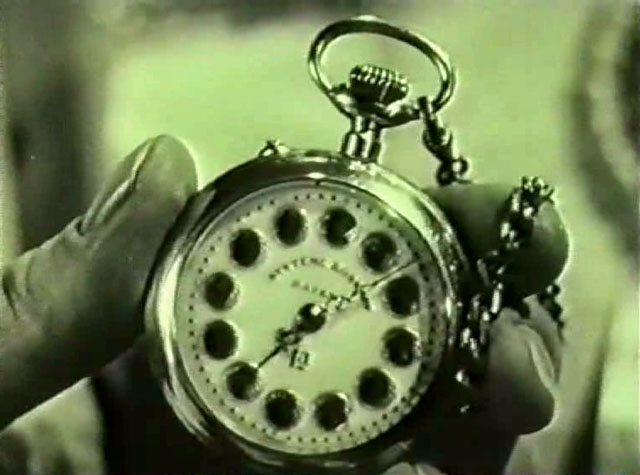
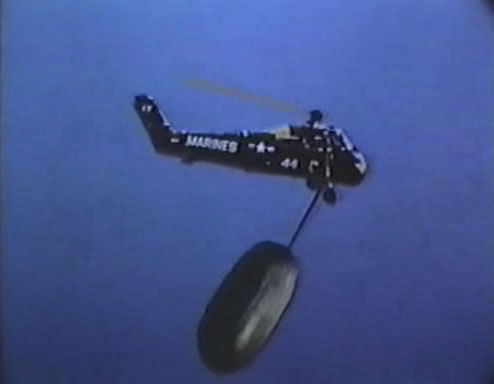
Too many great shots in this one:

The Fat and the Lean (1961)
A flunky is serenading a lazy fat man outside on a hot day. Every day the flunky helps the lazy man hunt and rest and eat and cool off, then tries to escape and gets stopped, until the lazy man ties the flunky to a goat. Times are tough for a while, but one day the flunky is released from the goat, and works twice as hard to please the lazy man, planting flowers all around him instead of trying to escape when the lazy man falls asleep. I was impressed by the acrobatic performance of the slave. IMDB says it’s Polanski himself, but then, IMDB also says Polanski played the old woman in the bathroom.

Mammals (1962)
Two dudes have one sled. Each pretends to be injured so the other will tow him in the sled. My favorite bit is when one wraps himself completely in bandages, turning invisible against the snow. Weird that R.P. would finally make an all-out comedy the same year Knife in the Water came out. I guess even Roman has to unwind once in a while. I don’t know an awful lot about Polish film, but this came after Wajda’s war trilogy, a few years before The Saragossa Manuscript was made, and before Kieslowski’s career had begun.

Monsieur Fantomas (1937, Ernst Moerman)
This was the prize short of the month… good show, Moerman. Takes the dream-logic, intense crimes and crazy escapes of Feuillade and goes all-out surrealist with them. The master criminal lives in a room with no walls on the beach (much of the movie takes place on the beach), seeks out his true love Elvire. Chief Juve is roused from the bathtub, consults with some seashells and heads buried in the sand. A hundred delightful things happen then it closes with the title card “end of the 280,000th chapter.” Made in Belgium, and I’m very sorry that Moerman didn’t shoot any more films. There really needed to be more surrealist cinema.

The cops close in on Fantomas… but is it really him, or just a cello?

Dinner For One (1963)
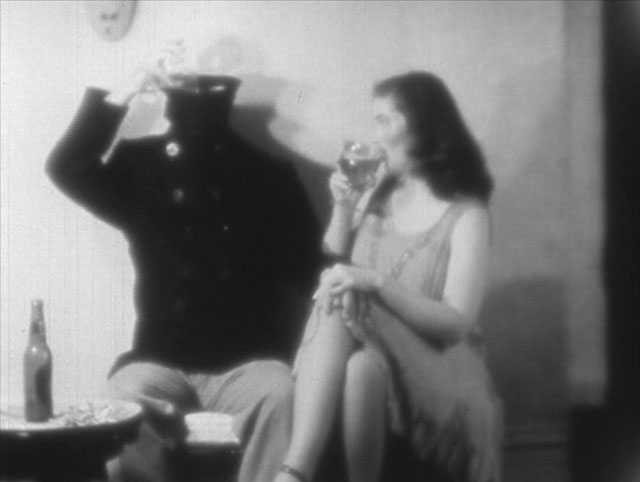
Shot in Germany, and shown traditionally every year on television since, a beloved little sketch in which a butler sets the table for an old woman’s absent guests, drinking toasts in each of their places and getting roaring drunk as he continues to perform his duties.

May Warden and Freddie Frinton:

The Spine (2009, Chris Landreth)
Group marital counseling + codependency, slowly coheres into a story. I didn’t like it nearly as much as his short Ryan.


Three by Sally Potter
These shorts predate Thriller by almost a decade, early film experiments not having much in common with her features – well, perhaps slightly with The Gold Diggers, which I started watching but haven’t finished.

Hors d’oeuvres (1972)
Silent avant-garde film, a flickering light shines on still photographs, then slow, unstable film footage of one person at a time in a bare room. Dance movements, slowed down then paused, superimpositions, the light pulsating. Lasted about twice as long as my willingness to appreciate it.

Play (1970)
Also silent, two cameras high up at different angles capture the same scenes of children playing on the sidewalk, at first presented side-by-side simulatenously, then re-edited, slowed down and chopped up.

Jerk (1969)
Faces, sped up and extremely rapidly edited. This was my favorite. I wonder if Potter considered the film’s motion to be “jerky” or if she thought this guy was a jerk.

Father (1977, Shuji Terayama)
a one-take silent sex scene that turns into a pleasant slideshow, featuring video superimpositions of a hand and the back of a head. No audio on my copy.

La Chambre (1972, Chantal Akerman)
Four slow pans around a cramped apartment, fully silent. First the director flutters her eyes at us from bed, then she is wriggling around, then playing absently with an apple, then – change of camera direction! – eating the apple, as the camera finally realizes she’s the only thing of interest in the room and starts rocking back and forth, homing in on her bed.

Birds Anonymous (1957, Friz Freleng)
“Birds is strictly for the birds.”
Just an average tweety and sylvester short, some kind of parody of werewolf movies and alcoholics anonymous, as far as I can tell. Wonder why this was on my laptop. And what is alum?

Playback (1970, Pere Portabella)
Two cameras, and you can see each in the other’s shot as they circle a composer who is arranging his unconventional choir piece, chattering constantly in unsubtitled Catalan. It’s all kind of exciting. I don’t know anything about Portabella, but I like his shooting style so far.

From the filmmaker’s official site:

Playback is presented as a short rehearsal in a double sense. It is a satellite of the constellation of works that Portabella dedicates to the analysis of the “materiality” of aesthetic and cultural languages (Vampir-Cuadecuc and Miró l’Altre among others can also be understood in this manner). At the same time, he analyzes the rehearsals that Carles Santos carries out for the playback recording of a film on the work of Antoni Gaudi. The choir of the Gran Teatro del Liceu of Barcelona reads fragments from Wagner’s Tannhauser, Lohengrin and the Valkyries. The film was shot in the theater “Lluïsos de Gràcia”.

Two Portraits (1981, Peter Thompson)
The director narrates a series of one-sentence statements about his father, as we see consecutive film frames cross dissolving. “His oldest son died at age 31. The decision to have children was left to his wife, as were all decisions except those concerning money.”

Second portrait is of his mother, filmed sleeping outdoors, while on the audio she reads pages from her diary. The first half was far more illuminating and sympathetic. I’m not sure what to do with the second part, but as with all of Thompson’s films that I’ve seen, I’d be glad to watch it again.

First portrait:

From Chicago Magazine: “When Peter Thompson was 35, his father committed suicide. That tragedy 29 years ago sent the Columbia College professor searching for Super 8 film of his father. He found only 12 seconds’ worth, but stretched them out to 17 minutes and added narration. When he expanded it to include his mother, the resulting film, Two Portraits, moved audiences to tears.”

Second portrait:

It snowed in Atlanta so everything shut down for an entire week. As is now traditional, I celebrated by watching a pile of shorts I’d long been planning to see (some as part of the Auteur Completist Initiative).

The Dreamers (1982, Orson Welles)
Welles as an old man narrates the story of opera singer Pellegrina Leone (Oja Kodar), who lost her singing voice in a fire. It’s all Welles and Kodar doing monologues. Maybe all of Welles’ films come down to monologues. Constructed from fragments, with black screens where footage was missing, narration recorded with the sound of rustling script pages. Ooh look, a Don Quixote reference. Not the most exciting of the many late-career Welles fragment films… personally I’d like to see more of The Deep.

Orson in his magician hat:

Invocation of My Demon Brother (1969, Kenneth Anger)
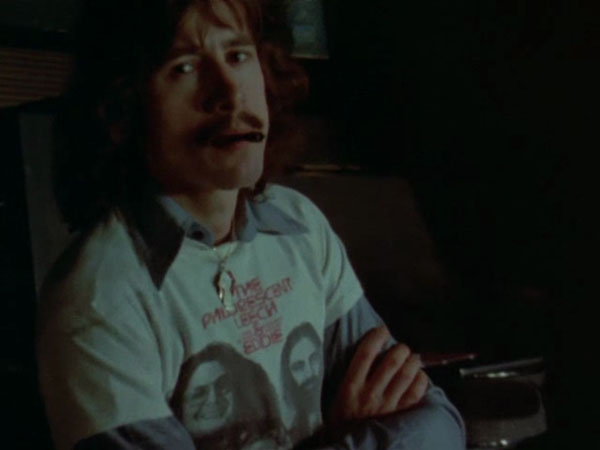
Good camerawork, but ridiculous movie. I think with his images Anger is trying to say that the military is a death-obsessed homosexual cult. I think with his audio Mick Jagger is trying to declare the death of interesting music. I think with his performance, Anton LaVey is trying to expose himself as a silly clown.

That is a nazi flag, but what is he burning?

Le Lion Volatil (2003, Agnes Varda)
Julie Depardieu (Guillaume’s younger sister) works for a psychic, while an aspiring magician named Lazarus Combes (Anton LaVey would be pleased) works at a tourist-trap dungeon around the corner. Every day on their lunch breaks they meet in front of the Lion of Belfort memorial – the same one featured in Rivette’s Pont du Nord and Paris s’en va. Their brief almost-romance doesn’t pan out, but more interestingly, Julie starts hallucinating variations on the lion – first it has a giant bone in its mouth (as supposedly suggested by Andre Breton), then it vanishes and is replaced by a giant housecat. Special effects + Vardaian whimsy = happiness.

Les Dites Cariatides (1984, Agnes Varda)
A tour of caryatids – human statues used as building columns or ornamental facades – throughout Paris, with poems by Baudelaire. “The Peloponesian city of Karyate aided Persia in a war against other Greeks, but Persia lost. The Greeks took revenge on Karyatian collaborators, slaying all the men and enslaving the women. They were paraded as spoils of war. The noble women were triumphantly shown in their lovely gowns and finery. To illustrate their punishment, architects used these statues on public buildings instead of columns.”

The Calligrapher (1991, Bros. Quay)
Three short (15-sec?) segments rejected as BBC2 ident bumps. My favorite kind of Quay film – awesome stop-motion with no human actors, repetition or long-winded confusing mythological story.

Storytime (1968, Terry Gilliam)
This came out while the show Do Not Adjust Your Set (a precursor to Flying Circus) was in production. Opens as a poorly-animated (in Gilliam’s magazine-cutout style) story of a cockroach named Don, who is then stomped on by a man called Jeremy Trousercrease… and so on, each minute-long concept leading into another. Even features a “we apologize for the previous cartoon – the animator responsible has been sacked” disclaimer, which would be reused in Monty Python. Not exactly a lost masterpiece, but a fun little series of cartoon gags.

Pandoora (2002, Takashi Miike)
Just a cheesy samurai music video – does not count as a Miike movie. It ends with our hero about to face off against a giant mantis. What, were they expecting a sequel?

Male (1962, Osamu Tezuka)
Lots of play with frame sizes and positions as a male cat narrates, talking to the man of the house, about how sex should be simple and private and should not end in stabbing your partner to death.

The London Story (1986, Sally Potter)
A woman conspires with a door opener and a retired photocopy machine operator, takes a government minister out to the theater and while he sleeps, replaces his speech about the future of Britain with a new one, causing panic in the media the next day as the conspirators enjoy a choreographed dance on a bridge. Delightful.

Reasons To Be Glad (1980, Jeff Scher)
More of Scher’s fanciful drawing and incredible editing based on rotoscoped (?) images and set to a Dinah Shore song.

The Bum Bandit (1931, Dave Fleischer)
Oh my. A Popeye-muttering train robber gets out-toughed by a passenger in the form of Proto-Betty Boop (still with the dog ears), the robber’s abandoned wife, who steals the locomotive and the bandit, closes the shades and makes with the sweet pre-code lovin’.

Betty and the Bum:

Negro passenger with stolen chickens:

Russian Rhapsody (1944, Robert Clampett)
Watched this recently on the big screen but it never gets old. Hitler’s plane is taken out by gremlins from the kremlin. Why don’t we have wartime cartoons anymore? I want to see the Penguins of Madagascar take on Osama Bin Laden.

Vinyl (1965, Andy Warhol)
In the 60’s it was revolutionary to make slow, cheap movies with bad gay actors, but not anymore. There are probably three filming as I type this. This isn’t technically a short film, but I gave up after thirty minutes, having dozed for the previous ten. A dude recites Burgess and dances to pop music – and it’s all one shot. Wikipedia says it was filmed unrehearsed, which I don’t doubt, and says it’s one of the “1000 films to see before you die,” which I do.

Last November I held the “month of 121 shorts” and burned myself out, so I didn’t feel like watching many in 2010. Thirty made the list last year including runners-up, but I barely watched that many in total this year. Anyway, here are twelve that I loved.

1. 11’09″01 (2002)
Specifically, the two entries with children in them, by Samira Makhmalbaf and Idrissa Ouedraogo. They’re the only two that dared to treat the subject with lightness or humor, and their bravery paid off.

2. Day & Night (2010, Teddy Newton)
Remember that thing before Toy Story 3 with the visual concept that I loved but have trouble explaining? That one.

3. Cry For Bobo (2001, David Cairns)
Best clown movie ever.

4. Guy Maddin’s Night Mayor and Send Me To The ‘Lectric Chair and The Little White Cloud That Cried

5. Narcissus (1983, Norman McLaren)

6. Gauguin and Van Gogh (Alain Resnais)

7. Letter to Uncle Boonmee (2009, Apichatpong Weerasethakul)

8. Talking Heads (1980, Krzysztof Kieslowski)

Runners-up: Spike Jonze’s robot thing I’m Here, Lindsay Anderson’s diary Is That All There Is (if that counts as a short – I’m starting to reconsider) and, though I’d seen it before, Bert Haanstra’s awesome Zoo.

Another entry for…

Initiated by Shadowplay

It’s rare for late-career shorts to even exist. Filmmakers tend to “graduate” from shorts to features, never looking back, unless called to work on some anthology film (like that one called “8” which Altman was scheduled to make after A Prairie Home Companion). Animators may be the exception, so half of the late shorts I rounded up were handmade.


Self Portrait (1988, Osamu Tezuka)
The few animations I’ve seen of Tezuka’s are among the most inventive I’ve seen from anybody. I’m not sure if the ten-second runtime of this short, made when he was 60, was imposed by the producer of this Animated Self-Portraits series or if that’s simply how much time Tezuka needed to make his point. Left/right/center portions of faces spin like a slot machine, and after four or five mismatches, the proper self-portrait alignment is reached – jackpot!


Is That All There Is? (1993, Lindsay Anderson)
Another self-portrait – the artist at age 70. Lindsay wakes up, takes a bunch of pills, puts on the news, watches some TV, has a bath, gazes at posters of his own films on the bathroom walls, goes shopping then back home, entertains writer Bernard Kops who talks about getting paid for his work, chats with some more visitors, moans about transportation with the cleaning lady, gets in a fight with his disgruntled nephew, complains about Michael Caine’s hair, discusses John Ford with a BBC producer, photocopies a newspaper review of Michael Powell’s Life in Movies that Lindsay wrote, goes through his scrapbook of past film writing, watches Ron Howard on Oprah (“I always wanted to make a movie … most importantly, I didn’t want it to be boring”), reviews his history of theater productions and film projects (he claims to have written If… 2), goes to the acupuncturist and the doctor, checks out sets and music for a new theater production, talks with his brother about gravitas, then holds a memorial service for two actresses who had appeared in his TV movie The Old Crowd fourteen years earlier. A full day. I don’t know much about Anderson – seen his bizarre Malcolm McDowell trilogy, but I only enjoyed two of them and probably understood none. This was downright enjoyable, especially considering my lack of enthusiasm for the day-in-the-life documentary format. Though I’m not saying this was a documentary – Anderson gets a writing credit, and the scene construction is subtly more intricate than could be expected from a single camera recording in real time.


Narcissus (1983, Norman McLaren)
McLaren’s final released film, made when he was seventy. A ballet version of the Narcissus tale, in which our hero dances against a black background with a girl, then with a guy, finally shunning them both in favor of his own reflection. Beautifully shot and danced. I didn’t notice much in the way of McLaren’s signature styles in the ballet until Narc began dancing with his own disappearing self accompanied by nintendo computer blips on the soundtrack. Probably won more awards than any other McLaren film, in part because by the 80’s there were more award shows and festivals than ever before.

Narcissus meets himself:

Dances with himself:


I consider “late” Buster Keaton to be the 70-ish movies he appeared in since the 1920’s, shortly after the arrival of sound when his career went to hell. So these are very late Keaton, made in the last couple years of his life when he was around seventy years old (see also: the Twilight Zone episode he did a few years earlier).

The Railrodder (1965, Gerald Potterton)
A wordless journey through desolate Canada, which must have been trying to attract humans to its empty factories, forests, harbors, fields and cities, all seen as Buster whizzes by on a motorized rail car. Not as good as a classic Keaton short, but not as bad as most state-sponsored promo pieces either, just a light amusement with some minor Keaton antics and major Canadian scenery, with possible references to The General and The Cameraman. I like when he turns the car into a duck blind, but the gag’s payoff is lame – it’s not the most well-planned or well-timed little picture. Director Gerald Potterton moved into animation, making the legendary Heavy Metal.

Buster Keaton Rides Again (1965, John Spotton)
A “making of The Railrodder” that runs almost triple the length of the feature. In fact it’s over-long, in love with its subject, providing nice quick summaries of Keaton’s past films and life story, then rambling on with the present-day footage. A coughing, gruff-voiced Keaton smokes whenever not on camera for Railrodder (he died of lung cancer the following year). He’s a stubborn bastard regarding the gags and filmmaking – it’s clear from this doc that the IMDB’s listing Buster as uncredited cowriter/director on Railrodder is accurate. My favorite gag was in the documentary, not the feature, Keaton pretending to pull a train that comes in while he’s standing near the tracks. It closes with Keaton singing “Casey Jones” in his trailer, more emotional of a picture than the fluffy promo piece it accompanies.

Film (1965, Alan Schneider)
Close-up of an eye. Protagonist, always shot from behind, staggers to his apartment, horrifying all who look upon him. Alternate blurry shots from his POV. In the apartment, he covers a mirror and removes or destroys everything that has eyes. Feels for his own pulse. Finally, Buster’s face is revealed, wearing an eyepatch and his signature hat. Close-up of an eye. I don’t understand Samuel Beckett. Could someone explain him to me?


Stop-motion pioneer Charley Bowers made these couple films over a decade after all his other work, and according to his IMDB bio, “no one is quite sure what he did” during that in-between decade. They’re his final films, completed the year before he became sick at age 64, unable to work until his death a few years later.

A Sleepless Night (1940, Charley Bowers)
No sound at all (who watched silent shorts in 1940?) so the DVD producer unconscionably included an audio track of projector noise. I listened to LCD Soundsystem instead, greatly improving the movie, which was otherwise slack-paced and plotless. We’ve got a stop-motion mouse family who defeats the dog of the house, drinks a bottle of milk, then eats soap and floats away on the resulting bubbles.

Wild Oysters (1941, Charley Bowers)
More technically accomplished (featuring much more camera movement) and snappier than the last one, and with the same models for the mouse family, makes me think A Sleepless Night was a test run for what he’d planned as a series of mouse adventures. Although, spoken dialogue and a song with lyrics that comment on the action aren’t the major improvement. The mouse torments a different dog and also a cat, drilling holes in the floor and pulling their tails through. Weirder is when he runs across some oysters, which link together as a chain and chase him about. Why oysters? Even Tom and Jerry never ran so low on ideas that they introduced a string of oysters. Anyway, weird movie but enjoyable.


The Karateguard (2005, Joseph Barbera & Spike Brandt)
The final Tom & Jerry short released to theaters, and the only one made by Barbera, aged 94 at the time, after the passing of partner William Hanna in 2001. It was a passing of the torch to Brandt, who is still making T&J cartoons. I was never a wildly enthusiastic T&J fan, so I can’t share the outrage of the IMDB reviewer who calls it “unbearably mediocre.” Jerry isn’t great at his karate lessons, so his translucent sensei encourages him to quit, instead gives him a magical gong that summons a stone-faced samurai dog, who proceeds to pummel Tom for six minutes. A good time is had by all.

The Wrong Trousers (1993, Nick Park)
Endlessly amusing, and full of curious references to unknown kinds of cheese. The baddie is a jailbroken diamond-snatching chicken with a rubber-glove rooster hat and some electrical skills. Some serious dejected Gromit sadness when the tenant chicken takes his place and he leaves home… why must funny cartoons also make me sad?


Dizzy Dishes (1930, Dave Fleischer)
A Bluto-type orders roast duck, but our blandly Bosko-like hero dances around the kitchen instead of preparing the meal professionally. He makes a half-hearted attempt to serve the duck (shaved – not roasted) when he’s distracted yet again by a dog-eared proto-Betty Boop, leaving Bluto so hungry that he eats the dishes and table (see also: Jan Svankmajer’s Food). Finally Bosko, a true villain, assaults the poor customer and leaves with the dancing girl.


Direction of an Actor by Jean Renoir (1968, Gisele Braunberger)
What to do when your father is a famed film producer? Hire Jean Renoir to give you acting lessons. Gisele is told to read lines to Renoir completely flat with no hint of affectation, and he stops her many times if he detects even a hint of predetermined acting style, saying that first she must read the lines bringing nothing to the table, and then the character’s voice will come from the lines. Sounds like good advice. I watched this short doc thinking it was connected to the ones Rivette made with similar titles, but I guess not. Shot by Edmond Richard (Discreet Charm of the Bourgeoise, Welles’ The Trial) – can’t see how exactly it counts as a film by Giselle, but I guess it was her idea.


The next four are from Revolución (2010), a Mexican omnibus film that I didn’t finish watching when it was briefly available online.

La Bienvenida (Fernando Eimbcke)
Armancio the tuba player sacrifices all his family time practicing for the big welcome song, then the guest of honor never shows. All the other orchestra members go home but the tuba stays and plays his rehearsed part solo for nobody. Non-moving camera, low lighting, black and white. It must be a comedy, since tubas indicate comedy, but why am I not laughing? True, the final shot was nice.


Beautiful and Beloved (Patricia Riggen)
A dying man’s wish to his U.S.-born daughter is that he be buried in Mexico, where she’s never been. There’s talk of selling her grandfather’s pistol from the Mexican Revolution for funeral expenses, but instead she gets a deal by sleeping with some sleazy guy, which I believe is seen as a victory for the revolution.


Lucio (Gael Garcia Bernal)
Lucio’s weird cousin comes to visit, refuses to participate in religious rituals and removes the christ-on-a-cross from the bedroom wall saying he doesn’t believe in images. Lucio has some sort of epiphany from all this, as seen by his running to the top of a mountain and gazing at the horizon.


The Hanging Priest (Amat Escakanate)
A couple of kids (who say they’re engaged to be married even though they’re ten – is that a Mexican thing?) come across a priest in the desert. They share their water, walk for a while, and end up at a McDonald’s.

WonderRoot’s Generally Local, Mostly Independent Filmmakers’ Night

Atlanta, Day One (John Duke and Kris Valeriano)
I liked. KV wears a three-dollar suit, tours picturesque ruins of Atlanta before he starts breaking down. I dig the editing at the end, as it cuts between scenes where he’s in the same physical pose, giving the impression of one movement transporting across locations.

Mouth 2 Mouth (Patrick Coll and Chris Chambers)
Hilarious, very short animation.

Until Dust (Nathan Honnold)
I remember saying to Jimmy afterwards that it’s good to know I’m not the only Guy Maddin fan in Atlanta, but I don’t remember much else. Oh wait, here it is on Vimeo! Blurry-focus titles, one of which says “hairdressing school,” yep, I stand by my Maddin comparison. Too bad it’s one of the only pieces projected interlaced, since it was shot originally on super8 film.

Rex (Jackson McDonald)
A guy picks up girls to feed to his hungry dragon. Shot decently and colorfully, complete with flashbacks.

Breathe (Fletcher Holmes)
Clever special-effects demo, shot underwater and somehow keyed, breathing SFX added later prompting a “how’d you DO that?” from the crowd.

17 Degrees Ain’t Nothing (Carlton Mackey and Dane Jefferson)
Two dudes got a camera, but what to film? They chose to interview some homeless people for an hour – and that hour changed their lives (the lives of the two dudes, not of the homeless people). A year later, footage is edited, theme songs are written, still photos are panned and zoomed, and lessons are learned.

The Charm and Rant of Charlotte Pomerate (Beth Malone)
The filmmaker has, what was it, a grandfather involved in “very far left” politics? And his wife wrote children’s books. And she was interviewed by her granddaughter, then the interview was turned into a claymation video… but it’s more “clay” than “mation”. Clay-still-life. Combines two styles I don’t like (documentaries about one’s relatives + animating audio conversations) but it was cute so I couldn’t stay mad.

Passion Seeker (Chris Chamber)
Video for a song by Little Tybee and Adron edited from 1930’s-90’s film clips. Played at around 2fps, and it’d be important to know whether that was intentional. If so, I’m not a big fan. If not, hey WonderRoot, I can give you advice on how to fix that. The song was nice.

Christmas and Hanukkah (Garry Bowden)
“Love is coming for us all,” says the description. A straight-faced romance soap-opera that inspired derisive laughter from the audience. Could Bowden be the Tommy Wiseau of Atlanta? Could he even be of Atlanta? I didn’t recognize any of the scenery, and it’s mostly shot outdoors. Story follows two people who find each other after sour breakups, shot by a man with a handicam but without a plan.

Heaven (Chris Sailor)
Heaven is a parking lot where echoes both precede and follow your words. You should be quiet, according to the man behind you in a creepy mask, but you are not. Also, you’d like a cigarette.

One Minute Fluid Toons on Paper (Brett W. Thompson)
Finally, the long-awaited return of Fluid Toons! Less narrative (and without the awesome sound effects) than the last installment, but any Fluid Toons is good Fluid Toons.

Godamsterdam: Yellow Fever (Ben Cohen)
Part of a web series celebrating political incorrectness. It’s no Sarah Silverman Program but it made me chuckle. Probably the most ambitious project here, setting up a regular cast of characters and a whole series of shorts, with higher than usual production values.

Uncle Ali (2000, Cheick Oumar Sissoko)
Cheikh’s uncle is super sick from AIDS, comes to live with his family after the uncle’s neighbors boot him from his apartment. Cheikh learns a bit about STDs, prejudice and love. The kid is Alioune Ndiaye of The Price of Forgiveness and Uncle Ali is Guelwaar himself, Thierno Ndiaye (also of Karmen Gei and Africa Paradis).

The Heart of the Matter (2004, Mahamat-Saleh Haroun)
It’s all monologue voiceover, and the voice acting isn’t the best. Actually all these “Scenarios from Africa” shorts online have been dubbed into English. I also checked out a Sissako (Good Reasons) and an Idrissa Ouedraogo (The Shop) from this series and none are interesting at all except as educational tools. Anyway, this one stars the mute girl from Haroun’s Abouna. It’s twice as long as the others, so I figured it’d have time to develop into more of an actual movie than a flimsy PSA, but no luck.

I’m Here (2010, Spike Jonze)
Where did this half-hour love story come from? Maybe Spike felt the need to create something personal after working on Where The Wild Things Are for years of his life. Awkward, traditional boy robot falls in love with rule-breaking girl robot. The twist comes when she keep losing limbs and he gives her his own to replace them, until finally she’s in a wheelchair, and he’s nothing but a head. Played at Sundance – somehow supposed to be an ad for a vodka company, but I didn’t see that.

Letter From Hong Kong (2010, Jimmy Lo)
Comes complete with deleted scenes of food, family and kitties. I liked the camera on the spinning table. Don’t think I’ve ever seen a movie where the cameraman sneezes before.

Falkenau, The Impossible (1988, Emil Weiss)

Weiss seems to love Sam Fuller, but he’s not on Fuller’s wavelength, unable to have much of a conversation with the man. So this doc (which is an hour long, but I crammed it in the shorts section anyway) admirably fulfills its purpose by screening all of Fuller’s WWII concentration camp cleanup footage while Sam narrates, taking him to the site of the camp in present-day and asking for his thoughts. That would’ve been more than enough, but Weiss leaves us with a one-sided (Sam likes to talk) silly-ass conversation about fictional representation of war, which would’ve been better left out. I’m most of the way through Sam’s autobiography, one of the greatest books I’ll ever read, where Fuller says this doc screened at Cannes and was praised for its straightforwardness.


Cry For Bobo (2001, David Cairns)

Poor and desperate, a man resorts to thievery to get by. He’s caught and imprisoned, then shot to death after escaping, as his wife and kid leave town, trying to start a new life without him. It’d be a miserable little story if the main characters weren’t clowns. Hilarious, reference-heavy, and better than I’d expected – and I had expected greatness. Already watched twice and trying to get Katy to see it (she hates clowns).


The Possibility of Hope (2007, Alfonso Cuarón)

Zizek:
“We no longer live in a world. ‘World’ means when you have a meaningful experience of what reality is which is rooted in your community, in its language, and it is clear that the true most radical impact of global capitalism is that we lack this basic literally ‘world view,’ a meaningful experience of totality. Because of this, today the main mode of politics is fear.”

Naomi Klein:
“More and more we see the progression of this economic model through disasters. So we’re now in a cycle where the economic model itself is so destructive to the planet that the number of disasters is increasing, both financial disasters and natural disasters.”

James Lovelock:
“If you live in the middle of Europe or here in America, things are going to get very bad indeed.”

Of course the “hope” part comes at the very end, as it does with all recent doom-gloom climate-change global-meltdown documentaries, and the hope in this one, despite the film’s title, isn’t all that hopeful. Start preparing now for how badly the future will suck – and it will suck. An Inconvenient Truth supposedly has a credit-time list of ways you can help the planet, Home encourages us to build windmills and go vegan, Wake Up Freak Out says we must act politically, and there’s always the hope during Collapse that the subject is just wrong, or that he’s a crackpot. Not so much here. If I’ve avoided talking about the filmmaking, well it’s basically a radio show with distracting visuals, much of it b-roll from Children of Men.


Night Mayor (2009, Guy Maddin)

Pronounce it similarly to “nightmare.” An inventor, a Bosnian immigrant, harnesses the “music” of the Aurora Borealis and converts it into dreamlike images which are sent across phone lines to his fellow Canadians using his Telemelodium. Even more/cooler junkpile inventions than in the electric chair short, some nudity (not as much as in Glorious or The Little White Cloud That Cried) and some delicious nonsequiturs. Clean narration by the accented inventor and two of his kids, along with excellent string music. At the end, the government shuts down his project, so he turns his attention from the skies to the seas, considers visualising whale songs.


One Minute Racist (2007, Caveh Zahedi)

Sweet three-minute cartoon story about the slippery slope of racism narrated by CZ, who codirected with a couple animators. Story of a student who doesn’t like asians because they’re too uptight and a paranoid library security guard who threatens to confirm the stereotype.


Talking Heads (1980, Krzysztof Kieslowski)
“What is your year of birth?”
“Who are you?”
“What do you most wish for?”
These three questions are asked to a one-year-old, then a two-year-old, and so on. The final answer: “I’m one hundred years old. What do I want? To live longer. Much longer.”

Most people seem to have thought about the questions for a while – possibly while the camera and lighting crew buzzed about their head, since the film looks like a lesson in how to effectively shoot subjects, professional but no-frills, by cinematographers Jacek Petrycki (No End, Camera Buff) and Piotr Kwiatkowski (second camera on the Three Colors). As a result, the answers come out seeming like a beauty pageant. Everyone wants more honesty and fairness, for everybody to just get along. The answers from kids under ten and adults over seventy are the best.


Born Free (2010, Romain Gavras)

I don’t count music videos as “shorts” or things would get too complicated, but then, I don’t really count this as a music video. M.I.A.’s music isn’t far enough up front, and the video (by Costa-Gavras’s son) is twice as long as the song. It’s a little piece wherein red-headed kids are rounded up by violent cops, beaten, shot and made to run through a minefield. Probably trying to make a point about tolerance and freedom, but for messages of tolerance I preferred the climactic speech in Cry For Bobo, also featuring overzealous cops: “First they came for the mimes, then the jugglers, then the bearded ladies. Next time, it were you.”


Hotel Torgo (2004, buncha dudes)

Buncha dudes head for El Paso and interview the last guy who remembers working on Manos: The Hands of Fate. There’s no real point to this, but the guy is very good-natured about it. Learned that Torgo was high all the time, which shouldn’t come as a surprise but somehow still does.