Archive for December, 2007

Brandon’s Twenty Favorite New Movies of 2007

My Favorite Twenty New Movies in 2007

not sorted, just grouped by vague categories:

five miraculous foreign films:
Bamako (Abderrahmane Sissako)
Black Book (Paul Verhoeven)
The Wind That Shakes The Barley (Ken Loach)
Dry Season (Mahamat-Saleh Haroun)
Chacun son cinéma (shorts by a buncha directors)

two critically-loved mid-year american masterpieces
Zodiac (David Fincher)
Ratatouille (Brad Bird)

three brilliant early-year action-comedies
Grindhouse (Rodriguez/Tarantino/Wright/Roth/Zombie)
The Host (Bong Joon-ho)
Hot Fuzz (Edgar Wright)

oscar-season masterpieces
Atonement (Joe Wright)
No Country For Old Men (Joel & Ethan Coen)

glorious and unconventional musicals
Sweeney Todd (Tim Burton)
Once (John Carney)

fits both of the above categories:
I’m Not There (Todd Haynes)

difficult auteur-defense conflict pictures
Inland Empire (David Lynch)
Eastern Promises (David Cronenberg)

three that nobody cared about but me:
Sunshine (Danny Boyle)
The Screwfly Solution (Joe Dante)
Ten Canoes (Rolf de Heer)

next ten runners-up: The NamesakeOffsideAcross the UniverseThe Lives of OthersAway From HerPrivate Fears in Public PlacesInto the WildParis je t’aimeThe Simpsons MovieThe Diving Bell and the Butterfly

Tags:

Comments

Brandon’s Twenty Favorite Old Movies of 2007

All seen on video for the first time, none are current releases, except maybe “The War Tapes” because I can’t remember if it played theaters here or not.

Top ten, in order:

1. Celine and Julie Go Boating (1974, Jacques Rivette)
far exceeds its reputation, a truly amazing film, like candy on my TV
2. Muriel (1963, Alain Resnais)
3. Dog’s Dialogue (1977, Raoul Ruiz)
one of my favorite short films ever
4. Pennies from Heaven (1981, Herbert Ross)
one of my favorite musicals ever
5. Three travel films by Chris Marker:
- Sunday In Peking (1956 China)
- Description of a Struggle (1960 Israel)
- The Koumiko Mystery (1965 Japan)
6. Matinee (1993, Joe Dante)
7. Miami Vice (2006, Michael Mann)
a work of art unfairly lumped in with “dukes of hazzard” and other TV remakes
8. The War Tapes (2006, Deborah Scranton)
I cried tears of pure sadness
9. Army of Shadows (1969, Jean-Pierre Melville)
fewer tears, but still a shocking war story
10. Little Dieter Needs To Fly (1997, Werner Herzog)
third war movie in a row, this one considerably happier

Next ten, alpha:

Cabin Fever (2002, Eli Roth)
The Exterminating Angel (Luis Buñuel)
The Face of Another (1966, Hiroshi Teshigahara)
The Girl Can’t Help It (1956, Frank Tashlin)
Guys and Dolls (1956, Joseph Mankiewicz)
The Lady Eve (1941, Preston Sturges)
Los Angeles Plays Itself (2003, Thom Andersen)
The Tales of Hoffmann (1951, Powell & Pressburger)
Waiting For Happiness (2002, Abderrahmane Sissako)
Werckmeister Harmonies (2000, Béla Tarr)

Runners-up:
Le Joli Mai (1963), Zazie dans le métro (1960), David Copperfield (1935)

honorable mention:
A Brighter Summer Day (1991, Edward Yang)
seemed like it lives up to its masterpiece reputation, but in the crummy version I watched, I think I lost a ton of plot details… will surely place higher when I see it again.

happy auteur discoveries:
John Ford (The Searchers)
Billy Wilder (Some Like It Hot)
Shohei Imamura (Vengeance Is Mine)
Eric Rohmer (first two moral tales)

five more great musicals:
The Young Girls of Rochefort (1967, Jacques Demy)
The Music Man (1962, Morton DaCosta)
Fiddler on the Roof (1971, Norman Jewison)
Meet Me In St. Louis (1944, Vincente Minnelli)
Red Garters (1954, George Marshall)

the better-than-it-should-be award:
a tie between Hard Candy & Lord of War (both 2005)

the most awesome cult / b-movie award:
Brain Damage (1988, Frank Henenlotter)

the “ahh, I get it now” award:
L’Avventura (1960, Michelangelo Antonioni)
runner-up: Hiroshima Mon Amour (1959, Alain Resnais)

the saddest movie award:
The Road to Guantánamo (Michael Winterbottom)

the “child favorite that is, against all odds, still a favorite 20 years
later” award: a three-way tie!
Gremlins 2: The New Batch (1990, Joe Dante)
Night of the Creeps (1986, Fred Dekker)
Little Shop of Horrors (1986, Frank Oz)

the “makes me feel cooler just for having seen it” award:
Pandora’s Box (1929, G.W. Pabst)

funniest movie ever seen on an airplane:
Jackass The Movie 2

Tags:

Comments

Brandon’s Top Ten Retrospective Screenings of 2007

Best Retrospective/Not-Current Films Seen Theatrically

#0. Out 1 (1971, Jacques Rivette) at the Museum of the Moving Image in New York
not so much a movie as an experience, too amazing to even join the rest of the list

1. Play Time (1967, Jacques Tati) at Emory
2. To Sleep With Anger (1990, Charles Burnett) at the film festival
3. An Autumn Afternoon (1962, Yasujiro Ozu) at Emory
4. La Ronde (1950, Max Ophüls) at Emory
5. Killer of Sheep (1977, Charles Burnett) at the film festival
6. Red Balloon / White Mane (1953/56, Albert Lamorisse) at the Midtown Art
7. Pierrot le fou (1965, Jean-Luc Godard) at the Midtown Art

all below had seen before, but was great to see again:
8. L’Atalante / Zero for Conduct (1933-34, Jean Vigo) at Emory
9. The Nightmare Before Christmas in 3-D (1993) at some multiplex
10. The 400 Blows (1959, Francois Truffaut) at the Plaza

Tags: ,

Comments

Six Movies I Didn’t Get in 2007

or, “The WTF Awards

Not the worst movies I saw this year - those are better forgotten (ugh, Vibroboy) - but the ones that I should’ve enjoyed but didn’t, and so it’s probably my fault.

My Brother’s Wedding & When It Rains (both Charles Burnett)
It was Burnett’s big comeback year. I thought both “Killer of Sheep” and “To Sleep With Anger” were overwhelmingly great, but these two left me cold… “Wedding” seeming especially amateurish considering it was made after the gorgeous “Sheep”, and “Rains” just didn’t live up to my expectations being one of Rosenbaum’s ten favorite films of the 1990’s. Fortunately both are out on video now, with “Wedding” available in a brand-new director’s cut, so I’ll get to try them again sometime.

Mutual Appreciation
Magazines and blogs love “movements”, and as Film Comment is pointing out in this month’s issue, the “mumblecore” movement died pretty quickly. Judging from this uninteresting little movie, a mumblecore keystone, it should have.

W.R.: Mysteries of the Organism
I heard this was great from way back, and once it came out on DVD and everyone got to see it anew, they all agreed it was great. So what’s my problem? I love bizarre and perverse euro-art films, but this bored me.

Le Plaisir (Max Ophüls)
Each Max Ophuls movie I see I enjoy less than the last one. At least I didn’t dislike “Letter from an Unknown Woman”, and I learned to appreciate it more when watching the DVD extras afterwards. This one I still haven’t figured out. The central segment felt tedious, and I’m sorry this is the one Ophuls movie that I’ve shown to Katy.

Paprika
It’s officially official - I do not understand anime.

Iraq in Fragments
Failed to find all the beauty that is supposedly within, still wondering if our film print was out of focus.

These are only runners-up because I should’ve known better:
The Good German (everyone said this Soderbergh flick was a dud, but I had to see for myself)
The Descent (halfheartedly-acclaimed horror that I halfheartedly liked)
Inferno & Pelts (Dario Argento continues to not ring my bell)

Tags:

Comments

Looking Back, Looking Ahead, 2007-08

Movie-wise, I’ve too many goals lately. Original quests to see every movie by Samuel Fuller (still got 1 or 2 left) along with as many films as possible from the IMDB list (206/250) and Rosenbaum list (about 340/1000) got a bunch more quests added to them:

Fritz Lang films (just two left)
Joe Dante (watched six this year, bought The Burbs and got some TV episode he did)
Stuart Gordon (a spur of the moment thing for shocktober, just two left, not counting his new one)
Jacques Rivette (saw seven great films, and got some more all lined up)
Luis Bunuel (just three this year, plus a half-hearted screening of “Land Without Bread”)
Alain Resnais (watched or re-watched eight of his earliest films and the recent “Coeurs”)
Chris Marker (watched/loved his first six films this year, up to the rocky 60’s-70’s period where everything’s either super-rare or untranslated on video)
Films from 1977 (watched maybe three features and a bunch of shorts)
The Criterion Collection (about 205/450)
“They Shoot Pictures, Don’t They?” top 1000 list (about 460/1000)
NOTE: they updated the list in December so now I’m closer to 450.

For 2008 I’ve got a new movie quest, one which will help all the above-listed movie quests as a side-effect… to watch movies I already have… as many as possible!

The “just two left” films by Fritz Lang mentioned above? Got ‘em. Same for Stuart Gordon. Probably around 40 Criterion movies, everything available by Marker and Resnais and Rivette, and tons of titles on the Rosenbaum list. But more importantly, I find myself buying treasured DVDs (how much longer can I hold off on Kino’s second avant-garde collecton and Criterion’s “Days of Heaven”?) and filing them carefully on the shelf unwatched amongst all the other unwatched discs, then going off to rent “Saw III”. It’d make more sense to save this particular quest for some time when Videodrome has burned down or Katy has gotten a job and moved us both to Nebraska, but it seems like a good thing to start now.

That said, there are still plenty of 2006-07 films that I’d love to see on video, or when they finally roll out to Atlanta theaters, such as:
- Syndromes and a Century
- Guy Maddin’s “Brand Upon the Brain” and “My Winnipeg”
- Belle toujours
- Whatever Miike has been up to
- Don’t Touch the Axe
- Klimt, in its original cut
- My Blueberry Nights
- The Man From London
- Paranoid Park
- Go-Go Tales
- There Will Be Blood
- and the Coens’ missing short from “Chacun son cinéma”

JR Jones:
“And as I’ve gotten older, I’ve grown much less tolerant of movies that waste my time, a development I call the Finding Forrester effect. By most accounts Gus Van Sant’s 2000 drama about a reclusive literary icon is a listless hack job; I’ve never been able to watch it myself because it was the last movie my father saw before he took ill, went into the hospital, and died. When I’m sitting in a press preview I sometimes think, “If I had only a few days left, would I want to spend two hours watching this?” That may seem like an absurdly high bar for a filmmaker to clear, but whoever said a filmmaker is entitled to two hours of your life? Anyone who wants those two hours has a responsibility to make the movie meaningful in some way.”

Tags:

Comments

Werckmeister Harmonies (2000, Béla Tarr)

“Storyboards are stupid, stupid things.” - Béla Tarr

37 shots (not counting credits) in 145 minutes, so average 4-minute shots, with all but a handful of scenes contained within a single shot. Camera usually in slow, gliding motion. Stark b/w photography.

Same editor as Tarr’s previous films (Tarr’s wife, now also credited as co-director), same composer and same author of the source novel. Similar in look and feel to Satantango for sure, which means it’s long and slow in a beautiful and captivating way. I never get bored watching these movies, and I don’t even have a theory for why that is… they ought to be boring as all hell, especially Satantango, but I’d gladly watch each one again.

From reading the credits you’d think it’s a grand communal project, not a film by one clear artistic voice. IMDB credits six people for cinematography, unbelievable, including a Kansas native (an acclaimed indie filmmaker), a French steadicam operator who worked on Amelie and The Science of Sleep, and unsurprisingly the guy who is sole credited cinematographer for Satantango and Damnation. Must read source novel sometime, “The Melancholy of Resistance” by Laszlo Krasznahorkai.

Opens in a bar at closing time, Janos Valuska positioning the other bar patrons into a model of the solar system, the camera spinning and rotating around them.

image

Janos walks to uncle Gyuri’s house (how does Tarr manage to make walking scenes the highlights of his films?) to put him to bed. Stops outside to watch a massive truck slowly roll into town, carrying an exhibition with a giant stuffed whale, various curiosities in jars, and “the prince”, a mysterious dwarf.

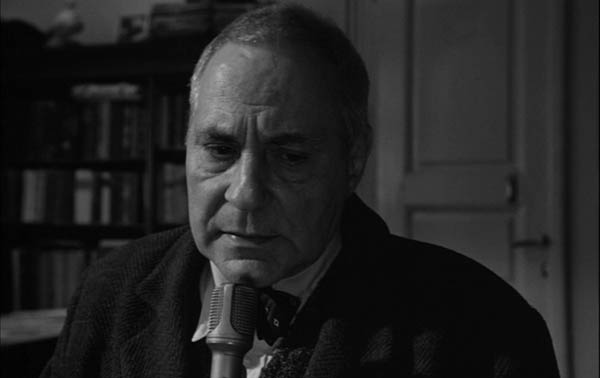
Next morning, townspeople are all alarmed, talking doom and destruction. Janos delivers some papers, goes back to his composer uncle Gyuri’s house and listens to Gyuri give a strange music-conspiracy speech.
image

Walks through the town square where groups of people are gathered whispering rumors amonst themselves. Thinking himself less naive and superstitious than the rest, Janos pays his 100 forints (about 50 cents) and tours the trailer. Walks home, sees uncle Lajos, must be tired by now cuz I can’t figure when Janos sleeps… but no time for rest, because his aunt Tunde (Gyuri’s estranged wife) comes with threatening news.

image

If Janos doesn’t get Gyuri to help her efforts gathering a town decency committee (presumably to eject the whale exhibition), she will move back into Gyuri’s house and make his life hell. So Gyuri and Janos get right on that.

image

They get some lunch, carry on, finally part and Janos goes back to the square, where he is accosted by the ever-more-restless townpeople gathered there. I’m starting to wonder if all of these are townspeople, or if some are outsiders drawn by the exhibition (which nobody but Janos is ever seen entering). Janos visits aunt Tunde to report, but she is with a raving police chief and Janos is sent to put the chief’s rowdy kids to bed. Okay, by now Janos has got to be tired, but he walks back to the square (sees uncle Lajos on the way) and sneaks into the trailer, hearing the trailer guy talking with the Prince (seen only in shadow) raving about chaos and destruction. Janos escapes and runs, hearing explosions in the distance behind him, presumably caused by the Prince’s riot-provoking megalomaniacal speech to the crowd.

image

Janos hides while the townsfolk smash up the trailer (off-camera) and tear up a hospital for some reason, terrorizing the people within including a very sad naked old man. Aftermath of that, everyone files slowly out of the hospital, Janos walks around and discovers uncle Lajos dead, and army men interview Tunde.

image

Back home, Janos sees aunt Harrer looking for her husband Lajos. She tells Janos that the army men are looking for him and he should flee town. He does so, running along the train rails until a helicopter catches him.

image

Gyuri is visiting Janos in a hospital. Is Janos mad? “Nothing counts. Nothing counts at all.” Gyuri leaves, walks through the square, examines the eye of the whale laid out on the destroyed trailer in the middle of town.

image

Main actor (Janos) is german Lars Rudolph (The Princess and the Warrior). His uncle Gyuri Harrer is Peter Fitz (Au revoir, les enfants) and aunt Tunde is Hanna Schygulla (star of Marriage of Maria Braun and other Fassbinders). Guy who played Petrina (Irimiás’s sidekick) in Satantango shows up as a hotel porter, and Janos’s neighboring aunt and uncle (I’m unclear whether these people are all actual aunts and uncles) played Halics and Mrs. Kráner in Satantango. I recognized Mrs. Schmidt in a scene as well.

Visual themes of space, shadows, enormity, eclipses, light disappearing.

MovieMartyr: “The film’s title gains meaning when János overhears his uncle György, a cooped-up music theorist, talk about tonal scales. He explains that the Werckmeister scale, upon which the musical octave is based, is a false construct, and is not true to natural sound since it cannot convey the full range possible in nature. He elaborates, stating that since all music is based on this faulty foundation, it is all inherently false. With his description of these musical concepts, György seems to tap into the film’s undercurrents. Certainly, the defective musical scale is roughly analogous to the broken political state of the country that the film is set in. His suggestion that all music is unnatural seems to set up a competition between the natural and unnatural (light and dark) that runs throughout the work. That he’s driven his wife Tünde out of his house with his obsession toward his out of tune piano doesn’t bother him in the least.”

Scope: “The climactic storming of the hospital, and the formation of the mob, is given more significance in the film than the novel. And although such an alteration suggests that Tarr intends Werckmeister Harmonies to be read as an allegory of fascist violence, the film does not offer any specific political causes for the violence. Rather, Tarr situates the violence as a function of modernity and industrialization, and, more abstractly, as having a cosmological basis.”

Sight & Sound: “The one truly identifiable centre of malevolence is Tünde, a reactionary opportunist exploiting superstition to gain power in the name of order. It may even be that her musicologist ex-husband Eszter, obsessed with the theories of 17th-century German composer Werckmeister, has himself contributed to disturbing the harmonic order of things by withdrawing from any active involvement; at the very least he is a representative of an enfeebled intelligentsia, vainly fiddling with abstractions while the world burns.” … “In the end the defeated thinker Eszter finally visits the whale, now beached and exposed in the wrecked square and more inscrutable than ever. It’s hard to imagine a more downbeat ending the complete triumph of entropy and reaction yet this conclusion derives a profound grace from the extremity of its pessimism. Explaining the cosmos to his drunks, Valuska pleads, “All I ask is that you step with me into the bottomlessness”, and that is essentially Tarr’s invitation to the viewer. The enigmatic harmonic preoccupations alluded to in the title suggest that this film rich in movement, low on dialogue aspires, as the old phrase has it, to the condition of music. But Tarr’s true achievement is to attain the condition of silence, and of bottomless, awesomely inscrutable nightmare.”

Online articles mention 39 shots, so one of us has mis-counted.

Béla Tarr: “We never use the script. We just write it for the foundations and the producers and we use it when looking for the money. The pre-production is a very simple thing. It takes always a minimum of one year. We spend a year looking all around and we see everything. We have a story but I think the story is only a little part of the whole movie. I have to tell you I absolutely hate the movies that I can watch at the theatres. They are like comics. They always tell the same stories. We don’t like these stories because for us every story is always the same old story from the Old Testament. After the Old Testament we have no new stories.”

Interviewer: “I just think there is a trend in world cinema towards this sort of existential terror and chaos.” Tarr, being awesomely elusive: “No, I just wanted to make a movie about this guy who is walking up and down the village and has seen this whale.”

“If you want to make a colour movie, and you go out onto the street, and you want to create the right atmosphere, you must paint the whole street, because every house is red, blue, green and so on. And you have no colours, you just have some colour chaos. For me it’s a kind of naturalism, the colour movie. With black and white you can keep it more stylistic, you can keep more of a distance between the film and reality which is important.”

same 2001 interview: “Do you know Georges Simenon? After the New York Film Festival one American producer called us. He wants to work with us. And he sent us a script which is full of shit and we said no, no, no. And afterwards he had another idea which we also said no to. And finally we proposed to him this short story by Simenon. The title is L’homme De Londres (The Man from London). And now we are working on this project. The script is ready. And this American producer founded this European company in Denmark and he moved from New York to Copenhagen. And we will start this project now which I hope we can complete.”

“You know the final cut took just half a day!”

Tags: ,

Comments

Mountains of the Moon (1989, Bob Rafelson)

Boring movie about two white guys competing to be the first white guys to find the source of the Nile. Richard Burton (Bergin of nothing major) and John Speke (Glen of the last two Resident Evil movies) are on an expedition together in the 1850’s which is badly thwarted by angry Africans. They eventually return, Burton is injured and has to return home early, so Speke gets the glory for discovering the source. The two of ‘em fight it out back at home for a while, plan a public debate to settle their stories, but Speke shoots himself on the day of. Burton was later a diplomat, knew a ton of languages, snuck into Mecca and translated “Arabian Nights” and the “Kama Sutra”… interesting guy. Fiona Shaw (H. Swank’s horrible mother in “Black Dahlia”) plays his love interest/wife, and Richard Grant (How To Get Ahead In Advertising) plays someone or other.

Burton writing:
image

Speke in trouble:
image

Grant:
image

Tags:

Comments

I’m Not There (2007, Todd Haynes)

Another quizzical music biography by Mr. Haynes. Someone said that any of his music movies (”Karen Carpenter Story”, Bowie doc “Velvet Goldmine”) could be titled “I’m Not There”. Dylan is actually there, playing harmonica in close-up at the very very end.

Dylans:

Rimbaud / in interview room giving evasive answers / guy from “Perfume”

Woody / train-hopping authentic-sounding blues kid actually a runaway / Marcus Carl Franklin from “Be Kind Rewind”

Billy / quiet recluse living in a western town of his own imagination / Richard Gere

Robbie / guy playing Dylan in typical hollywood bio-pic / Heath Ledger

Jack / fame-shunning Christian folk singer / Christian (heh) Bale

Jude (also heh) / the well-known “don’t look back” 60’s dylan who cavorts with the Beatles and flippantly defies fan and media expectations / Cate Blanchett in one of my favorite performances of the year

Aaand Charlotte Gainsbourg is Robbie’s estranged wife, who is the heart of the movie, the only character with actual human emotion and understandable actions. She barely belongs except to keep the thing reigned in a little.

Fascinating movie, amazing music (Dylan of course) and b/w/color cinematography (Ed Lachman - The Limey, Far From Heaven, A Prairie Home Companion). Must see again and again.

Tags: , , ,

Comments

Let’s Make Love (1960, George Cukor)

Amusing musical - widescreen, color, full of marilyn and better than its reputation. Written by playwright Arthur Miller (married to Marilyn) and one of the Normans from “White Christmas” (also wrote Lang’s “Fury”).

Unexciting frenchman Yves Montand (”Tout va bien”, “The War Is Over”) is mega-rich, hears of a low-key theater production in the hipster part of town that will be making fun of him, heads down there with employees Wilfrid Hyde-White (Col. Pickering in “My Fair Lady”) and Tony Randall (Rock Hunter, “Down With Love” and voice of the brain Gremlin in “Gremlins 2″). The director notices Yves and casts him as himself, a perfect lookalike. Yves isn’t interested in shutting the place down anymore because he falls for Marilyn during her outrageously sexy intro scene and aims to get her away from her boyfriend, pop star Frankie Vaughan. Yves hires comic Milton Berle, dancer Gene Kelly and singer Bing Crosby, playing themselves, to turn him into a star, but to no avail… so he tries to convince Marilyn that he’s the actual billionaire he’s playing in the play, also to no avail, until he takes her to his office and proves it at the end.

Cute movie, and title song and “my heart belongs to daddy” are hot tunes.

IMDB trivia: “Milton Berle placed ads in Hollywood trade papers seeking a Best Supporting Oscar nomination for playing himself.”

Tags: , ,

Comments

David Copperfield (1935, George Cukor)

From the opening scene (David’s birth during a windy storm) onward, this is funny and fantastic. Great acting + production from the artist Cukor and the mighty David O. Selznick. The quality of light is especially mesmerizing, and the sets held my attention as much as the performances.

That’s no slight on the performances. Professional child actor Freddie Bartholomew (Anna Karenina) plays David for the first half (passable Frank Lawton for the second half) and does very well. Occasionally he falls into that annoying overly-cute-and-naive groove that child actors rode for the first fifty years of Hollywood, but when asked to convey feeling he does a better job than most of the grown-ups.

Other stand-outs:
Edna May Oliver (the red queen in ‘33 “alice in wonderland”) as DC’s aunt, who opens the picture, disappears, then returns in the second half.
W.C. Fields as DC’s broke landlord turned assistant at the law offices.
Lennox Pawle (died the following year) as idiot savant Mr. Dick.
Maureen O’Sullivan (”the tall t”, famous for playing tarzan’s jane) as DC’s sickly child bride.
Madge Evans (romantic lead in “hallelujah i’m a bum” and bing crosby’s “pennies from heaven”) as Agnes, the girl DC is supposed to end up with.
Basil Rathbone (pointy-faced sherlock holmes) as evil stepdad Mr. Murdstone
Jessie Ralph (40+ films in the 30’s incl. “les miserables”) as Nurse Peggotty

Three of these actors would star together in Tod Browning’s “Devil Doll” the next year.

I missed “The Informer” actress Una O’Connor and “It’s a Wonderful Life” co-star Lionel Barrymore. Either too many actors to keep straight, or their scenes were during the ice cream break.

The giant novel is obviously very compressed to fit a two-hour movie. Katy says whole characters and eras and episodes are missing. It worked just fine for me, knowing I was watching a condensed version (if it’d been a standalone movie with no giant novel behind it, I might think it underdeveloped). Each character gets enough of a defining introduction scene so we remember him when he pops up later in the story… and it helps that the actors all look as distinctive as they do. I thought the movie was great. Katy half-watched and helped me connect story threads.

The only other features I’ve seen from 1935 are “The 39 Steps” and “Bride of Frankenstein”, both wonderful. “Mutiny on the Bounty” beat this out for best picture.

Tags: ,

Comments

White Christmas (1954, Michael Curtiz)

Less of a feel-good-about-war movie than a salute to war veterans, with Bing Crosby and his partner Danny Kaye (of Secret Life of Walter Mitty) coming across their old general by chance and staging a christmastime salute to him with all the old guys. Movie was pretty okay with good enough music, didn’t feel as lightweight as most of the musicals we’ve seen but also not as exciting / high-quality. Paramount’s first widescreen movie, funny since so much of it takes place indoors on stages.

The guys fall for a sister act that sings about being sisters (like in Young Girls of Rochefort, but the American sister song isn’t half as good as the French) played by glorious Rosemary Clooney (one of her only other film roles besides Red Garters) and Vera-Ellen (of some other Danny Kaye movies, not much else). V-E had to wear high collars in the movie to cover her neck which was gross-looking from anorexia. The ol’ general Dean Jagger played the sheriff in Fuller’s Forty Guns.

Kaye’s part was written for Sinatra to reunite the duo from “Holiday Inn”, the movie that premiered the Irving Berlin song “White Christmas” 12 years earlier. They even used sets from “Holiday Inn”, which I’m starting to suspect might be a better movie. Highest-grossing film of 1954, oscar-nom for Berlin’s new “Count Your Blessings Instead of Sheep”. I preferred “Gee, I Wish I Was Back in the Army.” This was Michael Curtiz’s 25th movie since Casablanca - he doesn’t seem a very distinctive or celebrated director. Shot by a guy named Loyal, written by a guy named Melvin and two guys named Norman.

Tags: , ,

Comments

Paprika (2006, Satoshi Kon)

Pretty bearable anime. I’d been warned that it’s such a mindblowingly twisted movie that most people can’t follow… but it’s not that I couldn’t follow, it’s that I didn’t care enough to. Some of the visuals are neat, but the story and movie are just so uninteresting, I barely made it all the way through. A plot description would take too long, but it involves a lot of scientists and a dream machine that makes some of ‘em go hudsucker-proxy nuts and makes others think they can take over the world in dreams. I don’t remember how it ends.

Tags: ,

Comments

Atonement (2007, Joe Wright)

Beautiful Keira K. (domino) lives in a fancy house with her writer kid-sister Briony (globe-nom Saoirse Ronan, appearing in the next Peter Jackson movie) and mom Harriet Walter (from Katy’s Pride & Prejudice, not Wright’s) and older brother (?) Patrick Kennedy from Bleak House. College hottie James McAvoy lives in a little house on their property with mom Brenda Blethyn (Wright’s P&P, Little Voice). The two are in love but (gasp) from different social classes. Will they defy society and marry anyway? Of course.

Wait, no. They’ve long been infatuated with each other, and during the summer when they are completely exploding for each other, a visitor to the estate rapes another visitor, and young peeping Briony tells the cops it was McAvoy, leading to his arrest and getting sent to war to die instead of going back to college and marrying his true love, who also went to war and died, but as a nurse. Briony also becomes a nurse (now played by spooky Romola Garai, Wilbur’s love interest in “Amazing Grace”) then an author. Fifty years later (now Vanessa Redgrave of “Cradle Will Rock” and “The Devils”) she’s on a TV interview show explaining that her new book is an attempt at atonement, the story of the long life the two lovers could have had together if not for her young meddling.

I loved the movie, beautiful and sad. I might just think it’s pretty good if I see it a second time, since my expectations were pretty low before the first time (period literary adaptation starring McAvoy, who was not good at all in Last King of Scotland), but this time I was enthralled. Sound design / music used typewriter key effects as percussion, my favorite part.

Guy from Slate says the epic single-shot at the beach is unnecessary and showoffy. Robbie on Reverse Shot calls it “tonally awkward” and says: “Wright’s grandstanding in this sequence bespeaks of a decidedly disjointed approach, as well as disappoints after his gloriously measured 2005 adaptation of Pride and Prejudice, which smartly employed the long take as a coherent, unifying device.” Elsewhere I’d read that the shot is there to show off (even Wright admits he was showing off) the enormity of war, to take it beyond our doomed male protagonist, open up the world of the film beyond the intensely personal closed-off world of the first half. Some part of that latter explanation clicked for me, because towards the end of the shot I’d decided that McAvoy wouldn’t make it out alive. Tonally consistent or not, the shot is terrific on its own.

Tags: ,

Comments

Comedians of Comedy: Live at the Troubadour (2007)

Comedians: Patton Oswalt (with his star wars bit), Sarah Silverman (scripted as always), Blaine Capatch (then wastes half his running time on lame stephen hawking jokes), David Cross (dog jokes?), Jasper Redd, Eugene Mirman (keeps the props and charts to a minimum), Maria Bamford (voices), Brian Posehn.

“Comedy”: Dana Gould (extended blowjob joke not as good as louis ck), Zach G (had nothing to say), Steve Agee (the gay neighbor who is not posehn in sarah silverman’s show), Jon Benjamin (as usual with prepped material that overstays its welcome), Andy Kindler, Morgan Murphy, “Seth” G.

Movie is shot on batman-bad-guy angle and edited in a way that does not pretend it was a seamless show, which is kinda refreshing for being more truthful than usual, but kinda sad because we get the full-length intros of each comic but abbreviated actual comedy.

Tags: ,

Comments

Early Films (1898-1910)

More shorts from “The Movies Begin” disc 1.

President McKinley at Home (1897): the first president on film plays with his hat and looks uncomfortable.
image

Pack Train at Chilkoot Pass (1898), reportedly recreated at the start of chaplin’s gold rush but I couldn’t say for sure.
image

Sky Scrapers of New York City from North River (1903)
image

Georgetown Loop, Colorado (1903) - those are passengers waving their hankies out the window to be on camera.
image

San Francisco: Aftermath of Earthquake (1906) - awesome film, I had no idea.
image

The Dog and His Various Merits (1908)
image

Moscow Clad In Snow (1908) - just what it says
image

Aeroplane Flight and Wreck (1910)
image

Tags: ,

Comments

« Previous entries