“Every girl is beautiful… until they kill somebody.”

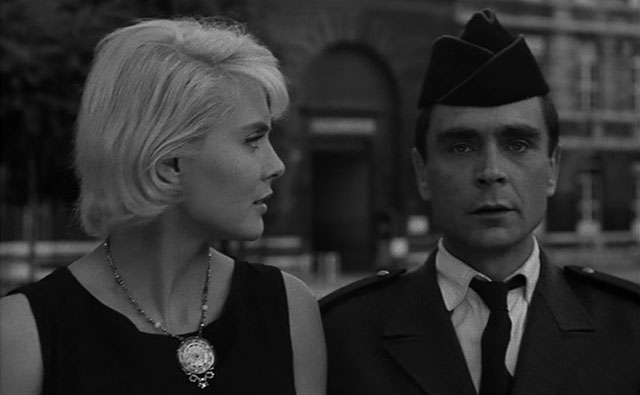
Wowie wow wow, the acting (or the dubbing) by our two leads is terrrrible. But I’ve seen this once before so I knew that and could focus on other things this time. Nice title music by Ennio Morricone, decent camerawork and good shot choices. Ultimately a stupid movie though, not half as good (or half as ludicrous) as Dead Pigeon on Beethoven Street. Worth watching only for Fuller completists like myself, or possibly for Claude Chabrol’s loony performance.

Bobby’s silhouette getting nabbed backstage:
image

Bobby Di Cicco, who I don’t remember being completely horrible in The Big Red One, is a loser wannabe musician who sneaks into the orchestra every night and watches from backstage. He meets Véronique Jannot at the unemployment office and they decide to take revenge on the agents there who humiliate the two while failing to find them work. First up is a mustache-grooming woman they call Mussolini, then a pervert they call Tartuffe played with campy hilarity by Claude Chabrol.

C.C. wearing funny gloves:
image

But when Tartuffe falls out the window (in an incident of neighborly peeping gone wrong) our two hero losers are on the run, assisted by Bobby’s music-shop-owning ex-con buddy and a girl they met while breaking into her dad’s house. These two accomplices (whom our heroes seem to barely know, but are willing to assault cops to help them get away) are nearly as awful actors as our heroes, but they have better voices… his is low and TV-cop-show-like, hers is small and airy.

Oh yeah, here’s Bobby:
image

And what’s her name, Veronica:
image

Presumably (or hopefully) the accomplices are arrested for being horrible liars. Our couple goes on the run. In a snowy small town rest stop en route to Spain, a loose-cannon ex-cop is introduced only moments before pulling out his gun and blasting away, killing Veronica. Bobby is wounded, somehow makes it back to Paris only to sneak into the orchestra, con his way onstage and die mid-performance… nice.

Movie isn’t a total waste of time – there are a few nuts scenes… some pretend-incest that seems to repulse/turn on landlady Christa Lang… Sam Fuller as “Zoltan” a jewelry fence and death-scene enthusiast with an eyepatch concealing a magnifying contact lens… the outer-space sound effects over Ennio Morricone’s score on the final scene.

Christa:
image

Sam:
image

Cameo as a brothel madam by Micheline Presle of some Demy movies, The Nun, I Want To Go Home and American Guerrilla in the Philippines:
image

NY Times called it “a rather mediocre crime story about a Bonnie-and-Clyde couple.” The video box calls it a tribute to the French New Wave. I’m not sure how, exactly… unless the final shootout in the snow is in memory of Shoot The Piano Player.

Two of Budd B.’s lately acclaimed late-50’s westerns starring Randolph Scott. Scott is around 60 in these, but not an Eastwood-like figure, kind of a big face and a game-show-host voice. All smiley in the first movie, darker and more serious in the second. I watched both on TCM, so all screenshots are stolen from elsewhere online.

The Tall T (1957)
Randolph Scott (“Randy” to Robert Osborne – they’re close) is kind of a stupid rancher, who loses his horse in a humiliating bet and has to hitch a ride home. Too bad the coach he hitches with is hijacked by bad men. The coach’s other passengers are a just-married couple, rich woman Maureen O’Sullivan and opportunistic accountant John Hubbard. Scott is just caught in the crossfire here, but since the bad men murdered his friend and the friend’s young son and tossed ’em in the well before Scott arrived, he is gonna get himself some revenge.

Randolph, 16 years after Fritz Lang’s Western Union, and Maureen, who started out in Frank Borzage’s Song o’ My Heart:
image

Our head bad guy is Arthur Hunnicutt (Big Sky, The Lusty Men), and he’s got two sidekicks – not so bright Billy Jack (Skip Homeier of Fixed Bayonets) and sharpshooter Chink (Henry Silva!). Arthur sends the husband to make a ransom deal with the girl’s father, then kills the husband. Scott gets philosophical with Maureen over the death, then when Arthur rides off to collect payment, the prisoners wipe out Billy Jack and Henry Silva (awful lot of blood for the 50’s), wait for Arthur to return then kill him too.

John Hubbard as the traitorous coward husband:
image

I liked it, but didn’t see what’s the big deal. Osborne points out that Randolph and Arthur seem like similar men, and their roles could just as easily have been switched – I guess I can buy that.

The great Henry Silva, forty years before Ghost Dog, in his first credited film role:
image

Ride Lonesome (1959)

This one I liked better. We’ve got a younger, prettier, tougher dame (Karen Steele), a less smiley Randolph Scott, James Coburn in the Henry Silva slot (a fair trade), and a bonus appearance by Lee Van Cleef.

TV’s Karen Steele was also in Boetticher’s earlier Decision at Sundown and John Turturro’s favorite film of 1955, Marty.
image

Scott is a bounty hunter who captures wanted killer Billy John (star of Fuller’s Verboten!) then runs into two other guys – smart guy Pernell Roberts (184 episodes of Bonanza) and dumb sidekick Coburn – who were out for BJ, not for the money but for an amnesty deal so they can live decent lives. These are obviously Good Guys, though the movie plays up the tension between them and Scott, having Pernell rave on about how he’ll have to kill Scott before they get to town.

James Coburn’s first film role! He’d become a regular for Sam Peckinpah, who also cast Randolph Scott in his final film role three years later.
image

But Scott isn’t out for the money after all. He knows BJ’s dangerous brother Frank will follow them, and wants revenge for Frank’s killing Scott’s wife some years ago. Revenge taken, he surrenders the prisoner to his buddies for a happy ending. Oh yeah, and Karen Steele tags along for the whole movie but I missed exactly why because I was in the kitchen getting some ice cream during that scene. There’s a standoff with some indians who just killed her husband – I think it’s mostly an excuse for another fight scene.

Lee Van Cleef, recently of Sam Fuller’s China Gate, 25 years before Master Ninja:
image

Good movie, gets a lot done in 90 minutes. Also the music doesn’t telegraph everything that’s gonna happen 20 seconds beforehand like in The Tall T.

Thrilling finale at the hangin’ tree:
image

Another Maddin masterpiece… I loved it. Slow start as he dreamily navigates his home town, telling stories, showing off landmarks, talking of snow and sleepwalkers. Trying to escape, he decides to film his way out, rents his old house and hires actors to play his family, except for his real mother (ha, “really” 1940’s noir queen Ann Savage) and of course, Maddin himself (ha again, really Darcy Fehr of Cowards Bend the Knee). So the premise is a lie, and the real-life actors are a lie, and yet he got this to be classified a documentary – I love it!

The parts about Maddin’s childhood are as veiled as usual – there’s the hair salon and siblings and pet dog, and some could-be-true anecdotes about straightening the hall rug and a fear of birds, but we also get his mother’s unlikely starring role in long-running TV drama “Ledge Man”. And there’s the traditional dead father, this time represented by a mound of earth under the living room rug, which the brothers use as a sort of beanbag headrest when watching TV. When Guy leaves home, things become sadder and more personal, showing city landmarks destroyed to build corporate malls, discussing the demise of the local hockey team and eventually the stadium. Very wonderful final segment imagines a character called Citizen Girl, representing the proud past of Winnipeg, who turns back time and resurrects the city’s history – as moving as anything in Guy’s filmography so far.

This is being called Maddin’s most accessible work. I guess the plot is more straightforward than most, and there’s less incest and horror than in my own starter pic Careful, but I’d still give that title to Saddest Music… it’s got stars and songs and an engrossing story and it’s right hilarious.

Double-feature on Turner Classic! Part two has mostly-good somewhat-exciting clips from MGM musicals introduced by Fred Astaire and Gene Kelly. Kelly directed the lame host segments, where he and Fred walk around some giant colorful shapes and dodgy video effects (and also tromp through Paris for a while). Whole thing is quite wholesome. It’s not all musical numbers – there’s a clip from A Night at the Opera and tributes to Frank Sinatra and Hepburn/Tracy – just a big nostalgic lovefest

Things learned:
– Eleanor Powell is pretty amazing.
– Anything with Judy Garland has gotta be worth watching.
– I like Jimmy Durante.
Cabin in the Sky looks good.

Apparently I was wrong in thinking these MGM musicals were on TV all the time in the 70’s, but they certainly were in the 90’s when part III came out, so they spiced it up with behind-the-scenes shots, scenes from rare films and scenes cut from more popular films. Very good idea, and the selections are given better setup with more historical context, making the whole thing seem less random. Written and directed by the editing team of the first two movies. Guess I always wondered why J. Rosenbaum picked part III of this series for his great films list without I or II, but the first two are merely compilations of film moments so if you have access to the source films there’s very little of value there. Part III is full of original content… an alternate camera angle on a dance number showing how the set was deconstructed mid-scene to make room for camera movement, some Judy Garland scenes from a movie in which Betty Hutton replaced her a few days into shooting, a censored scene of Lena Horne in a bathtub and some unused vocal tracks from Show Boat before they were dubbed by a different singer. Scenes are introduced by Horne, Mickey Rooney, Esther Williams and other surviving stars from the era. Neat stuff. I only technically watched three quarters of it, but I’m gonna cheat and take credit anyway.

I’d like to watch more double-features by filmmakers with whom I’m not familiar… gives a better immediate sense of who they are than watching one movie, then a couple years later managing to catch another, and so on. I’ve already watched Terence Davies’s 2000 The House of Mirth but I completely don’t remember it. Must’ve been late at night on DVD or cable… the only evidence that I’ve seen it at all is my 8 rating on the IMDB, which I may have just clicked by accident one day while looking up Eleanor Bron movies. Anyway, since Of Time And The City isn’t out here, I grabbed his other two most acclaimed features Distant Voices, Still Lives (1988) and The Long Day Closes (1992).

Both movies consist of beautifully shot sketches of memories. Distant Voices (the first half) was actually made as its own movie – about three siblings growing up under their father Pete Postlethwaite’s wrath. It was deemed too short to release, so the second part, Still Lives, was written and shot after – now father is dead from cancer and the kids are grown, moving out on their own and getting married. Episodes are shown in random-associative order, all superbly shot. Lots and lots of singing – movie is basically a musical… “takes a worried man to sing a worried song”… “in the bleak midwinter”… “there’s a man coming round taking names”… “when irish eyes are smiling”… tons more, all sung by the cast in bars, on the street or at home.

It was Pete Postlethwait’s breakout year – he was in two other reasonably big films. Davies in the DVD commentary: “It’s hard to believe that one man could’ve caused so much suffering and that all these years later I would make a film about it.”
image

Mom, Tony, (dad), Eileen and Maisie
image

Eileen (center) was in Aki Kaurismaki’s I Hired a Contract Killer. On left is a friend – loud, outspoken Mickey (good singer, too).
image

Married life doesn’t always work out… old friend Jingles looks upset.
image

Davies is annoyed that viewers thought the Christmas scenes gave sympathy to the father. He says his father deserves no sympathy. Seems from the commentary like everything actually happened in his life as we see it. Creative liberties are taken, of course… fewer siblings keeps things easier to follow, events and timelines are shuffled, but the movie is a mining of his real life. Reactions from family members to the film were mixed.
image

Davies also has a wonderful voice on the commentary. I could listen to him all day. If he did EVERY dvd commentary, people might actually listen to the things. After watching the movie I assumed influence by Alain Resnais, but he says the structure is influenced mainly by T.S. Eliot’s Four Quartets.
image

Won a whole pile of awards, including at Cannes and Toronto, but lost the European Film Awards to Kieslowski and Wenders, oh well.
image

image

image

The Long Day Closes is the same kind of thing, but in a shorter timespan and focusing on one kid (young Terence Davies, or “Bud”), his relationship with mother, home life, church and school. Still plenty of singing, though not as much as the other film, and now punctuated by audio clips from classic movies (the kid is happiest at the cinema). Subjective shots through his eyes, memory adding a dreamlike quality to certain scenes, rain and snow are so constant that sometimes they occur indoors.

Exquisite between-scene transitions… this is halfway through one of ’em.
image

I’d say there’s less story here than in the other movie, more impressionistic. I don’t usually love nostalgic childhood reminiscence movies, but that’s because most aren’t as gorgeous as this one.

image

By the time I got to the DVD commentary I’d already heard the one from DV,SL so I took it for granted that everything in Long Day Closes refers to a specific, sharply remembered incident in Davies’ real childhood. Liberties are taken, of course, like how the Christmas dinner table here seems to be out on the street.

image

image

image

August 2012:
If there’s any film that should be watched on 35mm in theaters, it’s this one, and unbelievably, I got a chance. It was playing in Seattle, so Katy grudgingly agreed that we could go. Looked amazing. Nobody else in the theater but us. Katy mostly didn’t like it, dozed through the last 20 minutes, but responded to the audio clip from Tammy and the Bachelor.

image

I liked this a whole lot, unexpectedly. Starts out in crisp black and white with moonlight shining on Audrey Hepburn’s mooning face, and only gets better. Not as much clever dialogue as Indiscreet, but a higher-quality film overall with just as much starpower, in its way – young beautiful Audrey versus super-suave Humphrey Bogart. Nominated for a pile of oscars, but trounced by On The Waterfront. Remade in the 90’s for some silly reason.

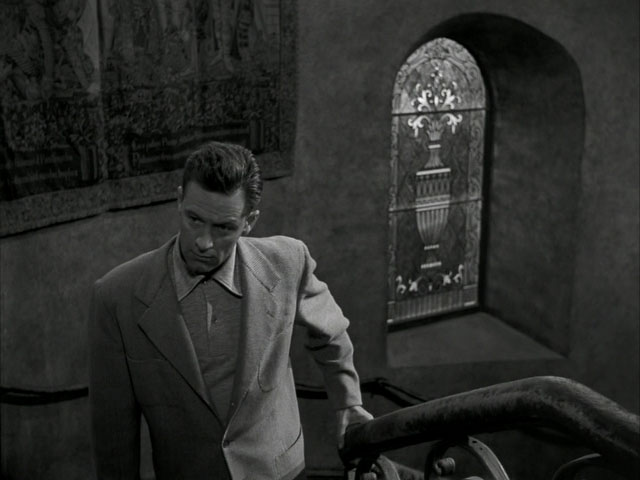
Audrey is the chauffeur’s daughter at the mega-rich Larrabee estate, has always been in love with wild, womanizing William Holden (normal-looking white guy from Sunset Blvd. and Executive Suite). She goes to Paris for two-year culinary training, comes back all fashion and sophistication. Holden falls for her before she even gets home – her dream come true. They go out, and dance at a family party, but he is supposed to marry a hot girl from another rich family as part of a family business merger (Larrabee develops super plastic made of sugarcane and her family owns a cane plantation) so big brother and super business-whiz Bogart incapacitates Holden by tricking him into sitting on wine glasses, then takes Audrey out for a few days to keep her away until the wedding. One place they go: a play of The Seven Year Itch, which is the next film Wilder would make.

But Audrey is awesome, has glowing moonlight cat eyes, and is now a master chef, so Bogie falls for her himself, and at end he cancels all appointments to catch up with the boat aboard which he’s shipped her off to Paris. Romantical!

This is now the latest Bogart movie I’ve seen – he’d be dead in under three years. Normal-looking William Holden is apparently a huge star, but I can’t say he stood out in this… certainly likeable enough. Head chauffeur John Williams had juicy roles in two Hitchcock movies around the same time, later in Will Success Spoil Rock Hunter as Tony Randall’s boss who dreams of being a gardener.

Wow, I wrote too much last year so I’ll keep this short. How am I doing on my ongoing quest to see every great movie?

– My 2008 goal to watch movies I already had (mainly purchased, never-watched DVDs but also rented/copied DVDs and downloads) was not a complete success, somewhere around a third complete. I’m allowing myself to start buying DVDs again with the condition that I watch at least one off the shelf for each new one I acquire… seems reasonable.

– Filmmaker-oriented goals, to see all the movies by Rivette, Resnais, Marker, Bunuel, were well explored and advanced in 2008, but are on hold now, since I’ve decided to ban all foreign-language films (except theatrically and in certain other cases) until I’m at least halfway through my long-long-delayed French lessons.

– Made my list of movies I definitely have to watch in 2009, but I overdid it as always, so it’s 270 titles long. Still, unrealistic goals are better than no goals at all.

– And of the best-movies-ever lists that I often refer to, I’m up five to 211/250 on the IMDB list (will never hit 100% as long as Crash 2004 is still on there), up fifty to 500/1000 on the They Shoot Pictures list, up forty to 380/1000 on the Rosenbaum list, up a mere five on the 1977 list, and up one percent (242/519 from 205/450) on the Criterion/Eclipse list (the hardest one to keep up with).

There are other new years goals and resolutions and lists and everything, but they ain’t movie-related so they are of no concern here.

As usual, only counting just-released movies I saw in theaters in 2008.

1. Paranoid Park (Gus Van Sant)
More youth poetry from Van Sant – nailed it this time.

2/3.
Wall-E (Andrew Stanton)
There Will Be Blood (P.T. Anderson)
TWBB is better than Wall-E in many ways, but I’m feeling more generous towards the lovestruck robot than the miserable oil-baron right now. They were both the visual and story delights of the year.

4. Profit Motive and the Whispering Wind (John Gianvito)
The only movie I watched three times this year.

5/6/7.
Let The Right One In (Tomas Alfredson)
Don’t Touch The Axe (Jacques Rivette)
The Edge of Heaven (Fatih Akin)
Three exquisite foreign flicks.

8. Youth Without Youth (Francis Ford Coppola)
FF Coppola’s universally ignored return to cinema. Due for a major critical re-evaluation sometime after his death, I imagine.

9. Milk (Gus Van Sant)
I had my problems with it, but it’s still great, and wins points for being extremely relevant.

10. Ashes of Time Redux (Wong Kar-Wai)
Both of Wong’s least-liked films (see My Blueberry Nights below) opened to empty theaters this year, and I’ve gotta say I enjoyed them both. Even his worst work still has a gorgeous power to it at times.

—–
Honorable Mentions:

Flight of the Red Balloon (Hou Hsiao-hsien)
Encounters at the End of the World (Werner Herzog)
Happy-Go-Lucky (Mike Leigh)
The Curious Case of Benjamin Button (David Fincher)
4 Months, 3 Weeks and 2 Days (Cristian Mungiu)
Opera Jawa (Garin Nugroho)

—–
Special Categories:

The Edward Burns Memorial Award, given to the movie I saw this year which I have already mostly forgotten, is mercifully awarded to Namibia: The Struggle For Liberation

The Alien Resurrection Award, given to a movie I liked which nobody else did, goes to My Blueberry Nights

The Kyle Cooper Award, given for greatest achievement in opening or closing credits: Michael Clayton

The Big Ehh Award, given for the least enthusiastic reception of an eagerly-awaited movie: Be Kind Rewind

The Batman Begins Award, given to a movie which everyone else must have been tripping while they watched because I can’t see what’s so great about it, goes to The Dark Knight – and what’s more, given the academy award buzz the movie has garnered, this will hereafter be renamed in its honor The Dark Knight Award!

1. Five by Jacques Rivette:
Love on the Ground (1984)
The Story of Marie and Julien (2003)
Duelle (1976)
Noroit (1976)
La Belle noiseuse (1991)
Rivette movies take me to a unique place – he is closer to the dream world of David Lynch than he gets credit for. These were each excellent in their own way, and taken as a whole, they easily catapult Rivette onto my top-five favorite filmmakers list, if he wasn’t already there from Out 1 and Celine & Julie.

2. The Life of Birds (1998, David Attenborough)
Haven’t even finished this yet, and I never wrote anything about it, but some of my happiest times this year were sitting on the couch watching amazing videos of birds with Katy.

3. The Golden Coach (1953, Jean Renoir)
I mostly loved watching this for Anna Magnani, until that final scene when the whole movie hit me at once. Ooh, that final scene… I scanned back and watched it again… and again…

4. Brand Upon The Brain! (2006, Guy Maddin)
Maddin’s best film yet (or do I say that about all of them?). Will check out My Winnipeg in the new year… I expect it’ll be Maddin’s best film yet.

5. My Terence Davies double-feature of two days ago, Distant Voices, Still Lives (1988) and The Long Day Closes (1992)

6. The Trap: What Happened to Our Dream of Freedom (2007, Adam Curtis)
I thought this was fascinating, but apparently it’s all in the presentation because whenever I tried to tell people about it they tuned me out. I scanned back to the intro and watched it again… and again…

7. Judex (1963, Georges Franju)
Wasn’t expecting this to make a top-ten… I didn’t even think it was supposed to be very good. Happiest surprise of the list.

8. Ordet (1955, Carl Dreyer)
I don’t know where to put this on a list, because it seems above judgement. My liking it or disliking it is entirely beside the point. Nevertheless I liked it… very much.

9. The Devils (1971, Ken Russell)
Movie on the list which I most need to rewatch, since my video copy was so poor.

10. Faces (1968, John Cassavetes)
So intense, makes me sure that I need to rewatch the Cassavetes movies I did not like, because I was probably wrong about them.

11. The Milky Way (1969, Luis Buñuel)

12. Ruggles of Red Gap (1935, Leo McCarey)
13. The Smiling Lieutenant (1931, Ernst Lubitsch)
Two comedies I watched with Katy and have mentioned every week since, much to her confusion since she thought they were just pretty good.

14. Lovers on the Bridge (1991, Leos Carax)

15. Three by Chris Marker: A.K. (1985) and Chats Perches (2004) and Remembrance of Things to Come (2001)
I watched more than fifteen Marker films this year, and these were the standouts.

16. Tabu (1930, FW Murnau)
A visual poem, one of my favorite Murnaus yet.

17. Stavisky (1974, Alain Resnais)

18. Artists and Models (1955, Frank Tashlin)

19. Tales of Hoffmann (1951, Powell & Pressburger)

20. Redacted (2007, Brian De Palma)


Honorable Mentions:
At Five in the Afternoon (2003, Samira Makhmalbaf)
French Cancan (1953, Jean Renoir)
Guelwaar (1992, Ousmane Sembene)
Harlan County USA (1976, Barbara Kopple)
Holy Mountain (1973, Alejandro Jodorowsky)
Je t’aime, je t’aime (1968, Alain Resnais)
Manufactured Landscapes (2006, Jennifer Baichwal)
Mix-Up (1985, Francoise Romand)
My Night at Maud’s (1969, Eric Rohmer)
The Mystery of Picasso (1956, Henri-Georges Clouzot)
Pervert’s Guide to Cinema (2006, Sophie Fiennes)
Stuck (2007, Stuart Gordon)
Woyzeck (1979, Werner Herzog)


Bonus: Ten Favorite Shorts
1. The Wizard of Speed and Time (1979, Mike Jittlov)
2. Outer Space (and the rest of the Cinemascope Trilogy) 1999, Peter Tscherkassky
3. The Film To Come (1997, Raoul Ruiz)
4. Presto (2008, Doug Sweetland)
5. A Valparaiso (1963, Joris Ivens)
6. Le Franc (1994, Djibril Diop Mambety)
7. Mirror of Holland (1950, Bert Haanstra)
8. Life and Death of 9413: A Hollywood Extra (1928, Florey & Vorkapich)
9. Ten Thousand Years Older (2002, Werner Herzog)
10. Neighbors (1920, Buster Keaton)


And this year’s Annual WTF Awards, given to movies I think I’m supposed to have liked but couldn’t figure out why, go to horror Them, documentary Derrida, french arthouse thing The Regular Lovers, extreme satire The Ruling Class, avant-garde headache Presents and two shorts by Michael Robinson.