A belated entry for…

Initiated by Shadowplay

“This war’s gonna have a head on it”

Frank Tashlin’s final film as director is a Bob Hope picture, appropriate since Hope gave Tashlin his big break into live-action directing in the first place with Son of Paleface. Tashlin was only 59 when this came out, younger than Hope, but would only live a few more years. It’s a shame to have lost him so young, since his style kept changing with the times – would’ve been a trip to see a Tashlin picture in the 1980’s. From The Girl Can’t Help It to Caprice, Tash’s films have seemed very of-their-time – until this one, which feels stodgy and old-fashioned.

Why is this? My guess is old buddy Bob Hope. The credited writers are responsible for some TV episodes and the goofy crystalline sci-fi flick The Monolith Monsters but this has Hope written all over it. It wants to be a comedy, but it can’t make any jokes at the military’s expense – not in ’68 with Hope a political right-winger who probably spent more time than any other entertainer performing for U.S. troops. It’s more consistent a story than most Tashlin movies but it lacks all the good gags – the best jokes are the couple that Hope makes at the expense of his beloved partner Bing Crosby – and any comic momentum is killed at the end with a dry ten minutes of flag waving. So you could say it fails as a comedy since it pulls so many punches, or more generously, that it’s a light military drama with a bit of humor.

Hope’s buddy Calvin Coolidge Ishamura, played by Mako of Conan the Destroyer and Pacific Heights – the movie is very tolerant of Japanese-Americans, if not Japanese-Japanese.

Makeshift beer fridge:

The premise is simple: the Japs sunk a boat delivering beer to the army/navy base and Hope schemes to recover it, following the tides to find drifts of beer cars which he passes out to friends and hides from others. Not caring much about military matters, I didn’t realize until late that there’s a whole army vs. navy rivalry on the base (or is it two bases?) which would’ve cleared up some mysteries – like friendly, clean-looking (but with spooky eyes) lieutenant Jeffrey Hunter (below with Hope), don’t know if he’s a rival, a superior, or just a buddy. This turned out to be a late film for Jeffrey Hunter (also Jesus in King of Kings) as well – his career was cut short by a fatal stroke the following year.

The other allowable topic for comedy besides beer is girls. The group sends for nurses, imagining a team of sexy young girls arriving on the island, but all they get is a wild-haired Phyllis Diller, my favorite person in the movie. Hope gets a flashback-provoking love interest in the form of Gina Lollobrigida (of Dassin’s The Law), and I already can’t remember what Mylène Demongeot (of those 1960’s Fantomas movies) was doing there.

The new nurses: imagined

The new nurses: actual

Tashlin has to sneak in one line about television – something about reruns, I forget the context, and he manages to close the picture on a Tashlinesque piece of live-action cartoonery, Hope pulling a captured submarine with his rowboat. I assume there’s a metaphor there.

Watched this the same night as The Social Network. They both currently rank in the top 150 movies of all time according to IMDB voters, who have no sense of history. I cringed when I saw Aronofsky’s handheld follow-cam from The Wrestler, but he didn’t overdo that stuff this time. He’s always had a knack for filming deteriorating human bodies and creating sustained intensity through editing and music – plenty of opportunity for both in a story about a ballet dancer going mad. Mila “Extract” Kunis was just as good as Natalie Portman. Barbara Hershey (as Portman’s mom) and Winona Ryder (as the washed-up dancer Portman replaces) round out the cast – apparently a very female picture, though it didn’t feel like one. Will Darren ever make a movie in which nobody dies (or suffers massive trauma, whatever) at the end?

Do I detect an Inland Empire influence?

Too bad the song “Black Swan” wasn’t in the movie, but it couldn’t have made a bigger impact than it did over the ending of A Scanner Darkly.

I avoided this because I don’t much care about Facebook, but after it started winning every major year-end award I thought again. Besides, I’ve seen every other David Fincher movie in theaters, so why stop now? And I kinda loved it. What’s strange is that the stylistic flourishes I love in Fincher’s films (didn’t love so much in The Benjamin Buttons) were missing from this one – except in the great scene of the Winklevoss brothers’ big race, a wordless high-energy montage scored to a Reznor version of In the Hall of the Mountain King (better known by me as the Tetris song). Otherwise, Fincher’s style seems to disappear, simply supporting the brilliant writing (Aaron Sorkin, Charlie Wilson’s War) and acting (Jesse Eisenberg of Zombieland, Andrew Garfield of Imaginarium of Dr. Parnassus, Justin Timberlake of Southland Tales and Armie Hammer, who recently played Harrison Bergeron).

Timberlake:

April 2024: Rewatched the first 20 minutes while reading Adam Nayman’s Fincher book.

Rooney Mara and her Jack Johnson 2003 tour poster:

A catalog-style entry for…

Initiated by Shadowplay

Not just a late film, but a whole compendium of late films: a catalogue of works by Orson Welles during his last twenty years, assembled with stylish fun by Silovic and Oja Kodar, very entertaining and informative. All these years I’ve read Jonathan Rosenbaum championing the late, unreleased works of Welles, I still haven’t been clamoring to see them – I figured I’ve got enough things to watch. But now that I’ve had a taste, the clamoring begins.

It starts, naturally, with magic and stage shows – this wonderful bit of duck hypnosis which I played again and again.

Then Orson’s 1975 acceptance speech for his AFI lifetime achievement award, at which he presented scenes from The Other Side of the Wind.

P. Bog as actor:

Oja introduces herself, says she wants to combat the public opinion that Orson idly spent his time doing voiceovers and liquor commercials, but she only fuels the opinion that he couldn’t finish projects at the end because he was easily distracted by newer, shinier projects. Sure, some of it was sheer bad luck, mostly finance-related, but also the negatives of Merchant of Venice going missing.

That unlabeled can holds the original cut of Ambersons:

Scenes from Filming The Trial are shown, a good opportunity for Welles to speak for himself out of character (or, more accurately, in character as himself).

Oja discusses the great trailer for F For Fake (his final completed feature) and shows half of the trailer, then rifles through paintings and sketches he made.

Monologue readings from Moby Dick: filmed solo performance of select scenes before water-shadowed backdrops. Supposedly the rushes have been edited together and screened in Germany and New York. Please feel free to send them here next.

Don Quixote, which he spent 30 years trying to complete. I haven’t seen Jesus Franco’s version, but despite all the public whining about it, it’s probably better than nothing. Franco had no access to some of the footage, which has since aired on television (and therefore on youtube).

A Winston Churchill-related comedy sketch piece in silhouette, and an embarrassing bit at a hammy tailor shop – these are possibly part of the compilation piece known as London, also edited in Germany. I wonder if the Germans would care to release a DVD.

With tailors Charles Gray (of Dearden’s Man in the Moon and a couple of Bond movies) and Jonathan Lynn (director of Clue, My Cousin Vinny):

A trailer for The Deep, a thriller set on a couple of boats in the middle of the ocean, featuring Jeanne Moreau.

Footage shot for Merchant of Venice. The film was almost completed when part of it went missing.

A desperately lonely-looking Welles performing the missing monologue outdoors on a windy evening.

“I think acting is like sculpture, in other words it’s what you take away from yourself to reveal the truth of what you’re doing that makes a performance … There is no such thing as becoming another character by putting on a lot of makeup.” – spoken by Welles, but similar to what Renoir says in that short with Gisele Braunberger.

More projects: The Orson Welles Show (featuring The Muppets, and available on video):

The Dreamers, which I know little about:

Overall a very useful little doc, which unsurprisingly got me fired up to watch more Welles movies (and to finally read that recent Welles book by Rosenbaum). Unfortunately my follow-up feature, Linklater’s Me and Orson Welles, was much less enlightening.

Afterwards I scouted around online, having a Late-Welles scavenger hunt. I came up with a couple interesting bits. First, a piece of Vienna, as it aired on the Arte channel – a segment of the 1969 One Man Band project. Seems like an unexceptional travelogue, featuring a man who feeds birds, a montage of quick zoom-ins on different cakes (also shown in the Silovic/Kodar doc). A caped and hatted Orson walks through the city scenery, visits a ferris wheel and comments on the Third Man soundtrack, then he and Mickey Rooney perform a magic trick with Senta Berger (of Major Dundee, The Terror of Dr. Mabuse).

Ten minutes of silent screen tests and still photography in preparation for Merchant of Venice, compiled by the Italians – not especially enlightening except to get another look at those long-nosed Eyes Wide Shut masks. I wonder how these tests got out while the film itself remains under wraps:

Another entry for…

Initiated by Shadowplay

There’s classic Jimmy Stewart (The Philadelphia Story, Shop Around the Corner and those Capra flicks), mid-life Hitchcock/Preminger Jimmy Stewart, and the ripe-for-retirement late Jimmy Stewart of Airport ’77 and The Magic of Lassie. But this film stands alone in featuring a post-retirement Jimmy Stewart.

IMDB trivia page says:

James Stewart said that he and his wife were vacationing at a game preserve in Kenya when they came across the filmmakers shooting this picture. He said he was persuaded to make a short appearance, speaking a few lines, because he thought it would help to promote wildlife conservation. “Never did understand what it [the film] was all about”, he said. “I did it on a whim.”

Jimmy Stewart feeds a hawk

And he does only speak a few lines, but that makes him a pretty major character in a movie where nobody speaks more than a few lines. Early on, the filmmakers announce their intention to feature a narrative, introducing a man (Philip Sayer of a couple British miniseries, who managed to die eight years before Stewart) in search of help after his plane crashes in the desert, but then they let us watch a girl named Maya romp with wild animals for another thirty minutes before anything else happens. Worryingly, the slender story wasn’t improvised by some actors who stumbled into a wildlife shoot, as it seems to have been, but was rather written by Hana’s old collaborator, legendary avant-garde filmmaker Terayama Shuji (Grass Labyrinth, Emperor Tomato Ketchup). Also worryingly, the “special effect” used to show Sayer’s plane crashing into a tree seemed to have been achieved by actually crashing a plane into a tree. It’s hard to tell if the dialogue was improvised, or if it was written for children, or if everything got simplified because of language barriers: a Japanese crew in Kenya with American, British and Italian lead actors, plus “Kathy” as Maya, no idea where she’s from.

(to be read flatly with a vague smile, revealing no emotion)
“Grandfather, the zebras and the gazelles are having babies again.”
“Ah, that means you’ll have a lot more friends now.”
“Yes, I have so many animal friends now, and I’ve got you, grandfather.”

But enough about story and dialogue. The filmmakers don’t care about it, so why should we? If you remove your expectations of “a Jimmy Stewart movie” or even “a decent film that makes a lick of sense,” it has its own pleasures. Stewart and his granddaughter Maya live in a thatched house with no doors or windows (a rhino wanders inside at one point) and spend their days playing with the wildlife and caring for their adopted pets, including a monkey and a grey thing I don’t even know what to call (they named it Tiki), which makes a “sknt!” noise that cannot be real. These two pets are treated as major characters. We get a better sense of Tiki’s personality than Jimmy Stewart’s (notice I don’t use his character name – I’m not sure that he has one). And I could think of worse ways to spend two hours than watching the beautiful Maya prance about, intercut with wonderfully shot Kenyan nature footage.

Tiki and his monkey friend:

But if Maya’s playful solo scenes recall the early Pocahontas scenes in Malick’s The New World (unfortunately set to what sounded like electro-symphonic versions of Abba songs), the effect is lost when she opens her mouth. It’s very possibly the directors’ fault (you never know), but she and Sayer and his fiancee Eleonora Vallone sure come out looking like lousy actors. Stewart, however, gets showcase scenes for his acting skills – a couple of raging anger moments, and a climactic emotional story told to Sayer about the accidental death of his son, Maya’s father, in a mine explosion. He also really comes to life, with a warm glow in his eyes revealing the depths of his love for nature, during a short speech about dung beetles. Since Stewart isn’t in the movie long enough to get to know him, these scenes don’t mesh well with his other personas in the film (benevolent nature-loving grandfather/mean old curmudgeon), lending credence to Stewart’s claim that he never understood the plot.

An actor, acting:

Oh yeah, the plot. So, since Sayer has amnesia after his plane crash, there’s nowhere he needs to be, so decides to stay with the hot (but chaste in a children’s-movie way) Maya, gaining the family’s trust by braving a snake-cutaway to rescue some cute creature from a hole it had fallen into, and comforting Maya after Jimmy Stewart’s easily-predicted death (actually I thought it was just as likely he’d wander off set and return to his vacation as stay long enough to shoot the death scene). Then, over an hour into the movie it switches to unsubtitled Japanese and I’m lost for a while. Lions behead some gazelles, tens of wildebeest and zebras drown on-camera in a horrible flood (making me pray it was not a children’s movie), some guy is killing “koala birds” with explosives, and there is a montage of animals yawning. Then rich fancy-girl Erika, the fiancee of the crash victim, sets out in her own plane to find him. Sayer somehow gets caught in a brush fire and a native (the movie calls them “the nomads”) walks him out safely. Erika catches up with the young couple and shoots Sayer with a dart gun in frustration when he won’t join her, then pisses off, leaving him in peace with Maya.

Erika at left, with the worst jumpsuit/upholstery combination in human history:

The movie doesn’t have a wildly good reputation online. J. Sharp:

With this overly precious would-be epic the director seems to be so cowed by his subject, the raw beauty of the Kenyan savannah and its denizens, that the end result resembles little more than a protracted holiday slide-show display. … It seems strange that Hani seems so content to dwell on such superficial trimmings, not only given his impressive track record in the 60s, but also that he’d previously been in Kenya to film The Song of Bwana Toshi shortly after the country had achieved independence from Britain. Bwana Toshi had dealt with the cross-cultural encounters of a Japanese geological engineer with the local community in which he is sent to work, and at least addressed such issues as expatriate-local relationships and the misunderstandings that arise due to the cross-purposes of the parties involved. In Africa Story there’s barely a black face in sight.

This was last fiction film to date by Susumu Hani, a Japanese New Wave director of the 50’s and 60’s. Co-director Simon Trevor specializes in camerawork for films shot in Africa – he worked on Gorillas in the Mist, White Hunter Black Heart and Out of Africa.

Midnight Eye has the scoop:

Susumu Hani’s career began with documentaries about youth and shifted into pseudo-documentary dramas, climaxing with Nanami, one of the greatest masterpieces of Japanese film. Although his work proves he had a profound understanding of human psychology, Hani was becoming increasingly disillusioned with humanity, which may explain why he abandoned human subjects in favor of making nature documentaries for NHK. It’s best to keep that in mind while watching this film, because at this late stage in his career, Hani seems to be completely uninterested in human drama. Instead of focusing on developing the characters, Hani chooses to simply incorporate more nature footage than the story will allow.

The vertical lines were supposed to be slimming:

Another entry for…

Initiated by Shadowplay

It’s rare for late-career shorts to even exist. Filmmakers tend to “graduate” from shorts to features, never looking back, unless called to work on some anthology film (like that one called “8” which Altman was scheduled to make after A Prairie Home Companion). Animators may be the exception, so half of the late shorts I rounded up were handmade.


Self Portrait (1988, Osamu Tezuka)
The few animations I’ve seen of Tezuka’s are among the most inventive I’ve seen from anybody. I’m not sure if the ten-second runtime of this short, made when he was 60, was imposed by the producer of this Animated Self-Portraits series or if that’s simply how much time Tezuka needed to make his point. Left/right/center portions of faces spin like a slot machine, and after four or five mismatches, the proper self-portrait alignment is reached – jackpot!


Is That All There Is? (1993, Lindsay Anderson)
Another self-portrait – the artist at age 70. Lindsay wakes up, takes a bunch of pills, puts on the news, watches some TV, has a bath, gazes at posters of his own films on the bathroom walls, goes shopping then back home, entertains writer Bernard Kops who talks about getting paid for his work, chats with some more visitors, moans about transportation with the cleaning lady, gets in a fight with his disgruntled nephew, complains about Michael Caine’s hair, discusses John Ford with a BBC producer, photocopies a newspaper review of Michael Powell’s Life in Movies that Lindsay wrote, goes through his scrapbook of past film writing, watches Ron Howard on Oprah (“I always wanted to make a movie … most importantly, I didn’t want it to be boring”), reviews his history of theater productions and film projects (he claims to have written If… 2), goes to the acupuncturist and the doctor, checks out sets and music for a new theater production, talks with his brother about gravitas, then holds a memorial service for two actresses who had appeared in his TV movie The Old Crowd fourteen years earlier. A full day. I don’t know much about Anderson – seen his bizarre Malcolm McDowell trilogy, but I only enjoyed two of them and probably understood none. This was downright enjoyable, especially considering my lack of enthusiasm for the day-in-the-life documentary format. Though I’m not saying this was a documentary – Anderson gets a writing credit, and the scene construction is subtly more intricate than could be expected from a single camera recording in real time.


Narcissus (1983, Norman McLaren)
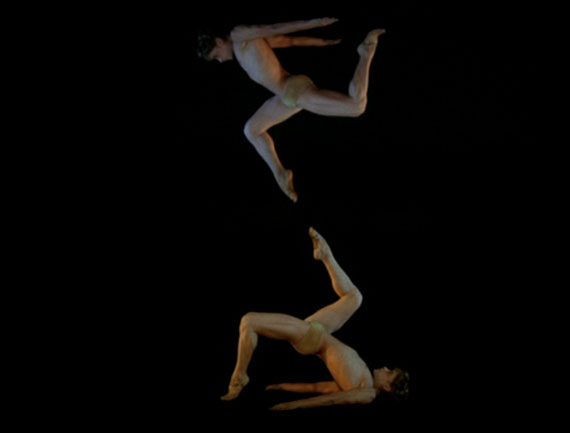
McLaren’s final released film, made when he was seventy. A ballet version of the Narcissus tale, in which our hero dances against a black background with a girl, then with a guy, finally shunning them both in favor of his own reflection. Beautifully shot and danced. I didn’t notice much in the way of McLaren’s signature styles in the ballet until Narc began dancing with his own disappearing self accompanied by nintendo computer blips on the soundtrack. Probably won more awards than any other McLaren film, in part because by the 80’s there were more award shows and festivals than ever before.

Narcissus meets himself:

Dances with himself:

I consider “late” Buster Keaton to be the 70-ish movies he appeared in since the 1920’s, shortly after the arrival of sound when his career went to hell. So these are very late Keaton, made in the last couple years of his life when he was around seventy years old (see also: the Twilight Zone episode he did a few years earlier).

The Railrodder (1965, Gerald Potterton)
A wordless journey through desolate Canada, which must have been trying to attract humans to its empty factories, forests, harbors, fields and cities, all seen as Buster whizzes by on a motorized rail car. Not as good as a classic Keaton short, but not as bad as most state-sponsored promo pieces either, just a light amusement with some minor Keaton antics and major Canadian scenery, with possible references to The General and The Cameraman. I like when he turns the car into a duck blind, but the gag’s payoff is lame – it’s not the most well-planned or well-timed little picture. Director Gerald Potterton moved into animation, making the legendary Heavy Metal.

Buster Keaton Rides Again (1965, John Spotton)
A “making of The Railrodder” that runs almost triple the length of the feature. In fact it’s over-long, in love with its subject, providing nice quick summaries of Keaton’s past films and life story, then rambling on with the present-day footage. A coughing, gruff-voiced Keaton smokes whenever not on camera for Railrodder (he died of lung cancer the following year). He’s a stubborn bastard regarding the gags and filmmaking – it’s clear from this doc that the IMDB’s listing Buster as uncredited cowriter/director on Railrodder is accurate. My favorite gag was in the documentary, not the feature, Keaton pretending to pull a train that comes in while he’s standing near the tracks. It closes with Keaton singing “Casey Jones” in his trailer, more emotional of a picture than the fluffy promo piece it accompanies.

Film (1965, Alan Schneider)
Close-up of an eye. Protagonist, always shot from behind, staggers to his apartment, horrifying all who look upon him. Alternate blurry shots from his POV. In the apartment, he covers a mirror and removes or destroys everything that has eyes. Feels for his own pulse. Finally, Buster’s face is revealed, wearing an eyepatch and his signature hat. Close-up of an eye. I don’t understand Samuel Beckett. Could someone explain him to me?


Stop-motion pioneer Charley Bowers made these couple films over a decade after all his other work, and according to his IMDB bio, “no one is quite sure what he did” during that in-between decade. They’re his final films, completed the year before he became sick at age 64, unable to work until his death a few years later.

A Sleepless Night (1940, Charley Bowers)
No sound at all (who watched silent shorts in 1940?) so the DVD producer unconscionably included an audio track of projector noise. I listened to LCD Soundsystem instead, greatly improving the movie, which was otherwise slack-paced and plotless. We’ve got a stop-motion mouse family who defeats the dog of the house, drinks a bottle of milk, then eats soap and floats away on the resulting bubbles.

Wild Oysters (1941, Charley Bowers)
More technically accomplished (featuring much more camera movement) and snappier than the last one, and with the same models for the mouse family, makes me think A Sleepless Night was a test run for what he’d planned as a series of mouse adventures. Although, spoken dialogue and a song with lyrics that comment on the action aren’t the major improvement. The mouse torments a different dog and also a cat, drilling holes in the floor and pulling their tails through. Weirder is when he runs across some oysters, which link together as a chain and chase him about. Why oysters? Even Tom and Jerry never ran so low on ideas that they introduced a string of oysters. Anyway, weird movie but enjoyable.


The Karateguard (2005, Joseph Barbera & Spike Brandt)
The final Tom & Jerry short released to theaters, and the only one made by Barbera, aged 94 at the time, after the passing of partner William Hanna in 2001. It was a passing of the torch to Brandt, who is still making T&J cartoons. I was never a wildly enthusiastic T&J fan, so I can’t share the outrage of the IMDB reviewer who calls it “unbearably mediocre.” Jerry isn’t great at his karate lessons, so his translucent sensei encourages him to quit, instead gives him a magical gong that summons a stone-faced samurai dog, who proceeds to pummel Tom for six minutes. A good time is had by all.

An entry for…

Initiated by Shadowplay

A true “late film,” Cold Lazarus was the final script completed by Dennis Potter just weeks before his (and his wife’s!) death from cancer. He wrote it after his diagnosis as a companion piece to Karaoke, which he didn’t feel should stand alone as his final work. I watched Karaoke a year before starting this memory-enhancing blog, and so don’t remember it perfectly, but enough to get the connections between the two stories.

C. Chapman on the general idea:
“A dying writer, haunted by his past creations and aware of how his legacy will be picked over by the media barons he so hates, writes about a dying writer, haunted by his past creations, and then how his legacy is picked over by the media barons.”

Potter on Potter:
“You don’t mind the frozen head in itself so much as you care about the stories it’s telling.”

Authority figures wear silly helmets in The Future:

Set in the year 2300, a lab run by Prof. Emma Polack (Frances de la Tour of Rising Damp, suddenly in a bunch of mega-budget Hollywood movies) has got the frozen head of Albert Finney’s character from Karaoke hooked up to machines and chemicals, with which the lab rats can visualize his memories. Unfortunately for them, Finney was a creative type whose thoughts don’t always reflect events as they actually occurred – a fun premise which I wish had been given more time. Had Potter lived long enough to workshop the script with actors/readers, assuming he ever did that sort of thing, he may have realized how much time was spent instead on typically tedious sci-fi blather, characters rattling off endless serial numbers (because in The Future, numbers replace names for everything) and silly futuristic words (the scientists didn’t go to college, but “cyber-college”). He also may have noticed how clueless these supposedly brilliant scientists seem when they ponder aloud the nature of subjective memory. I don’t mean to be hard on the guy, though – it’s an interesting story, and he was under the strictest writing deadline: to finish the story before his imminent death.

I’ll bet Finney’s frozen head would fetch good money on Ebay:

Frances de la Tour and Ganiat Kasumu, whose hilarious hairstyle you can’t make out properly from this screenshot:

So, Emma runs the lab along with shady Fyodor (Ciaran Hinds, a henchman in The Cook, The Thief, etc, and FBI in Miami Vice), straight-laced Tony (Grant Masters, whose previous claim to fame had been “man in laundry room” in a Mr. Bean episode), Luanda (Ganiat Kasumu of Nigeria), Kaya (Claudia “no relation” Malkovich) and Blinda (Carmen Ejogo, Maya Rudolph’s sister in Away We Go). They’re all under severe budget restrictions from artifically-young Cruella DeVillianous lab owner Martina (Diane Ladd: Laura Dern’s lipstick-smeared obsessive mother in Wild at Heart). But Martina’s buddy/rival Dave (Henry Goodman of Taking Woodstock), a benevolent television mogul, finds out about the lab’s research with the aid of Martina’s VR helmet (remember VR?) and his own network of robotic-bird spies, and secretly offers to buy them out, offering them an unlimited budget in exchange for the rights to broadcast Finney’s memories.

Evil Diane Ladd consorts with evil Henry Goodman:

Intrigue: Fyodor is secretly an agent of the underground RON (“Reality or Nothing”) organization, and when Kaya exhibits enough human compassion that he thinks she might be turned to their cause, he introduces her to a RON-affiliated coworker, to disastrous results. Blinda is found to be a spy for the owner, so Fyodor takes her out in the movie’s most Army of Shadows-worthy scene. And new boss Dave’s supposed benevolence turns quite unsurprisingly evil. The movie’s most interesting unanswered question is what will happen when Finney’s conscience is broadcast into every home. Dave is counting on an unprecedented ratings bonanza, people passively consuming a man’s psyche as entertainment, but Fyodor hopes that glimpses into a less-authoritarian past will make people realize their own lack of freedom and rise up, inspired by the RON slogan. Potter preferred not to allow us an answer, as Fyodor shoots first Dave then the head (which somehow provokes a lab-consuming, Fyodor-vaporizing explosion).

Ciaran Hinds, about to shoot either Goodman or Finney:

Of course since it’s Potter, there’s also rape and depression, torture and nihilism, and Finney sings Pennies From Heaven (probably a scene from Karaoke). Funny how his “memories” are edited rather to the rhythm of a 1990’s British TV miniseries, heh. The perverted sex-scientist whom Dave places on the team in the second half and Martina’s series of scantily-clad poolboys were a fun touch.

In the doc Dennis Potter: A Life in Television, someone says at least Potter was never boring – which is true of this. It’s not his very best writing (I’d even prefer the hardly-ever-discussed Lipstick On Your Collar) but it’s never boring. It’s a classy production too, with CGI effects that seem very good for mid-90’s television. The John Williamsy music is a bit loud, and the actors are more than a bit loud, everyone seeming drunkenly overenthusiastic.

Finney appears full-grown in his own childhood memories, an approach used before by Potter in Blue Remembered Hills:

Director Renny Rye (who also made Karaoke, Midnight Movie, Lipstick On Your Collar) was hand-picked by Potter for having no personality. Rye:

One of the reasons about Dennis wanting me to do it, was that he had this anxiety about directors wanting to impose their own stamp to such a degree that the writer’s original voice is masked or overcoloured. That distancing is one of the things he was dramatising. … Dennis loved the conceit of this group of scientists exploiting a writer’s brain after his death. ‘That’s what you’re going to be doing in a year’s time,’ he said: ‘exploiting my work.’

Katy said let’s start holding theme months again – perhaps Westerns Month, or Robert Altman Month. To delay making a decision, I played a Robert Altman Western. She said it wasn’t bad, but please no more movies like that, so Westerns it shall be.

Foolish me, I actually thought this wouldn’t be so Altmanesque. He made it right after MASH, but I’ve seen Images from the following year, so I’d convinced myself that he didn’t pick up the ensemble overlapping-dialogue thing again until ’75 with Nashville, making a few movies with a distinguishable soundtrack there in between. But no, this one was extremely ensembley and each noisy scene seemed to have been recorded with a room mic placed a couple rooms over. Katy points out that it may have exploded Western conventions in ’71, but now that they’ve been exploded for so long, we don’t see this as a very daring experiment, just a mushmouthed dialogue-heavy flick full of Leonard Cohen songs with a great chase/shootout ending.

McCabe:

Another disappointment: when Julie Christie finally showed up I was expecting a force of nature a la Joan Crawford in Johnny Guitar, but she doesn’t do much more than build a bath house and take over the whoring at Beatty’s new pub. As an article in The Guardian points out, our protagonists are “nothing like as confident as they would have us believe.” Recognized Shelley Duvall in a pretty small role as a mail-order bride and Michael “Tanner” Murphy as a businessman who fails to negotiate with Beatty over the sale of his land, leading to a snowy hide-and-seek shootout throughout the town, Murphy replaced by a gang of thugs who do not negotiate. I’m slowly learning my Carradines – a fresh-faced Keith (star of Fuller’s Street of No Return) played a doomed vacationing cowboy.

Mrs. Miller:

Mostly I liked the look, the feel, the light, the editing and pace. I wouldn’t say it had a documentary feel, but it felt like the scenes were happening on their own and the cameras were struggling to keep up (*). Has a good reputation these days, voted one of the greatest-ever westerns by some group or another. At the time, Christie lost her oscar to Jane Fonda, for something called Klute, and Vilmos Zsigmond’s hazy cinematography was only honored at the Baftas, where he was also nominated for Images.

(*) I thought that was a pretty neat thing I’d thought/written there about the movie, but when I went looking for articles I found that everyone else had thought it already. For instance, C. Taylor for Salon:

Mrs. Miller (Julie Christie), is a hard-headed madam with dreams of her own, the ones emanating from her opium pipe. The movie feels as delicate, as lulling, as Mrs. Miller’s drug-induced visions, and yet the life it shows us, the town and its people, are so real and sturdy we seem to have stumbled on them. The life the movie shows us is already being lived by the time we turn up. And everything we encounter evolves naturally — the setting, the characters, the story and most of all the mood.

A. Danks for Senses of Cinema:

McCabe and Mrs. Miller follows the coordinates of the most rudimentary of westerns; full of archetypal and cliched characters and situations such as the loner/stranger who shakes up a frontier town and the whore-with-the-heart-of-gold. But these classical or archetypal elements are undermined by the film’s opaque view of its characters, its foregrounding of atmosphere and place (including the ‘atmosphere’ of place, weather), and a technique which captures characters (both their bodies and voices) within pictorial tableaux that emphasise their relativity to the unfolding drama. In this respect, parts of, and indeed images within McCabe and Mrs. Miller resemble a painting by the sixteenth century artist Pieter Bruegel; broken up into interlocking tableaux and brought up to date (i.e. into cinema) by the deployment of favourite Altman devices like the zoom, the pan and multi-tracked sound – these devices serving to distance the events and characters from the viewer while opening up the frame, and the relationship between frames, to the scrutiny of the spectator.

I think I liked it better than Katy did, but then, she’d seen The Princess and the Frog so I had lower expectations – the most recently-produced Disney animated movie I’d seen was Atlantis (and before that The Lion King). Didn’t find it as edgy and Shrek-like as the poster and trailer promised (which is a Good Thing), just a perfectly-paced, well-animated classic adventure story.

Backstory: the kingdom’s magical rejuvenating flower is used to heal the pregnant queen, so her daughter’s hair takes on the flower’s powers. Evil stepmom witch kidnaps the young princess so that the hair will keep her forever young (by that logic, why doesn’t Rapunzel’s own hair keep her from growing past the age of five?) but Rapunzel yearns to escape in order to see up close the lanterns released in the kingdom each year in memory of the missing princess. That accounts for the classic fairy-tale part, then the thief, a royal guard’s white horse, Rap’s pet chameleon, and the tough bar patrons who wish to be mimes represent the hyperactive post-Aladdin Disney.

Actors: I didn’t recognize Southland Tales star Mandy Moore as Rapunzel, nor the Voice of Chuck as the thief, nor Doc Ock’s wife in Spider-man 2 as the old witch, nor Ron Perlman as the thief’s twin thug associates, nor Pixar regular Brad Garrett, nor Jeffrey Tambor, etc, etc.

Pedigree: One of the directors did Bolt, the writer worked on Cars, and supervising animator Glen Keane (the Family Circus author’s son), who sounds like the main man behind the look of the film, has been a Disney guy since the 70’s.