A silly-ass buddy western with inappropriately jaunty Burt Bacharach music (including a bonkers musical romance scene set to “Raindrops Keep Falling On My Head”). If I was watching this movie in a void I’d assume it was so tonally off-base that it diminished the Western genre permanently until it was finally killed off with Clint Eastwood’s dire Pale Rider. But no, the internet tells me this is one of the AFI’s and IMDB’s best-loved films of all time. What gives? That’s not to say the movie doesn’t have its pleasures. The buddy banter and some of the action scenes (especially an awesome train explosion early on) make the whole thing worth sitting through.

Both Butch (Paul Newman, not long after Cool Hand Luke) and Sundance (Robert Redford, not long before The Candidate) love the same girl, Etta (Katharine Ross, Dustin’s younger love interest in The Graduate). That and the freeze-frame ending make me think director Hill and/or writer William Goldman were Truffaut fans. Conventionally edited (for the late 60’s) with the deaths abstracted away, mostly happening distantly or off-camera – who’d have known The Wild Bunch came out just a few months earlier? I’d find coincidence that the movie’s anti-heroes were hunted down and killed in Bolivia just like Che, except that both movies were based on true events, so instead I’ll just remember not to flee to Bolivia if I’m in trouble.

A very good Wyatt Earp/Doc Holiday movie. Earp (Henry Fonda) is retired from the legendary fastest-gun-in-the-west lawman business, running cattle with his brothers, until his cattle is stolen and his youngest brother killed near Tombstone. Forms a tentative partnership with sickly, drunken badass Doc (Victor Mature) to take out the Clanton clan run by Walter Brennan (a real asshole, far from his lovable drunk character in To Have and Have Not). Schoolteacher Clementine comes to town looking for old flame Doc but finds him a changed man shacking up with his new love Chihuahua (my favorite character: Linda Darnell, conductor’s wife in Unfaithfully Yours) and while she’s hanging around town, Earp falls for her. Leads inexorably to a gunfight at the OK Corral, Doc and all the Clantons getting shot down. Much, much better than I’d expected from the title. I’m getting to like this John Ford fellow. Katy liked it, too.

Westerns Month continues. This is one of those contrary-auteurist favorites. It’s not even popular enough to be out on DVD in the states, and it’ll never make an AFI list, but, just for example, it’s on Jonathan Rosenbaum’s top 100 list (that’s hundred, not thousand). Not of westerns – of movies. So I had high expectations. And hell, I loved it, but I wouldn’t say I loved it more than Stagecoach or My Darling Clementine (or Red Garters), so maybe I wasn’t paying the right kind of attention, as usual.

L-R: Ben Cooper, Crawford, Carradine, Hayden:

Made the year before Rebel Without a Cause, and the acting style seems like a warm-up for that picture. Joan Crawford and Mercedes McCambridge play town rivals. These actresses were so mad that one had a movie made about how she abused her children, and the other voiced the devil in The Exorcist. They play everything so huge that when they finally meet for a shootout at the end, you can see sparks flying off the film. The women are the men in this picture. Town leader (Ward Bond: Rio Bravo and Wyatt’s older brother in My Darling Clementine) takes his cues from Mercedes, and the other two men are named Johnny Guitar and The Dancin’ Kid – not so tough.

The Kid offends McCambridge; Ward Bond looks on:

Johnny, a former gunfighter trying his luck as a musician, is Sterling Hayden (still a couple years before The Killing) and the Kid is Scott Brady (who starred in a not-so-well-loved Billy the Kid movie for William Castle this same year) with reasonable henchman Royal Dano and mean, irritable henchman Ernest Borgnine. Those fellows are kind of assholes but they’re not criminals – that is, not until a Mercedes-led mob tosses them out of town. Then they figure they might as well knock over the bank on the way out. Crawford is an entrepreneur like McCabe, opening a bar and gambling hall right where the train is gonna come through town. All she ever did wrong was to steal the Kid away from Mercedes. The mob shuts her down and almost hangs her after the bank heist. Her loyal employee (Stagecoach vet John Carradine) is killed and her place burned to the ground, so she hides out with the Kid’s gang until the mob tracks them town. Awesome final scene – the men all stand aside as the two women face off. Mercedes shoots the Kid in the head then gets blasted by Joan, who walks off with Johnny.

McCambridge stares down Crawford…

…while Hayden hides behind some wood:

Empire calls it “a truly demented Western, with vividly colourful settings and and an almost operatic intensity of emotional and physical violence … Best of all, the film acts as a vigorous indictment of the McCarthy witch-hunts; as a lynch mob rides after Crawford while McCambridge bullies witnesses into false confessions.” I suppose so – unlike the mobs in The Sun Shines Bright the previous year or Lang’s Fury, this one has a ringleader who eggs them on. In fact, as soon as Mercedes is shot, they’ve lost their voice – nobody moves or says a word as Johnny escorts Crawford past them all. There’s little doubt that writer Ben Maddow (blacklisted for being a lefty shortly after winning an oscar for The Asphalt Jungle) would’ve held a grudge with McCarthy.

My favorite shot: the (sharply dressed) mob looks past the body of The Kid:

The Guardian: “It is difficult to describe what makes Johnny Guitar so fascinating, except to say that Ray’s orchestration of Philip Yordan’s almost literary screenplay gives a small budget film, made for Republic Studios, a kind of heady but clipped dignity.”

Noir about a sleazy lawyer in the illegal gambling “numbers” racket who tries to get rich, tries to help out unlucky small-time older brother Leo, and fails miserably at both. At least he gets the girl, but at the end he’s turning himself in, disgusted that his buddies murdered his brother. The girl (stage actress Beatrice Pearson, only in one other film) is Doris, who is like a daughter to Leo and therefore as distrustful of Garfield as Leo is, but she comes around after Garfield keeps bailing her out of jail and incessantly harassing her. That’s how love worked in the 40’s.

Doesn’t look like the movie had much of a budget, but director Polonsky and D.P. George Barnes (who shot Rebecca and Spellbound for Hitchcock) made it look marvelous. Polonsky was an up and coming talent, oscar-nominated for his debut the year before, but blacklisted soon after this movie failed to make a huge impact. John Garfield was very good in this, even though I couldn’t have picked him out of a lineup of greasy dark-haired white guys an hour later. He was oscar-nominated the same year for Body and Soul, died a few years later of heart problems. Older brother Thomas Gomez (The Furies, Key Largo) lived long enough to appear in Beneath the Planet of the Apes.

I’ve taken to posting lists of movies I’d like to watch on this blog, which is unnecessary since I already keep a master list of movies I’d like to see in a database. Keeping extra lists here just means I’ve made everything less efficient. But no matter. A month or two ago I declared The Auteurist Completion Project, with aims to watch the last few remaining titles by directors I care about whose complete works I’d almost seen. Here’s the status report for that particular goal.

P. Anderson: The Dirk Diggler Story
W. Anderson: Bottle Rocket (short)
Anger: Invocation of My Demon Brother, Lucifer Rising, Anger Sees Red, The Man We Want to Hang
Arnold: Deanimated
Bahrani: Man Push Cart, Plastic Bag
Baldwin: Spectres of the Spectrum
Bong: Memories of Murder, Barking Dogs Never Bite, Influenza
Cocteau: Eagle Has Two Heads, 8×8
Cronenberg: From the Drain, Italian Machine
Dante: Second Civil War, The Hole
Fuller: Day of Reckoning, Crimson Kimono, Verboten, The Command, The Tanks are Coming
Gilliam: Storytime, Tideland
Gondry: The Letter, Thorn in the Heart
Guest: For Your Consideration
Hartley: Fay Grim, shorts vol. 2
Haynes: Poison
Hillcoat: Ghosts of the Civil Dead, To Have and to Hold
Jarmusch: Permanent Vacation, Year of the Horse
Jodorowsky: Santa Sangre, The Rainbow Thief
Keaton: The Navigator, Battling Butler
Korine: Trash Humpers, Julien Donkey-Boy
Kubrick: Fear and Desire
Lang: Harakiri, The Wandering Image, Four Around a Woman
Leone: Duck You Sucker, My Name is Nobody
Linklater: Me and Orson Welles, It’s Impossible to Learn to Plow…
Lynch: On The Air
Marker: Loneliness of the Long Distance Singer, The Last Bolshevik, Level Five
Moore: Pets or Meat, Slacker Uprising
Murnau: Haunted Castle, Burning Soil, 4 Devils
Panahi: White Balloon, The Mirror
Park: Chicken Run, Creature Comforts
Quays: Piano Tuner of Earthquakes, Songs for Dead Children, Inventorium Sladow
Raimi: Within the Woods
Soderbergh: King of the Hill, The Girlfriend Experience, And Everything Is Going Fine
Svankmajer: Jabberwocky, Sileni, Surviving Life
Tarkovsky: Nostalghia, Mirror, Steamroller and the Violin
Tarr: Macbeth, Almanac of Fall, Damnation
Tati: Jour de Fete, School for Postmen, Trafic
Taymor: Juan Darien, The Tempest
Welles: Around the World, Chimes at Midnight, Fountain of Youth, The OW Show
Wong: In the Mood DVD extras

Deleted from list because I was missing more titles than expected: Miike, De Palma, Dreyer, Tashlin, Van Sant, Varda, Demy, Bunuel, Cassavetes, Kieslowski, Kitano, Powell/Pressburger, Sally Potter, Dennis Potter, Renoir, Resnais, Rivette, Scorsese, Watkins.

If I was planning to make my annual end-of-year list of movies which I simply must watch next year (which I’m not, since I feel like having a freeform 2011), those titles would probably be on there. Though it would be more fun to tackle famed filmmakers whose works I’m largely (or in most cases, completely) unfamiliar with, so here’s a handy list of those, too.

Joseph Losey
Anthony Mann
Rainer Fassbinder
Josef von Sternberg
Cecil B. DeMille
Roberto Rossellini
Otto Preminger
William Wyler
Alexander Dovzhenko
King Vidor
Luc Moullet
Pier Paolo Pasolini
Mikio Naruse
Jean Eustache
Marcel Carné
Raoul Walsh
Derek Jarman
Elia Suleiman
Julien Duvivier
Terayama Shuji
Luchino Visconti
Aleksandr Sokurov
Fatty Arbuckle
Ritwik Ghatak
Masahiro Shinoda
Yevgeni Bauer
James Benning
Stanley Kwan
Carlos Saura
Maurice Pialat
Jacques Becker
Marguerite Duras
Theo Angelopoulos
Marcel L’Herbier
João César Monteiro
Herschell Gordon Lewis
Humphrey Jennings
Otar Iosseliani
Chantal Akerman
Lee Chang-dong
Paul Leni
Hiroshi Shimizu
Albert Brooks
Rene Clement
Whit Stillman
Jean Epstein
Bertrand Tavernier
Tran Anh Hung
Barbet Schroeder
Zhuangzhuang Tian
Andrea Arnold
Marco Bellocchio
Pere Portabella
Vera Chytilová
Anthony Asquith
Basil Dearden
Mark Rappaport
Hong Sang-soo
Takashi Ito
Jan Sverák
Youssef Chahine
Karel Zeman
Bruno Dumont
Francesco Rosi
Karel Reisz
Don Siegel
Roger Vadim
Guy Debord
Mara Mattuschka
Henry Hills
Andy Warhol

The Armando Iannucci Shows (2001)

Sadly there was only one season, but I guess he tackled every major issue that humanity faces in these eight episodes (Time, Reality, Work, Twats), so why make more? Aired in September 2001 so I imagine it could have been overlooked. I have no idea if it was, though, since here practically all British television is overlooked. I sought this out after loving Iannucci’s In The Loop. Still looking forward to The Thick of It and Time Trumpet.

All vaguely thematically-tied sketch comedy, a la the first two seasons of Mr. Show, mostly (but not limited to) starring Armando as himself, or his stand-up persona.

A poem from the show:

As she grimly walked away
“I’m leaving you,” she said
And I had nothing new to say
Like the second album by Portishead


30 Rock seasons 3 & 4

Remained funny/good over two more seasons. Less stand-alone-episodic, more season-long plot threads. Until netflix gets more episodes, there’s no other show we can easily agree to watch together – contenders have included Parks & Rec, Louie, Slings & Arrows and Arrested Development.

New writers & directors: Steve Buscemi (!), Todd Holland (director of the Fred Savage classic The Wizard), Ron Weiner (writer of one of my favorite Futurama episodes), Tricia Brock (made a 2004 Fred Willard movie), 15-year SNL writer Paula Pell, and the show’s music composer directed an episode.

Oh, the guests!
The cast of Night Court, Oprah (my favorite guest spot), J. Aniston, Steve Martin, Peter Dinklage, John Lithgow, Alan Alda, the Beastie Boys, Jon Glaser, Betty White, the voice of Gilbert Gottfried, Al “should not be allowed on television” Gore, Buzz “ditto” Aldrin, James Franco, Will Ferrell and Matt Damon, and semi-regulars Elaine Stritch, Salma Hayek, Jon Hamm, Michael Sheen and Juliane Moore.

Katy’s first pick for Westerns month was this, the most acclaimed Western of all. We both liked it very much, though I’m probably not qualified to proclaim its greatness or otherwise. For one thing, it’s not all Citizen Kane-y, shouting its own greatness to the heavens, just a cheap-looking, charming flick (reportedly, Welles loved it). Story by Ernest Haycox (Canyon Passage, Union Pacific), screenplay by Ford regular Dudley Nichols (also Bringing Up Baby and Scarlet Street – I like this guy). Remade in the 60’s with Ann-Margret, Bing Crosby and Slim Pickens, then in the 80’s with Highwaymen Willie, Kris, Johnny and Waylon. I would kinda love to see both remakes. Ford also made two Henry Fonda movies this year, including Young Mr. Lincoln.

Bunch of people who do not belong together are crammed into the stage to Lordsburg through dangerous Indian territory and their military escort has vanished. The long-dreaded attack comes, but they’re saved last-minute by the cavalry, and everyone learns a little something about each other. Lots more humor than I expected, too. It’s hardly a dry, stodgy classic. It’s hardly realistic either – you never forget that it’s a movie (in fact, sometimes it feels like a stage play).

John Wayne (in his star-making role after flying under-radar for his last hundred movies) shows up late, out for revenge on some guys who killed his brother, watched closely by Marshall Curley (George Bancroft, star of those Josef von Sternberg movies Criterion just put out). It seems weird now that Claire Trevor (Dark Command, Key Largo, that 60’s remake of Pickup on South Street) was first-billed in this. She’s a hottie haunted by her dark past (as a “saloon girl,” it seems, not a prostitute) and shunned by the right and proper other girl, pregnant Lucy (Hollywood short-termer Louise Platt of Street of Chance, Spawn of the North) who’s trying to meet up with her husband.

There’s an uptight crooked banker named Gatewood (Berton Churchill, the villainous senator in Judge Priest) who gets arrested upon arrival, after irritating everyone the entire way, and for comic relief, nerdy whiskey salesman Peacock (appropriately named Donald Meek, also of You Can’t Take It With You, Peter Ibbetson, Return of Frank James) and the seriously drunk Doc Boone (Thomas Mitchell, who won an oscar for this, also with major parts in Mr. Smith Goes to Washington, Gone with the Wind, Only Angels Have Wings and The Hunchback of Notre Dame – all this same year!). The doc sobers up just long enough to deliver Lucy’s baby halfway through the trip, becoming everyone’s hero. I can’t tell if gentleman gambler Hatfield (John Carradine, who was playing Robert Ford in the Jesse James films around the same time) is a hero or not, dying in the attack (somebody had to) before he could blast Lucy in the head to spare her from Indian capture. And I loved coachman Andy Devine, whom Katy immediately pegged as the voice of Friar Tuck in Robin Hood. And oh yeah, when they get into town, lawman Curley lets Ford blow away his opponents then escape with Claire Trevor.

D. Cairns:

Stock types, but Nichols and Ford and the cast make them fresh by letting them bounce off one another in surprising ways. Character change elevates Stagecoach far above The Hurricane, where the cardboard figures blow in the wind but don’t bend. Nearly everybody in Stagecoach is either developed or transfigured during the adventure. Snooty Lucy transcends the prejudices of her upbringing via her growing respect for Dallas, and even the timid Mr. Peacock gains a little force. A family man, he is more able to assert himself after Lucy’s baby is born, even if nobody pays much attention. Curley, meanwhile, thanks to his exposure to that noble outlaw the Ringo Kid, abandons his rigid service to the law so a higher justice can be done. … Throughout the film, the Apaches are an anonymous threat, Geronimo a mere renegade with no motivation supplied. It’s the least nuanced portrayal of Indians in any of Ford’s classic westerns, though his relations with the Navajo extras were very warm—he even had a medicine man on retainer to arrange photogenic cloud formations for his camera.

We watched it on crummy netflix streaming, not on the gloriously restored, feature-rich new Criterion-edition blu-ray, so I have no supporting materials.

A very late entry for…

Initiated by Shadowplay

Le final film de Jean Renoir, made for television when the director was in his mid-70’s, eight years after his last theatrical picture The Elusive Corporal. Some tinges of bitterness, of sadness and despair, but as always Jean is finally generous and life-affirming, closing with a whole town roaring laughter, making me laugh in response.

But first, Renoir minimizes expectations. Away from the monumental cinema screen (which he often conflated with a theatrical stage), now working for television, he envisions a diminished stage, a tiny theater, and so presents short stories instead of one long work.

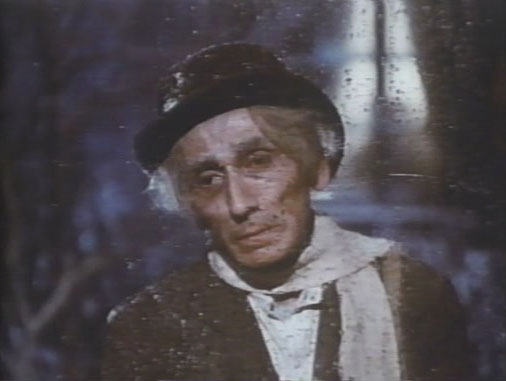
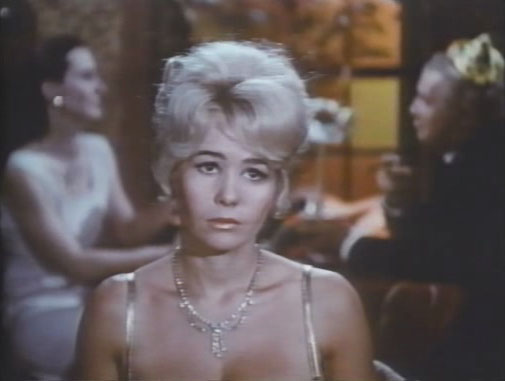
A rich loudmouth (Roland Bertin of The Model Couple, The Hairdresser’s Husband), in a move imitated by Lars Von Trier for The Five Obstructions, pays a homeless guy to watch his friends’ Christmas feast through the restaurant window. Some of his guests are bummed, so they flit off elsewhere, leaving this guy outside making restaurant patrons nervous until the maitre d’ pays him in food and wine to buzz off. The bum (Nino Formicola) brings the food to his girlfriend (singer Milly, in The Conformist the same year) under a bridge – they celebrate the holiday talking together (but not eating) then lie down and freeze to death with happy smiles on their face. A weird holiday fable, and a circular one for Renoir, who’d filmed The Little Match Girl (with much window gazing and freezing to death) over forty years prior.

Gaze from outside:
Gaze from inside:
As with the concept of the “petit theater” itself, the next episode can be seen as a cranky old-timer’s refusal to accept modern technology, but in both cases he suffuses his premise with humor, downplaying the crankiness in favor of amusement. It’s the most comedic and musical of the pieces, featuring a Greek choir of townsfolk, a painting that changes expression, and cartoonishly fun acting.

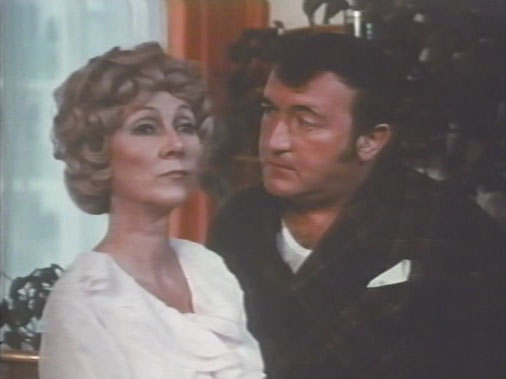
Marguerite Cassan (my favorite actor of the same year’s La Rupture – mother of the husband-gone-mad) wants only an electric floor buffer, and bullies her husband about it until the next-door neighbor, an electric floor buffer sales rep, overhears and comes over to demo the product. Unfortunately, Cassan’s poor husband (Pierre Olaf of Camelot) slips on the ultra-smooth floor and dies. She remarries a man with a stronger will (Jacques Dynam, who played buffoon inspector Juve’s second-in-command in the 1964 Fantomas) who insists she not run the machine while he’s home. She disobeys and he hurls it out the window, so she hurls herself out the window. That’s two Renoir stories in a row that end in demise.

M. Cassan giving the silent treatment to first husband:

M. Cassan giving the silent treatment to second husband:
Part Three is a musical interlude featuring Jeanne Moreau (the same year she was/wasn’t in Orson Welles’s The Deep) singing “When Love Dies.” Incredibly, the producers of the VHS copy I watched decided not to subtitle the song.

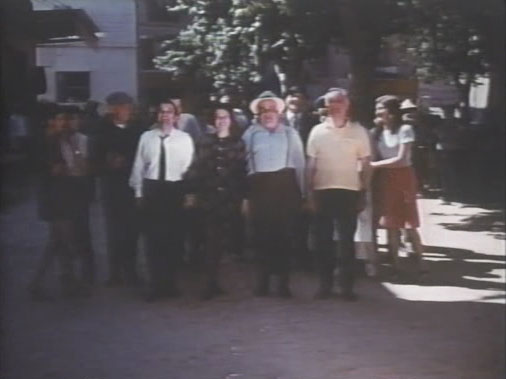
The final segment was my favorite. Duvallier (Fernand Sardou), a well-loved retired captain, resides happily in his big house with his young wife (Francoise Arnoul, lead girl in French Cancan) and a lovestruck maid (the rarely seen Dominique Labourier, a few years before starring in Celine and Julie Go Boating), spending his days in town playing bowls (a similar game to bocce). All is bliss until the wife is discovered to be sleeping with a friend of his, then it’s tears all around. Duvallier ponders the situation, asking townsfolk for advice, while the friend first decides to leave town (him: “He loves you”, Mrs. Duvallier: “Yes, but only when I’m happy. When I’m unhappy I upset him, and if you leave I’ll be unhappy.”) then proposes a duel. But Duvallier decides it’s best for everyone to stay happy, to live as they have been, and so the trio goes into town for a game of bowls. It’s the most cheerful movie about infidelity that I’ve ever seen.

Final bow:
On one hand, I really want to see the G.I. Joe movie (since I used to watch all the cartoons) and Supernova (since it’s a legendarily troubled sci-fi with F.F. Coppola involvement) and many other, even worse movies. On the other hand, time is precious and I take my movie watching seriously. So I find The Last Ten Minutes to be a happy compromise – in one guilty-pleasure hour, I kill six potentially trashy time-wasting movies, at an average savings of 89%, or over 13 hours per ten movies! What a deal.

G.I. Joe: The Rise of Cobra (2009, Stephen Sommers)
Ah, what’s happening?! General Hawk (Dennis Quaid) looks concerned. A stealth bomber was shot with green smokey special effects and Ripcord (Marlon Wayans) escaped alive. People are referring to “joes” and their “hoo-rah” when they get excited is of course “yo joe!”. Maybe they should’ve gotten rid of those parts. Cobra Commander and Destro (I never thought of him as Scottish) are off doing creepy villain stuff and saying lines like “you and what army?” The visuals look slick as shit, though. Why is Duke (Channing Tatum of Public Enemies) so young? Mild sequel set-up, Jonathan Pryce-as-president coda, and it looks like I missed all the Storm Shadow scenes. Movie looks totally bearable overall. In a few years I look forward to G.I. Joe: The Wrath of Golobulus then G.I. Joe: Beyond Thunderdrome.

Horsemen (2009, Jonas Akerlund)
Why is General Hawk (Dennis Quaid) putting Zhang Ziyi in prison, and what does it have to do with the apocalypse? Oh of course baddies are after his family and are luring him to an abandoned building… that is way more boring than the apocalypse. Quaid’s son (Lou “Thumbsucker” Pucci) is hanging Ichi The Killer/Hellraiser style over a stage saying some boringness about neglectful parenting while Quaid is chained up watching. And every Saw sequel said the same thing. Why don’t our parents worry about us? Why don’t our parents worry about us? From the director of nothing and the writer of Doom.

Supernova (2000, Walter Hill)
James Spader in a Leviathan diving suit fought a badass white guy who I don’t recognize until rescued by Angela Bassett. The ship’s computer warns us about “ninth-dimensional matter.
Karl gets extremely blown up, but I wouldn’t call it a supernova. I don’t think Angela Basset has a shirt on. Ah there’s the supernova – neato. After going warp-speed while nude and hugging, Basset-Spader have gone all The Fly and swapped eye colors and now she’s pregnant – that never happens when people beam up together on Star Trek. Interesting pedigree, this movie – from pseudonymed director Walter “The Warriors” Hill with uncredited help by Francis Ford Coppola.

John Q (2002, Nick Cassavetes)
Denzel… shoots himself in the head! But the safety was on. Transplant heart for Denzel’s insurance-less dying child is arriving. The police arrest a False Denzel while the real one sneaks around in hospital scrubs, but Robert Duvall is on to the plot. Is this really what heart transplants look like? So simple and clean, like the Operation game. Montage of people telling us America may have a national health-care problem. A blatant message movie, then. Look, James Woods! I thought it didn’t seem terrible overall until a cringey final shot.

Hollow Man 2 (2006, Claudio Fäh)
Was Hollow Man even successful? Invisible Christian Slater (the poor man’s Invisible Kevin Bacon) indirectly kills a suited guy who’s tracking him via infrared scanner. Oh wait, dialogue tells me that was actually Invisible Peter Facinelli of the Twilight series… Slater is now trying to murder Laura Regan until Facinelli shows up. Invisible Man fight in the rain ends with a shovel stuck into Slater. From the writer of all sorts of unnecessary sequels, from Hellraiser: Hellworld to Dracula 2000, from Pulse 3 to Prophecy 5.

Surrogates (2009, Jonathan Mostow)
Short movie. Evil James Cromwell, inventor of the surrogate system, surprises Bruce Willis with a gun. Ooh, in the future we have light-up staircases. Crom “uploaded a virus into the system” to kill all the surrogates, but a fat guy excitedly shouts some key commands at a blonde chick, then shots are fired and all the robot surrogates in the world fall down. So whoever she was (Bruce’s wife?) she saved all of humanity from a life of surrogate slavery, waking them from, one might say, the Matrix in which they lived. From the director of sad sequel Terminator 3.