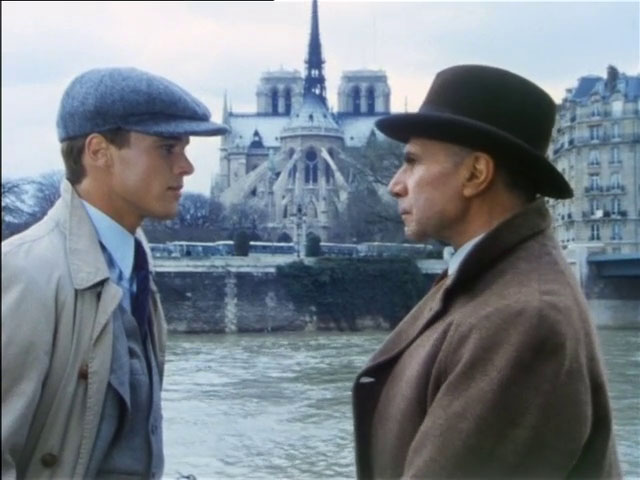
Since I’ve watched nearly all of Alain Resnais’s movies, and loved nearly all the ones I’ve watched, I had the completist urge to watch his hour-long entry in a series of TV episodes about creative types: Kafka, Vivaldi, Einstein among others in an optimistically-titled, short-lived series called The Audio-Visual Encyclopedia. Didn’t expect much, but it’s pretty remarkable.

Bertrand Tavernier digs through the archives:

Opens with a player piano, seen but not heard, then people talking about Gershwin in different languages, unsubbed. The film’s writer Edward Jablonski is on screen talking about Gershwin when a narrator starts talking over him. Photos fade in and out, people vanish like in Not on the Lips. Resnais makes much of Gershwin’s erratic behavior shortly before dying of a brain tumor, uses this to justify interruptions and strangeness in the movie. And Resnais’s recent interest in graphics – see (or preferably don’t see) his comic-book movie I Want To Go Home – comes alive with illustrations.

One speaker is put on hold in a corner of the frame while the movie lets another person talk:

Dollhouse season 1 (2009)

Whedon’s project before Cabin in the Woods.
I love this show.
Ends with a motherfucker of a leap into the future.

Echo (Eliza Dushku, Arnold and Jamie Lee’s teenage daughter in True Lies) is lead doll, alongside exotic-looking Sierra (Dichen Lachman from Nepal of a recent nuclear submarine drama series) and Victor (Enver Gjokaj, billed below Harry Dean Stanton in The Avengers – side note: Harry Dean Stanton was in The Avengers?!).

DeWitt (Olivia Williams, Rosemary Cross in Rushmore) runs the place with techie Topher (Fran Kranz, great in Cabin in the Woods), security guy Dominic (sinister-looking, eyes-too-close-together Reed Diamond of Homicide: Life on the Street) and Dr. Saunders (Amy Acker, in the Cabin in the Woods control room), later revealed to be a doll. Harry Lennix (of Titus) is a major part of the early episodes, later takes over Dominic’s job.

Meanwhile, clueless pawn but sweetly determined FBI man Ballard (square-jawed canadian Tahmoh Penikett, Stanley Kubrick in Trapped Ashes) tries to expose the place and protect his too-perfect neighbor Miracle Laurie who is, of course, a doll. Bonus baddie: Alpha (Alan Tudyk, pilot of the Serenity and voice of King Candy in Wreck-It Ralph)

The staff writers moved on to Spartacus: War of the Damned, Dr. Horrible’s Sing-Along Blog, Agents of Shield and Undercovers. Directors include Tim Minear (Firefly), Dwight Little (Halloween 4), Elodie Keene (The Wire season 2), Felix Alcala (Criminal Minds), James Contner (Buffy/Angel, TV movies She Woke Up Pregnant and Hitler’s Daughter), David Straiton (Hemlock Grove), Allan Kroeker (three different Star Trek series), Rod Hardy (the David Hasselhoff Nick Fury movie), David Solomon (Buffy) and Joss Whedon (Buffy/Angel/Firefly)

Veep season 1 (2012)

The Thick of It in the USA, wonderful. Veep Julia Louis-Dreyfus is ably assisted by blonde Amy (Anna Chlumsky, star of My Girl), red haired Mike (Matt Walsh of Upright Citizens Brigade), Tony “Buster” Hale and dark handsome careerist Dan Egan (My Boys).

Also great: receptionist Sue (Sufe Bradshaw) and white house go-between Jonah (Timothy Simons of an upcoming Kevin Costner baseball movie).

Created by the great Armando Iannucci (The Thick of It) with cowriting by In The Loop collaborators Simon Blackwell and Tony Roche, Time Trumpet writers Sean Gray and Will Smith, and Peep Show creator Jesse Armstrong. Directed by Iannucci, Christopher Morris (The Day Today) and Tristram Shapeero (Community).

United States of Tara season 1 (2009)

Diablo Cody’s gift for snappy, hilarious dialogue and Toni Collette’s adeptness at her multiple-personality role made this a joy. Let’s see, she plays herself (harried mom mostly cleaning up after her own messes), “T” (sex-crazed teenager), Buck (alpha-male biker), Alice (perfect housewife), and mysterious unnamed poncho-wearing monster.

Tara’s married to patient John Corbett (Northern Exposure), has sister Charmaine (Rosemarie DeWitt, title character in Rachel Getting Married) and kids Marshall (Keir Gilchrist, star of It’s Kind of a Funny Story) and Kate (Brie Larson, Scott Pilgrim‘s rocker ex-girlfriend). Also great: Nate “Rob’s brother” Corddry of Studio 60 as Kate’s boss and Patton Oswalt as Corbett’s coworker.

Directors include Craig Gillespie (Lars and the Real Girl), Mark Mylod (Ali G Indahouse, The Fast Show), Brian Dannelly (Saved!), Tricia Brock (Killer Diller), Tommy O’Haver (Ella Enchanted) and John Dahl (Rounders)

Look Around You season 1 (2002)

Suppose I first looked this up because Edgar Wright plays one of the scientists. Faux-vintage science program. I kept watching since the episodes are only ten minutes each, and got more into it as the concepts and experiments grew more absurd (“Ghosts” was a highlight). Cowriter/star Peter Serafinowicz played Shaun of the Dead‘s uptight roommate, and director Tim Kirkby is working on Veep. It’s probably worth looking up The Peter Serafinowicz Show.

Jon Benjamin Has a Van season 1 (2011)

I guess this isn’t coming back… Benjamin getting his own absurd live-action comedy show was too good to last. A well-assembled self-aware sketch show that worked at least half the time.

Jon’s cowriters: Leo Allen (of Slovin & Allen), Nathan Fielder (who got his own show Nathan for You this year) and Dan Mintz (voice of Tina on Bob’s Burgers), all of whom wrote for Important Things.

Kristen Schaal: Live at the Fillmore (2013)

Weirder and more conceptual than I’d expected. Lots of sex jokes, an extended parody of The Vagina Monologues, a couple of skits. Mostly a miss, but I loved her Sally Jesse Rafael impression and her fake meltdown, repeatedly stumbling over the word “airplane” and requesting a glass of water.

Holy Flying Circus (2011, Owen Harris)

Opens with a fart joke then a sweary joke, and never gets funny, throwing out faux outrages and pained Python references in place of jokes – but it features Mark Heap wearing a beret, so that’s something. Lots of speech-impediment humor: stuttering and tourettes are hilarious. I suppose Life of Brian, which this movie is defending, scores laughs from Pontius Pilate’s lisp, though. Builds to a reenactment of an infamous talk show appearance pitting pythons against clueless religious types – since the dialogue quotes from the actual talk show, it would’ve been nice to just watch that instead.

From a writer on The Thick of It/In the Loop/Veep and a Black Mirror director. Fake Cleese was in Smack the Pony and Hippies, Fake Chapman played something called “Top Hat” in Van Helsing, and Fake Palin is Edie’s newspaper editor in Downton Abbey. I did enjoy the sword/lightsaber puppet duel.

Garrone’s follow-up to Gomorrah prompts a lot more smiles and less dread, though the dread builds towards the end. The second fiction I’ve seen after Dead Set revolving around the show Big Brother, which must be bigger in Europe (or maybe it was huge here and I just haven’t noticed).

Opens with a great helicopter shot with Elfmanesque music. Luciano, who runs a fish market and plays a noisy blue-wigged woman at parties, is coerced by his family into interviewing for Big Brother at a local mall, then he gets a callback interview at Cinecitta. He becomes obsessed with the show, sells his business to prepare for stardom and gives all his possessions to the homeless to impress producers he thinks are spying on him, but the season’s cast is announced and his phone never rings, so he takes to stalking the show’s spokesman, a former winner named Enzo. Luciano’s obsession grows, but he also learns to hide it from his family, so at the end he wanders off during a trip to Rome, sneaks into the Big Brother house, and the camera pulls slowly out as he laughs crazily to himself.

There’s also a scam plot involving Luciano and his brother getting local seniors to apply for free government-issued robots (?!). I caught one of the gun-happy kids from Gomorrah as a bartender. Alexandre Desplat contributes the wonderful fantasy score.

Reverse Shot:

Back home in Italy, the film has registered more keenly, perhaps because they are still crawling out from under a prime minister whose legacy is marked by tax evasion and media monopoly, game shows and bouncing bimbos. A show predicated on voyeurism and humiliation like Big Brother, the program that sits like a bioluminescent tumor at the center of Garrone’s film, would seem to be the quintessential cultural marker for a period led by a man who was once a cruise-ship and nightclub crooner. Reality is then the unspoken anti-Berlusconi film of the moment, interrogating at once a culture of crassness, wild social inequality, and blatant fraudulence, both financial and otherwise.

Downton Abbey season 3
Please tell me something will prevent season four from ever happening, and the series will forever end with the shameful scene concluding the “Christmas episode”, the death of Matthew Crawley, who suddenly thinks himself too good to appear in a smash-hit show alongside Maggie Smith.

Parks & Recreation season 4
The Leslie-running-for-city-council season, versus Paul Rudd as an idiot millionaire and his ruthless campaign manager Kathryn Hahn. Entertainment 7Twenty goes out of business and Tom briefly quits the parks dept. Leslie wins despite a different mini-scandal every episode. Ron loves riddles.

I watched Charlie Brooker’s How TV Ruined Your Life and loved it (the re-enactments are better than ever, and there’s a slightly Adam Curtis tone to the commentary), then anxiously waited a few months until his Screenwipe review of 2012 came out (haha, “real life Titanic“), then that wasn’t enough so I watched his 2007 and 2010 specials, and some Christmas 2006 thing which is apparently different from the 2006 review special, then his new weekly TV show premiered – and abruptly ended after six episodes (the last of which was a clip show!). Must everything in Britain, even current-affairs shows, last only six episodes? Apparently he’s got a new scripted show called A Touch of Cloth.

Also rewatching The Wire with Katy – we’re up to season 3.

Sports Night season 1 (1998-99)

Good Aaron Sorkin show. Casey (Peter Krause of Six Feet Under) and darker-haired Dan (Josh Charles of Muppets From Space) are anchors of a sports show run by Felicity Huffman (of Transamerica and apparently Magnolia) and Robert Guillaume (Benson, Rafiki in The Lion King). Casey likes Felicity, who is engaged to Ted McGinley, and Dan likes Teri Polo (mom in The Hole), who is married. The only stable relationship is Felicity’s assistant Sabrina Lloyd (Harley’s The Girl From Monday) with new guy Joshua Malina (a Sorkin regular).

Asylum (1996)

Edgar Wright’s first series – and he has four others that I’ve never heard of between this and Spaced. Cowritten with the cast, overall uneven with a slim overarching story and characters that get tiresome if you watch the episodes too close together.

Simon Pegg is a pizza boy called to an asylum then imprisoned there. Jessica Stevenson plays the sadistic head nurse and a daytime-TV-addict inmate. Mighty Boosh star Julian Barratt is a talkative, pretentious artist (and the highlight of the show). Standup comic Adam Bloom is a Lenny Bruce obsessive, Paul Morocco a mute juggler, Norman Lovett (of Red Dwarf) the head doctor and Mick O’Connor (whose only other credit is The Falls) the receptionist. Each episode ends with a music video, which I kinda loved.

Big Train season 1 (1998)

Excellent sketch comedy show starring Simon Pegg (between Asylum and Spaced), Mark Heap (Brian in Spaced) and Kevin Eldon (a dim officer in Hot Fuzz), with Julia Davis (Nighty Night) and Amelia Bullmore (Jam and I’m Alan Partridge).

Weird to hear a Tortoise song scoring a fake TV ad in episode 3, and to see a parody of the intro to A Matter of Life and Death. Lots of animated (barely) footage of the staring-contest world finals.

Cowriters Arthur Mathews and Graham Linehan worked on The Fast Show, and with Christopher Morris on Jam and Brass Eye. Still need to watch Morris’s feature Four Lions

Arrested Development season 3 (2005-06)

So very good. I love how it ends with none of the characters having learned anything at all. Appearances by Justine Bateman, Judge Reinhold and a long section with Charlize Theron.

Scott Walker: 30 Century Man (2006)

Since I didn’t watch this with the release of The Drift like I was supposed to, I watched it with the release of his follow-up album. Wow. Some records I need to get: Night Flight, Climate of Hunter, the Ute Lemper album. Scott worked on Pola X so they show some behind-the-scenes bits of the warehouse performance and motorcycle crash.

The Pee-Wee Herman Show on Broadway (2011)

Apparently, Pee Wee is better remembered than revisited.

Also watched Maria Bamford‘s stand-up thing recorded at her house with no audience – weird and awesome. She’s got a new one with her parents as the audience, which sounds even better.

The Queen of Versailles (2012, Lauren Greenfield)

Katy watched on netflix in a couple installments – I think I was there for all of it, but not too sure. Belongs in the Movies I Only Sorta Watched category. Pretty fascinating, starting as a document of the loony mega-rich couple building the largest house in America, until the housing crisis delays their plans and threatens his timeshare business. Wonderful to see things from the 1% perspective, especially when they’re in what they consider to be desperate financial straits (though the wife has a five-shopping-cart trip to walmart and visits the warehouses where their extraneous crap is stored), repeatedly referring to themselves as normal people who got screwed by the banks.

Found a new version of Fantomas – see also the Feuillade original, the stupid 1960’s version and the surrealist 1930’s short.

Episode 1: L’Echafaud Magique

The original novels and/or serials may have been written as they went along, but in 1980 they should’ve had time to shuffle things a bit. Instead this first episode faithfully recreates the major plot points of the first Feuillade episode – master criminal Fantomas kills an ambassador, is having an affair with the dead man’s wife Lady Beltham, sneaks into a rich woman’s house handing out vanishing-ink business cards, is caught and sentenced to death but switches with an actor, who goes to the guillotine. In this version at least, Inspector Juve discovers the fake seconds after the beheading instead of seconds before – makes Fantomas’s switcheroo more of a sinister plot, less saving his own skin.

Written by Bernard Revon (two of Truffaut’s Antoine Doinel features) and directed by Claude Chabrol, who would tackle another silent-film master-criminal a decade later in Dr. M. Kind of disappointing for what used to be an adventure series – slow and talky, achieving in 90 minutes what Feuillade did in 60 (including intertitles). Fantomas doesn’t get a great introduction as a criminal mastermind, either. He starts strong, killing a woman en route to cashing in her winning lottery ticket under the nose of Juve (Jacques Dufilho of Black and White in Color). Then he breaks into the rich Princess Sonia’s house and. . . bugs her? After Juve catches on to the Lord Beltham disappearance, Fantomas is caught by the Belthams’ gardener, beaten up and handed over to the cops, then relies on his girlfriend, a gullible prison guard and incredible coincidence to escape prison.

Fantomas vs. the Princess:

Juve’s reporter friend Fandor isn’t a pre-existing character here, but the revenge-seeking orphan godson of the slain lottery-ticket woman. Juve assigns him a new name and destiny in an awkward scene.

Fantomas is Helmut Berger, star of some Visconti films. He’s good at playing both the criminal and the windbag actor doing a Fantomas play. Good to see the elegant Gayle Hunnicutt, star of Feuillade-affiliated Nuits Rouges, as Lady Beltham.

Episode 2: L’Etreinte du Diable

Directed by Juan-Luis Bunuel, immediately better than part one, more stylish and energetic. The plot is even stupider and more convoluted – a dead woman is planted in a half-deaf doctor’s house, while a gangster called Lupart has some scheme involving his prostitute girlfriend. The doctor is Fantomas (not sure about the gangster) taunting the police. Shootout at the docks follows, a definite throwback to the originals even if I don’t remember the rest.

Juve vs. Josephine:

Lady Beltham was presumed to be the dead body found earlier, but is discovered alive in a convent – and then she’s followed to her old house, where she has been secretly meeting with Fantomas. Two more good bits from the original follow, to lesser effect than in the silent – a snake attack and the house explosion that “kills” Juve.

Fantomas vs. Lady Beltham:

Episode 3: Le Mort Qui Tue

The Baroness (Danielle Godet of The Fighting Pimpernel) is told by her banker Fantomas that she is ruined. She’s soon found dead, and a young painter asleep in the same room – so the painter (Maxence Mailfort of elder Bunuel’s films and a version of Bartleby) is arrested and hangs himself in prison – then disappears from his cell. It’s always gotta be complicated.

Dead painter’s sister and Fandor are on the case, while an instantly recognizable Juve is undercover in the underground. A sweet train heist featuring a bulletproof mask breaks up all the dialogue and the pointless return of the princess from part one.

Lots more murders and robberies follow. Fantomas is discovered (he’s always hiding right in Juve and Fandor’s faces) but escapes using electromagnets, not the suit with fake arms – a fair trade.

Fandor, stopped in his tracks by magnetic floor:

Episode 4: Le Tramway Fantome

Back over to Chabrol, and it opens with Fantomas knifing a cat. Now he’s Mother Kirsh, friendly landlady in Moravia, and also a fake marquis, both framing a vacationing Fandor for murder then getting Juve caught under suspicion of being Fantomas, the master criminal whom nobody but Juve has ever seen. Lady Beltham, a kidnapped king, and trap-murders causing the cops to kill victims with strings tied to triggers and doorknobs.

Good guys:

The dubbing seems worse than usual, and the subtitles aren’t perfect but I can’t complain. “To use the alarm clock technic to kill is abominable!” Nice that F. and Lady B. get away at the end.

Futurama season 7 (2010)

The first season on Cartoon Network (after the four movies) feels like the show never left. Particularly excellent episodes were the first one (explaining the few years’ absence and the crew’s sorta-survival from a massive crash) and a time-travel story.

The Thick of It season 2 (2007)

A weird “season” in two hour-long chunks, showing our government goons from season one and their opposition group (“the nutters”) who think they’ll be taking power when the prime minister resigns. Fewer jokes, insults and comprehensible situations to someone as dumb about British politics as I am. Season four just aired, exciting.

Screenwipe season 5 (2008)

I can’t seem to stop watching this, even though it’s irrelevant to my life and I don’t get most of the jokes. I just like Charlie Brooker. Best was the episode on children’s programming, less good was the humor-free double-length one on TV writing. Also checked out the special Gameswipe, an unhelpful hour introducing video games to people who are afraid of them.

Patterns (Jan 12, 1955)

A workplace drama that put writer Rod Serling on the map. It was a huge hit, re-broadcast (re-performed, since it’s done live) the next month and turned into a film the following year with the same director, Fielder Cook (from Atlanta).

New executive Staples arrives at the office, gets introduced to big boss Everett Sloane (Welles’s scheming employer in The Lady From Shanghai) and nervous coworker Ed Begley. The boss intends for Staples to take Begley’s place, but has to get rid of Begley first – can’t just fire him, so he tries to force the guy out, finally succeeding when Begley has a heart attack after a ruthless attack at a board meeting. Staples protests, thinks of himself as a good man recognizing corruption in the system, but he and his wife want this position and promotion too badly so he goes along with it. Nicely mobile camera, with bigger sets than Marty.

Ghost Train, the first episode of Amazing Stories, directed by Spielberg in 1985 – which I watched when it premiered. Lukas Haas, the main kid in Mars Attacks! is the boy whose grandpa (Roberts Blossom: scary neighbor in Home Alone) awaits the train that he derailed 75 years ago, killing everyone aboard. The train coming through the family’s house is impressive – the rest is a bit too Spielbergian-lite, but an improvement on his Twilight Zone episode.

Also watched an (cr)apocalyptic double-feature of Cloverfield and The Day After Tomorrow with Rifftrax.

Stiller manages a perfectly realistic virtual-reality simulator set in the future so government (and increasingly, industry) can make predictive policies. And about ten minutes into the three and a half-hour movie I realized that Stiller is himself a fictional character inside a virtual reality. I knew this because I’ve seen science fiction before, and the story was seeming familiar – turns out it’s based on the same source novel as The Thirteenth Floor. Fortunately, Stiller figures this out at the halfway point, after obsessing over an erased security chief whom only he can remember, so we’ve got the whole second half (episode – this was a TV miniseries) to deal with this info. More fortunately, there’s no slow grinding of the plot gears as the characters slowly realize something that I already know, because the film is 100% fun to watch, even while being obvious. Fassbinder has found a way to make low-budget, no-effects TV sci-fi look terrific, covering every surface with mirrors and windows and screens (you catch sight of the camera crew pretty often – another fun game), creeping around corners with his Ruizian camera (with sparing use of the requisite 70’s zooms) and playing with perspective. With this and Sam Fuller’s Dead Pigeon on Beethoven Street being my only touchstones, I have to assume that mid-70’s German television was amazing.

Stiller (Klaus Lowitsch of Peckinpah’s Cross of Iron), the shortest person in the movie, is taking over the project because his predecessor/father-figure Vollmer has unexpectedly suicided. Vollmer’s daughter Eva, Stiller’s main squeeze, has grown distant, the corporate project head (Stiller’s boss) Siskins is becoming more demanding, and Stiller’s new secretary Fromm (Fassbinder regular Barbara Valentin) is obviously a spy, implanted to keep Stiller abreast of the situation.

Get it?

Stiller gets more impertinent, programs a singing, tap-dancing version of his boss into the simulacrum. He goes on the run after his mid-movie revelation, realizing that Vollmer was killed for finding out the same thing. Eva reappears, says she’s from the real world, that Vollmer never had a daughter until she programmed herself in a few days before, that they have many virtual worlds but this one captured attention for being the only one that created its own sub-virtual-world. And since the real Eva is in love with the virtual Stiller, she helps him escape by swapping psyches with someone outside.

Eva and Stiller trying to pull a Minority Report pose:

I liked the electronic music, daring for 1973, but sometimes the bonkers, intense squeals which occur when Stiller is troubled would make Ash upset. I also like that you can have fully naked women on German television. Don’t know much about Fassbinder, assumed he’s kinda Nick Ray meets Doug Sirk meets Sam Fuller meets Hedwig, based on my decade-ago half-rememberance of watching The Marriage of Maria Braun.

Stiller being told that he’s a fictional character:

Stiller sneaks into a theater while on the run from the law, watches what appears to be based on the last few minutes of Dishonored:

Nashville Scene rightly calls it “a film that feels somehow inevitable in your viewing, a missing link that should have been there all along.”

Another key reference for World on a Wire is Jean-Luc Godard’s own lone foray into sci-fi, 1965’s Alphaville. Much like Godard’s film, World generates a futurescape from the present mostly by judicious selection. Abandoned building sites, freeways and glass skyscrapers, it seems, are forever. (In the final moments of World, Fassbinder completes the homage as Alphaville’s star, Eddie Constantine, makes a cameo appearance.)

Eddie C.:

Film Quarterly:

Despite not actually being an adaptation of a Dick fiction, World on a Wire has more in common with the wry mordancy of Dick’s work than many official Dick adaptations, not least in the way that it shows each of its three nested worlds as being equally drab. We actually see very little of the world “below” (the world inside the Simulacron) and almost nothing of the world “above” (the world one level up from what we first took to be reality). The world below we see only in snatched glimpses of hotel lobbies and inside a lorry driver’s cab. But it is the revelation—or non-revelation—of the world above at the climax of the film that is most startling. Instead of some Gnostic transfiguration, we find ourselves in what looks like a meeting room in some ultra-banal office block. At first, the electronic blinds are down, momentarily holding open the possibility that there will be some marvelous—or at least strange—world to be seen once they are up. But when they do eventually rise, we see only the same grey skies and city- scape.

Vollmer, just before his death:

Varda films her own travels for a year or so, as she visits old friends and new, goes to lots and lots of art exhibits and museums, and attends retrospectives of her work. “Now that I’m old, everyone tends to give me awards and trophies.”

I didn’t get tired of the framing story: a tree at her offices is severely pruned, all shot in still photographs. And speaking of photographs, the main excitement in episode one is that she visits Chris Marker at his studio. She shoots the cables behind his computers, “the secret threads of the labyrinth of his art.” A Demy-fest celebrating the 50th anniversary of Lola, featuring Aimee, Piccoli and Varda’s children. Lots of exciting artwork.

Manuel de Oliveira attends Varda’s screening in Lisbon. Somebody explains Oliveira’s cinema: “He says reality is merely the result of certain conventions. It’s very important in Manoel’s films to understand that society becomes the artifice. Cinema is not the artifice. Manoel’s films help us get some distance from this reality imposed on us, so we can interpret it in another way.” Then Oliveira clowns around for Varda, doing his Chaplin impression and miming a fencing match, and my understanding of him changes. When he was a piece of trivia, The Oldest Working Filmmaker, it always seemed like he had very little time left, that each film might be his last (a review I found of Non, over two decades and thirty films ago, suggested that it would be his last), but seeing him in action I suddenly realize that he may live forever.

Varda chills in Marker’s world:

Oliveira:

Ep. Two, she goes to Brazil and meets Glauber Rocha’s daughter and Jeanne Moreau for the Rio film festival. A chair in a gallery prompts a montage of chairs Varda has photographed. Stockholm, and an Ingmar Bergman auction. Agnes is so fascinated by her interviewer, they end up swapping jobs. She calls gallery director Hans Ulrich a “contemporary art detector.” Varda meets Jonas Mekas and Yoko Ono while dressed as a potato. Flashbacks to Vagabond and Beaches. An elephant upon its trunk announces an exibition.

Agnes Potato with Mekas:

Ep. Three: igloos in Basel. Varda’s installation film Patatutopia is a triptych of potato images. Another installation of interviews, each one playing on its own television in front of its own easy chair. “A piece by George Segal attracts my attention. I didn’t know how to film my distress when Jacques died. So I wrapped myself in white, like plaster, and imitated Alice. I listened to music we both loved. Artists invent ways for us to express our emotions.” At the Alliance Francaise she attends a presentation of Beaches and a photo exhibit, including portraits she took of filmmakers (Demy, Visconti, a superb shot of Fellini). She visits the Hermitage and flashes back to Russian Ark, then back in Paris has a fascinating chat with artists Annette Messager and Christian Boltanski.

the Segal piece:

Patatutopia:

Boltanski’s holocaust-metaphor used-clothing installation:

Ep. Four: setting up a Beaches installation, with sand and her shack made of filmstrips. Some visitors to the shack: “Their interpreter murmurs ‘New Wave'”. Digital beaches, a man who collects buttons (and button stories), then a return to La Pointe Courte, where she films the 2010 version of the same jousting tournament she shot in 1954 for her first feature. A Marker grinning cat leads to more museums, including an exhibit by a painter who works only in black. I liked how he displays his paintings, suspended in the middle of a room instead of upon the walls, so you can look past one to compare it with another in 3D. Jean-Louis Trintignant recites poetry in the park – this kind of thing never happens where I live.

Varda street on la pointe courte:

Trintignant:

Ep. Five: a visit to her buddy Zalman King, Richard Pryor’s costar. Towers built by a “hero of outsider art.” Interview with a reluctant participant at the gang violence memorial. She talks about Jim Morrison and visits her old beach house, presumably during the Lions Love era, then toys with blue screens on the beach. Some 15th century angel/Jesus paintings then, more fun, skeletons in Mexico City. Agnes gets her interpreter to play piano and her assistant to pose nude for a photograph. Interview, with clips of Japon, with Carlos Reygadas, before visiting Frida Kahlo’s house. A juice factory that also houses a massive collection of modern art. Matthew Barney, Marina, Abramovic, and the best molé in town.

Zalman:

Agnes and Mexico interpreter Elodie, not nude:

And the series ends with no grand sweeping statement on the travels, just a series of sketches accumulated over a year or two, the time it took for the tree in her courtyard to completely re-grow.