Assayas’s idea of a good, fun b-movie, except he forgot the “good” and the “fun.”

Asia Argento used to do demeaning sex work for powerful businessman Michael Madsen in order to turn him on and steal business secrets, and now after years she is back. Long push-pull dialogue segments prep us for twisty psychological intrigue, but nothing is ever especially twisty. Oh wait, Madsen has a big-money disagreement with Alex Descas (scientist/vampire-boyfriend in Trouble Every Day) but that couldn’t possibly be important. Asia pulls a gun and kills Madsen, planned by her new boyfriend Carl Ng, whose wife Kelly Lin (Zu Warriors, ex-wife/cop in Mad Detective) is in on the plot.

Girls still faint in movies:
image

But will Kelly really let Asia get away with the crime and leave with her husband? No, well, yes, sort of. Shocker: Alex Descas shows up at the end. It was his idea to kill Madsen! None of the surprises are surprising and none of the tension is tense… Demonlover had more twists in its last five minutes than this one can manage in ninety. If I’d seen this when it first came out I might have skipped Summer Hours, which would have been a mistake. Guess Assayas can be inconsistent but still makes great films.

image

It might hurt Michael Madsen’s feelings to be cast in what the director calls a b-movie, but he’s not any good, nor is Sonic Youth’s Kim Gordon as a Hong Kong crime boss, and even Asia isn’t giving a knockout performance. I’d think Kelly Lin stole the show if there was much of a show to steal. Turns out most critics agreed with me – I didn’t re-check the reviews, probably got this confused with Go Go Tales in thinking it was well-loved.

image

Truth 24FPS agrees:

The project must have seemed promising, at least on paper – a globe trotting thriller with kinky sex, drug deals gone awry, murder, double and triple crosses, gun fights. But the film comes across as tepid, warmed over trash, and strangely, contains none of the kinetic forcefulness of the Hong Kong films Assayas champions. Assayas’ view of the world can at least partially be gleaned from his casting choices – an Italian who speaks French and English, with American and Chinese lovers, who travels from Paris to Hong Kong and eventually encountering a crime boss played by an indie rock icon. … The first half of the film consists of [Argento & Madsen] squaring off in increasingly repetitive encounters, with a kind of will they or won’t they do it sexual tension (answer: who cares?).

Asia Argento only liked the movie thiiiis much:
image

Dissent from G. Kenny:

His mastery of the camera and his always innovative approach to setting are constant, knotty pleasures; the Paris of the film’s first half is as alien to our recieved ideas of Paris as Godard’s Alphaville was, while his Hong Kong is a crumbling labyrinth where the only clues about which corner to turn are provided by cell phone rings.

image

But my favorite comment is from a forum poster on Premiere: “It made me want to punch Asia Argento in the face, but that would probably turn her on.”

On one hand, this guy’s got a point that his is a life worth documenting… I mean, he and his boyfriend directed a musical version of Blue Velvet in their high school using Marianne Faithfull songs.

On the other hand, this is a guy who filmed himself in closeup while on the phone hearing that his mother overdosed on lithium. Reminds me of the Grizzly Man setting up his camera and doing retakes of himself jumping down a hill. Too much information sometimes, too personal, blogging-as-filmmaking.

image

But it’s an engaging movie, edited to death with music video segments and as many cheap visual effects as he could find. Frequent use of intertitles (which refer to himself in the third person) help make it less narcissistic, and in fact it looks like the film was supposed to be about his mother, documenting her history and personality as a warning against electro-shock therapy, but she’s not always around since he moved away from the family for a few years. Don’t think I’d agree with the “best doc of the decade” raves I was reading last week but it’s definitely a good one.

image

Forbak is going to build a pleasure palace but WWI interferes and his girl marries another guy. When he opens his castle, diminished from its original plan, he invites all his friends to stay locked inside and drink a potion of forgetfulness, awakening to blissful ignorance and holding a chastely sensual orgy. For some reason Forbak’s sinister, wheelchair-bound father is pleased by all this. Forbak’s lost love Livia agrees to stay out of curiosity but doesn’t drink the potion, spying on the goings-on afterward, while her naive husband Raoul drinks and dies for reasons unknown halfway through the experiment.

Forbak casts a spell:
image

Sounds like another oddball movie along the lines of Je t’aime, je t’aime – but wait, there’s more! Decades later, present-day, the castle is being used as a progressive (read: new-agey) school under crabby headmistress Holberg, and the site of an educators’ conference. Local guy Robert throws toys around and acts like Natalie Portman when she’s doing something nobody has ever done before in Garden State, visitor Elizabeth acts the uptight moralist who believes in true love, Nora the confident modern woman and Walter the elder celebrity. The conference devolves into squabbling and the importance and methods of education becomes secondary to guessing who will hook up with whom (Nora bets Elizabeth falls for Robert, but Liz rides off with Walter in the end).

Robert and his son… and who’s that guy on the left? Big head, stiff hair… looks familiar.
image

Scenes alternate, with a wildcard movie thrown into the middle… Melies-tribute tableaux fantasy shots involving kings and monsters and children and swords, dwarfs and damsels in distress.

The king orders more people beheaded… note stingray at bottom. The same plaster stingrays are staggered up the walls in the present-day scenes within the castle.
image

Weird movie, puzzling but fully enjoyable. Possibly the turning-point movie where Resnais went from anguished memory-obsessed time-traveling Muriel mode to stagey comedic ensemble Not On The Lips mode. The musical thing started here for sure – there are singsongy intros and everyone seems about to burst into song, but they do not… and then finally Elizabeth relieves the musical tension with a couple full songs. For me it recalled Rivette’s Love on the Ground more than any Resnais movie. Maybe it was the wacky architecture, the castle in which grown-ups perform a childish drama.

“The age of happiness is beginning,” they tell us, “Love! Happiness!” chanted forever. English title was “Life is a Bed of Roses” but the subtitles tell us “Life is a Fairy Tale” and the strict translation seems to be “Life is a Novel.” Closing lines: kids saying “as my father said, life isn’t a fairy tale.” Resnais’ only time with cinematographer Bruno Nuytten (who worked with Marguerite Duras and Claude Berri) and his second of three with writer Jean Gruault.

Bonheur:
image

Lots of familiar faces in this one! In the WWI-era scenes, idealist Ruggero Raimondi (so he’s not familiar, an opera singer) vies with Andre Dussollier (another link with Love on the Ground, later in Coeurs) for the hand of Fanny Ardant (star of two then-current Truffaut films).

Fanny Ardant and Andre Dussollier:
image

In present-day, Vittorio Gassman (then of a couple by Robert Altman, before that a hundred Italian films) is the bearded celeb Walter, Geraldine Chaplin (another Rivette/Altman connection), funny with her falsely “bad” French is Nora, Sabine Azéma (married redhead in Not On The Lips, caretaker/realtor in Coeurs) is timid Elizabeth, Pierre Arditi is the charming/ridiculous Robert and Robert Manuel (in Rififi back in the day) is the group organizer.

Walter… and there’s that guy again on the left:
image

Resnais:

The theme of the film is “Can we create happiness for ourselves without hurting others?” It isn’t easy. The second theme, even though it’s bad to have two in a story, is “Are there really any grown-ups?”

Dying mother in demonland performs one last song:
image

Stylus:

vacillates between three superficially unrelated vignettes, one set in medieval times, one in 1914, and one in the present day. The first has operatic tableaux in the place of a narrative; the second is a Poe-esque cautionary tale on the spiritual rebirth of high society, and the third an airy romantic farce. This is no Three Times: the three are linked by the locale of a castle, but otherwise thematic parallels are unclear—“love and happiness,” the casts in all three chant, but isn’t this a rather dime-store way of threading segments together?

Eager to discover why Resnais had employed such seemingly arbitrary affectations, I rushed home and googled the film, and was giddy upon the realization that the three parts were tributes to three of Resnais’ favorite French filmmakers: Georges Méliès, Marcel L’Herbier, and Eric Rohmer.

Fanny decides not to drink the kool-aid:
image

D. Ehrenstein:
“Rather than a novelist as was his practice in the past, Resnais worked with veteran scriptwriter Jean Grualt, whose credits include Jules and Jim, Les Carabiniers, The Story of Adele H, The Rise of Louis XIV and Paris Belongs to Us.”

Scale model vs. World War One:
image

Resnais at a film fest press conference:
“I never had the idea that the audience should go out of the theater scratching its head and asking questions about the meaning of the film … The important thing for us is that we wanted to make a comedy.” Also says the film expresses “‘variations on the theme of dominance.”

Robert’s springheaded son and his cronies:
image

NY Times

Although ”Life Is a Bed of Roses” has a deliberately distancing, non-realistic style, and although its uniquely skewed logic effectively prevents the audience from trying to regard it rationally, the film winds up more purely confounding than can have been intended. Arch little asides, like the abundant choral flourishes, cannot help but feel pointless without a clear sense of what they are departures from.

About the title, Mr. Resnais explained that ”Life Is a Novel” is its French equivalent. French parents, he said, often tell their children that ”life is not a novel,” in the same way that American parents declare ”life is not a bed of roses.”

Sabine Azéma as Elizabeth:
image

Cineaste calls it a “fascinating misfire” and says “it would take as long to summarize the plot(s) as it takes to watch the movie.”

DVD Talk (unless they’re quoting Kino) guesses at intentions:
“Through parody and “civilized” snobbism the French director also critiques the foundations of modern intellectualism, those who thrive on it.”

Pleasure blanket:
image

Films de France:
“Both Forbek and the seminar’s organisers are striving for similar things, the creation of a better world. Both are doomed to failure.”

Movies that open with a rape scene have a lot of catching up to do. Then two dead guys floating in a pond. These events bookend a minutes-long tracking shot through the woods. Dead guys could be the rapists if we were going in circles. Sets up a movie in which I’m never quite sure if we’re going in circles, especially when traveling these woods.

image

Nop is a photographer, married to May who works in an office and sleeps with her boss (and never with Nop). Nop is briefly seen shooting an interview with someone talking about spirits. Now we’ve got a disorienting forest, sex, death and vague mention of spirits. That’s all the answers we’re ever gonna get out of this movie – no big final scene where all the mystery is explained. If I’d read what I’m writing now before watching the movie I’d think it’d remind me of K. Kurosawa’s Charisma, but while watching it, didn’t remind me of nothing. I also tried to draw Tropical Malady connections (couples and spirits in Thai forests) but that didn’t work either. Best I’ve got is Antichrist. A couple in trouble retreats to the forest, ends up permanently changed by supernatural events and only one makes it back home (not to mention a sex-upon-tree-roots shot, below, that seemed directly related).

image

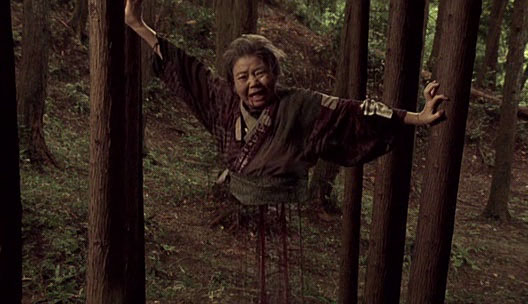
May likes her cellphone, takes sleeping pills, does anything to avoid Nop, but searches for him frantically when he goes missing in the woods. She’s taken home by her boss, where she finds Nop the next morning, sleeping on the couch, acting bizarre, obsessed with plants and consuming only water. Back to the forest to attack a mystical tree with a machete, Nop is in the woods too, tells her and the boss to leave. Or, he tells the boss to leave… May is unconscious at this point, since she spends half the movie getting knocked out or fainting or sleeping through important events. Was Nop ever really back home or has he been in the woods this whole time? Is he walking the forest in his pajamas or a naked and helpless captive inside a hollow tree? What exactly is the naked nymph doing to him? This would be a good time to know more about Thai mythology.

image

Wikipedia says it’s a Greek thing, that they’re female personifications of nature, tied to a specific location. Not much help elsewhere… Twitch says the film is slow to a fault and calls it “the least commercial film of Ratanaruang’s career,” Ion says it’s “deeply rooted in non-discourse.”

image

Pen-Ek himself: “It’s more of a mystery than a horror story. The filmmakers have sided with the ghost in this film, therefore the humans in the film are scarier than the ghost. … I am preoccupied with bad relationships and lonely people,” and about his change in style before shooting Last Life in the Universe and apparently continuing today, “I wanted there to be no story – I wanted to film mood.”

image

I told Katy it was more a string of comic episodes than a consistent story, but I badly misremembered. Very consistent indeed… almost too consistent, with some mopey bits and plot necessities dragging down the comic momentum. But Chaplin’s goal was presumably not to make just the funniest film, but something both funny and true.

From A. Vanneman’s terrific Chaplin articles in Bright Lights:

Charlie has three big men to contend with in The Gold Rush, Tom Murray as “Black Larsen,” Mack Swain as “Big Jim,” and Malcolm Waite as “Jack Cameron.” Wolf Larsen scarcely has a personality. He is merely a symbol of the savagery of nature. He murders two Mounties and leaves Big Jim for dead, before Nature herself, reclaiming her own, sends him plunging to his death in an avalanche.

Big Jim is Chaplin’s partner/rival searching for gold. They don’t do much searching, really, just hide out in murderer Larsen’s cabin attempting to keep peace and stay alive through the cold and hunger. Among the danger and misery we get Chaplin turning into a chicken, a cooked and eaten shoe and the famous cabin-on-edge-of-cliff number. Big Jim found plenty of gold at the start of the film but can’t get back to it, and when he does Larsen clubs him (amnesia!) before heading for death by avalanche. Jim, dazed, wanders towards town and isn’t seen for 45 minutes.

Charlie takes the second half with a love story, pining for Georgia Hale who makes fun of him, then feels sorry for him, and finally decides she loves him moments before Charlie reveals he’s become a millionaire by helping Big Jim re-find his gold. Not quite a City Lights ending but it’ll do.

More Vanneman:

“Oh, you’ve spoilt the picture,” exclaims the cameraman when Charlie and Georgia kiss, an inside joke based on the cliché that in Chaplin’s pictures he never got the girl. When Chaplin re-released The Gold Rush with a soundtrack in 1942, he cut out the kissing scene for some reason, although it’s still clear that Charlie and Georgia are going to get married.

Second time I’ve avoided the re-release, which is shorter and supposedly has Chaplin’s bemused voice narrating instead of the intertitles. Sounds ghastly, but maybe I’ll be on a Chaplin completist kick one day and check it out.

“In the new human paradigm everything will be local.”

L.A. policeman starts by talking about the CIA smuggling drugs into the country, moves on to the recent/current financial crises, explains the concept of peak oil (we’re running out) then leads us down the Road to global devastation, huge drops in population, suburbanites starving in their homes.

I need to start growing vegetables in our back yard this spring. Quitting my job, opening a bicycle repair shop. Can rain barrels be used for drinking water?

Big city newspaper owner Carter is publically attacked by small town newspaper owner Ulysses Bradford for twisting the truth, exploiting the sacred power of the press for commercial gain.

“A free press is the sole right of the people. The editor is but the trustee of that right, not the dictator. Beware of those who hide behind the front pages of America who use for their own advantage the power of the press. They are as dangerous as enemy planes, bombs, guns, tanks.”

Carter, shamed, agrees with Bradford’s editorial, vows to improve his paper at a press conference, but is shot before he can get through the speech. Things get farfetched here, but it’s obviously the work of chief editor Howard Rankin (below), a transparent villain introduced delivering a light line about sending someone to a concentration camp.

image

Hard to find an interesting screen shot. Doesn’t have half the visual interest of It Happened In Hollywood or Park Row.

Now it’s up to Edwina (“Eddie” to her friends), Carter’s longtime secretary, to convince smalltime Bradford to come to the big city, take the reins of the paper (it was left him in Carter’s dying will), get managing editor Griff from under Rankin’s thumb, catch trigger man Trent at another murder and force a confession from Rankin. Can they succeed in these noble deeds? Yes!

image

Oh and I didn’t mention Rankin incites a riot to destroy a warehouse hoarding rationed goods, which turns out to be a secret army supply, and he frames a young commie ex-newsman for Carter’s murder. All this in 60 minutes. Big ol’ propaganda piece for a free press, with more and more spoken comparisons between Rankin and nazi bigwigs as the crimes are revealed. But the worst insult of all: “Why, Howard Rankin isn’t even a real newspaperman.”

Fuller wrote the story, not the screenplay, but we still get idealistic speeches about the press, mentions of Horace Greeley and a character named Griff. Sounds like our Sam. Doesn’t look like him unfortunately… feels like a quickie. No wonder, since director Lew Landers made 28 movies from 1942-44.

Minor Watson (Woman of the Year, Lang’s Western Union) played the murdered newsman, Larry Parks (played Al Jolson in a biopic and its sequel) the commie, Victor Jory (the Rupert Everett part in the 1935 A Midsummer Night’s Dream, also played The Shadow in the 1940 serial) the evil henchman, Atlanta native Lee Tracy (Doctor X and Borzage’s Liliom) the eventual-good-guy editor Griff and Otto Kruger (High Noon, Dracula’s Daughter) the maniacal Rankin. Our female lead Gloria Dickson died in a house fire two years later. Guy Kibbee (Ulysses) seems to have had a nice career despite his unfortunate name, from 30’s musicals to Capra to John Ford. The previous few years he’d been starring in a comedy series as Scattergood Baines.

In the featurette, Tim Robbins says a buncha general things about Fuller’s movies, mentions the year 1959, so I figure he thought he’d be on the Crimson Kimono disc, not having his interview slapped between clips of Power of the Press. Tim is a suitable interview, since I’ve had that song about “the press, the press, the freedom of the press” from his Cradle Will Rock in my head since I watched this.

At the turnover of every year I like to comb my must-see list (4000 titles and growing) and make a shorter goal list of movies to watch in the next year. The list is no big deal – usually I’m over-ambitious and I don’t make it to a quarter of them, forget to even check it after April. This year, though, I’ve got a Project. I’ve been reading lots of best-of-decade lists and culling titles I haven’t seen, planning to watch those in 2010. After all, if a movie makes a respected critic’s yearly top-20 list it’s worth considering, but if it makes his DECADE top-20 list I’ve just gotta see that. So here are the 155 movies I feel I’ve gotta watch in 2010 (that’s three a week, unrealistic as ever). Maybe I’ll cross ’em off this list as we go.


Decade list:

11’09″01
Afterschool
All About Lily Chou Chou
All The Real Girls
As I Was Moving Ahead I Saw Brief Glimpses of Beauty
Battle In Heaven
Beau travail
Best of Youth
Birth
Blissfully Yours
Bourne trilogy 1 2 3
Bus 174
Chuck & Buck
La Cienaga
Colossal Youth
Corpus Callosum
Darwin’s Nightmare
Death of Mr. Lazarescu
Divine Intervention
Domestic Violence
Esther Kahn
Eureka
La face cachee de la lune
Failed States (henry hills)
Fat Girl
Fengming: A Chinese Memoir / West of the Tracks
Five Dedicated to Ozu
Frontier of Dawn
Gerry
The GoodTimes Kid
Good Morning, Night
Half Moon (bahman ghobadi)
Headless Woman
Head-On
House of Mirth
I’m Going Home
In Praise of Love
In the City of Sylvia
Innocence (lucile hadzihalilovic)
The Intruder
Jonestown: Life and Death of People’s Temple
Kandahar
Kings and Queen
Lady and the Duke
Late Marriage
Let Each One Go Where He May
Lilya 4-Ever
M/Other
Mad Songs of Fernanda Hussein
Magic Mirror
Michelangelo Eye to Eye
Morvern Callar
Night and Day
Oasis
The Other Half (ying liang)
Ou git votre sourire enfoui? / Sicilia
Platform
The Queen
Raja
RR
Secret of the Grain
Silent Light
Sobibor, Oct. 14, 1943, 4pm
The Son (dardenne)
Songs from the Second Floor
Spring, Summer, Fall, Winter and Spring
St. Ignatius Church Exposure: Lenten Light Conversions / Golden Gate Bridge Exposure: Poised for Parabolas (lynn marie kirby)
Star Spangled To Death
Syndromes and a Century
Tarnation
Tearoom (william e. jones)
Ten
This Is England
Three Burials of Melquiades Estrada
Three Times
The Tracey Fragments
El Valley Centro
Waltz With Bashir
What Time Is It There?
When the Levees Broke
The White Ribbon


Unseen movies by favorite filmmakers:

Bunuel
Illusions Travel By Streetcar
Susana
El Bruto
Criminal Life of Archibaldo del Cruz

Gilliam
Tideland
Imaginarium of Dr. Parnassus

Herzog
Strozek
Enigma of Kaspar Hauser

Kurosawa
Guard from the Underground
Serpent’s Path

Marker
The Owl’s Legacy
The Last Bolshevik

Resnais
La Vie est un roman
Love Unto Death

Rivette
Le Pont du Nord
Merry-Go-Round
Va Savior

Tashlin
Rock-a-Bye Baby
It’$ Only Money

Varda
Jacquot de Nantes
La Pointe Courte
Lions Love


Unseen DVDs:

Adventure in Sahara
Scandal Sheet
Elena and Her Men
The River
Lucky Star
They Had to See Paris
Young America
Song o’ My Heart
Liliom
Bad Girl
After Tomorrow
Four Devils
City Girl
Madame de…
Fanny & Alexander
The Navigator
Battling Butler
A King in New York
Sin of Harold Diddlebock


Brand new hotness

Mock Up on Mu
Mother
Nymph
Mary and Max
It Felt Like a Kiss
Film Ist: A Girl and a Gun
Liverpool
Eccentricities of a Blonde Hair Girl
Guy Maddin’s new shorts


Old ones I’ve been excited to finally watch:

Battleship Potemkin
Queen Kelly
Make Way for Tomorrow
The Best Years of Our Lives
Brief Encounter
Johnny Guitar
The Naked Spur
The Apartment
Deanimated
Daisies
McCabe and Mrs. Miller
The Wind Will Carry Us
Actress


…and to rewatch:

The Nun
Fire Walk With Me
The Crimson Kimono
Underworld USA
The Steel Helmet
Fixed Bayonets
Spider
Point Blank
Vagabond
Yi Yi

The reason I make lists of the top movies I’ve seen in a particular year rather than the top movies released worldwide in that year should be obvious – I don’t have access to most movies until a year or two after their release.

For example, in 2006 I watched 32 feature-length movies which the IMDB would count as original 2006 releases, but since then I’ve seen 35 more theatrically – that’s more than twice the number before even considering stuff I caught on video, which adds another 80.

So three years late, it seems right to make a best of 2006 list.

Pruning the ’05 titles from my original ’06 list and shuffling a couple others, this is how things would stand at the beginning of 2007:

1. Children of Men
2. A Scanner Darkly
3. A Prairie Home Companion
4. Slither
5. Borat!
6. The Fountain
7. Shortbus
8. Inside Man
9. The Hills Have Eyes remake
10. The Science of Sleep

Adding stuff I’ve seen since, and reassessing, I get:

1. Children of Men
2. Black Book
3. Bamako
4. Inland Empire
5. A Scanner Darkly
6. Brand Upon The Brain
7. The Host
8. Offside
9. The Screwfly Solution
10. Miami Vice
11. The War Tapes

A much better list! In the future I will be making best-of-year lists for every year at the end of every year!

I didn’t spend all of 2009 obsessively watching ’06 releases (although I considered it) so there are still plenty of unwatched acclaimed movies (Colossal Youth, Death of Mr. Lazarescu, Half Nelson, I Don’t Want to Sleep Alone), award-winners (Indigènes, Red Road, Flandres, The Queen, An Inconvenient Truth) less-acclaimed movies that I expect to like anyway (Tideland, Perfume, Nacho Libre, Rescue Dawn, The Last Winter) and others (The Decay of Fiction, Klimt, Three Times, Cafe Lumiere, The Boss of it All). But that’s more the subject of the next list…